Table of Contents |
Let’s begin by thinking about supply, which is the idea that there are different quantities of goods and services that producers can make at different prices.
EXAMPLE
Let’s look at a farmer’s willingness to supply apples. Here is a chart that outlines the different prices of apples and the quantity that he is willing to supply.| Price of Granny Smith Apples | Quantity of Granny Smith Apples Each Week |
|---|---|
| $2.00 | 7 |
| $1.75 | 6 |
| $1.50 | 5 |
| $1.25 | 4 |
| $1.00 | 3 |
| $0.75 | 2 |
| $0.50 | 1 |
| $0.25 | 0 |
Now, if we chart those numbers, we can see that the supply curve is upward sloping. As the farmer believes he can receive a higher price for his apples, he is willing to supply a greater quantity. As the price falls, he is not willing to supply as much of the quantity.
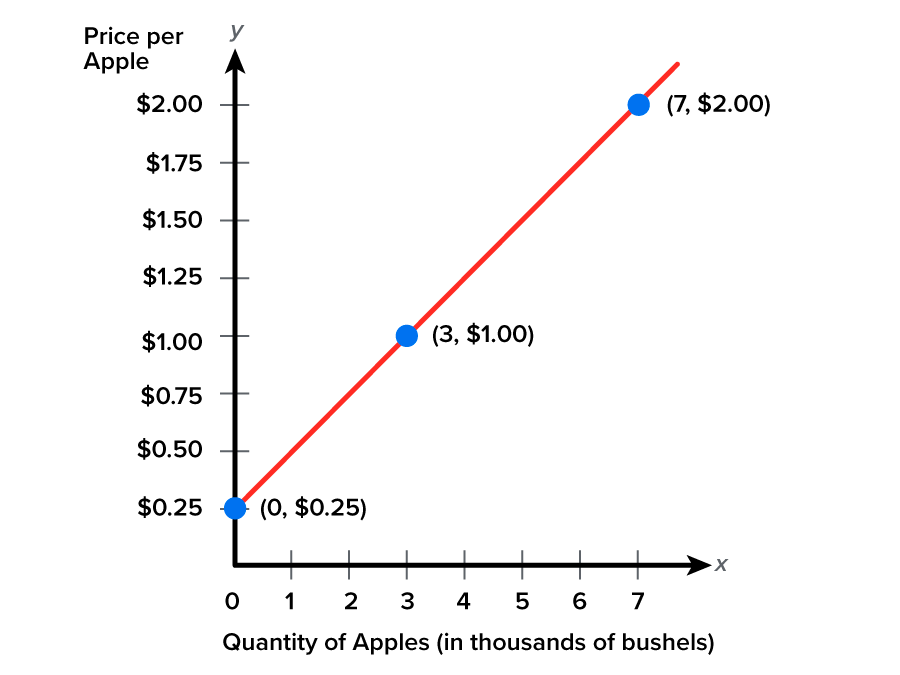
This is basically the law of supply. Notice that the price and the quantity being supplied move in the same direction, so there is a positive relationship between them for supply.

This is known as movement along a supply curve or demand curve, as you will see later in the lesson. When the price of a product changes, it impacts the quantity being supplied or the quantity being demanded because we move up and down that curve.
However, this assumes “ceteris paribus,” a Latin phrase that means “holding all other things constant.” The idea here is that as the price of apples falls, we can expect the farmer to produce fewer apples because it is not worth as much of his time.
However, what ceteris paribus assumes is that the price of apples is the only thing that has changed. For instance, it assumes that the price of their resources, or inputs, did not change, nor did their technology. Only the price of the apples changed, which correlates with that movement along the curve.
However, we know that things in the world are always changing. For instance, what if fertilizers have suddenly become more expensive, the farmer has to pay his workers more money because the wages have risen, or new technology has been developed that makes apple picking much more efficient?
These things will not just be movements along the supply curve. The farmer will not supply the same amount of apples, yet the price of the product—the apples—does not change. So, now, we need to shift the supply curve and note that the same rules will apply to demand.
When there is a shifting of the supply curve, it means that different quantities are going to be supplied or demanded at all prices. For supply, the shift occurs because of more or less resource access, a decrease or increase in the price of inputs, or changes in regulation like taxes and subsidies.
EXAMPLE
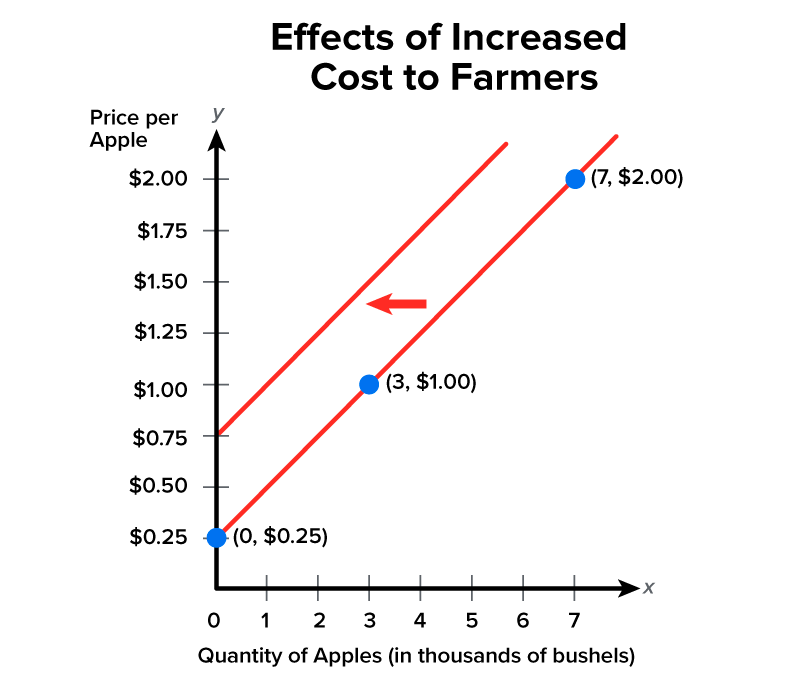
If there is an increased cost to the farmer, like his fertilizers becoming more expensive, he now cannot supply as many apples at every price level.| Price of Granny Smith Apples | Quantity of Granny Smith Apples Each Week |
|---|---|
| $2.00 | 5 |
| $1.75 | 4 |
| $1.50 | 3 |
| $1.25 | 2 |
| $1.00 | 1 |
| $0.75 | 0 |
| $0.50 | 0 |
| $0.25 | 0 |
This is seen as a shift of the supply curve to the left, which is a decrease in supply. This happened because the price of apples did not change, so now there is an entirely new relationship between price and quantity.
As a reference, here is a list of factors that cause a shift in supply:
EXAMPLE
As a reminder, a change in input price, like the increased cost of fertilizers, will cause a decrease in supply and a shift to the left.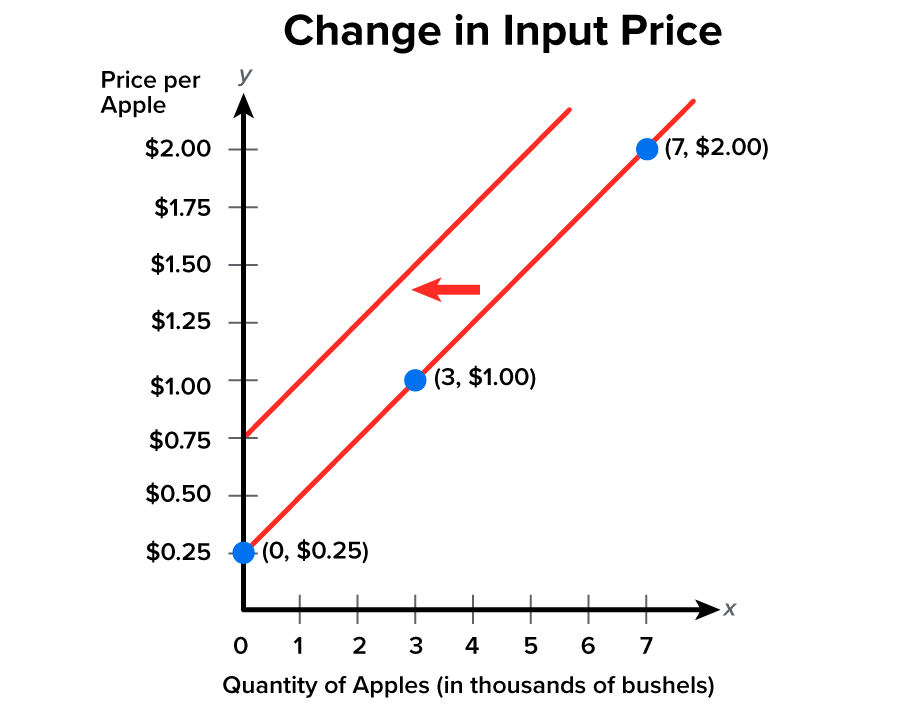
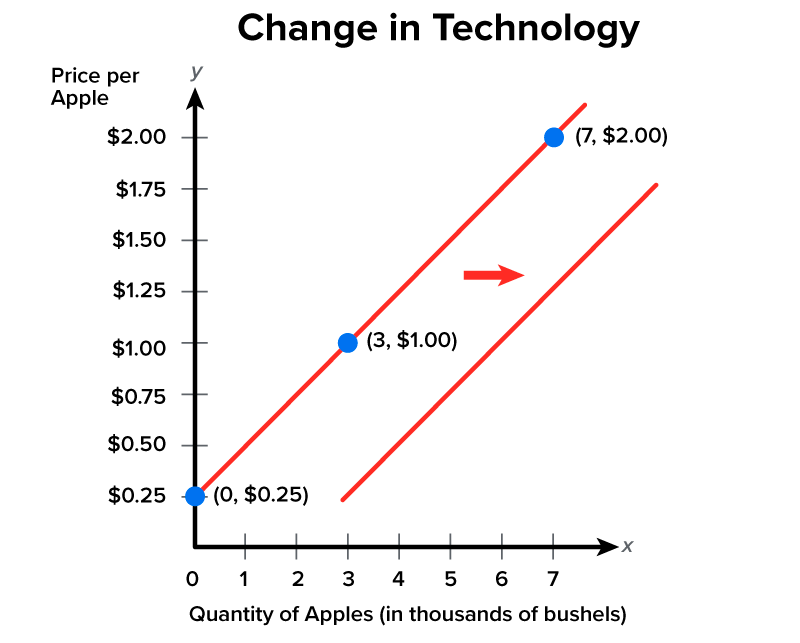
Alternatively, if technology improves and the farmer can be more efficient, he can now supply more apples at all prices, which causes a shift in supply to the right.
Now, let’s shift our focus to demand. Demand is easier for most people to think about because they are consumers who purchase stuff almost every day of their lives.
Demand is the quantity of goods and services that may be purchased at a given time, specific to a set income and range of price levels.
EXAMPLE
For the same apple scenario, here is a chart detailing the prices and quantities of Granny Smith apples. Notice, though, that there is a different relationship this time, because even though producers want to sell their products at high prices, we, as consumers, do not want to buy them at these high prices. We do not want to pay $2 for one apple!| Price of Granny Smith Apples | Quantity of Granny Smith Apples Each Week |
|---|---|
| $2.00 | 0 |
| $1.75 | 1 |
| $1.50 | 2 |
| $1.25 | 3 |
| $1.00 | 4 |
| $0.75 | 5 |
| $0.50 | 6 |
| $0.25 | 7 |
| $0.00 | 8 |
As the price falls, notice how the quantity demanded rises. With demand, there is an inverse relationship between price and quantity, which is the opposite of that with supply.
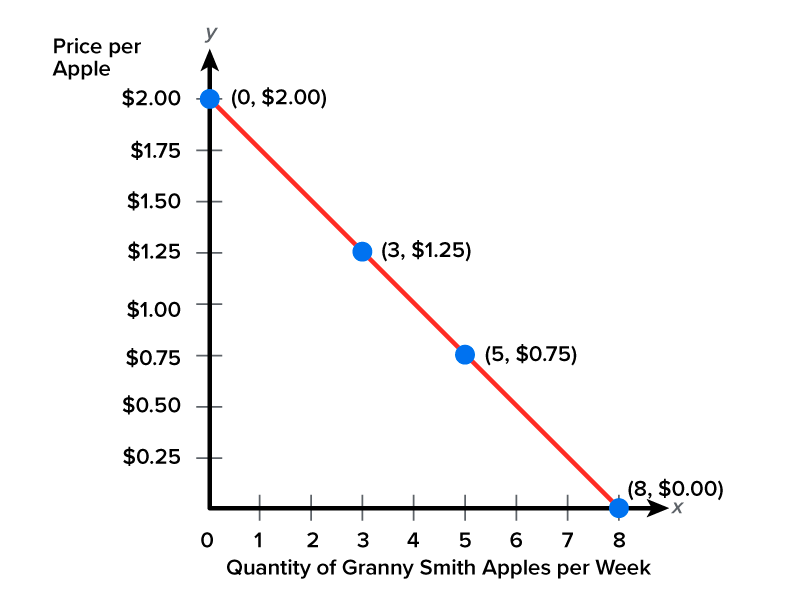
This represents the law of demand. As prices fall, the quantity demanded rises; we want to buy more. As prices rise, we want to buy less.

Again, this assumes ceteris paribus. As the price of Granny Smith apples goes up, yes, we want to buy fewer Granny Smith apples, but ceteris paribus assumes that only the price of green apples changed. For instance, the price of Gala apples did not change, the price of oranges or bananas did not change, and our income did not change.
Again, we know that things are always changing. For instance, if you have to take a significant pay cut, or perhaps you read an article saying Granny Smith apples are the least healthy apple, you are not likely to buy the same amount of Granny Smith apples now, even though the price of Granny Smith apples has not changed.
Therefore, we need a new curve.
A shifting of the demand curve occurs because something other than the price has changed, causing a new relationship between price and quantity.
So, if you take that significant pay cut, you will then buy different quantities at all prices.
| Price of Granny Smith Apples | Quantity of Granny Smith Apples Each Week |
|---|---|
| $2.00 | 0 |
| $1.75 | 0 |
| $1.50 | 0 |
| $1.25 | 0 |
| $1.00 | 1 |
| $0.75 | 2 |
| $0.50 | 3 |
| $0.25 | 4 |
| $0.00 | 5 |
Notice how demand, or the quantity being bought, fell at every single price level, which required a new demand curve, shifting to the left, to show the decrease in demand.
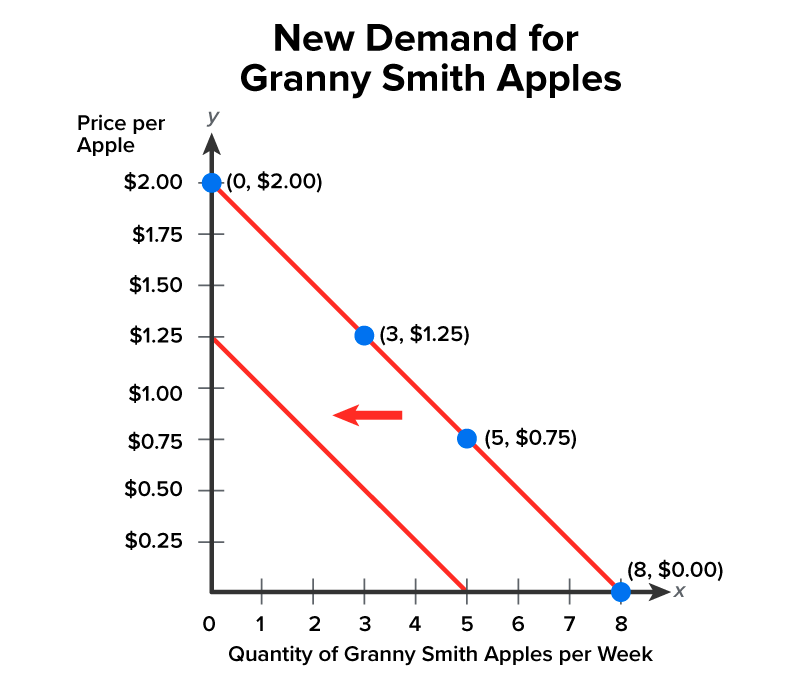
As a reference, the following factors cause a shift in the demand curve:
EXAMPLE
If you make less money, you cannot afford as many apples. So, the curve shifts to the left to account for the decrease in demand.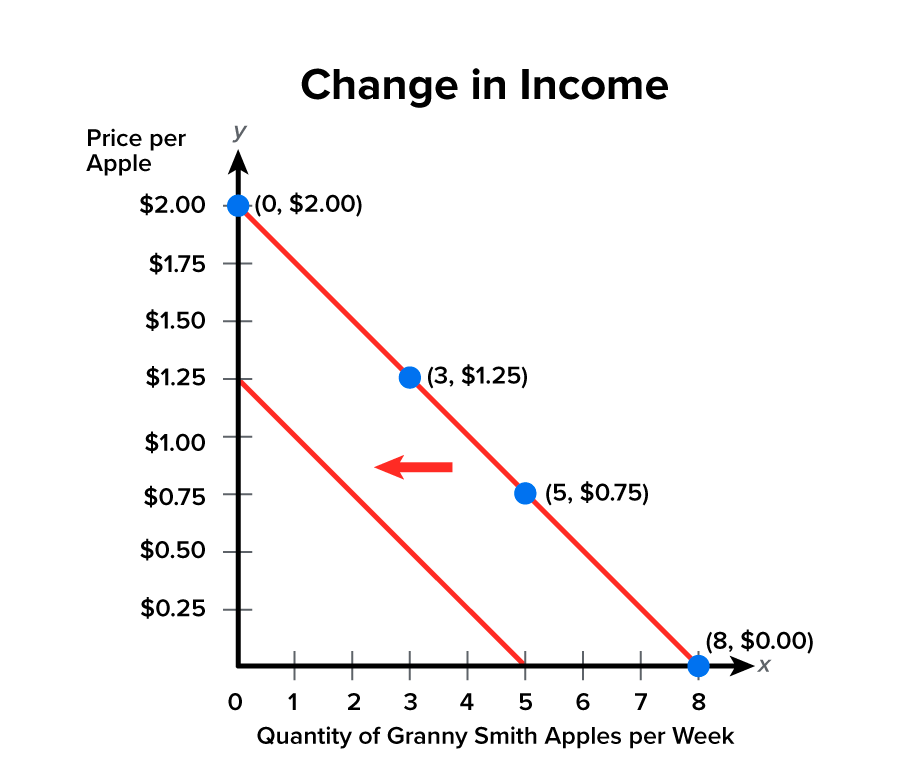
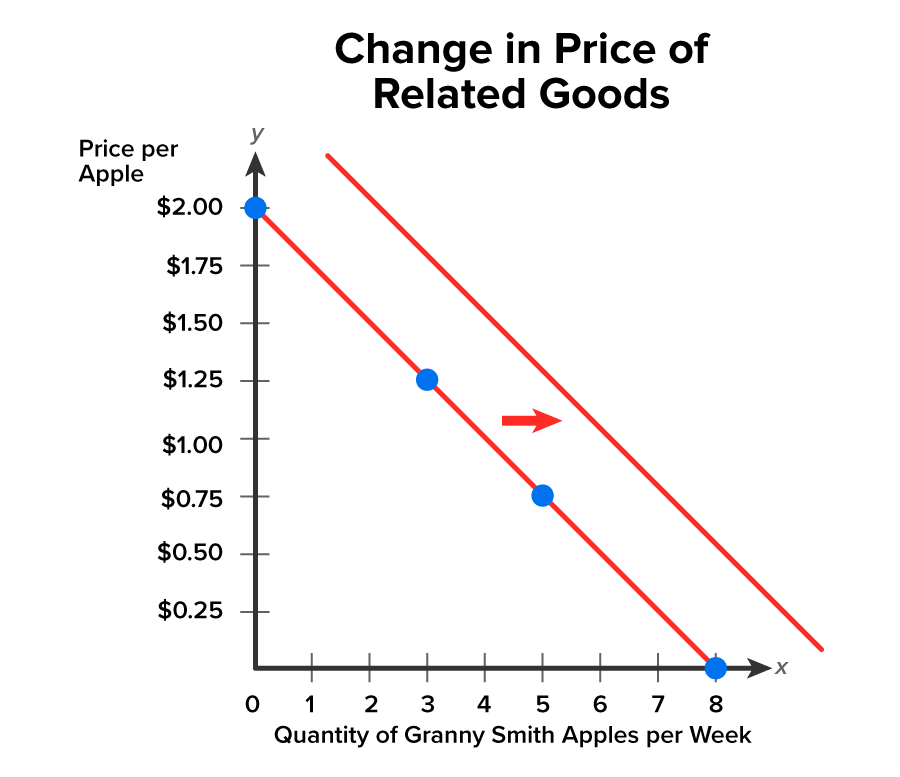
Alternatively, consider changes in the prices of related goods. If caramel apple dips go on sale, you are going to buy more Granny Smith apples. Even though Granny Smith apples have not changed in price, something else has, causing you to buy more.
The sale price of caramel apple dips causes a change in the quantity demanded, or a movement along the caramel apple dip demand curve. However, you can see below that you will buy more Granny Smith apples even though the price of Granny Smith apples has not gone down. Therefore, there is an increase in demand to the right.
Changes in taste and preferences are huge in the demand world. When the toy Tickle Me Elmo became very popular, there was an increase in demand. Conversely, anytime there are negative news reports, like an E. coli breakout in spinach, people buy less spinach at all prices.
Finally, let’s turn our attention to equilibrium, which is the point at which the quantity supplied at a given quantity–price combination equals the quantity demanded. This is where the supply and demand curves intersect.
Here is a graph that combines the quantity of apples supplied and the quantity of apples demanded.
| Price of Apple | Quantity of Apples Supplied | Quantity of Apples Demanded |
|---|---|---|
| $2.00 | 7,000 | 0 |
| $1.75 | 6,000 | 1,000 |
| $1.50 | 5,000 | 1,500 |
| $1.25 | 4,000 | 2,000 |
| $1.00 | 3,000 | 3,000 |
| $0.75 | 2,000 | 4,000 |
| $0.50 | 1,000 | 5,000 |
| $0.25 | 0 | 6,000 |
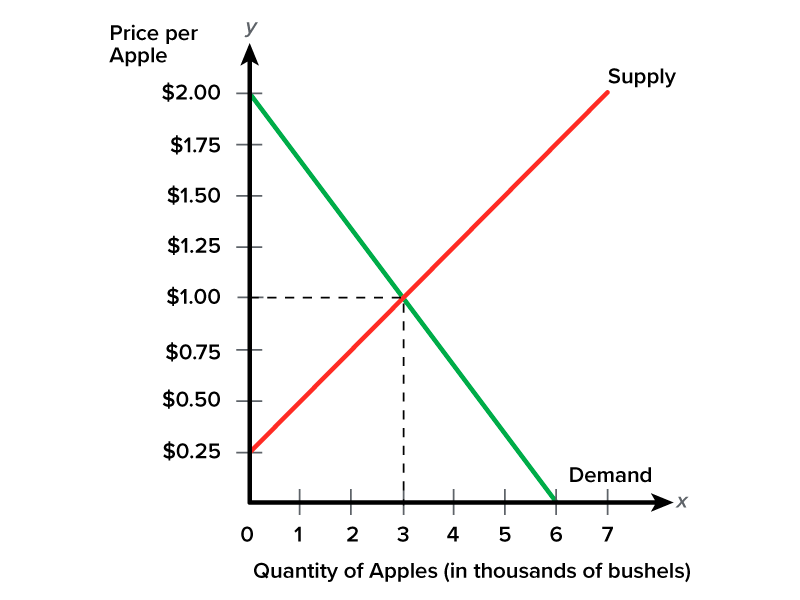
At prices at $1.00: Qs = Qd.
At prices below $1.00, Qd > Qs
With this graph, you can see that at any price above $1, the quantity of apples supplied exceeds the quantity of apples demanded, creating an economic surplus.
However, at any price below $1, the quantity of apples demanded is much greater than the quantity of apples supplied.
There is only one price at which the quantity supplied equals the quantity demanded.
In an economic shortage, the quantity demanded by the consumer is greater than the quantity supplied by the producer. So, there would be a demand for apples that the producers can’t meet. The inverse of this is an economic surplus.
It is the only price at which there is no tendency for change. If the price is too high, sellers will recognize this and lower their price, and there will be a downward movement along the supply curve. As prices decrease, the quantity demanded increases. If the prices are too low, suppliers will also recognize this and raise their prices, and the quantity supplied will rise. As prices go up, the quantity demanded falls, and, again, it will meet in the middle at equilibrium.
In this case, equilibrium represents an equilibrium price of $1 and a quantity of 3,000 bushels.
Source: THIS TUTORIAL WAS AUTHORED BY KATE ESKRA FOR SOPHIA LEARNING. PLEASE SEE OUR TERMS OF USE.



