Table of Contents |
As you are writing your final essay, you will want to create as polished a final draft as possible. When you edit, you make changes at the sentence level: phrasing, grammar, mechanics, and wording.
You may also think about voice. While voice broadly describes a writer’s tone and style, and beyond the scope of this class, the terms active voice and passive voice refer to the way a writer uses verbs in a sentence.
In the active voice, the subject of the sentence performs the action of the verb.
EXAMPLE
The dog bit the man.In the passive voice, the subject receives the action. That is, the grammatical subject is not the “doer” in the sentence.
EXAMPLE
The man was bitten by the dog.Sometimes the passive voice is used intentionally to soften a sentence’s meaning.
EXAMPLE
Unfortunately, you were not selected by the committee.Sometimes the passive voice can remove the actor entirely, which can obscure the responsibility for an action.
EXAMPLE
The man was bitten.This is often done at trials, in press releases, in newspaper headlines, or other situations when somebody is trying to avoid accepting or assigning blame.
EXAMPLE
Mistakes were made, and lives were lost.Although passive sentences are sometimes necessary, overuse of passive sentences can obscure the meaning of a passage, and usually makes it more boring to read. Active-voice verbs make something happen. By using active voice wherever possible, you will create stronger, clearer, and more concise sentences.
Another way to ensure that sentences are effective and engaging is to make sure the subjects are concrete nouns, that is, physical things that can be seen, heard, or touched. It’s even better to make sure the subject is a person, group of people, or at least a living thing, and that the verbs describe an action. While this is a different concept than active voice, the two concepts are closely related.
EXAMPLE
Another way to maximize the impact of a sentence is to make sure you place emphasis on the most important ideas, that is, the ones that connect to your thesis statement. The most emphatic place in a sentence is the end. To achieve the strongest emphasis, end with the idea you want readers to remember. Place introductory, less important, or contextual information earlier in the sentence. This strategy is not one you need to use to edit your entire paper. It can, however, be a really good strategy for the most important sentences and paragraphs in your paper.
IN CONTEXT
Emphasis of Ideas
Consider the following two example sentences. They say the same thing, but notice how the sentences seem to convey a different overall evaluation of Gregory as a worker:
While Gregory has been difficult to work with, his work has been excellent.
Whie Gregory’s work has been excellent, he has been difficult to work with.
While essays or reports usually need to be a certain number of words, that does not mean your instructors are looking for wordy essays or reports. Getting to the point quickly can be really valuable. Concise writing makes every word count.
Editing sentences for emphasis, concrete nouns, and active voice will help you write clearly and precisely, as will the following strategies. To be concise, eliminate wasted words and filler but not ideas, information, description, or details that will interest readers or help them follow your thoughts. Eliminate words and phrases that do not add meaning. Consider the following sentences, which say essentially the same thing:
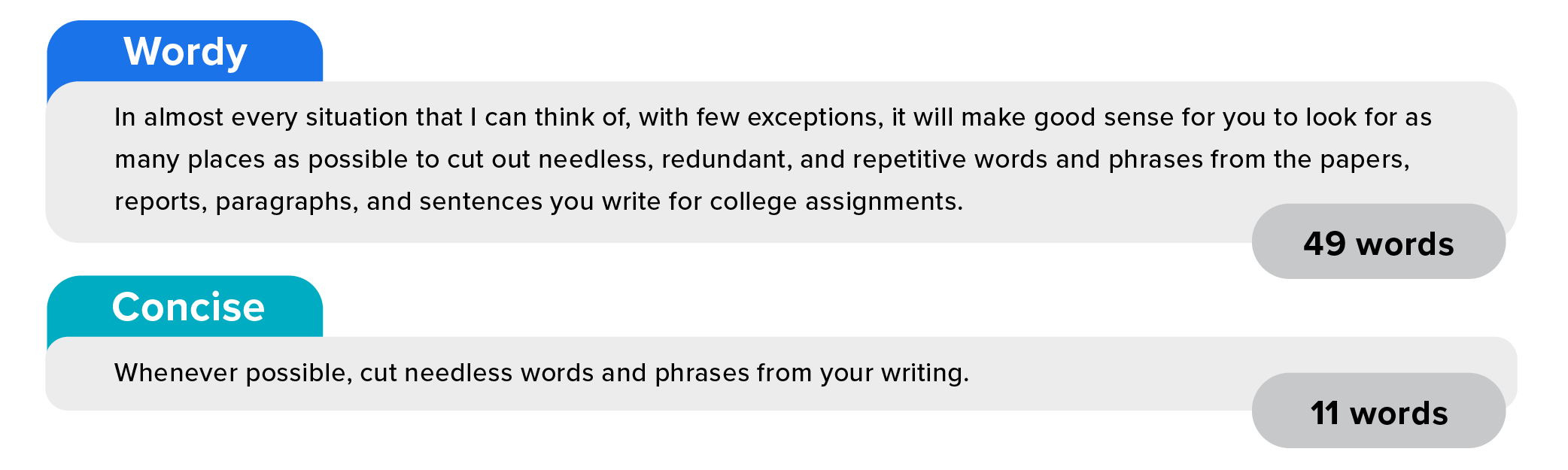
The wordy sentence is full of early-draft language in three chunks. The first chunk comes at the beginning of the sentence. Most of us have words or phrases that we end up using as we type that we don’t really need in a final draft. You might use a phrase like “it goes without saying” as you are typing certain kinds of sentences just because you need something to type as you are thinking through what to write next. Look for your own patterns and decide when they should stay in and when they should be edited out.
Try to cut out words that do not add meaning, rhythm, or emphasis. Sentences clogged with unnecessary words often cause readers to lose interest, patience, and comprehension. Edit sentences to include concrete nouns and action verbs—or “doers” and “actions,” as described above. Additionally, choosing modifiers carefully will help you weed out unnecessary words.
Using action verbs is one of the most direct ways to cut unneeded words. Whenever you find a phrase like the ones below, consider substituting an action verb.
| Instead of the phrase . . . | Use an action verb |
|---|---|
| reach a decision, come to a decision | decide |
| made a choice | chose |
| hold a meeting | meet |
| arrive at a conclusion | conclude |
| have a discussion | discuss |
Within a sentence, parallelism, or the repetition of a word or grammatical construction, creates symmetry and balance, makes an idea easier to remember, and sounds pleasing to the ear.
EXAMPLE
In this example, the parallelism is established by the repetition of the phrase beginning with who.
Varying the length and structure of sentences makes your writing more interesting to read. Think about a really, really long piece of music. It can be hard to pay attention for all 20 minutes of a musical piece. Then think about a song that is only a few notes long. How many incredibly short songs do you really want to hear? When you are writing, you are trying to help your reader understand. It is easier for readers to understand what you are saying when you vary your sentence length.
There are lots of different types of sentences. It can be useful to talk over a few kinds so that you can use them to vary your sentence structure. In order to talk about sentences, we need to talk a little bit about some of the things that make up a sentence. We won’t dive too far into grammar here, but we want to make sure everyone is on the same page.
A word is the smallest unit of meaning, and the only punctuation part that can join two words is a hyphen (-). A phrase is a small group of words, but it can either have a noun or a verb. Phrases are usually joined to other parts of sentences by commas (,), dashes (--), and parentheses (()).
A clause is a small group of words, but clauses have both a noun and a verb. If a clause can stand alone, then it is called independent. If a clause could not be its own sentence, it is called dependent. A dependent clause (also called a subordinate clause) is a group of words that contains a subject and a verb but does not express a complete thought. Because it cannot stand alone as a sentence, it must be attached to an independent clause to form a complete sentence. Clauses are joined to other parts of sentences by commas (,), dashes (--), parentheses (()), semicolons (;), and colons (:).
A simple sentence has one idea expressed in a single clause (also known as an independent clause), which contains a subject and a verb and can stand alone as a sentence.
EXAMPLE
She still felt nervous before the test.A compound sentence contains two or more main clauses that are equally important to the meaning of the sentence. You can create compound sentences in the following ways:
| Technique | How to Do It | Example |
|---|---|---|
| Compound Sentence Using a Coordinating Conjunction | Create a compound sentence by using a coordinating conjunction—for, and, nor, but, or, yet, or so (fanboys)—to join main clauses. To remember the coordinating conjunctions, use the mnemonic device "fanboys." | Critical thinking requires careful analysis, and it also involves questioning assumptions. |
| Compound Sentence Using a Semicolon | A semicolon can join two main clauses that are closely related in meaning. When using a semicolon, you must have a complete sentence before and after it. You might have seen some peers using semicolons as if they were a kind of “strong” comma. That isn’t how semicolons work. Where commas usually show something is dependent on something else in the sentence, semicolons usually show that two things could work independently. So, a semicolon’s function is usually the opposite of a comma. | Critical thinking takes time to develop; it requires both practice and patience. |
| Compound Sentence Using a Semicolon and Transitional Word or Phrase | A transitional word or phrase such as however, in fact, meanwhile, therefore, consequently, as a result, instead, or furthermore indicates the relation of two or more equally important ideas in the main clauses. | Critical thinking helps students make informed decisions; however, it also challenges them to question their own beliefs. |
A complex sentence contains one main clause (a clause that contains a subject and a verb and can stand alone as a sentence) and one or more subordinate clauses (also known as dependent clauses). Subordinate clauses begin with a subordinating word or phrase such as although, because, even if, when, whenever, since, as though, whether, as long as, until, or while.

One way to tell if something is subordinate is to imagine someone walking up to you and saying just that part of the sentence. If you would be waiting for them to finish their thought, then you have something that is subordinate. It creates the expectation that it will be attached to something else. The main clause expresses the main idea of the sentence, and the subordinate clause expresses the less important idea. Like a main clause, a subordinate clause has a subject and verb; however, unlike a main clause, it cannot stand alone as a sentence. A subordinate clause punctuated as a sentence is a type of sentence fragment.
EXAMPLE
Although critical thinking can be challenging, it is essential for solving real-world problems.The sentence uses the subordinating word "although" to show contrast between the difficulty and importance of critical thinking.
A compound-complex sentence contains two or more main clauses (clauses that contain subjects and verbs and can stand alone as sentences) and one or more subordinate clauses (clauses that begin with a subordinating word such as although, because, even if, when, whenever, since, as though, whether, as long as, until, and while). A compound-complex sentence is an effective structure to use when you want to express three or more ideas in a single sentence.
EXAMPLE
While some people rely on intuition, critical thinkers analyze the facts carefully, and they consider multiple perspectives before making a decision.Combining your sentences is a revision strategy that ensures you are varying your sentence types, to help your reader stay with your train of thought and understand your argument. You can combine short, repetitive sentences into a simple sentence with a compound verb or subject. Or you can combine the shorter sentences into a complex sentence with a dependent clause.
IN CONTEXT
Sentence Variety
Short Sentences: I began using critical thinking. I was in middle school. Asking questions became my learning strategy. Challenging assumptions also became part of my process.
Combined Sentences: I began using critical thinking in middle school, and both asking questions and challenging assumptions became key parts of my learning strategy.
Read through the draft of your essay and look for sentences that are closely related enough that they can be combined. Keep in mind that some short sentences can be effective in your writing. Create a balance between sentence lengths and types to engage your audience. Remember, too, that the best test of whether words are pulling their own weight and providing rhythm, balance, and emphasis is to read the passage aloud.
Source: This tutorial has been adapted from OpenStax "Writing Guide". Access for free at openstax.org/books/writing-guide/pages/1-introduction . License: Creative commons attribution 4.0 international. Accessed by January 2025.