Table of Contents |
In the job analysis process, following a structured approach is crucial for achieving the best outcomes. HR plays a central role in this process, ensuring that each step is carried out effectively. HR professionals are responsible for gathering and analyzing job-related information, which is essential for creating accurate job descriptions and specifications.
Along with other stakeholders, including the current job incumbents in the process is also vital. These employees provide firsthand insights into the tasks, responsibilities, and requirements of the job. Their input helps ensure that the data collected is accurate and reflective of the actual job duties.
In this lesson, we will explore each of the five steps in the job analysis process. These steps include identifying the purpose and scope, collecting data, analyzing the data, verifying the information, and developing job descriptions and specifications. By understanding and following these steps, organizations can make more informed decisions, leading to better hiring practices, more effective training programs, and improved performance evaluations.
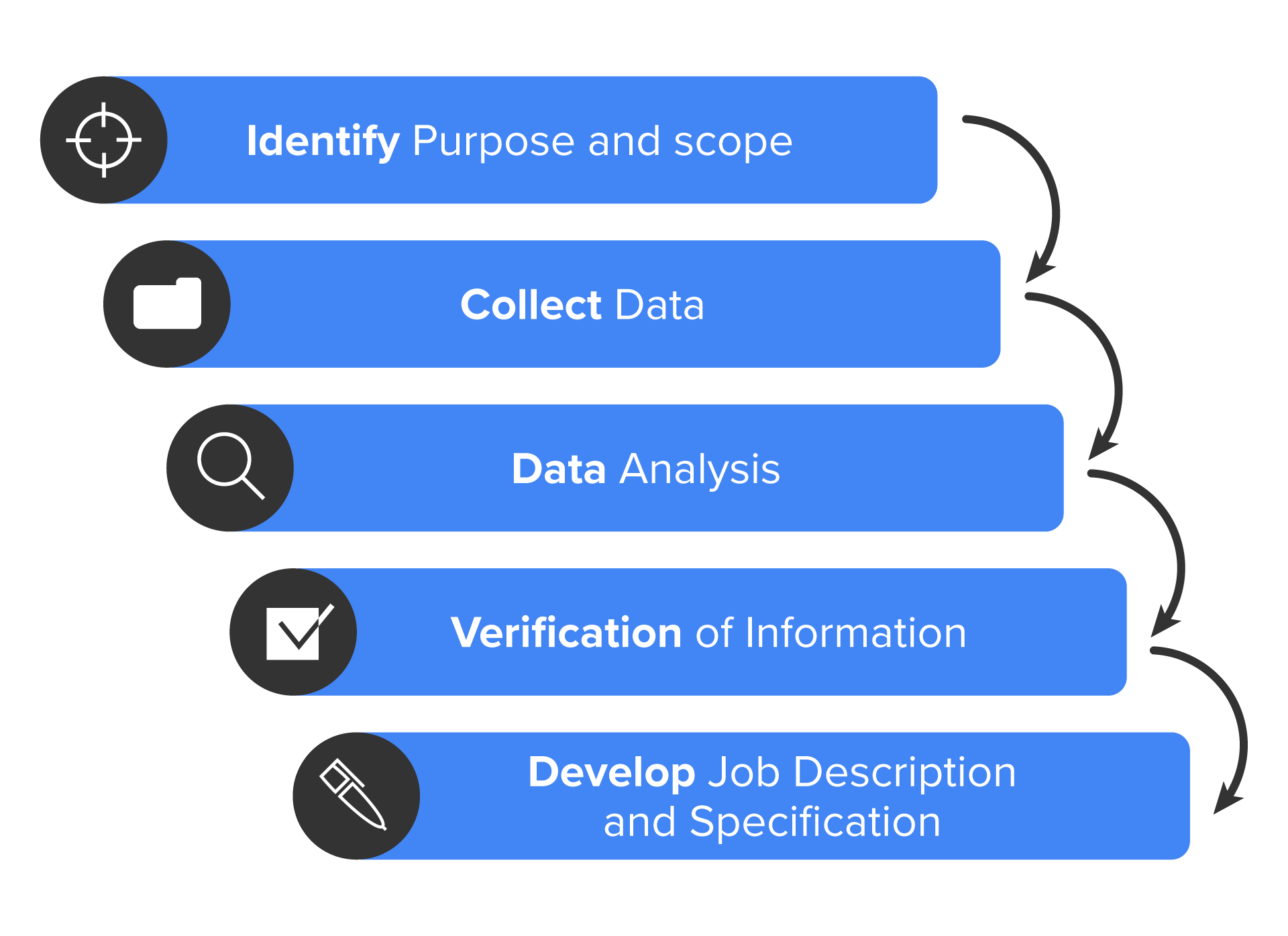
The first step in the job analysis process is to identify the purpose and scope. This foundational step sets the direction for the entire analysis. Understanding the purpose involves determining why the job analysis is being conducted. Common reasons include creating job descriptions, improving hiring practices, developing training programs, or evaluating performance. Clearly defining the purpose helps ensure that the analysis is focused and relevant, aligning with the organization’s strategic goals.
Defining the scope involves outlining what specific information is needed and which jobs will be analyzed. This includes deciding on the depth of information required and the aspects of the job that need to be examined, such as tasks, responsibilities, skills, and qualifications. It also involves determining the resources and time available for the analysis. By establishing clear boundaries, HR professionals can manage the process more effectively and ensure that the analysis remains on track.
Putting in the effort upfront in this step is important as it helps ensure that the data collected is both relevant and valid. When the purpose and scope are well-defined, it prevents the collection of unnecessary data, which can save time and resources. This focused approach ensures that the analysis is efficient and effective, providing valuable insights that can be used to make informed decisions.
HR professionals play a central role in this step, guiding the process and ensuring that all necessary elements are considered. They must communicate with various stakeholders, including managers, supervisors, and employees, to gather input and ensure that the analysis meets the organization’s needs.
A well-defined purpose and scope also improve communication and understanding among all parties involved. When everyone is clear on the objectives and boundaries of the job analysis, it reduces confusion and ensures that the process runs smoothly. This clarity is particularly important when multiple jobs are being analyzed simultaneously, as it helps maintain consistency and coherence across the analysis.
Ultimately, a thorough and well-planned approach to identifying the purpose and scope of a job analysis leads to more accurate and useful outcomes.
IN CONTEXT
Step 1 Scenario
You are part of the HR team at a mid-sized tech company. Your team has been tasked with conducting a job analysis for the software development department. The goal is to create accurate job descriptions and improve the hiring process.
To start, you need to identify the purpose and scope of the job analysis. You meet with the HR manager, Fatima, and the head of software development, Hiroshi, to discuss the objectives. They explain that the company is expanding and needs to hire more developers. They also want to ensure that current job descriptions reflect the actual duties and skills required.
Next, you outline the scope. You decide to focus on three key roles: junior developer, senior developer, and team lead. You will gather information on tasks, responsibilities, skills, and qualifications for each role. You also set a timeline of four weeks to complete the analysis.
An important part of this step is deciding who should be involved in the process. You determine that it is essential to include current job incumbents, their supervisors, and other stakeholders such as project managers and team leads. These individuals provide valuable insights into the day-to-day responsibilities and requirements of each role. Their input helps ensure that the data collected is accurate and reflective of the actual job duties.
By clearly defining the purpose and scope, and deciding who should be involved, you ensure that the data collected will be relevant and valid. This upfront effort helps streamline the process, making it more efficient and effective.
Collecting data is the next step in the job analysis process. This step involves gathering detailed information about the job’s tasks, responsibilities, skills, and qualifications. There are several methods for collecting data, each with its own advantages and considerations. Choosing the right method depends on the specific needs of the job analysis and the resources available.
| Job Analysis Data Gathering Methods | ||||
|---|---|---|---|---|
| Method | Description | Type of Data Collected | Best for Types of Jobs | Advantages and Disadvantages |
| Interviews | Conducting one-on-one or group discussions with employees and supervisors. | Detailed descriptions of tasks, responsibilities, required skills, and personal experiences. | Jobs requiring complex, nuanced understanding, such as managerial or technical roles. |
Advantages: In-depth information allows for clarification. Disadvantages: Time-consuming, potential for interviewer bias. |
| Questionnaires | Distributing structured forms to employees to collect standardized information. | Quantitative data on job tasks, frequency of tasks, and required skills. | Jobs with clear, standardized tasks, such as administrative or clerical positions. |
Advantages: Efficient for large groups, easy to compare responses. Disadvantages: Limited depth, potential for low response rates. |
| Observations | Watching employees as they perform their job tasks to gain firsthand insights. | Real-time data on job tasks, workflow, physical requirements, and environmental conditions. | Jobs involving physical tasks or manual labor, such as manufacturing or construction roles. |
Advantages: Accurate depiction of job tasks, identifies discrepancies. Disadvantages: Can be intrusive, observer bias. |
| Critical Incidents | Collecting specific examples of particularly effective or ineffective job performance. | Specific examples of job performance, key behaviors, and situations that lead to success or failure. | Jobs where performance can vary significantly, such as customer service or sales positions. |
Advantages: Highlights key behaviors, useful for performance evaluation. Disadvantages: Relies on memory, may miss routine tasks. |
| Diaries and Work Logs | Asking employees to maintain records of their daily activities and tasks. | Chronological data on daily tasks, time spent on activities, and variations in job duties. | Jobs with varied daily tasks, such as project management or creative roles. |
Advantages: Detailed and chronological data, captures variations. Disadvantages: Time-consuming for employees, potential for incomplete entries. |
When conducting a job analysis with limited resources, employers need to be strategic and efficient. They can use cost-effective methods like online surveys and internal interviews to gather necessary information. It’s important for employees involved in the process to maintain confidentiality, ensuring that sensitive data about job roles and personal information is protected. By leveraging existing resources and emphasizing discretion, employers can still achieve a thorough job analysis that supports accurate job descriptions, fair compensation, and effective workforce planning.
IN CONTEXT
Step 2 Scenario
You are part of the HR team at a healthcare company. Your team needs to conduct a job analysis for the nursing department to create accurate job descriptions.
To start, you decide on the data collection methods. You choose to use interviews, questionnaires, and observations. Here’s how each method works in practice:
Interviews: You schedule one-on-one interviews with several nurses, including Sofia and supervisors like Ahmed. During these interviews, you ask detailed questions about their daily tasks, responsibilities, and the skills required for their roles. Sofia explains how she manages patient care, administers medication, and coordinates with doctors. Ahmed provides insights into supervisory duties, such as scheduling shifts and overseeing patient care standards.
Questionnaires: To collect standardized data, you distribute questionnaires to all nursing staff. The questionnaires include questions about the frequency of specific tasks, the importance of various responsibilities, and the skills needed for the job. Nurses fill out these forms, providing quantitative data that can be easily compared and analyzed
Observations: You also spend time observing nurses during their shifts. You watch as they perform their duties, such as checking vital signs, updating patient records, and assisting with procedures. Observing nurses like Maria and David in action gives you a firsthand understanding of the physical and mental demands of the job. It also helps you identify any discrepancies between what is reported in interviews and questionnaires and what actually happens on the job.
By involving various stakeholders and using multiple data collection methods, you ensure that the data collected is accurate and comprehensive.
Once you have gathered data through methods such as interviews, surveys, and observations, the next step is to analyze it. The goal is to identify key duties and requirements by finding patterns and common themes that accurately describe the job. The table below outlines the essential steps in this process, helping to systematically identify and document the job’s core responsibilities, and ensuring thorough and accurate job descriptions for various HR functions. HR will typically lead the data analysis process with the support of the manager and incumbents of the role.
| Steps in the Data Analysis Process | |
|---|---|
| Step | Description |
| Organize Data | Categorize the collected data into aspects such as tasks, responsibilities, skills, knowledge, and abilities. Look for recurring elements across different data sources. |
| Identify Key Elements | Identify key duties and requirements by finding patterns and common themes in the data. Prioritize duties and skills based on their importance to the job. |
| Prioritize Duties and Requirements | Determine which duties are critical to the job’s success and which skills are necessary for performing these duties effectively. |
| Document Findings | Document the findings in a clear, concise, and well-organized manner. Start with a summary of the job, followed by a detailed description of each duty and requirement. |
| Describe Duties | For each duty, describe what the task involves, how often it is performed, and its importance to the overall job. |
| Specify Requirements | For requirements, specify the skills, knowledge, and abilities needed to perform the job effectively. Use straightforward language and avoid technical jargon. |
| Organize Document | Group related duties and requirements together. Use headings and subheadings to break up the text and make it easier to navigate. Visual aids like charts or tables can also be helpful. |
After collecting and analyzing job data, the next step is to verify the information to ensure its accuracy and completeness. This process is crucial for creating reliable job descriptions and making informed HR decisions. Verification involves cross-checking the data with multiple sources and seeking feedback from those who are familiar with the job.
Start by reviewing the data for consistency. Compare the information gathered from different methods, such as interviews, surveys, and observations. Look for any discrepancies or conflicting details. If you find inconsistencies, investigate further to understand why they exist. This might involve going back to the data sources or conducting additional interviews to clarify the information.
Next, seek feedback from employees and supervisors who are directly involved with the job. Share the preliminary findings with them and ask for their input. They can provide valuable insights and help identify any missing or incorrect information. This step not only improves the accuracy of the data but also ensures that the job analysis reflects the real-world experience of those performing the job.
Another important aspect of verification is to ensure that the data covers all aspects of the job. Check if all key duties, responsibilities, and requirements have been identified and documented. If any important elements are missing, gather additional data to fill in the gaps. This might involve revisiting the job site or conducting follow-up interviews.
Once you have verified the data, make any necessary adjustments to ensure its accuracy and completeness. Update the job description to reflect the verified information. This might involve adding new duties, refining existing ones, or adjusting the required skills and qualifications. Ensure that the final document is clear, concise, and accurately represents the job.
Job descriptions are important tools in human resource management. They provide a clear and detailed outline of the duties, responsibilities, and requirements of a specific job. Job descriptions help both employers and employees understand what is expected in a particular role, making them necessary for effective communication and performance management.
In addition to job descriptions, job specifications are equally crucial. Job specifications detail the qualifications, skills, and attributes required for a particular job. They include information about the necessary education, experience, technical skills, and personal qualities that a candidate must possess to be successful in the role. Together, job descriptions and job specifications provide a comprehensive view of what a job entails and what is needed to perform it effectively.
Writing the job description is the final step in the job analysis process. By analyzing the collected data, HR professionals can ensure that job descriptions are accurate and comprehensive.
In a future lesson, we will explore the components and structure of job descriptions, examining how they are used in various HR functions such as recruitment, training, and performance evaluation.
Source: This Tutorial has been adapted from "Human Resources Management" by Lumen Learning. Access for free at courses.lumenlearning.com/wm-humanresourcesmgmt/. License: CC BY: Attribution.



