Table of Contents |
There are several ways to configure the routing tables to include all the networks so that packets are forwarded. Understand that what’s best for one network isn’t necessarily what’s best for another. Knowing about and being able to recognize the different types of routing will really help you come up with the best solution for your specific environment and business requirements.
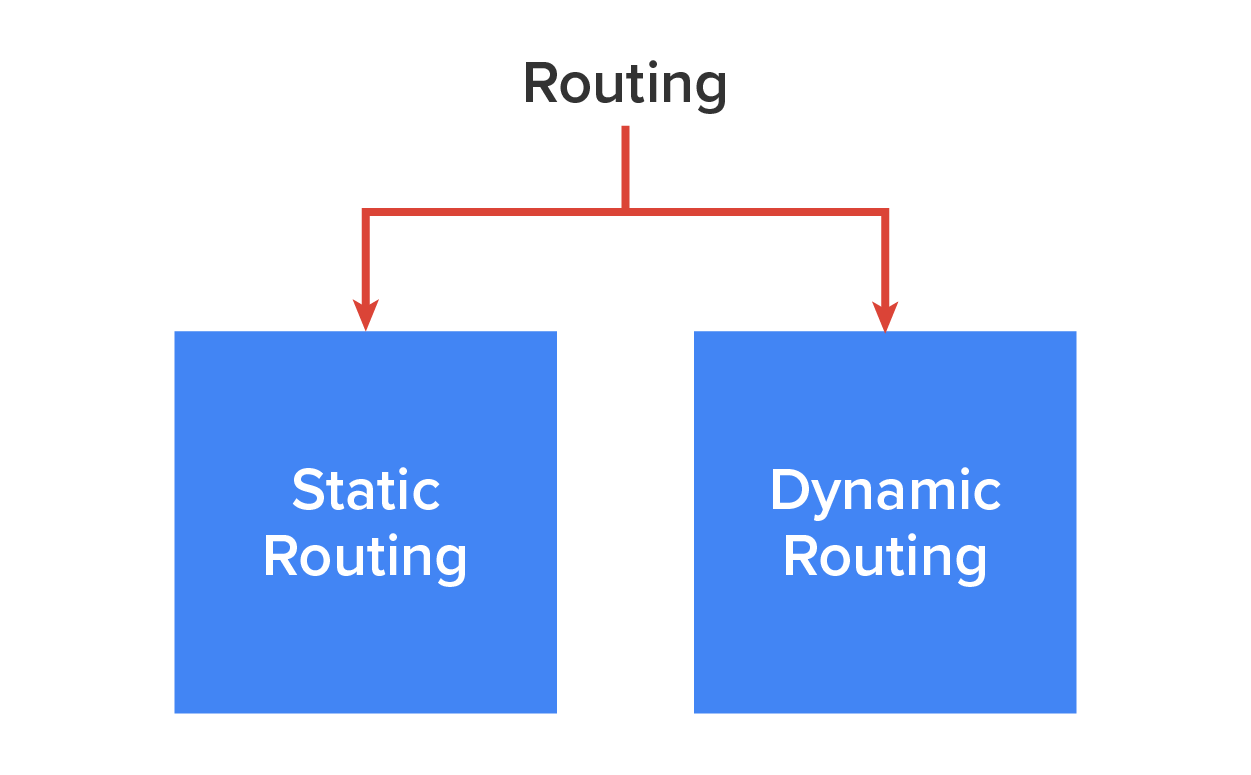
Looking at the diagram below, you can see that we can configure a router with either static or dynamic routing. If we choose static routing, then we have to go to each router and type in each network and the path that IP will use to send packets.
Dynamic routing protocols break into many different categories or types of protocols, as shown in the diagram below. The first split in the dynamic protocol branch is the division of interior gateway protocols (IGPs) and exterior gateway protocols (EGPs). We are going to talk about each protocol and category but for now the difference between IGP and EGP is the interior or exterior routing of an autonomous system (AS).
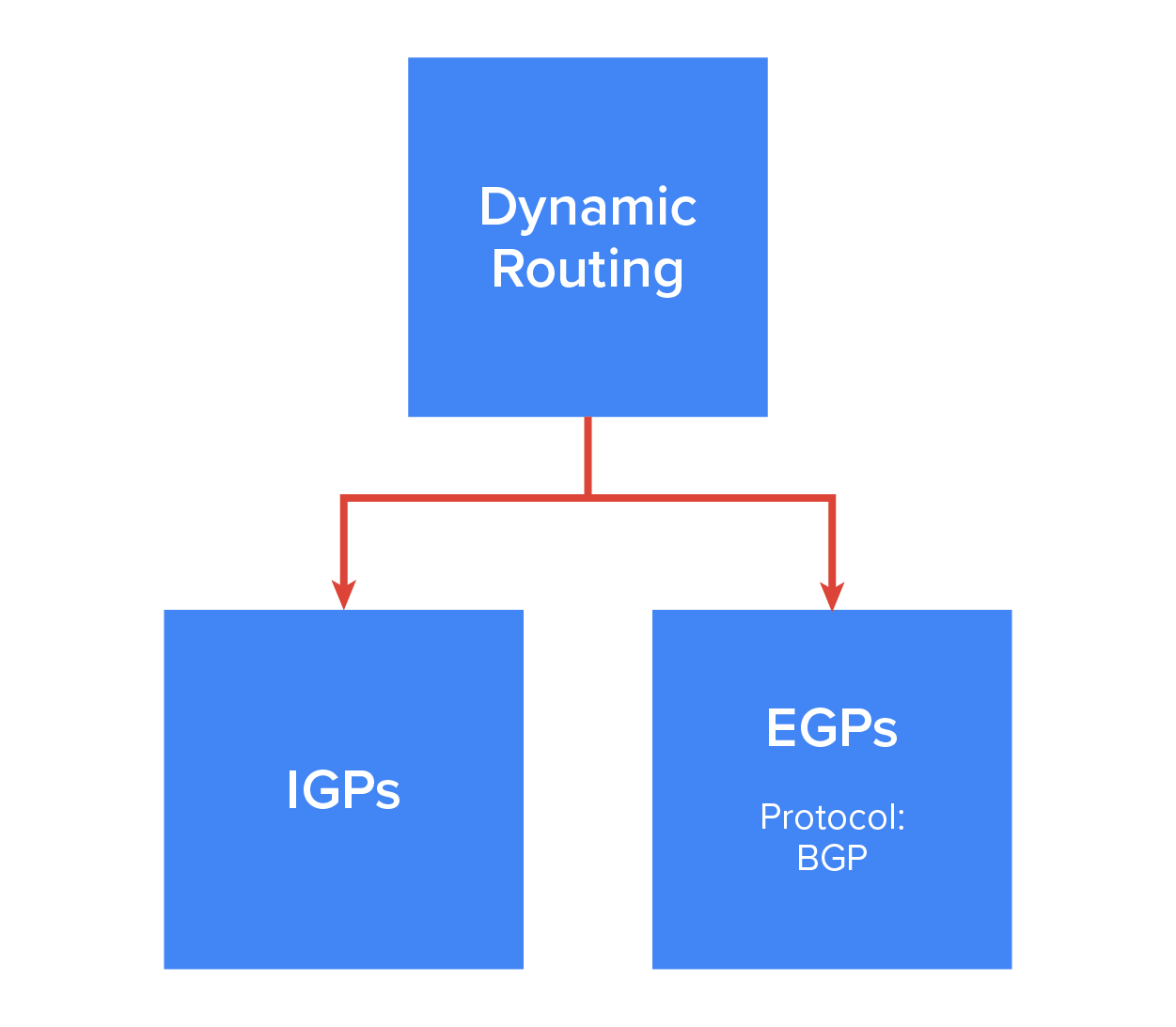
An autonomous system (AS) is a collection of networks or subnets that are in the same administrative domain. This is another way of saying an administrative domain is within your company’s network, and you control or administer all the subnets that are within it. You control and set the policy for what happens in the network or autonomous system. An IGP operates and routes within an AS and an EGP works outside or between more than one AS.
The most popular protocol for an EGP is Border Gateway Protocol (BGP), which is typically used by ISPs or really large corporations. As an administrator of a small to medium network, you’ll probably never use BGP. BGP will be discussed later in the course.
Now that we have that out of the way, let’s talk about the functions of dynamic routing protocols. Manageability is a benefit of dynamic routing because of the amount of time and energy we save configuring routers. We won’t have to go to every single router and define for it, with a static route, what and where every destination network is. The protocols will take care of most of the updating and sending information to each other.
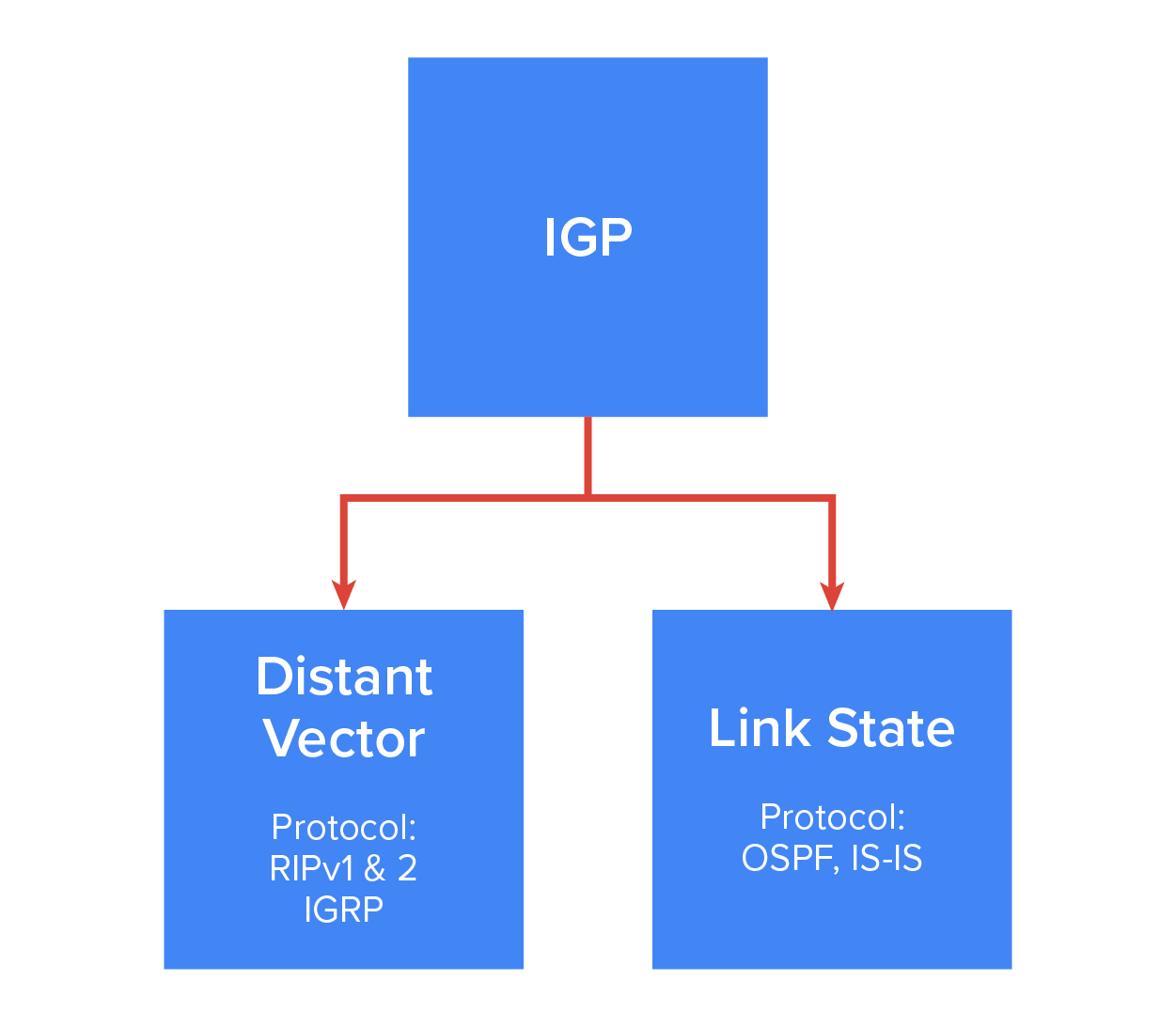
That is the end of the EGP branch of the tree, but the IGP branch continues to split out as we go down further. Looking at the diagram below, with the IGP split, you can see that there are two primary categories: distance-vector (DV) and link-state (LS) routing protocols.
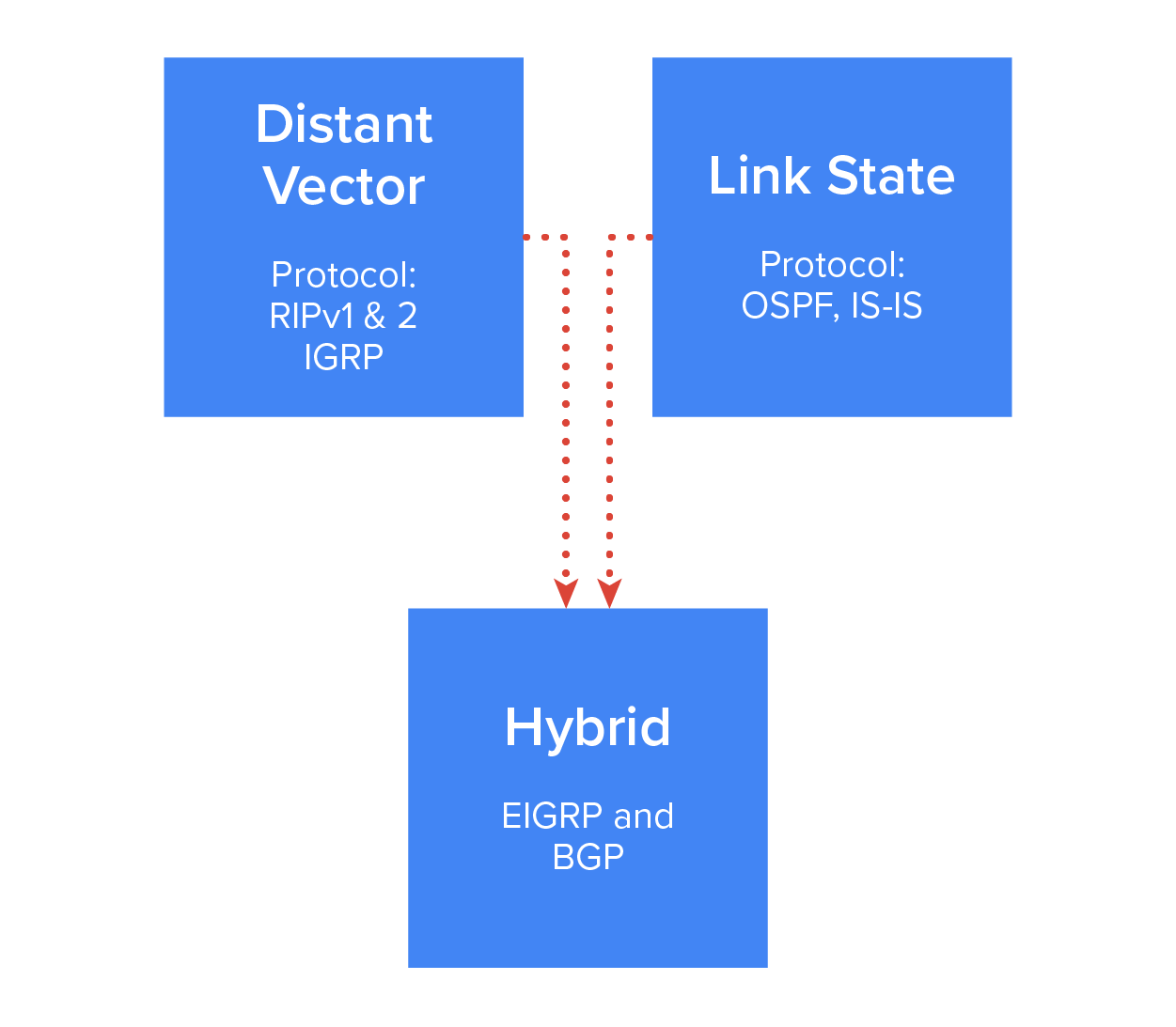
Now, in the diagram below, you can see that there is a third category: the hybrid protocol category.
The administrative distance (AD) is used to rate the trustworthiness of routing information received on one router from its neighboring router (and has nothing to do with the physical distance between devices). An AD is represented as an integer from 0 to 255, where 0 equals the most trusted route and 255 the least. A value of 255 essentially means “No traffic is allowed to be passed via this route.”
If a router receives two different updates listing the same remote network, the first thing the router checks is the AD. If one of the advertised routes has a lower AD than the other, the route with the lower AD is the one that will get placed in the routing table.
If both advertised routes to the same network have the same AD, then routing protocol metrics like hop count or the amount of bandwidth on the lines will be used to find the best path to the remote network. And as it was with the AD, the advertised route with the lowest metric will be placed in the routing table. But if both advertised routes have the same AD as well as the same metrics, then the routing protocol will load-balance to the remote network. To perform load balancing, a router will send packets down each link to test for the best one.
EXAMPLE
The following table shows the default ADs that a router uses to decide which route to take to a remote network.| Route Source | Default AD |
|---|---|
| Connected interface | 0 |
| Static route | 1 |
| External BGP | 20 |
| Internal EIGRP | 90 |
| IGRP | 100 |
| OSPF | 110 |
| IS-IS | 115 |
| RIP | 120 |
| External EIGRP | 170 |
| Internal BGP | 200 |
| Unknown | 255 |
If a network is directly connected, the router will always use the interface connected to that network. Also good to know is that if you configure a static route, the router will believe that route to be the preferred one over any other routes it learns about dynamically. You can change the ADs of static routes, but by default, they have an AD of 1. That’s only one place above zero, so you can see why a static route’s default AD will always be considered the best by the router.
This means that if you have a static route, a RIP-advertised route, and an EIGRP-advertised route listing the same network, then by default, the router will always use the static route unless you change the AD of the static route.
The three classes of routing. They are Distance Vector, Link State, and Hybrid.
The distance-vector protocols find the best path to a remote network by judging distance. Each time a packet goes through a router, it equals something we call a hop, and the route with the fewest hops to the destination network will be chosen as the best path to it.
These protocols send the entire routing table to all directly connected neighbors.
Using link-state protocols, also called shortest path first protocols, the routers each create three separate tables. One of these tables keeps track of directly attached neighbors, one determines the topology of the entire internetwork, and one is used as the actual routing table.
Link-state protocols send updates containing the state of their own links to all other routers on the network.
A hybrid protocol uses aspects of both distance vector and link state. EIGRP and BGP are hybrid routing protocols. BGP has the capability to work as an EGP, and to be used in supersized internetworks internally. When deployed in this way, it’s called internal BGP, or iBGP, but understand that it’s still most commonly utilized as an EGP.
Source: This content and supplemental material has been adapted from CompTIA Network+ Study Guide: Exam N10-007, 4th Edition. Source Lammle: CompTIA Network+ Study Guide: Exam N10-007, 4th Edition - Instructor Companion Site (wiley.com)



