Table of Contents |
From what you’ve learned so far about the importance of sleep and the biological processes and structures involved in sleep, it may be evident that sleep is not just a passive period for your brain and body to shut off. On the contrary, even though you are not conscious during sleep, your brain and body are still active and busy.
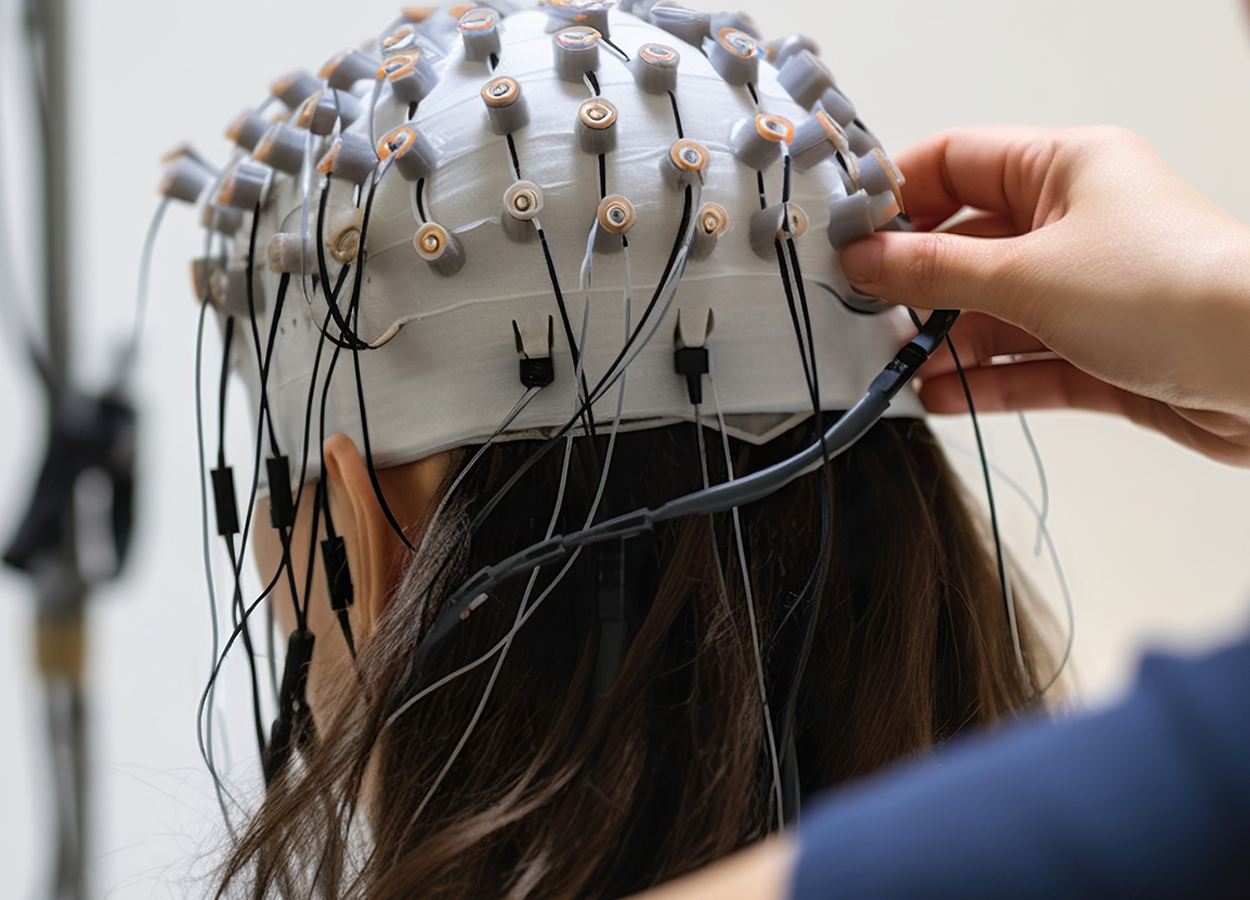
What we know about brain activity during sleep started from research decades ago. The image below shows an electroencephalogram (EEG), a test that measures electrical activity in the brain using small metal discs called electrodes that are attached to the scalp (Mayo Clinic Staff, 2022). In 1937, a researcher used an EEG to document brain waves that occur in different stages of sleep. In the 1950s, further research outlined specific cycles of sleep based on these brain waves (Shepard et al., 2005).
When a person goes to sleep, they progress through four different sleep stages that occur in a cyclical pattern over the course of their sleep time. NREM (non-rapid eye movement) sleep has three stages that represent continually deeper sleep. Each stage has unique brain wave patterns (Altevogt & Colton, 2006). These stages are referred to as stage 1, stage 2, and stage 3.
Stage 1 sleep is also called N1 and is the first stage of NREM sleep. This stage occurs when you first fall asleep, and it lasts about 1–7 minutes (Suni & Vyas, 2023). For a normal adult, this stage will only comprise about 2–5% of your total sleep (Altevogt & Colton, 2006). In this stage, your body and brain start to slow down, evidenced by slower heart rate and breathing activity (Pacheco & Singh, 2023). However, you are not fully relaxed and can be easily woken up during this stage (Suni & Vyas, 2023).
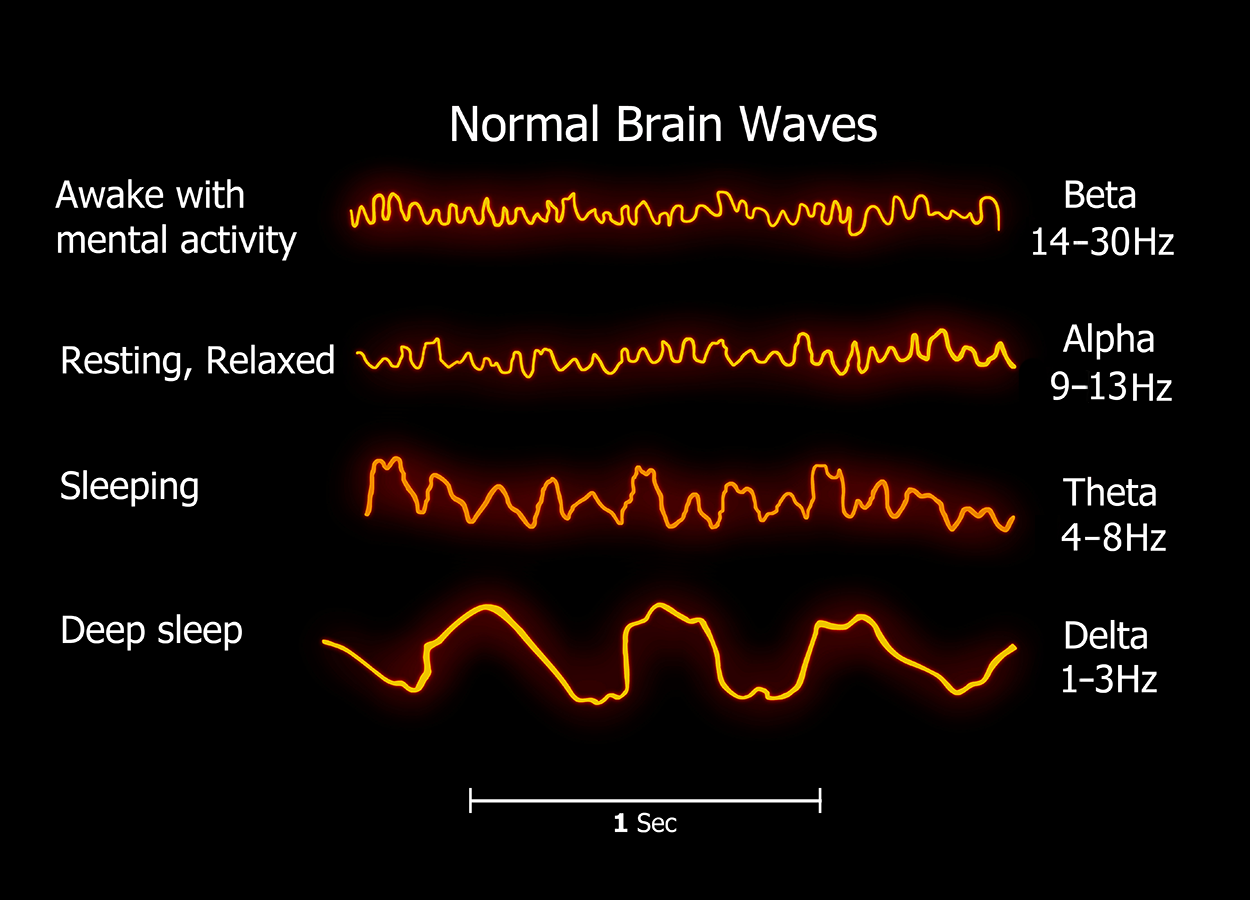
When you are awake and your brain is mentally active, the output on an EEG would reflect beta waves. These show a high frequency of activity and demonstrate conscious thought, concentration, and focus (Priyanka et al., 2016). Alpha waves are slower than beta waves and occur when someone is awake but relaxed, as in meditation or sitting quietly (Summer, 2022). Alpha waves also occur as you start to enter stage 1 sleep and make the transition from alertness to drowsiness. Once you transition into sleep, your brain waves start to slow down even further. Your brain activity here on an EEG reflects theta waves, which are slower than alpha waves and are associated with deep relaxation (Patel et al., 2022).
In stage 2 of sleep, also called N2, your breathing rate and heart rate start to slow down even more, your muscles relax, and your body temperature drops (Suni & Vyas, 2023). Initially, this stage lasts about 10–25 minutes, but you will cycle through this stage repeatedly over the course of your sleep time, and each N2 stage gets successively longer (Altevogt & Colton, 2006). You will spend about half of your total sleep time in stage 2.
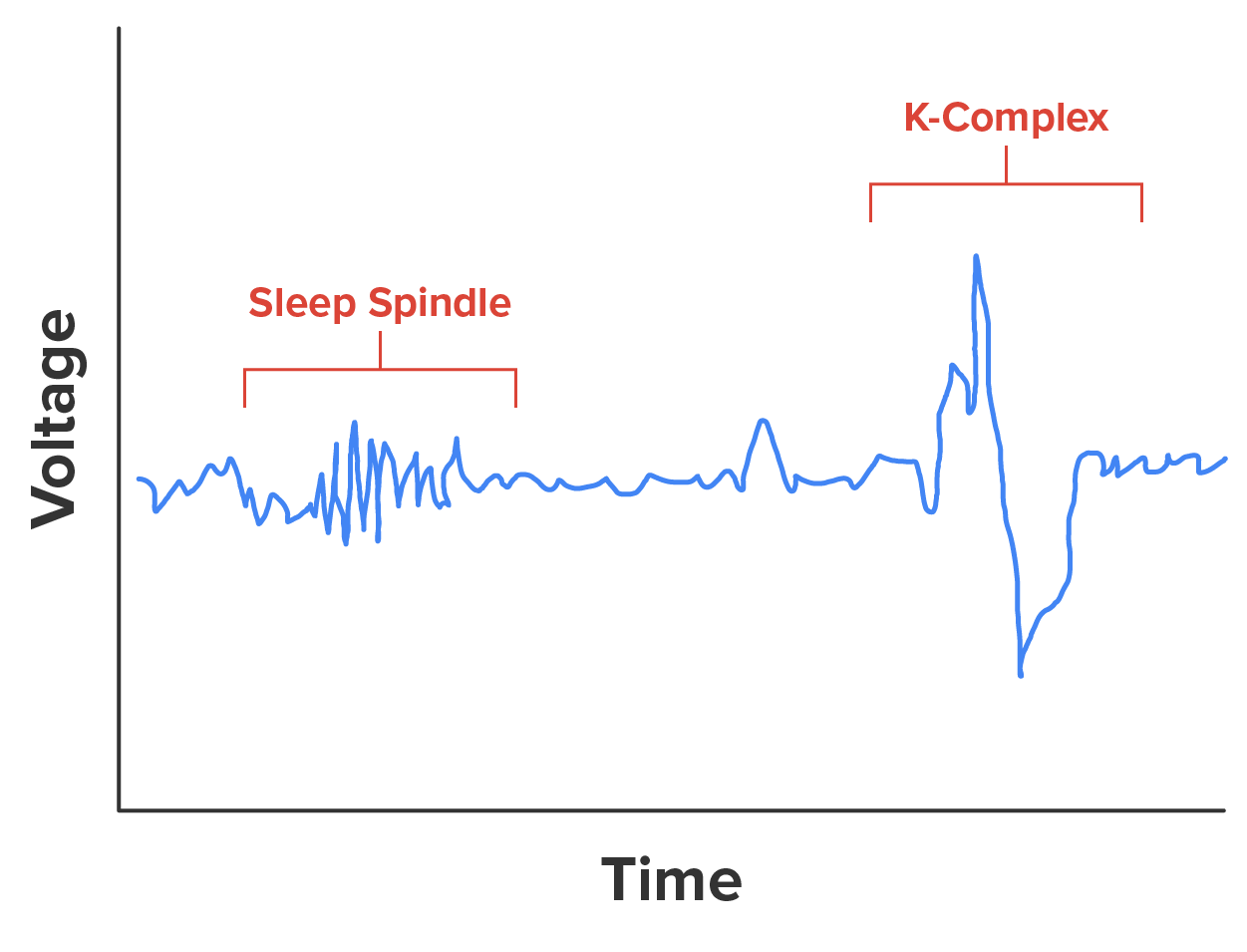
There are two unique aspects of brain activity that regularly appear on an EEG in stage 2 of sleep. Sleep spindles occur every 3–6 seconds and represent brief bursts of brain activity (Pacheco & Singh, 2023). They are thought to be important for consolidating memories (Patel et al., 2022) along with helping us block out the external environment to maintain uninterrupted sleep (Summer & Rehman, 2022). K-complexes have a distinct, sharply peaked shape and are the largest type of waveform on an EEG (Gandhi, 2022). They last for about 1 second and are also associated with consolidating memories and maintaining restful sleep (Patel et al., 2022).
Stage 3 of NREM sleep marks another change in brain wave activity. An EEG reflects slow, wide waves called delta waves, and in fact, this stage is sometimes called slow-wave sleep (Altevogt & Colton, 2006). Your body processes like your heartbeat and breathing rate are also at their slowest in stage 3 sleep (Pachecho & Singh, 2023). You spend about 25% of your total sleep time in this stage, and this stage is when your body enacts processes of repair and restoration, such as building bone or muscle and strengthening your immune system (Patel et al., 2022).
REM (rapid eye movement) sleep is a stage of sleep characterized by bursts of rapid eye movements, dreaming, and highly active brain waves that are more like wakefulness (Altevogt & Colton, 2006). Compared to the other stages of sleep, your brain uses the most energy in REM sleep (Shaw, 2016). It is theorized that REM sleep is critical for consolidating memories. It also plays a role in learning and creativity (Suni & Vyas, 2023).
During REM sleep, your heart rate and blood pressure also rise and come close to the levels you would have when you are awake (Summer & Singh, 2023). While the muscles of your eyes are active in REM sleep, the rest of your muscles typically have reduced muscle tone (Patel et al., 2022).
REM sleep makes up about 25% of total sleep time, but typically, you do not reach REM sleep until about 90 minutes after falling asleep (Suni & Vyas, 2023). While dreams can occur in NREM sleep, most of your dreaming happens in REM sleep, and dreams in REM sleep are typically the most vivid (Summer & Singh, 2023).
There are multiple theories on the reasons for and benefits of dreaming. Some of these theories state that dreams help strengthen our memories and manage emotions by rehearsing situations. Some theories also state that dreams are used by the brain to clean up information (Suni & Dimitriu, 2023).
Now that you know about the different stages of sleep, let’s look further at how these stages unfold over the course of a typical circadian rhythm. Sleep architecture is the breakdown of a person’s sleep by cycles and stages (Suni & Vyas, 2023). If you were to have an EEG cap on while sleeping, it would reveal your sleep architecture based on brain activity.
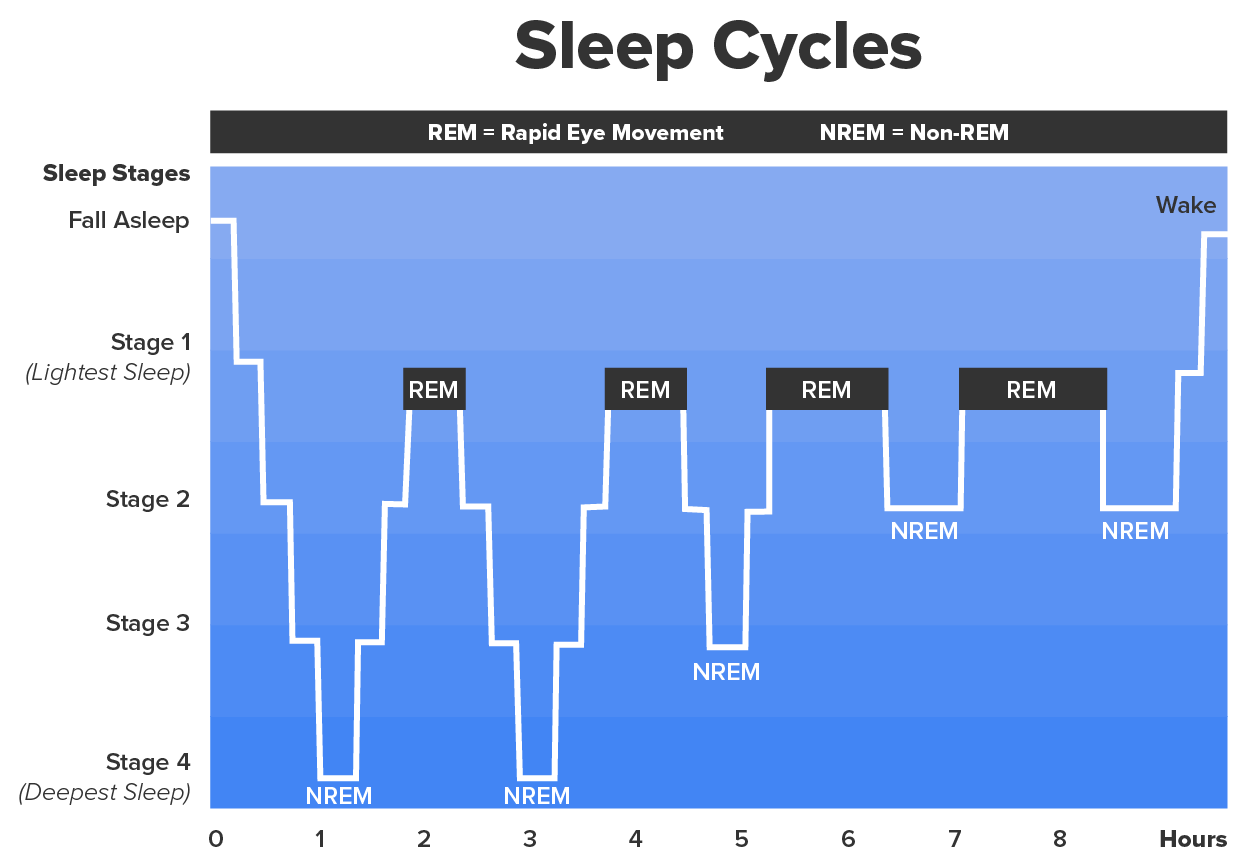
During a typical sleep period of the circadian rhythm, a person will cycle through all four sleep stages within about 90 minutes (Pacheco & Singh, 2023). The cycles repeat, alternating between NREM and REM sleep but get progressively longer and can last around 120 minutes (Altevogt & Colton, 2006). In total, a typical person goes through the sleep stages 4 to 6 times. You will spend more time in NREM sleep during the first half of your total time sleeping. Most REM sleep occurs during the second half of your total time asleep (Suni & Callender, 2022).
About one third of U.S. adults nap more than once a week, with the average nap lasting about an hour (Sommer, 2022). There are some best practices for napping, considering the sleep cycle and stages of sleep.
The best time for a nap is between 1 PM and 3 PM, coinciding with a drop in energy and alertness that typically occurs around that time as per our circadian rhythm (Sommer, 2022). Since our homeostatic sleep drive increases the longer we are awake, napping closer to bedtime will make us likely to sleep more deeply (Pacheco & Wright, 2022). This can disrupt restful sleep at night.
Naps have benefits beyond reducing sleepiness during waking hours. Naps can improve memory, prepare the brain to learn new things, and help with processing emotions (Mantua & Spencer, 2017). In cases of sleep deprivation or shift work, naps can also be helpful in decreasing levels of stress hormones and boosting immune system function (Faraut et al., 2017).
However, not all napping is beneficial. Frequent napping has been associated with increased risk of health conditions like hypertension, depression, diabetes, and cognitive decline (Mantua & Spencer, 2017). Napping for long periods frequently may mean that a person is not getting enough regular, restful sleep.
It may be tempting to consider naps to repay accumulated sleep debt. Naps can provide a short-term sense of feeling recovered, but it can take multiple days to recover from just a single hour of lost sleep (Kitamura et al., 2016). A study with more than 12,000 participants found that napping only helped offset severe sleep debt in 25% of participants (Leger et al., 2020). One perspective is that naps are like snacking between meals—naps can give you a boost of energy but should not be a substitute for getting adequate, restful sleep (Sommer, 2022).
Source: THIS TUTORIAL WAS AUTHORED BY SOPHIA LEARNING. PLEASE SEE OUR TERMS OF USE.
Disclaimer: The use of any CDC and United States government materials, including any links to the materials on the CDC or government websites, does not imply endorsement by the CDC or the United States government of us, our company, product, facility, service, or enterprise.
REFERENCES
Altevogt, B. M., & Colten, H. R. (Eds.). (2006). Sleep disorders and sleep deprivation: an unmet public health problem. Institute of Medicine (US) Committee on Sleep Medicine and Research. National Academies Press: Washington, DC. www.ncbi.nlm.nih.gov/books/NBK19956/
Brooks, A., & Lack, L. (2006). A brief afternoon nap following nocturnal sleep restriction: which nap duration is most recuperative?. Sleep, 29(6), 831–840. doi.org/10.1093/sleep/29.6.831
Faraut, B., Andrillon, T., Vecchierini, M.-F., & Leger, D. (2017). Napping: A public health issue. From epidemiological to laboratory studies. Sleep Medicine Reviews, 35, 85–100. doi.org/10.1016/j.smrv.2016.09.002
Gandhi, M.H., Emmady, P.D. (2023). Physiology, K Complex. In: StatPearls [Internet]. Treasure Island (FL): StatPearls Publishing. www.ncbi.nlm.nih.gov/books/NBK557469/
Johns Hopkins Medicine (2023). Can a nap boost brain health? Johns Hopkins Medicine. www.hopkinsmedicine.org/health/wellness-and-prevention/can-a-nap-boost-brain-health
Kitamura, S., Katayose, Y., Nakazaki, K., Motomura, Y., Oba, K., Katsunuma, R., Terasawa, Y., Enomoto, M., Moriguchi, Y., Hida, A., & Mishima, K. (2016). Estimating individual optimal sleep duration and potential sleep debt. Scientific Reports, 6, 35812. doi.org/10.1038/srep35812
Leger, D., Richard, J. B., Collin, O., Sauvet, F., & Faraut, B. (2020). Napping and weekend catchup sleep do not fully compensate for high rates of sleep debt and short sleep at a population level (in a representative nationwide sample of 12,637 adults). Sleep Medicine, 74, 278–288. doi.org/10.1016/j.sleep.2020.05.030
Mantua, J., & Spencer, R. M. C. (2017). Exploring the nap paradox: are mid-day sleep bouts a friend or foe?. Sleep Medicine, 37, 88–97. doi.org/10.1016/j.sleep.2017.01.019
Mayo Clinic Staff (2022). EEG (electroencephalogram). Mayo Clinic. www.mayoclinic.org/tests-procedures/eeg/about/pac-20393875
Pacheco, D., & Singh, A. (2023). What is NREM sleep? Sleep Foundation. www.sleepfoundation.org/stages-of-sleep/nrem-sleep
Pacheco, D., & Wright, H. (2022). Does napping during the day affect your sleep at night? Sleep Foundation. www.sleepfoundation.org/how-sleep-works/does-napping-impact-sleep-at-night
Patel, A.K., Reddy, V., Shumway, K.R. (2022). Physiology, Sleep Stages. In: StatPearls [Internet]. Treasure Island (FL): StatPearls Publishing. www.ncbi.nlm.nih.gov/books/NBK526132/
Priyanka, A., Abhang, B. W. G., & Suresh, M. (2016). Technical aspects of brain rhythms and speech parameters. Introduction to EEG-and Speech-Based Emotion Recognition; Academic Press: Cambridge, MA, USA, 16-50.
Shaw, B. (2016). Developments in the neuroscience of dreams. Activitas Nervosa Superior, 58, 45-50. doi.org/10.1007/bf03379951
Shepard, J. W., Jr, Buysse, D. J., Chesson, A. L., Jr, Dement, W. C., Goldberg, R., Guilleminault, C., Harris, C. D., Iber, C., Mignot, E., Mitler, M. M., Moore, K. E., Phillips, B. A., Quan, S. F., Rosenberg, R. S., Roth, T., Schmidt, H. S., Silber, M. H., Walsh, J. K., & White, D. P. (2005). History of the development of sleep medicine in the United States. Journal of Clinical Sleep Medicine: JCSM: official publication of the American Academy of Sleep Medicine, 1(1), 61–82. doi.org/10.5664/jcsm.26298
Sommer, C. (2022). Who’s napping, how long, and what does it mean for our health? Sleep Foundation. www.sleepfoundation.org/sleep-news/who-is-napping-and-how-long-are-naps
Summer, J. (2022). Alpha waves and sleep. Sleep Foundation. www.sleepfoundation.org/how-sleep-works/alpha-waves-and-sleep
Summer, J., & Rehman, A. (2022). Sleep spindles. Sleep Foundation. www.sleepfoundation.org/how-sleep-works/sleep-spindles
Summer, J., & Singh, A. (2023). What is REM sleep and how much do you need? Sleep Foundation. www.sleepfoundation.org/stages-of-sleep/rem-sleep
Suni, E., & Callender, E. (2022). What happens when you sleep? Sleep Foundation. www.sleepfoundation.org/how-sleep-works/what-happens-when-you-sleep
Suni, E., & Dimitriu, A. (2023). Dreams. Sleep Foundation. www.sleepfoundation.org/dreams
Suni, E., & Vyas, N. (2023). Stages of sleep. Sleep Foundation. www.sleepfoundation.org/stages-of-sleep



