Table of Contents |
As you remember from the last lesson, the first step in the process of managing stakeholders during the initiation phase is to identify stakeholders. Remember, the ultimate goal is to identify your stakeholders, analyze their needs, and then eventually create the stakeholder register—which ultimately helps you manage your stakeholders. This will be a living document you use throughout the life of a project.
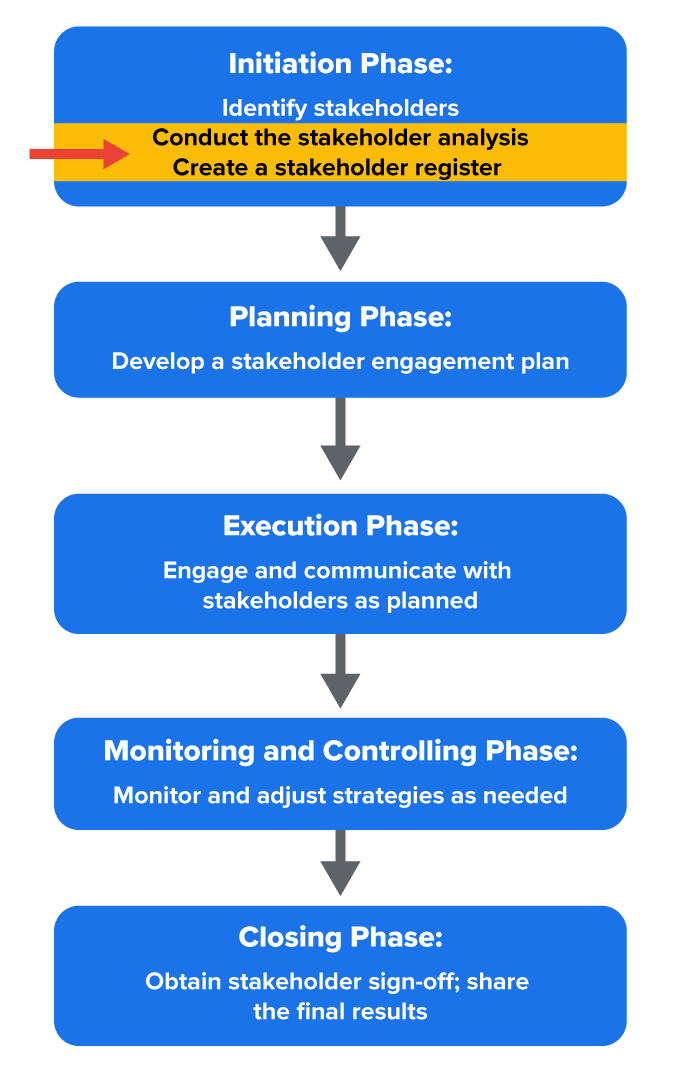
Let’s look at how we perform stakeholder analysis, now that we have our stakeholders identified. We can use a variety of tools to assess how we might want to manage and communicate with them. Let’s look at some of those tools now.
Now that you know who your stakeholders are, you need to determine what power they have and what their intentions toward your project are. Do they have the power to have an impact on your project? Do they support or oppose you? What strategies can you use to manage them?
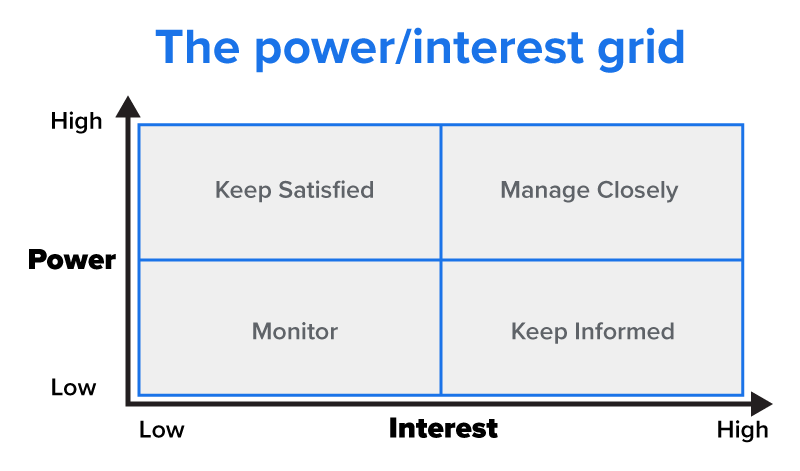
As you can see, the power-interest grid has two dimensions:
EXAMPLE
If a stakeholder has low interest and low power, a project manager doesn’t need to do much except monitor them. However, a stakeholder with high power and high interest will be managed closely through more detailed and frequent communication.Prioritizing stakeholders in this way is significant for several reasons:
| Quadrant | Description | Strategy |
|---|---|---|
| High power, high interest | Stakeholders who can influence the project and are deeply invested in its success |
Manage closely: Involve them in decision making, keep them informed, and engage them regularly. |
| High power, low interest | Stakeholders who can influence the project but aren’t very involved or interested |
Keep satisfied: Provide just enough information to keep them supportive without overwhelming them. |
| Low power, high interest | Stakeholders who care about the project but lack the authority to influence it significantly |
Keep informed: Provide updates and involve them as appropriate; they can be valuable supporters. |
| Low power, low interest | Stakeholders who have minimal influence and limited interest in the project |
Monitor (minimal effort): Keep an eye on them in case their position changes, but don’t invest heavily in engagement. |
The advantage of using this grid is to help prioritize communication, stakeholder engagement, and support smoother stakeholder management during the execution phase in the project lifecycle.
Once you know the power and interest of each of your stakeholders, you add to the document we started in the last lesson by including the level of interest and influence for each stakeholder. That has been added for our day spa example:
| Stakeholder Name/Group | Role | Internal/External | Interest/Influence | Communication Needs |
|---|---|---|---|---|
| Maria Lopez | Project sponsor | Internal | High: oversees project success and provides funding | |
| James Chen | Project manager | Internal | High: responsible for project execution and timelines | |
| Marketing department | Content and branding support | Internal | Medium: needs consistent branding and timely content delivery | |
| IT contractors | Technical support | External | High: responsible for infrastructure, hosting, and security | |
| Employees/staff | Intranet users | Internal | Medium: affected by usability and internal communications | |
| Customers | End users of a public website | External | High: expect a user-friendly, accessible, and reliable online experience | |
| Visual design agency | Visual design contractor | External | High: delivers visual assets critical to project branding and user experience (UX) | |
| Freelance web developer | Web development | External | High: implements front-end/back-end functionality and ensures technical success | |
| Community members | Local public audience | External | Low: may be indirectly impacted by project reach and visibility |
Now that we know the interest and power of each of our stakeholders, we can fill in the next step of our stakeholder register, which is the final step in the initiation phase of the project management lifecycle.
Stakeholders with high power and high interest should be managed closely. These are individuals, like project sponsors or executives, who need to be engaged regularly through detailed updates, frequent meetings, and opportunities for decision-making input. Clear, proactive communication helps keep them supportive and informed. Communication with these individuals should be frequent, detailed, and collaborative. They might include meetings and reports on a frequent basis.
Those with high power but low interest should be kept satisfied. They may not be involved in day-to-day decisions, but their influence means they should receive occasional high-level updates, especially at key milestones, to ensure their support and prevent disengagement or pushback. Communication here should be brief but strategic, giving them just enough to stay aligned with the project’s progress. Communication with these individuals should be occasional, concern high-level/big-picture matters, and be in the form of a status update email.
Stakeholders with low power but high interest, such as end users or team members affected by the project, should be kept informed. These individuals are often deeply invested in the outcome, so regular communication, such as status updates, training sessions, and opportunities to provide feedback, helps maintain their support and morale. While they may not drive decisions, their buy-in is essential for implementation success.
Lastly, stakeholders with low power and low interest should be monitored with minimal effort. These individuals require only occasional updates or passive communication, such as access to general information via newsletters or a project website. It’s still important to track their status in case their level of interest or influence changes.
By categorizing stakeholders in the stakeholder register now, we know how to communicate with them throughout the next phases of the project.
Let’s look at how our stakeholder register might be filled out now, based on the information about communication levels, combined with the information we’ve developed in our power-interest grid:
| Stakeholder Name/Group | Role | Internal/External | Interest/Influence | Communication Needs |
|---|---|---|---|---|
| Maria Lopez | Project sponsor | Internal | High: oversees project success and provides funding | Regular executive updates and milestone progress reports |
| James Chen | Project manager | Internal | High: responsible for project execution and timelines | Daily or weekly team meetings and status reports |
| Marketing department | Content and branding support | Internal | Medium: needs consistent branding and timely content delivery | Weekly check-ins and content review cycles |
| IT contractors | Technical support | External | High: responsible for infrastructure, hosting, and security | Clear technical documentation and scheduled updates |
| Employees/staff | Intranet users | Internal | Medium: affected by usability and internal communications | Training sessions and feedback surveys |
| Customers | End users of a public website | External | High: expect a user-friendly, accessible, and reliable online experience | Usability testing and satisfaction surveys |
| Visual design agency | Visual design contractor | External | High: delivers visual assets critical to project branding and UX | Creative briefs, feedback loops, and revision cycles |
| Freelance web developer | Web development | External | High: implements front-end/back-end functionality and ensures technical success | Technical specs, sprint reviews, and regular updates |
| Community members | Local public audience | External | Low: may be indirectly impacted by project reach and visibility | Public announcements and press releases |
IN CONTEXT
Agile Connection
In the Waterfall project management method we’ve been discussing and the Agile focus on stakeholders and how to effectively manage them, the main differences exist in “when” communication with stakeholders happens. In the Waterfall method, stakeholders are listed up front (in the stakeholder register), and a communication plan is addressed. With Agile, stakeholders are identified, but they are involved in the entire process of development—and it is more continuous and collaborative rather than focused on informing them along the way.
The stakeholder register, throughout the project lifecycle, will be the guiding document for stakeholder communication. In our next lesson, we will address some of the other considerations when identifying stakeholders.
Source: THIS CONTENT HAS BEEN ADAPTED FROM PRESSBOOKS "NSCC PROJECT MANAGEMENT” BY ADRIENNE WATT. ACCESS FOR FREE AT https://pressbooks.atlanticoer-relatlantique.ca/projectmanagement/ LICENSE: CREATIVE COMMONS ATTRIBUTION 4.0 INTERNATIONAL



