Use Sophia to knock out your gen-ed requirements quickly and affordably. Learn more
×

Special Senses: Vision

Author: Sophia

what's covered
In this lesson, you will learn about the special sense of vision. Specifically, this lesson will cover:

Table of Contents

1. Vision

Vision is the special sense of sight that uses the eye to detect light waves and convert them into neural signals. The eyes are located within either orbit in the skull. The bony orbits surround the eyeballs, protecting them and anchoring the soft tissues of the eye. The eyelids, with lashes at their leading edges, help to protect the eye from abrasions by blocking particles that may land on the surface of the eye. Tears are produced by the lacrimal gland, located just inside the orbit, superior and lateral to the eyeball. Tears exit the lacrimal gland and flow over the surface of the eye, washing away foreign particles, exiting the eye through the nasolacrimal duct at the medial corner of the eye. This tube connects and drains tears into the nasal cavity.
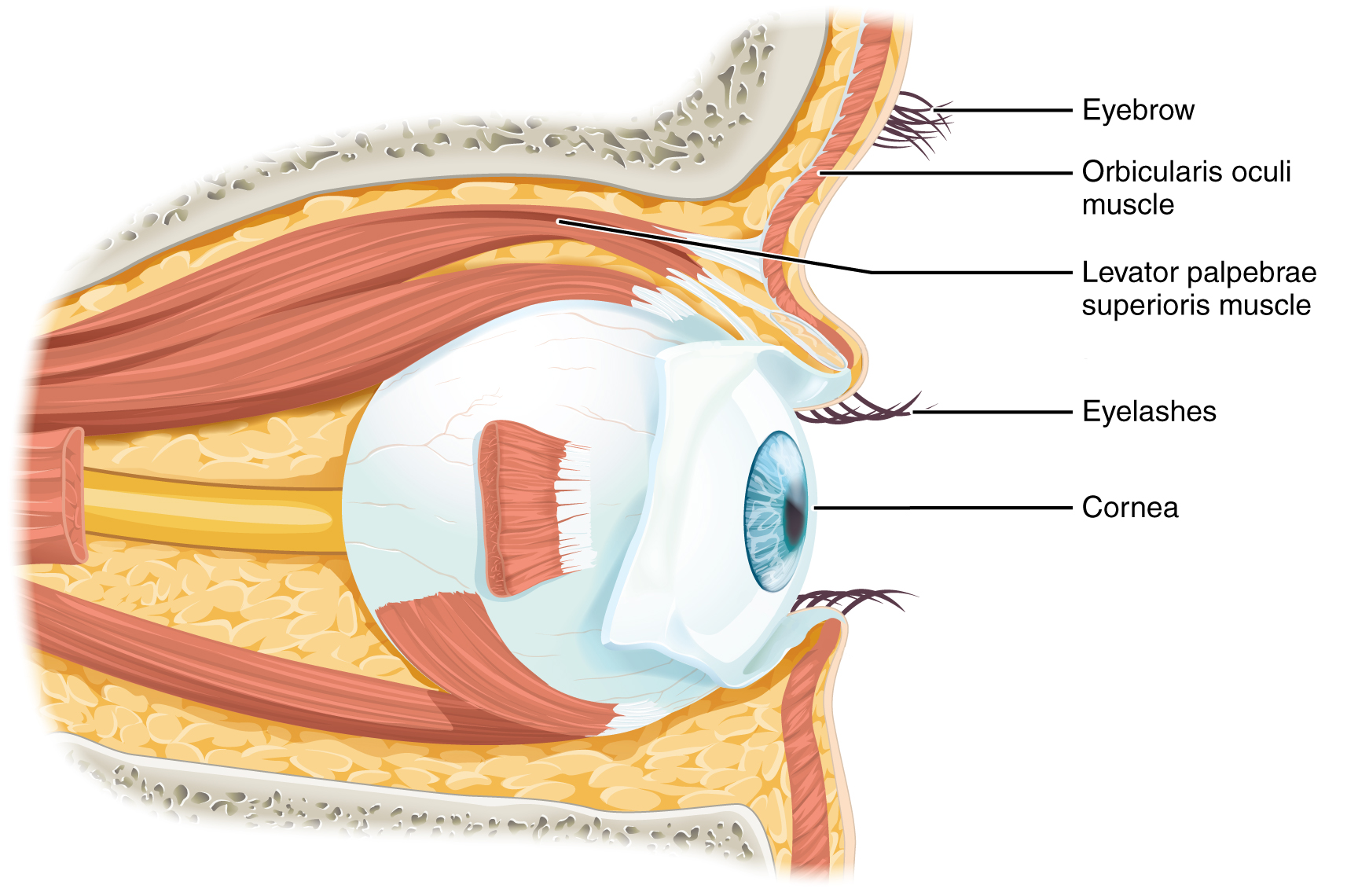
This diagram shows the lateral view of the eye. The major parts are labeled.
The Eye in the Orbit - The eye is located within the orbit and surrounded by soft tissues that protect and support its function. The orbit is surrounded by cranial bones of the skull

Movement of the eye within the orbit is accomplished by the contraction of six extraocular muscles that originate from the bones of the orbit and insert into the surface of the eyeball. For more detailed information, please refer to the supplemental Axial Muscles.pdf. These muscles are innervated by three cranial nerves, the oculomotor (CN III), trochlear (CN IV), and abducens nerves (CN VI).

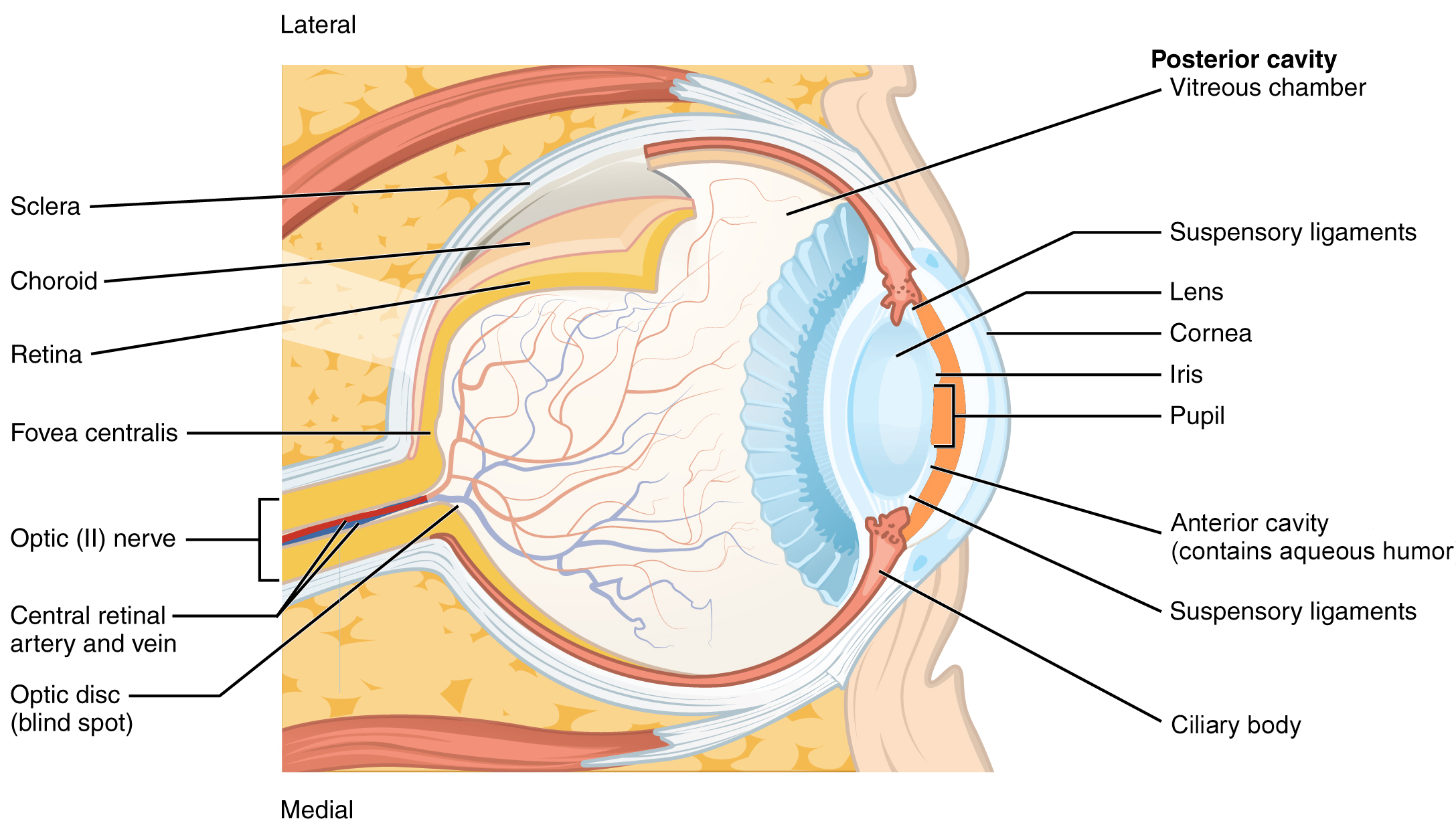
The eye itself is a hollow sphere composed of three layers of tissue called tunics (tunic, coat)—the fibrous tunic, vascular tunic, and neural tunic. The outermost layer is the fibrous tunic, which includes the white sclera and clear cornea. The sclera accounts for five-sixths of the surface of the eye, most of which is not visible, though humans are unique compared with many other species in having so much of the “white of the eye” visible. The transparent cornea acts like a curved window, covering the anterior tip of the eye and allowing light to enter the eye.

The middle layer of the eye is the vascular tunic, which is mostly composed of the choroid, ciliary body, and iris. The choroid is a layer of highly vascularized connective tissue that provides a blood supply to the eyeball. The choroid is posterior to the ciliary body, a muscular structure that is attached to the lens by suspensory ligaments, or zonule fibers. These two structures bend the lens, allowing it to focus light on the back of the eye. Overlaying the ciliary body, and visible in the anterior eye, is the iris—the colored part of the eye. The iris is a smooth muscle that opens or closes the pupil, which is the hole at the center of the eye that allows light to enter. The iris constricts the pupil in response to bright light and dilates the pupil in response to dim light. The innermost layer of the eye is the retina, or neural tunic, which contains the nervous tissue responsible for photoreception.

The eye is also divided into two cavities:
  • The anterior cavity
  • The posterior cavity
The anterior cavity is the space between the cornea and lens, including the iris and ciliary body. It is filled with a watery fluid called aqueous humor.

The posterior cavity is the space behind the lens that extends to the posterior side of the interior eyeball, where the retina is located. The posterior cavity is filled with a more viscous fluid called the vitreous humor.

In the posterior cavity, the retina is composed of several layers and contains specialized cells for the initial processing of visual stimuli. The photoreceptors are specialized receptor cells that change their membrane potential when stimulated by light energy. The change in membrane potential alters the amount of neurotransmitter that the photoreceptor cells release onto bipolar cells in the outer synaptic layer. It is the bipolar cell in the retina that connects a photoreceptor to a retinal ganglion cell (RGC) in the inner synaptic layer. The axons of RGCs, which lie at the innermost layer of the retina, all converge at one point in the eye and exit the eye collectively as the optic nerve (CN II). The point at which they exit the eye is called the optic disc, also known as the blind spot. Because these axons pass through the retina, there are no photoreceptors in that space. This creates a “blind spot” in the retina and a corresponding blind spot in our visual field.

This diagram shows the structure of the eye with the major parts labeled.
Structure of the Eye - The sphere of the eye can be divided into anterior and posterior chambers. The wall of the eye is composed of three layers: the fibrous tunic, vascular tunic, and neural tunic. Within the neural tunic is the retina, with three layers of cells and two synaptic layers in between. The center of the retina has a small indentation known as the fovea.

Note that the photoreceptors in the retina are located behind the axons, RGCs, bipolar cells, and retinal blood vessels. A significant amount of light is absorbed by these structures before the light reaches the photoreceptor cells. However, at the exact center of the retina is a small area known as the fovea centralis, or fovea for short, that lacks the supporting cells and blood vessels and only contains photoreceptors. Because this is where the least amount of light is absorbed by other retinal structures, it is where visual acuity, or the sharpness of vision, is greatest. As one moves in either direction from this central point of the retina, visual acuity drops significantly. In addition, each photoreceptor cell of the fovea is connected to a single RGC. Therefore, this RGC does not have to integrate inputs from multiple photoreceptors, which reduces the accuracy of visual transduction. Toward the edges of the retina, several photoreceptors converge on RGCs (through the bipolar cells) up to a ratio of 50 to 1.

watch
View the following video for more information on this topic.

try it
The difference in visual acuity between the fovea and peripheral retina is easily evidenced by looking directly at a word in the middle of this paragraph. The visual stimulus in the middle of the field of view falls on the fovea and is in the sharpest focus. Without moving your eyes off that word, notice that words at the beginning or end of the paragraph are not in focus. The images in your peripheral vision are focused by the peripheral retina and have vague, blurry edges and words that are not as clearly identified. As a result, a large part of the neural function of the eyes is concerned with moving the eyes and head so that important visual stimuli are centered on the fovea.

Light falling on the retina causes chemical changes to pigment molecules in the photoreceptors, ultimately leading to a change in the activity of the RGCs. Photoreceptor cells have two parts, the inner segment and the outer segment. The inner segment contains the nucleus and other common organelles of a cell, whereas the outer segment is a specialized region in which photoreception takes place. There are two types of photoreceptors—rods and cones—which differ in their shape and light sensitivity. Rods have a rod-shaped outer segment and contain the photosensitive pigment rhodopsin. These cells are sensitive to light intensity but do not detect colors. Rod photoreceptors only generate black-and-white images. Cones have a cone-shaped outer segment and contain one of three photosensitive opsin pigments, each sensitive to a particular wavelength (color) of light. The pigments in human eyes are specialized in perceiving three different primary colors: red, green, and blue.
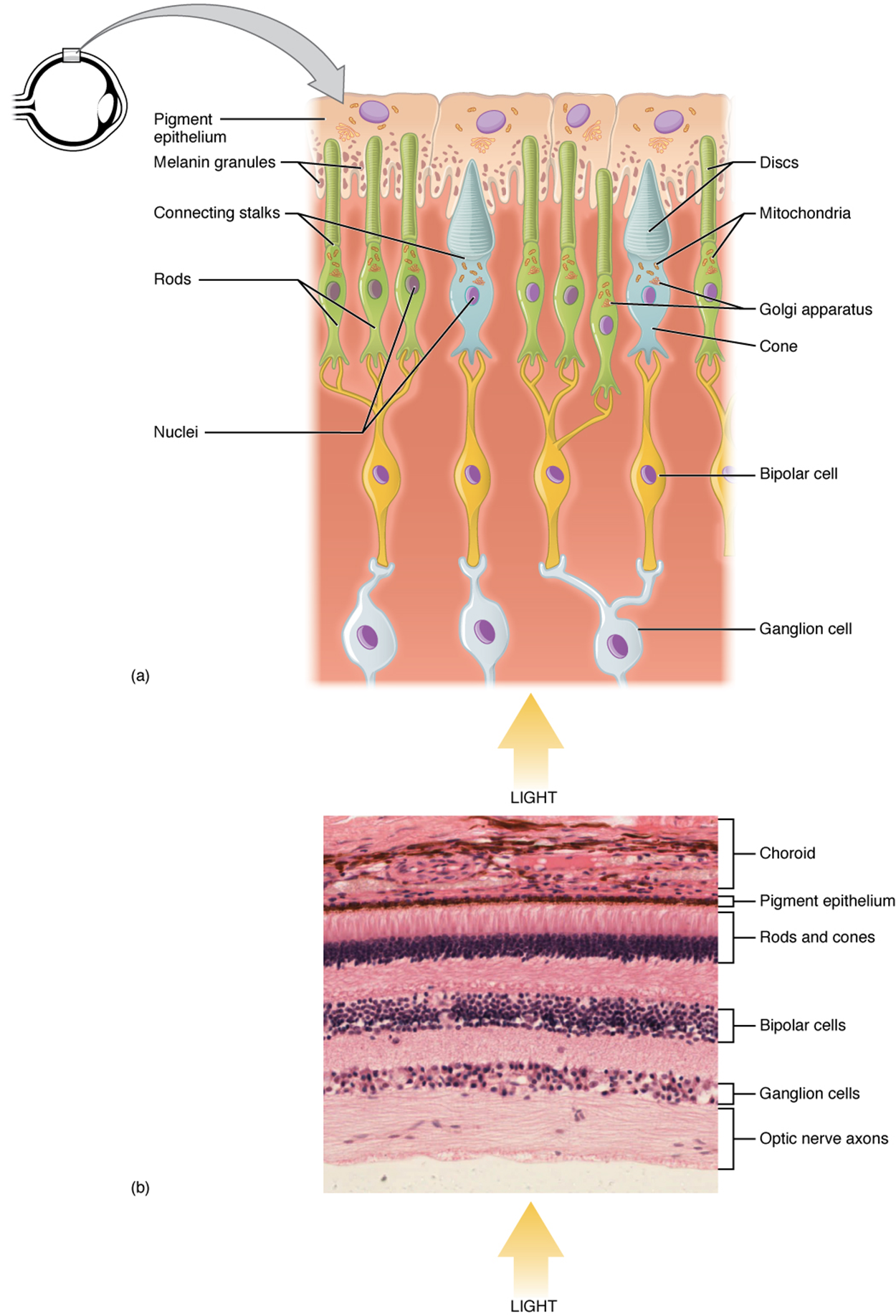
The top panel shows the cellular structure of the different cells in the eye. The bottom panel shows a micrograph of the cellular structure.
Photoreceptor - (a) All photoreceptors have inner segments containing the nucleus and other important organelles and outer segments with membrane arrays containing the photosensitive opsin molecules. Rod outer segments are long columnar shapes with stacks of membrane-bound discs that contain the rhodopsin pigment. Cone outer segments are short, tapered shapes with folds of the membrane in place of the discs in the rods. (b) Tissue of the retina shows a dense layer of nuclei of the rods and cones. LM × 800.

watch
View the following video for more information on this topic.


At the molecular level, visual stimuli cause changes in the photopigment molecule that lead to changes in membrane potential of the photoreceptor cell. A single unit of light is called a photon. The energy of a photon is represented by its wavelength, with each wavelength of visible light corresponding to a particular color. Visible light has a wavelength between 380 and 720 nm. Light with a wavelength of 380 nm is blue whereas light with a wavelength of 720 nm is dark red. All other colors fall between red and blue at various points along the wavelength scale.
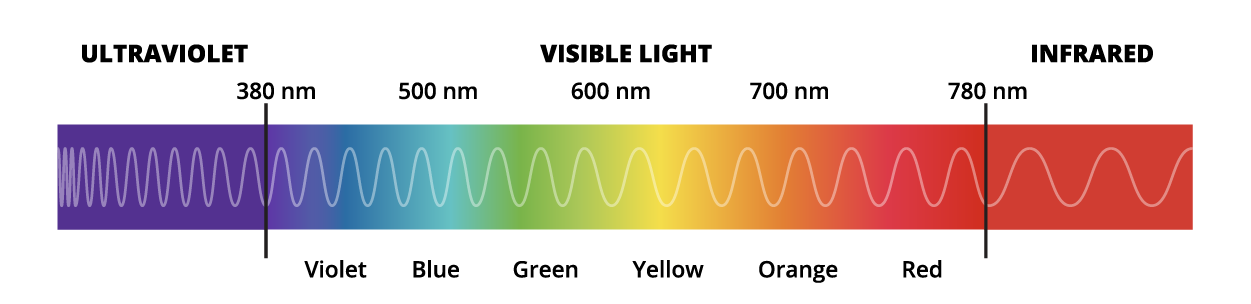
This diagram shows the visible light spectrum with colors and wavelengths labeled, including infrared and ultraviolet light.
Wavelengths of Visible Light - Visible light spans wavelengths from 380 to 780 nm along the electromagnetic spectrum.

Opsin pigments are transmembrane proteins that contain a cofactor known as retinal. Retinal is a molecule related to vitamin A. When light hits retinal, it changes shape in a process known as photoisomerization. The shape change of retinal in the photoreceptor membrane initiates a change in its membrane potential. This causes the photoreceptor cell to decrease neurotransmitter release. This means that photoreceptor cells and the optic nerve decrease activity in the presence of light stimuli and increase in the absence of light stimuli.

Additionally, until the retinal molecule is changed back to its original shape by another enzymatic reaction, the opsin cannot respond to light energy, which is called bleaching. When a large group of photopigments is bleached, the retina will send information as if opposing (negative) visual information is being perceived.

EXAMPLE

If you look at a bright light and then look away, your vision will have an afterimage of a dark spot, also known as flash blindness.

The same general process also works for colors. If you look at a relatively light red image and then look away, your vision will see the same afterimage but in green (the opposite color to red).

All visual pigments are sensitive to limited wavelengths of light. Rhodopsin, the photopigment in rods, is most sensitive to light at a wavelength of 498 nm. The three color opsins have peak sensitivities of 564 nm, 534 nm, and 420 nm corresponding roughly to the primary colors of red, green, and blue. The absorbance of rhodopsin in the rods is much more sensitive than in the cone opsins; specifically, rods are sensitive to vision in low light conditions, and cones are sensitive to brighter conditions. In normal sunlight, rhodopsin will be constantly bleached while the cones are active. In a darkened room, there is not enough light to activate cone opsins, and vision is entirely dependent on rods. Rods are so sensitive to light that a single photon can result in an action potential from a rod’s corresponding RGC.

The three types of cone opsins, being sensitive to different wavelengths of light, provide us with color vision. By comparing the activity of the three different cones, the brain can extract color information from visual stimuli.

EXAMPLE

A bright blue light that has a wavelength of approximately 450 nm would activate the “red” cones minimally, the “green” cones marginally, and the “blue” cones predominantly.

The relative activation of the three different cones is calculated by the brain, which perceives the color as blue. However, cones cannot react to low-intensity light, and rods do not sense the color of light. Therefore, our low-light vision is—in essence—in grayscale. In other words, in a dark room, everything appears as a shade of gray. If you think that you can see colors in the dark, it is most likely because your brain knows what color something is and is relying on that memory.
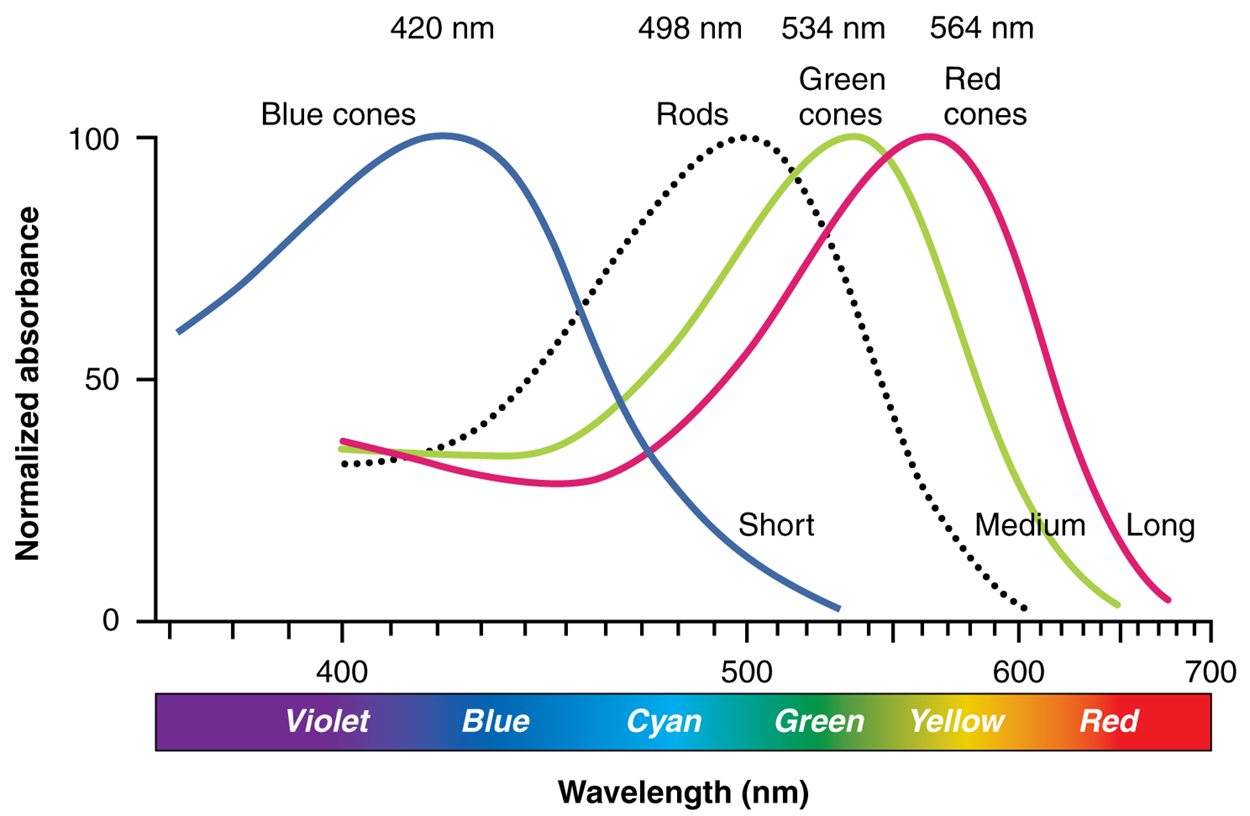
This graph shows the normalized absorbance versus wavelength for different cell types in the eye.
Comparison of Color Sensitivity of Photopigments - Comparing the peak sensitivity and absorbance spectra of the four photopigments suggests that they are most sensitive to particular wavelengths.

terms to know
Vision
The special sense of sight that uses the eye to detect light waves and convert them into neural signals.
Lacrimal Gland
A gland superior to the lateral angle of the eye that produces and secretes tears.
Nasolacrimal Duct
A tube that connects the medial angle of the eye to the nasal cavity to drain tears.
Fibrous Tunic
The outer layer of the eye containing the sclera and cornea.
Sclera
The white of the eye.
Cornea
The transparent covering of the anterior tip of the eye that allows light to enter.
Vascular Tunic
The middle layer of the eye containing the choroid, ciliary body, and iris.
Choroid
The vascular tissue of the eye.
Ciliary Body
A smooth muscle structure on the interior of the iris that controls the shape of the lens.
Lens
A component of the eye that focuses light on the retina.
Zonule Fiber
Fibrous connection between the ciliary body and lens.
Iris
The colored ring of the eye.
Pupil
The black hole at the center of the iris that allows light to pass into the posterior chamber.
Retina (aka Neural Tunic)
The inner layer of the eye containing sensory receptors and neurons, the retina.
Anterior Cavity
The space between the cornea and lens.
Aqueous Humor
The fluid located in the anterior cavity.
Posterior Cavity
The space behind the lens.
Vitreous Humor
The viscous fluid located in the posterior cavity.
Photoreceptor
Specialized receptor cell in the neural layer of the eye that is sensitive to light stimuli.
Bipolar Cell
A cell that connects the photoreceptor to the retinal ganglion cell.
Retinal Ganglion Cell
A neuron of the retina which transports a signal along the optic nerve.
Optic Disc
The point at which all retinal ganglion cell axons exit the eye as the optic nerve; blind spot.
Fovea Centralis
The central point in the eye with the greatest visual acuity.
Rod
Photoreceptor that is specialized for low-light vision.
Rhodopsin
A photosensitive pigment found in rod photoreceptors.
Cone
One of three photoreceptors that is specialized for color vision.
Photon
A single unit of light.
Photoisomerization
A change in the chemical structure of a photosensitive pigment.
Bleaching
A process by which an opposite visual after-image is perceived after exposure to a bright light source.

summary
In this lesson, you learned about the special sense of vision. You learned the anatomy of the eye and how the light performs photoreception.

Source: THIS TUTORIAL HAS BEEN ADAPTED FROM OPENSTAX “ANATOMY AND PHYSIOLOGY 2E.” ACCESS FOR FREE AT HTTPS://OPENSTAX.ORG/DETAILS/BOOKS/ANATOMY-AND-PHYSIOLOGY-2E. LICENSE: CC ATTRIBUTION 4.0 INTERNATIONAL.

Terms to Know
Anterior Cavity

The space between the cornea and lens.

Aqueous Humor

The fluid located in the anterior cavity.

Bipolar Cell

A cell that connects the photoreceptor to the retinal ganglion cell.

Bleaching

A process by which an opposite visual after-image is perceived after exposure to a bright light source.

Choroid

The vascular tissue of the eye.

Ciliary Body

A smooth muscle structure on the interior of the iris that controls the shape of the lens.

Cone Photoreceptor

One of three photoreceptors that is specialized for color vision.

Cornea

The transparent covering of the anterior tip of the eye that allows light to enter.

Fibrous Tunic

The outer layer of the eye containing the sclera and cornea.

Fovea Centralis

The central point in the eye with the greatest visual acuity.

Iris

The colored ring of the eye.

Lacrimal Gland

A gland superior to the lateral angle of the eye that produces and secretes tears.

Lens

A component of the eye that focuses light on the retina.

Nasolacrimal Duct

A tube that connects the medial angle of the eye to the nasal cavity to drain tears.

Neural Tunic (aka Retina)

The inner layer of the eye containing sensory receptors and neurons, the retina.

Optic Disc

The point at which all retinal ganglion cell axons exit the eye as the optic nerve; blind spot.

Photoisomerization

A change in the chemical structure of a photosensitive pigment.

Photon

A single unit of light.

Photoreceptor

Specialized receptor cell in the neural layer of the eye that is sensitive to light stimuli.

Posterior Cavity

The space behind the lens.

Pupil

The black hole at the center of the iris that allows light to pass into the posterior chamber.

Retinal Ganglion Cell

A neuron of the retina which transports a signal along the optic nerve.

Rhodopsin

A photosensitive pigment found in rod photoreceptors.

Rod Photoreceptor

Photoreceptor that is specialized for low-light vision.

Sclera

The white of the eye.

Vascular Tunic

The middle layer of the eye containing the choroid, ciliary body, and iris.

Vision

The special sense of sight that uses the eye to detect light waves and convert them into neural signals.

Vitreous Humor

The viscous fluid located in the posterior cavity.

Zonule Fiber

Fibrous connection between the ciliary body and lens.


