Table of Contents |
Buddhism spread to Southeast Asia via trade and missionary work. Ashoka, who ruled in India during the Mauryan period, was responsible for making Buddhism popular within his kingdom in India. His pillars and edicts, along with the stupas that he had built in multiple locations, served as visual reminders of the religion and its tenets, which he supported in the form of laws and ethical practices. He also sent emissaries along trade routes to encourage the spread of Buddhism as far as possible, to present-day Afghanistan in the west and Indonesia in the east. His own son and daughter traveled to Sri Lanka to encourage conversion to Buddhism. His actions brought Buddhism to distant lands, including Cambodia and Indonesia, along a trade route known as the Maritime Silk Road. It is also thought that Indian merchants brought religious practitioners of Hinduism and Buddhism, spreading these religions far beyond India.
By the 1st century CE, Buddhism had spread to Indonesia. The oldest Buddhist archaeological site in Indonesia dates from the 2nd century CE and is located on the island of Java, which is the world’s most populous island and home to 56% of the population of Indonesia. The site of Borobudur is located in central Java and is the largest Buddhist temple in the world.
From a distance, Borobudur looks like a holy mountain.
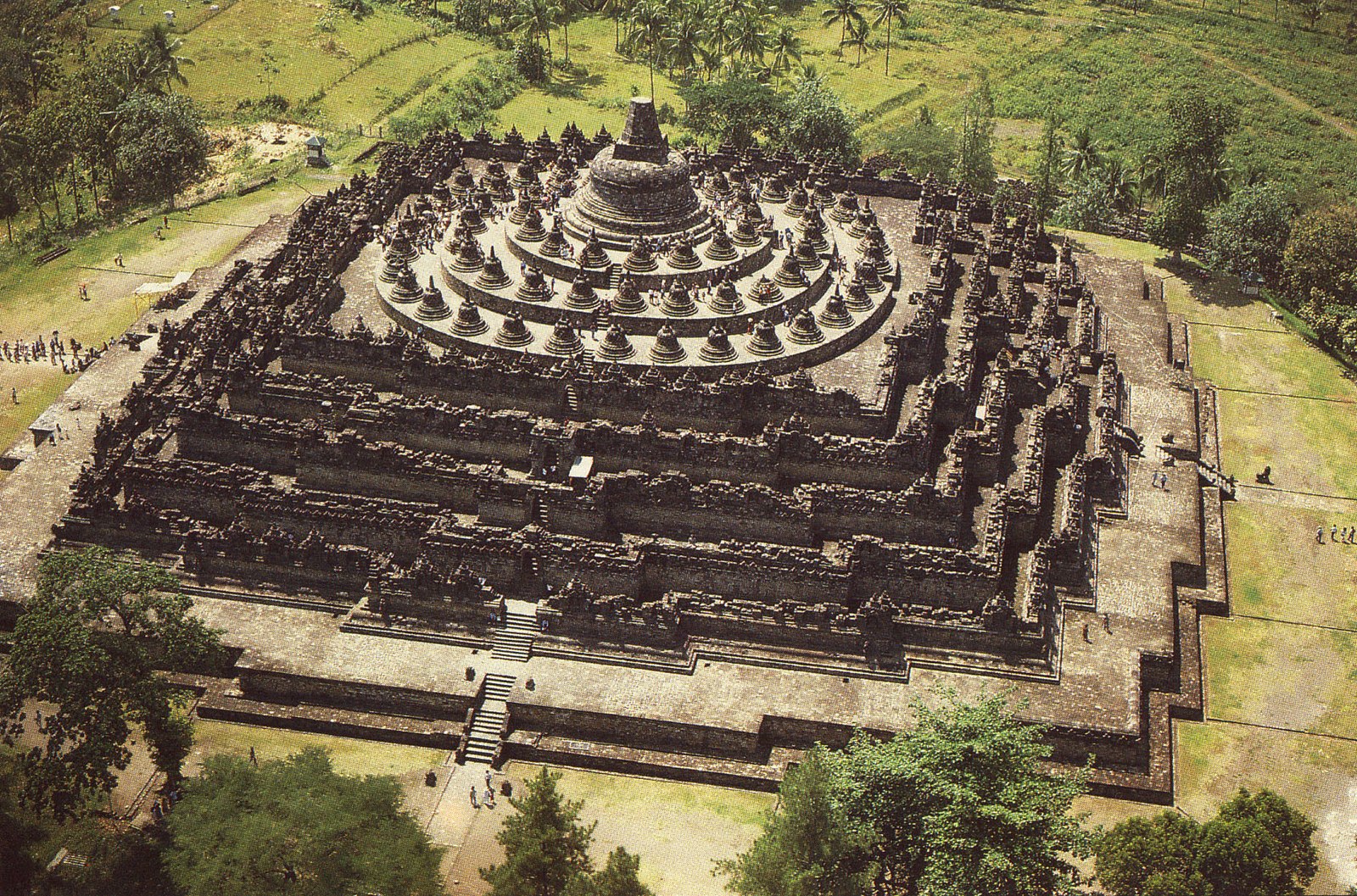
Borobudur
Magelang Regency, Central Java, Indonesia
9th-century CE, Sailendra dynasty
Gray andesite-like stone
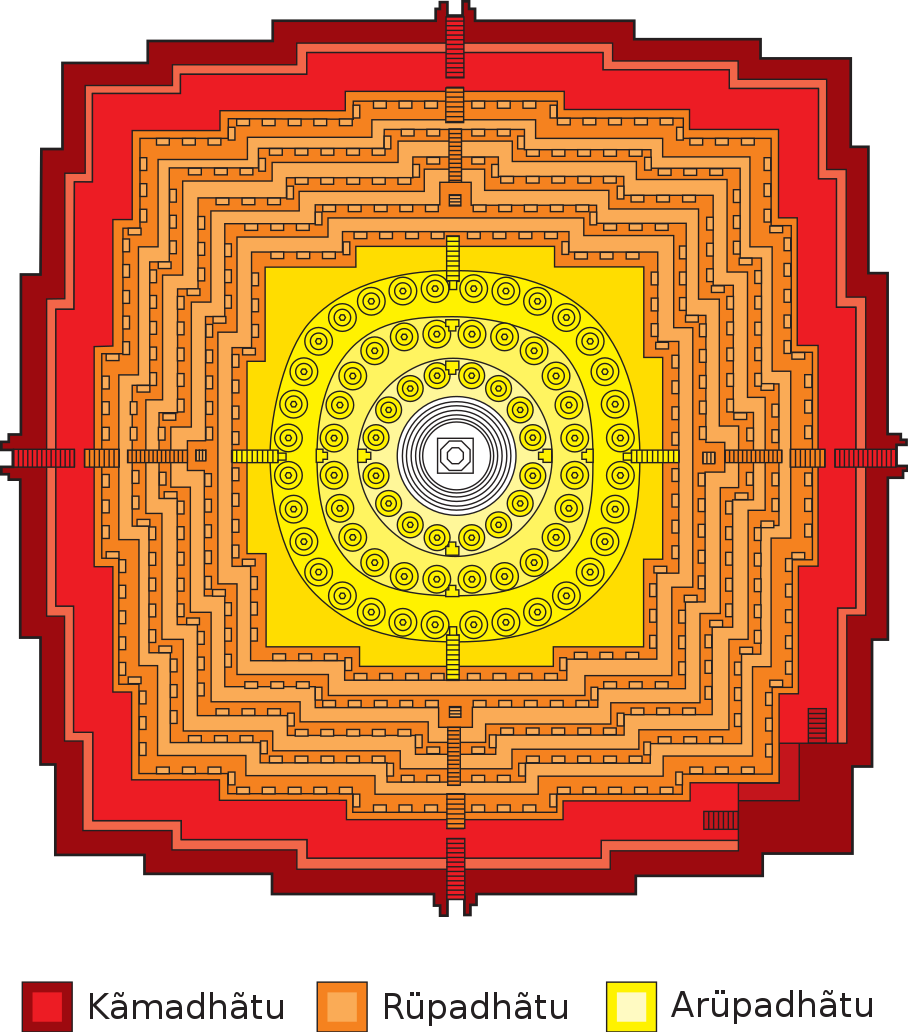
It is actually an enormous, three-dimensional mandala, with nine levels. It is a pilgrimage site, and people experience this temple by ascending through the various levels, which are further divided into the three levels of Buddhist cosmology. These are the levels that one has to attain before finally reaching enlightenment.
Here is a plan of the site:
Along the way, there are a series of bell-shaped, perforated stupas that contain sculptures of the Buddha, as well as a series of sculptures seated in niches in the lotus position. They appear at first glance to be all the same but are holding their hands in different mudras. Originally, there were a total of 504 Buddha sculptures, but 43 are now missing, and 300 have had their heads removed. Some of these heads have ended up in the collections of museums in the Netherlands, France, Great Britain, and Germany. All of the German museums decided to give their heads back and assisted with reattaching them, as well as general conservation at the site.
Below are stupas and a Buddha sculpture inside a niche at Borobudur.
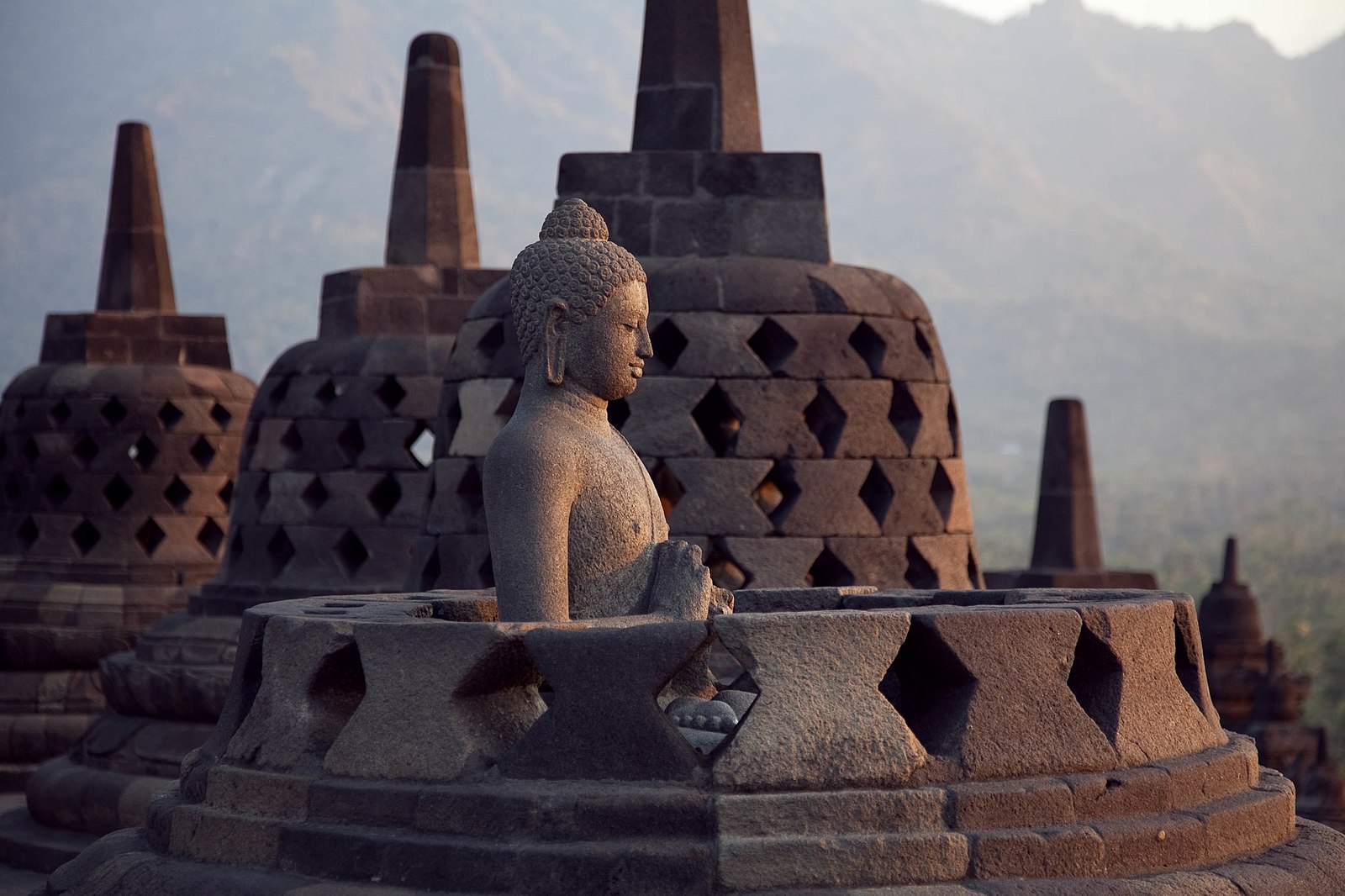
Stupas and Buddha sculpture at Borobudur
Magelang Regency, Central Java, Indonesia
9th-century CE, Sailendra dynasty
Gray andesite-like stone
In addition to the Buddha sculptures, there are a number of relief sculptures on the walls of Borobudur. They depict various subjects, including scenes from the life of Buddha, everyday life in Indonesia during the 8th century, and Buddhist spiritual beings. We might think of these relief sculptures as functioning a bit like an enormous open book in stone. They provided instruction, particularly to those viewers who were maybe less familiar with the story of Buddhism, or who were illiterate. Like the complex as a whole, they also functioned as aids to meditation. Although Borobudur was originally made in bluish-gray stone, research has uncovered the presence of pigments and gold leaf on the surface of the sculptures, suggesting that they were once painted.
Here are relief sculptures at Borobudur.
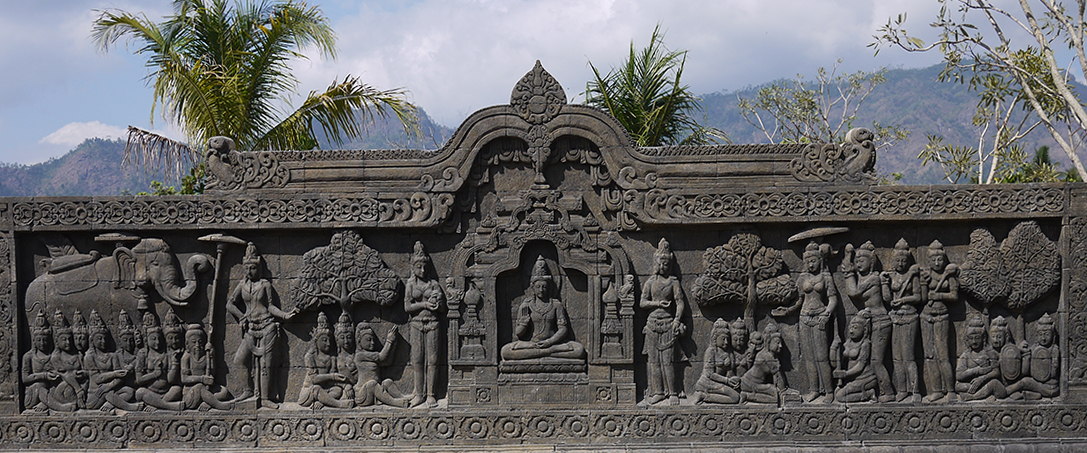
Relief sculptures at Borobudur
Magelang Regency, Central Java, Indonesia
9th-century CE, Sailendra dynasty
Gray andesite-like stone
Borobudur was abandoned in the 14th century, or perhaps sooner, as the result of a combination of volcanic eruptions and the arrival of Islam in Indonesia. It grew over with plants and vines that concealed it almost completely. In the 1800s, locals told the British colonial rulers about the site. At first, it was not valued, and many of its sculptures were looted, but around the year 1900, efforts began to preserve the site.
Angkor Wat (1110–1150 CE) is a Hindu temple complex located in the Siem Riep province of Cambodia. It is one of the largest religious structures in the world, comparable in size to the Egyptian temple at Karnak, and consists of over 1,000 buildings. The king Suryavarman II was responsible for its creation, which took place during the 12th century. Angkor Wat is the most important example of Khmer-style architecture. The Khmer are the people of present-day Cambodia. The Khmer Empire existed from the 9th century to the 15th century. The only examples of Khmer-style architecture that remain today are religious structures made out of stone. Houses, which were most likely made out of wood and other perishable materials, deteriorated a long time ago.
Below is the Angkor Wat, showing the main tower, surrounded by four smaller towers and a moat.
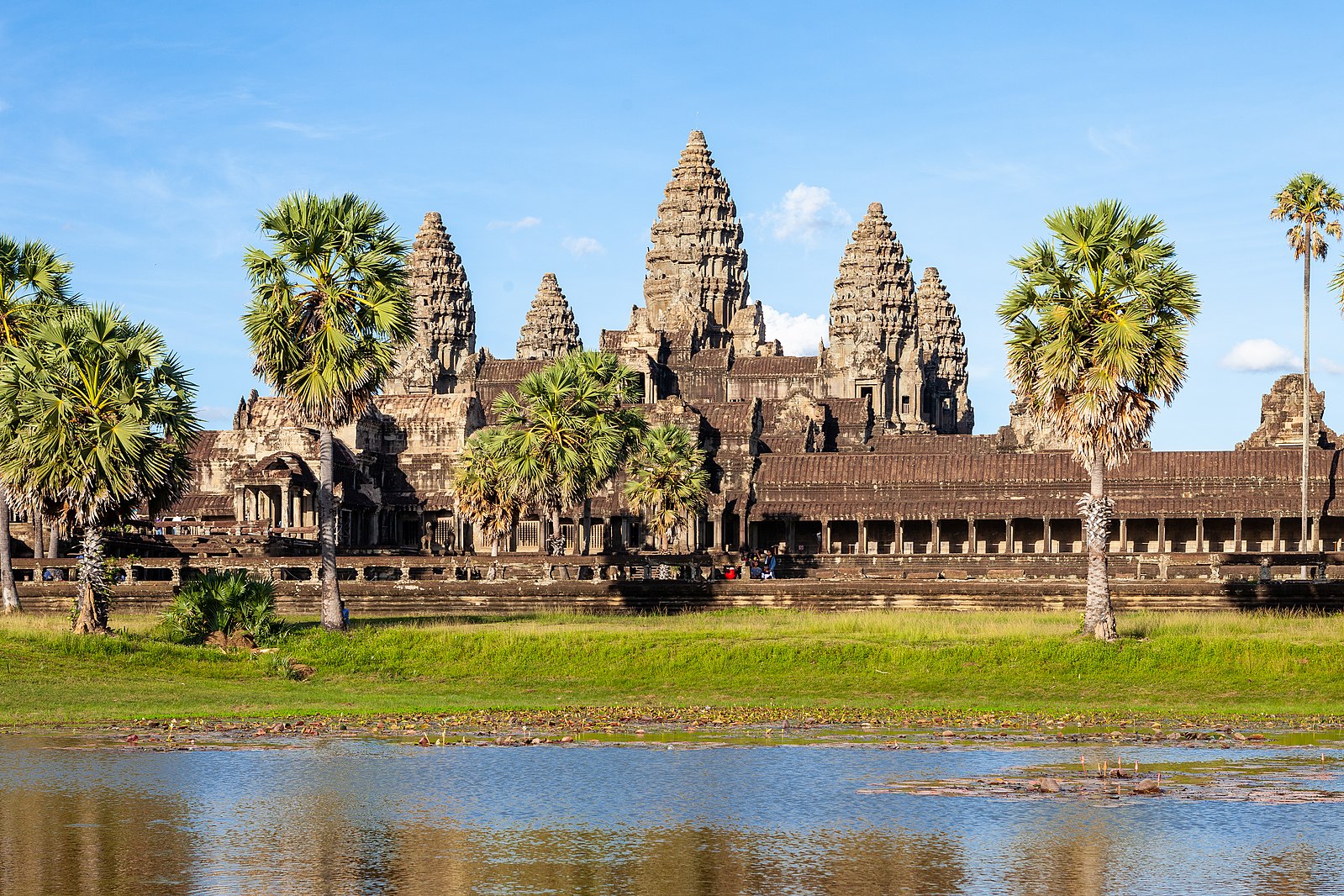
Angkor Wat
Siem Reap, Cambodia
1122–1150 CE
Sandstone
The features of Khmer-style architecture include a tall central element or temple mountain, meant to represent Mount Meru, the Mount Olympus of Hinduism. This structure is surrounded by a series of concentric walls and structures. Angkor Wat features a central tower 216 feet tall that represents Mount Meru. Surrounding it are four smaller structures. At the outer edge is a moat, representing the waters at the edge of the world. Angkor Wat is therefore a model of the cosmos, as the Khmer understood it.
In this plan of Angkor Wat, you can clearly see the concentric design of Khmer-style architecture.
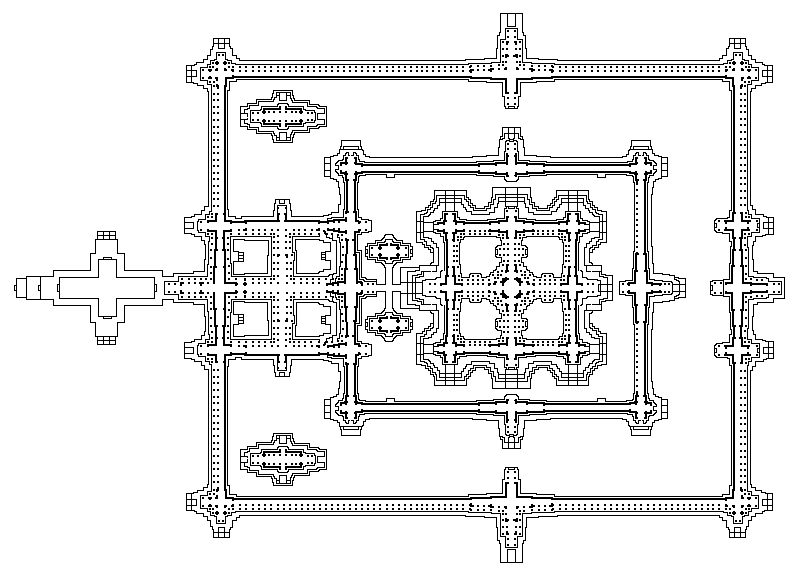
Angkor Wat is only accessible from the west. At first, archaeologists thought that this meant that it was supposed to be a funerary complex. However, they soon realized that Angkor Wat is actually dedicated to the Hindu deity Vishnu, who was seen at that time as a protector god of the Khmer people. Their rivals were the Cham people of Thailand and the Dai Viet of Vietnam, who were Buddhist. For this reason, the Khmer viewed Buddhism as a threat. Angkor Wat contains multiple images of Vishnu, including images of Suryavarman II performing his kingly duties in Vishnu’s presence.
In this relief sculpture of Suryavarman II sitting in state, you can see his subjects in the lower right-hand corner, and an assortment of fly whisks and fans. There are traces of red pigment in the background.
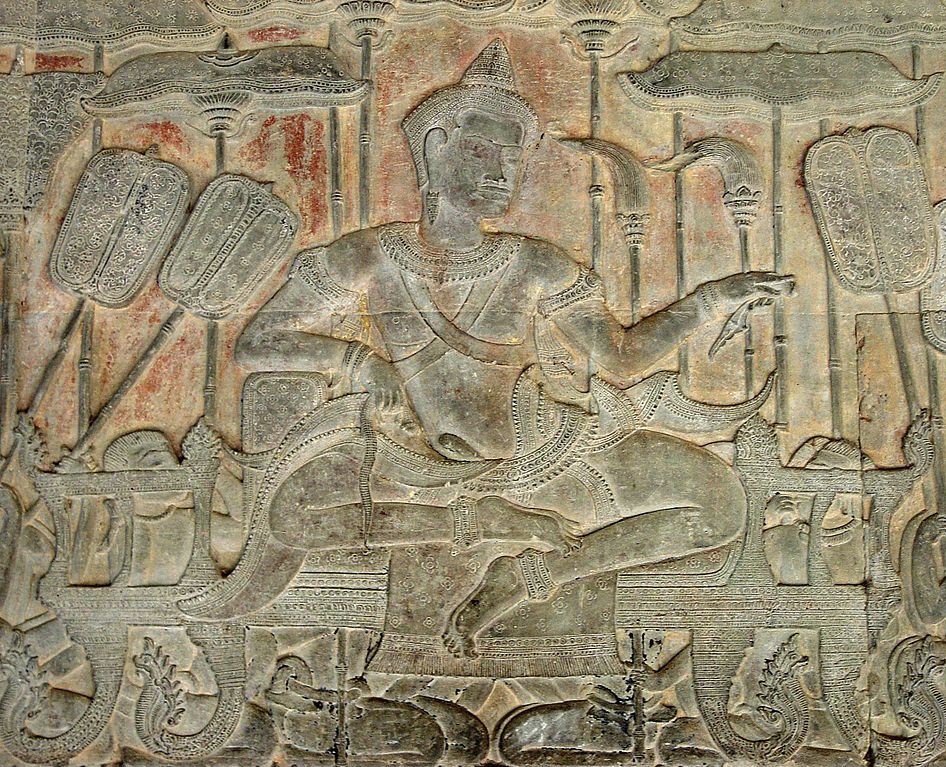
Relief at Angkor Wat
Siem Reap, Cambodia
1122–1150 CE
Sandstone
One of the most important sculptures at Angkor Wat is a relief depicting the churning of the ocean of milk. According to this story, the gods had been cursed and weakened in their power. They invited demons to help them release the milk of immortality (amrita) to gain back their power. Both groups would have to work together to obtain the amrita but then fight each other immediately after to see who would gain control over it. The sculpture depicts the moment when both the gods and demons are swinging a giant snake, with Vishnu in the middle, to churn the cosmic ocean, bringing the amrita to the surface. References to this story are included elsewhere in the complex, including hundreds of sculptures of apsaras, or heavenly maidens, that were created when the cosmic ocean was stirred. The entrance to the complex is a bridge with a seven-headed snake decorating the balustrade. And the moat itself represents the cosmic ocean.
Below is the Churning of the Ocean of Milk relief sculpture at Angkor Wat, featuring Vishnu in the middle of gods and demons using a snake to stir up amrita. Above them are apsaras, or heavenly maidens.
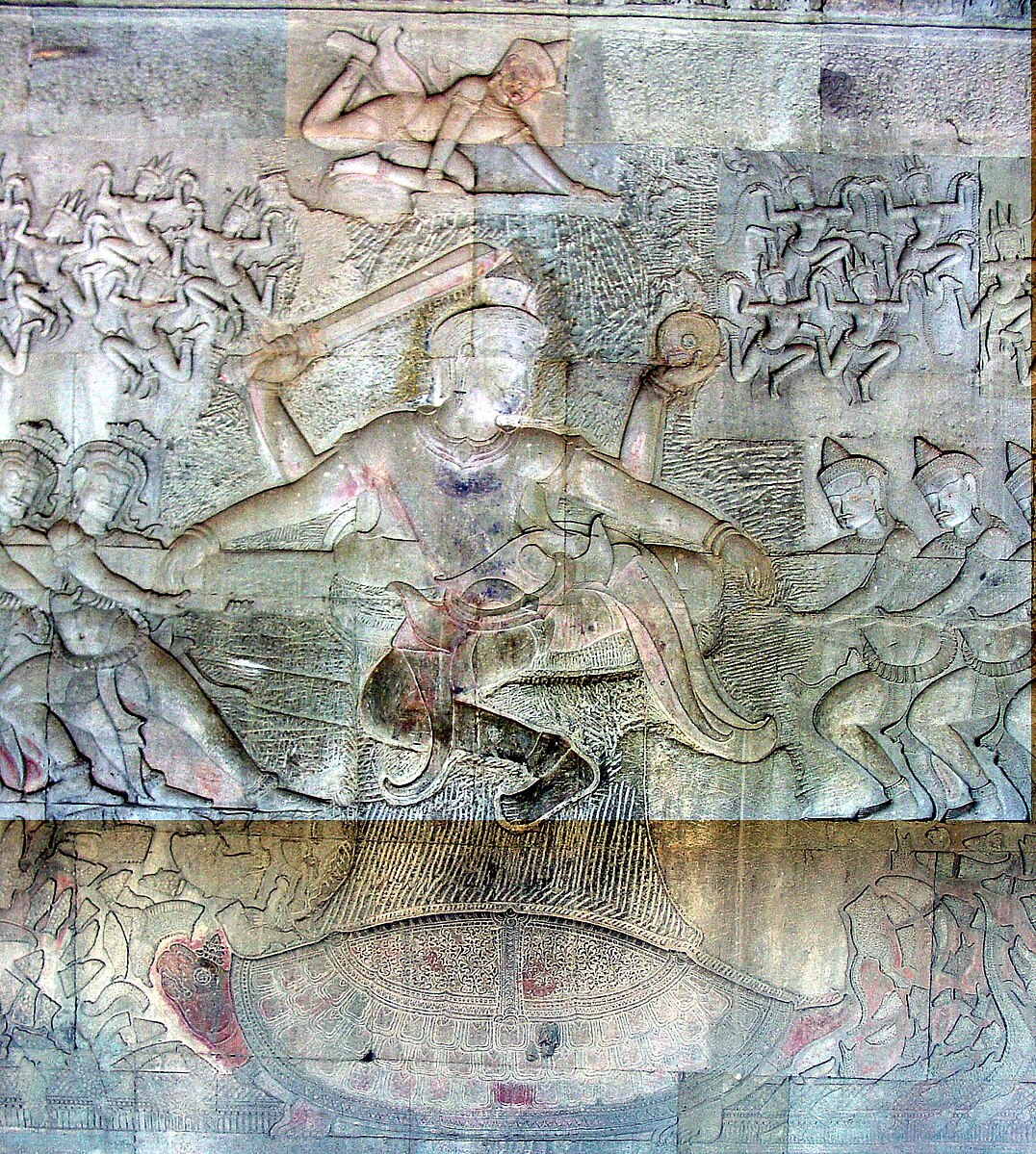
Churning of the Ocean of Milk relief at Angkor Wat
Siem Reap, Cambodia
1122–1150 CE
Sandstone
Eventually, the Khmer Empire fell, and Angkor Wat was taken over by Buddhist monks, who added Buddhist sculptures while respecting the Hindu imagery and not damaging it. After a while, the complex was completely abandoned. During the 1800s, Europeans showed an interest in Angkor Wat and cleared away the jungle growth, taking the first steps toward its conservation. Today it is one of the most visited tourist attractions in the world.
EXAMPLE
Angkor Wat is so closely associated with Cambodia that its image is featured on the Cambodian flag.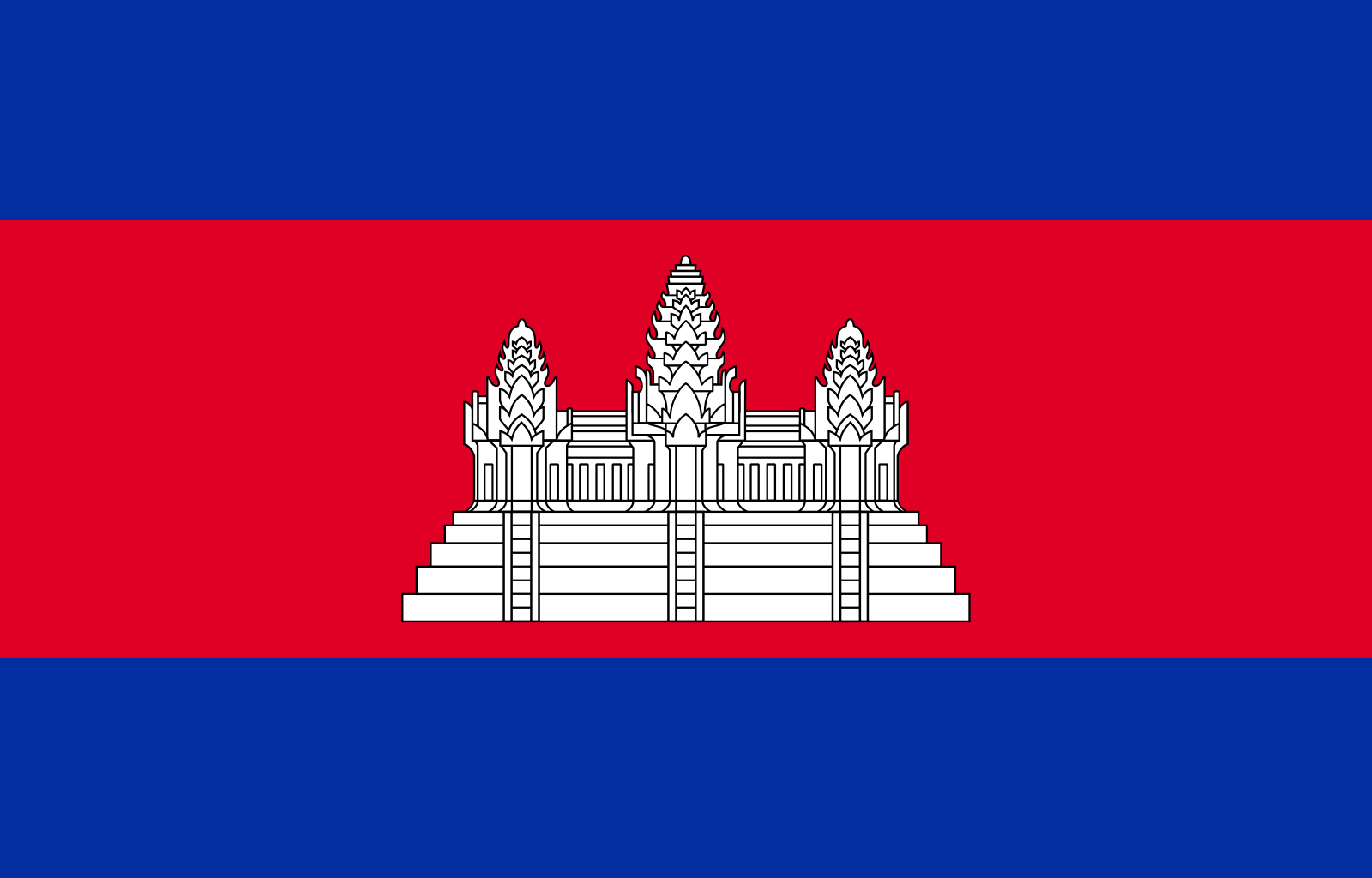
Source: THIS TUTORIAL WAS AUTHORED BY SOPHIA LEARNING. PLEASE SEE OUR TERMS OF USE.