In this lesson, you will learn how conflicts over unmet needs can come from two main sources. Specifically, this lesson will cover the following:
1. Sources of Conflict
Conflict arises from a myriad of sources, each contributing to the complexity and dynamics of human interactions. These sources can be broadly categorized into external and internal needs and a combination of both. External needs refer to tangible, outward demands such as resources, environmental conditions, and sociopolitical factors that impact individuals or groups. On the other hand, internal needs pertain to psychological, emotional, and personal desires and motivations that drive behavior and decision-making. Often, conflicts emerge from an interplay of both external and internal needs, where the struggle to balance or satisfy these varying demands can lead to tension and discord. Understanding the roots of conflict through these lenses allows for more effective resolution strategies and a deeper comprehension of human behavior.
1a. External Needs
A range of factors can lead to conflict:
- Unmet needs (interest-based conflict)
- Lack of information/different interpretations of data (data-based conflict)
- Clashing or contradictory beliefs (values-based conflict)
- Relational patterns (relationship-based conflict)
- External forces (structural conflict)

As you learned in a previous lesson, a need or interest is an action, belief, or physical item that a party perceives as important or essential to their satisfaction or happiness. Every conflict includes parties who have needs and interests. The conflict occurs because one party feels its need or interest is incompatible with the other party’s. An external need could be a physical, tangible object or a situation that has tangible impacts. Let’s look at some examples of conflicts involving external needs.
-
EXAMPLE
Interest-based: A family is dividing up the inheritance after a death, and a feud develops over some of the objects. Tangible objects are at the center of this conflict.
-
EXAMPLE
Structural: Diego has to drive to work every day, and it takes him two hours to commute. That long commute eats up a lot of his free time, so it creates a structural conflict.
-
EXAMPLE
Data-based: Anita is signing up for health insurance, but she has questions about some of her options. She has been on hold with the health insurance representative for hours and she still hasn’t gotten through, and she can’t complete her health insurance enrollment until she understands her options better. Anita is experiencing data-based conflict.
-
- External Need
- A physical, tangible object or a situation that has tangible impacts.
1b. Internal Needs
An internal need is an emotion, a mental state, or general satisfaction. Let’s look at some examples of conflicts involving internal needs.
-
EXAMPLE
Values-based: You enjoy the music of a particular performer, but you learn that the performer holds a political position that you find deeply unethical. The performer has recently begun integrating their politics more into their music. Whether you continue to listen to this performer’s music or continue your patronage of their work with your money is a values-based internal conflict.

-
EXAMPLE
Relationship-based: Your friend really likes to spend time talking things out, but you just like to get the job done without a lot of conversation. These represent relational types that could find themselves in conflict because of different internal needs.
-
- Internal Need
- An emotion, a mental state, or general satisfaction.
1c. Both Internal and External Needs
Conflicts frequently involve a combination of these needs, as outlined in comprehensive theories of conflict that examine the interplay of various factors in causing disputes. However, it is important to realize that in a conflict, internal and external needs are not mutually exclusive.
-
EXAMPLE
Let’s return to the example of the family feud over heirlooms. When you get to the root of the conflict, you might find that the fight isn’t just about a piece of artwork; perhaps it’s also about the following:
-
Relational patterns: Maybe the sister feels that her younger brother always gets his way. The sister feels that nobody listens to her.
-
Values: The brother is very nostalgic and would like to keep things. His sister thinks, “No, why don’t we sell this off and get the money? We’ll divide the money up.”
These issues can manifest themselves in different ways depending on the real source of the conflict.
-
EXAMPLE
The same thing could be true of a data conflict. Anita’s lack of information about her health insurance is a data-based conflict that is getting in the way of her ability to enroll in health insurance, but it might also be other types of conflict:
-
Internal values: Maybe Anita feels embarrassed that she can’t understand the health insurance information without assistance.
-
Structural conflict: Anita is likely anxious about the data she needs because if she makes the wrong selection, her health conditions might not be covered. This is a structural conflict because the health insurance system is set up in a way that makes it possible for her to make a selection that would put her in medical debt.
You then discover that the issue here is external in the form of data and structure and internal in the form of values.
2. Common Features of Conflict
The common features of conflict typically include the following elements:
-
Perceived incompatibility: Conflict arises when parties see their goals or values as incompatible, leading to struggles over resources, power, or recognition.
-
EXAMPLE
Two coworkers, Alex and Jamie, both want to lead a high-profile project. They perceive that only one can be the leader, leading to a conflict over who gets the role.
-
Interdependence: Conflict occurs between interdependent parties, where one’s actions affect the other, as seen in relationships, workplaces, or nations.
-
EXAMPLE
In a family business, the success of one sibling's department depends on the timely delivery of materials from another sibling's department. Delays cause conflicts as each sibling's actions directly impact the other's performance.
-
Interference: One party’s actions are perceived as hindering the other’s goals, manifesting as opposition or obstacles.
-
EXAMPLE
A student, Sam, needs quiet to study, but their roommate, Taylor, likes to play loud music. Taylor's actions interfere with Sam's goal of studying, leading to conflict.
-
Emotional involvement: Conflicts evoke strong emotions like anger or anxiety, escalating challenges and complicating resolution.
-
EXAMPLE
During a heated argument about household chores, both partners in a relationship feel anger and frustration, making it harder to resolve the issue calmly.
-
Communication breakdown: Misunderstandings or poor communication exacerbate conflicts, making effective communication crucial for resolution.
-
EXAMPLE
In a workplace, a manager's unclear instructions lead to misunderstandings among team members, causing frustration and conflict over how tasks should be completed.
-
Dynamic nature: Conflicts are dynamic and escalate if underlying issues aren’t addressed, turning minor disagreements into major disputes.
-
EXAMPLE
A minor disagreement between neighbors about property boundaries escalates into a major dispute involving legal action because the underlying issues were not addressed early on.
-
Perceived threats: Conflicts involve perceived threats to needs or interests, leading to defensive or aggressive behaviors.
-
EXAMPLE
An employee feels threatened by a new colleague who seems more skilled and worries about job security, leading to defensive behavior and conflict.
-
Diverse perspectives: Conflicts arise from different perspectives and backgrounds, causing contrasting interpretations.
-
EXAMPLE
In a multicultural team, different cultural norms and values lead to misunderstandings and conflicts about appropriate workplace behavior.
-
Power imbalances: Conflicts often involve power dynamics, with one party having more power or resources, influencing outcomes.
-
EXAMPLE
In a company, a manager has more power than their direct reports. This power imbalance can lead to conflicts if employees feel their concerns are not being heard or addressed.
-
Resolution opportunities: Conflicts, despite their negativity, offer growth, better understanding, and stronger relationships when managed well, fostering problem-solving and innovation.
-
EXAMPLE
After a conflict over project direction, a team holds a meeting to discuss their differences. This leads to better understanding, improved communication, and innovative solutions that benefit the project.
Understanding these features helps in identifying, addressing, and resolving conflicts in various contexts, whether personal, organizational, or societal.
-
- Perceived Incompatibility
- Conflict arises when parties see their goals or values as incompatible, leading to struggles over resources, power, or recognition.
- Interdependence
- Conflict occurs between interdependent parties, where one’s actions affect the other, as seen in relationships, workplaces, or nations.
- Interference
- One party’s actions are perceived as hindering the other’s goals, manifesting as opposition or obstacles.
- Emotional Involvement
- Conflicts evoke strong emotions like anger or anxiety, escalating challenges and complicating resolution.
- Communication Breakdown
- Misunderstandings or poor communication exacerbate conflicts, making effective communication crucial for resolution.
- Dynamic Nature
- Conflicts are dynamic and escalate if underlying issues aren’t addressed, turning minor disagreements into major disputes.
- Perceived Threats
- Conflicts involve perceived threats to needs or interests, leading to defensive or aggressive behaviors.
- Diverse Perspectives
- Conflicts arise from different perspectives and backgrounds, causing contrasting interpretations.
- Power Imbalances
- Conflicts often involve power dynamics, with one party having more power or resources, influencing outcomes.
- Resolution Opportunities
- Conflicts, despite their negativity, offer growth, better understanding, and stronger relationships when managed well, fostering problem-solving and innovation.
2a. The ABCs of Conflict
Before we begin learning more about the features of conflict, let’s talk about the conflict triangle, also known as the ABCs of conflict, a framework developed by Norwegian sociologist Johan Galtung to analyze and understand the dynamics of conflict.
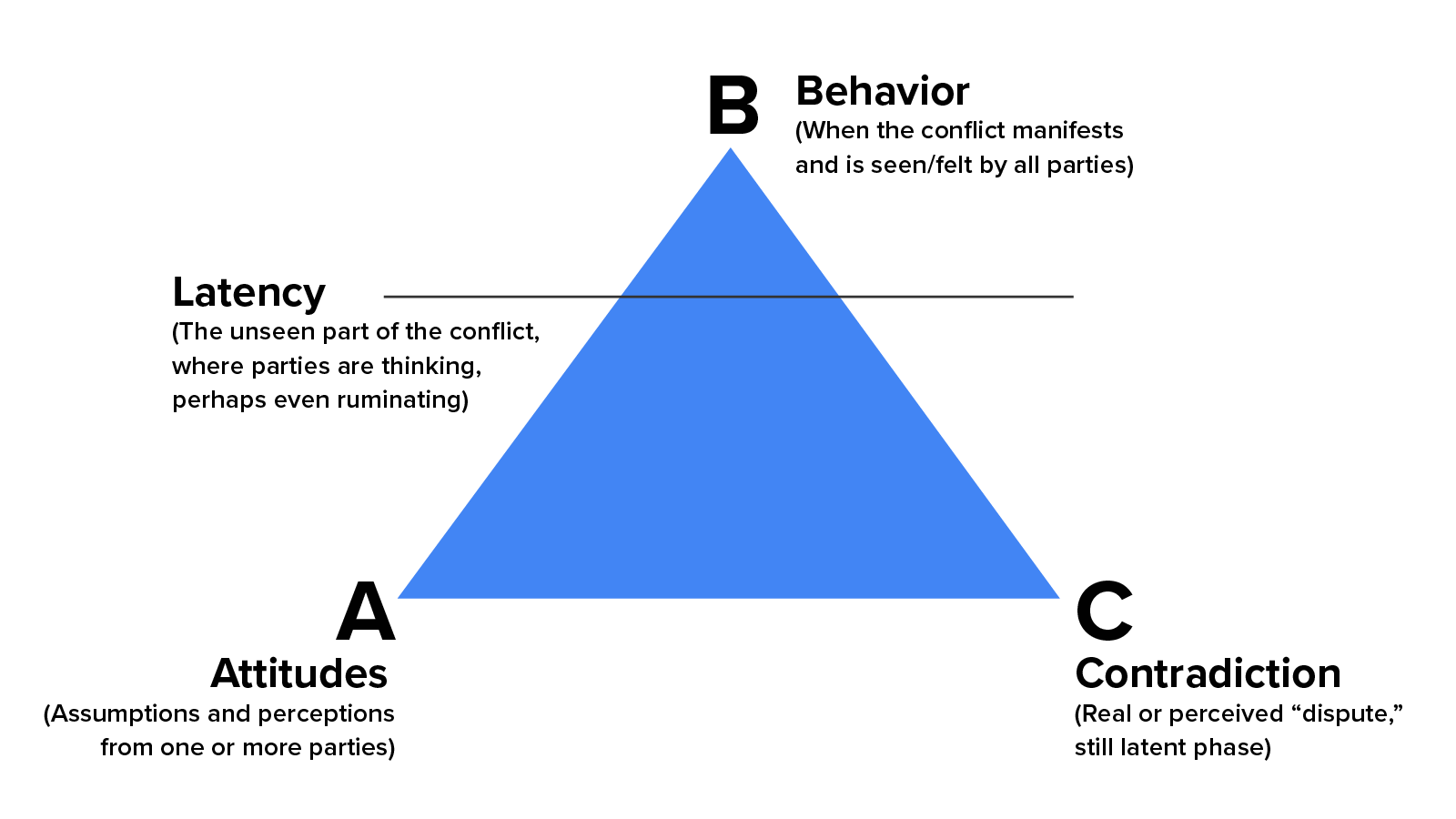
This model breaks down conflict into three interrelated components: attitudes (A), behavior (B), and contradictions (C). By examining these elements, we can gain a comprehensive understanding of the sources, nature, and common features of conflict, which aids in developing effective resolution strategies.
- Attitudes (A): Attitudes refer to the psychological aspects of conflict, including perceptions, emotions, and cognitive orientations of the parties involved. These include feelings such as distrust, anger, hatred, and prejudice, as well as positive feelings like empathy and understanding.
- Behavior (B): Behavior encompasses the actions, reactions, and interactions of the conflicting parties. This can include communication patterns, physical actions, and other observable behaviors. Behaviors can be overt, such as arguments, violence, and passive-aggressive actions, or covert, such as avoidance or sabotage.
- Contradictions (C): Contradictions are the underlying incompatibilities, discrepancies, or issues that form the root of the conflict. These can be structural, interest based, or value based. Contradictions often involve competing goals, needs, or desires that are perceived as mutually exclusive.
Typically, by the time we see attitudes, the conflict has been bubbling beneath the surface for a while, like a pot of hot water moving from simmer to boil. Additionally, the three components of the conflict triangle are interconnected, meaning changes in one area can influence the others:
- Attitudes and Behavior: Negative attitudes can lead to hostile behaviors, and hostile behaviors can reinforce negative attitudes.
- Behavior and Contradictions: Unresolved contradictions often manifest in conflicting behaviors, and these behaviors can bring underlying contradictions to the surface.
- Attitudes and Contradictions: Attitudes are shaped by perceived contradictions; for example, perceived injustice (a contradiction) can lead to feelings of resentment (an attitude).
-
Remember, just as changes in one area can spark negative behavior, they can also spark positive behavior. Can you think of ways the interconnectedness of the triangle can spark positive behavior?
2b. Latent Conflict
Sometimes, it can take time for a conflict over a perceived incompatibility to surface, which brings us to the concept of latent conflict.
-
A
latent conflict is a state in which parties have differences that bother one or the other but do not consider those differences significant enough to act on them. Latency, as a feature of conflict, refers to the underlying tension or potential for conflict that exists even when it is not currently visible or active. The latent phase is crucial to understanding conflict dynamics because it represents the preexisting conditions and factors that can lead to the emergence of active conflict.
Here’s how latency plays a role:
- Unexpressed tensions: Latent conflict involves feelings of dissatisfaction, frustration, or perceived injustice that have not yet been expressed openly.
- Potential for activation: The latent phase holds the potential for conflict to become active if triggered by certain events or actions.
In both work and personal relationships, underlying issues like unmet needs or past grievances might remain unspoken. These latent conflicts can emerge during stressful situations or misunderstandings. Once a latent conflict is out in the open, the parties have the power to resolve it.
IN CONTEXT
John and Mary work together, and it’s time for the annual holiday party. John makes a joke that hurts Mary’s feelings.
Mary thinks, “That really made me feel bad, but you know John—he’s like that, and people know he’s always joking around. He never means anything by it, so I think I’ll just let it pass.”
After the third time John offends her, Mary starts to think about how John always leaves the lights on at the end of the night and she always has to turn them off and how she always finds him eating her snacks and so on and so on, until she nearly bursts with anger at John and his inconsiderate ways.
What would be a better way for Mary to manage her stressors with John? Let’s dig in a bit more. The impact of latency includes the buildup of stress, sudden escalation, and complex resolutions.
- Buildup of stress: Latent conflict can lead to a buildup of stress and anxiety among the parties involved, as underlying issues fester without resolution.
- Sudden escalation: When latent conflicts are triggered, they can escalate quickly and unexpectedly because the underlying issues have been accumulating over time.
- Complex resolution: Resolving latent conflicts can be more challenging because they often involve deep-seated issues and require addressing the root causes rather than just the immediate triggers.
Identifying latent conflict includes making observations and regular feedback mechanisms.
- Observation: Careful observation of behaviors, attitudes, and communication patterns can help identify signs of latent conflict; for example, increased absenteeism, passive-aggressive behavior, or declining performance may indicate underlying issues.
- Feedback mechanisms: Implementing regular feedback mechanisms, such as surveys or open forums, can help uncover latent conflicts before they escalate.
Addressing latent conflict requires proactive communication, mediation and counseling, and preventive measures to prevent future latent conflict.
- Proactive communication: Encouraging open and honest communication can help bring latent issues to the surface before they become active conflicts.
- Mediation and counseling: Providing mediation or counseling services can assist in addressing underlying grievances and preventing latent conflicts from escalating.
- Preventive measures: Implementing policies and practices that promote fairness, transparency, and inclusivity can reduce the likelihood of latent conflicts developing.
Understanding latency as a feature of conflict emphasizes the importance of being attuned to underlying issues and addressing them proactively, and applying the ABC framework helps address the conflict comprehensively. By recognizing and managing latent conflicts early, it is possible to prevent them from escalating into more significant and damaging disputes.
-
Let’s take a look at it from the ABC lens:
- Addressing attitudes: Conflict resolution strategies might focus on improving communication, fostering empathy, and building trust to change negative attitudes.
- Modifying behavior: Techniques like mediation, negotiation, and conflict management training can help change destructive behaviors into constructive ones.
- Resolving contradictions: Identifying and addressing the root causes of conflict through problem-solving, resource allocation, or policy changes can help resolve contradictions.
-
In the example above, how could Mary have resolved the conflict with John before it escalated?
By analyzing conflicts through the lens of the conflict triangle, parties can better understand the multifaceted nature of disputes and work toward more effective and holistic resolutions.
-
- Latent Conflict
- A state in which parties have differences that bother one or the other but do not consider those differences significant enough to act on them.
2c. Power
Now that the conflict has come to the surface, power becomes involved. Power is the ability to control an individual or group through influence, force, coercion, or manipulation to get the individual or group to do something that they would not otherwise do. Power can, thus, take many forms.
-
EXAMPLE
Let’s return to John and Mary. Mary’s annoyed because John jokes around all the time. He thinks he’s being funny, but he’s gone a little over the top a few times, and Mary is now annoyed enough that she would like to talk with him about it. She wants to use her power, and there are a couple of ways they can do this:
-
Social power: Mary might invoke social power by talking about John’s mean remarks with their mutual friends, who she knows like her better than John, and see if anyone else will join her in confronting John or keeping her distance from him going forward.
-
Self-protective power: Mary might stop spending time with John altogether, using her power to separate herself from the source of potential conflict.
-
Rhetorical power: Mary might confront John, knowing that if she prepares herself with specific examples of mean things John has said, she is more likely to outmatch him in the conversation and convince him to behave better.
-
Force: Mary could punch John in the nose the next time he says something she doesn’t like.
-
Coercion: Mary could offer an ultimatum to John, wherein she tells him that the next time he says something she doesn’t like, she will tell the entire friend group and ensure that he doesn’t get invited to other parties.
While we clearly might view some of these methods as positive and some as negative, they are all ways of using power in a relationship.
-
- Power
- The ability to influence or control people or events, with or without resistance, through various means.
In this lesson, you learned that conflict is always between two or more parties over a real or perceived incompatibility. Sources of conflict can stem from external needs, internal needs, or a combination of both external and internal needs.
You learned about the common features of conflict: A conflict can remain latent, or under the surface, for some time before a party decides to take action, using power to influence the outcome. You now understand that only once a conflict has been brought to the surface can the parties involved begin working toward a solution. Additionally, you were introduced to the ABC model of conflict, which breaks down conflicts into three interrelated components: attitudes (A), behavior (B), and contradictions (C). By analyzing these components, you can better understand the psychological aspects, actions, and underlying issues driving the conflict, which is essential for effective resolution.



