Use Sophia to knock out your gen-ed requirements quickly and affordably. Learn more
×

Software Development Methodologies

Author: Sophia

what's covered
In this lesson, you will explore the most widely used software development methodologies and see how they guide projects from planning to delivery. You will learn about traditional approaches like Waterfall and the V-Model, iterative models such as Rapid Application Development and prototyping, and modern frameworks like Agile, Lean, and DevOps. For each, you will consider when it works best, how it is applied, and how these approaches compare in meeting today’s software development needs. Specifically, this tutorial will cover:

Table of Contents

1. Waterfall and V-Model

A software development methodology is a structured way of organizing and managing the phases of the software development life cycle (SDLC). While the SDLC outlines stages such as planning, design, development, testing, deployment, and maintenance, a methodology is the practical approach teams use to carry out those stages. Teams select methodologies based on project size, scope, budget, timeline, and how likely requirements are to change. Sometimes organizations even combine multiple methodologies to create hybrids tailored to their needs.

big idea
A methodology is not the same as the software development life cycle. The SDLC provides a broad outline of stages—planning, requirements, design, development, testing, deployment, and maintenance, versus a methodology, which is a practical way of implementing those stages.

When we studied productivity software earlier, you learned that Waterfall is one possible approach to project management. It follows a linear, sequential path in which each phase must be completed before the next begins.

Traditionally, most software development projects have used this approach to move through the stages of the software development life cycle. Teams would move step by step, beginning with requirements, followed by design, implementation, testing, deployment, and maintenance.
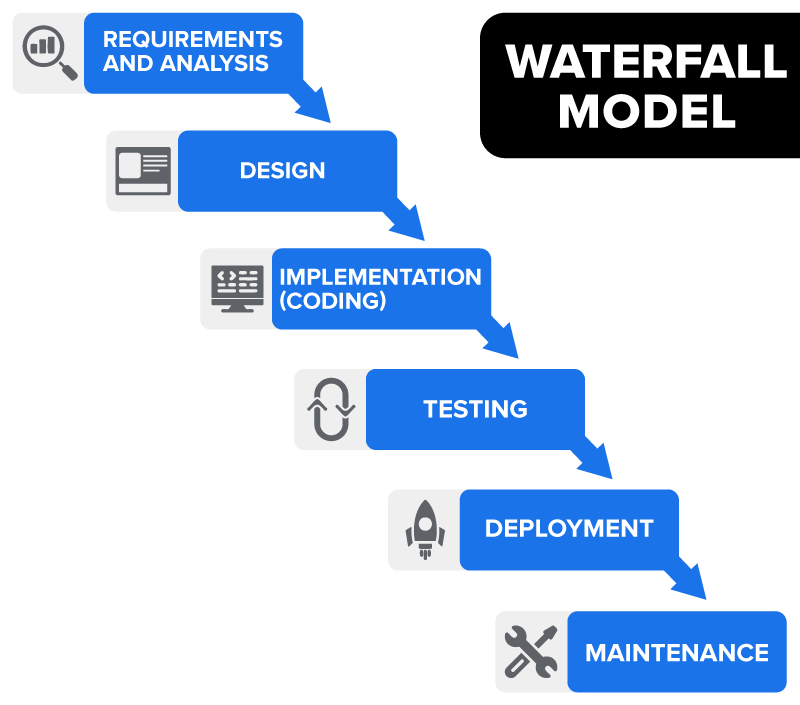
Diagram of the Waterfall model showing six sequential stages: Requirements and analysis, design, implementation (coding), testing, deployment, and maintenance.

A variation of this linear approach is the V-Model, which pairs each stage with a corresponding test. The left side of the “V” represents planning and design, while the right side represents corresponding testing activities, such as unit testing, integration testing, and system verification. This makes the V-Model particularly valuable in industries where quality and safety are critical, such as healthcare, aviation, and defense.
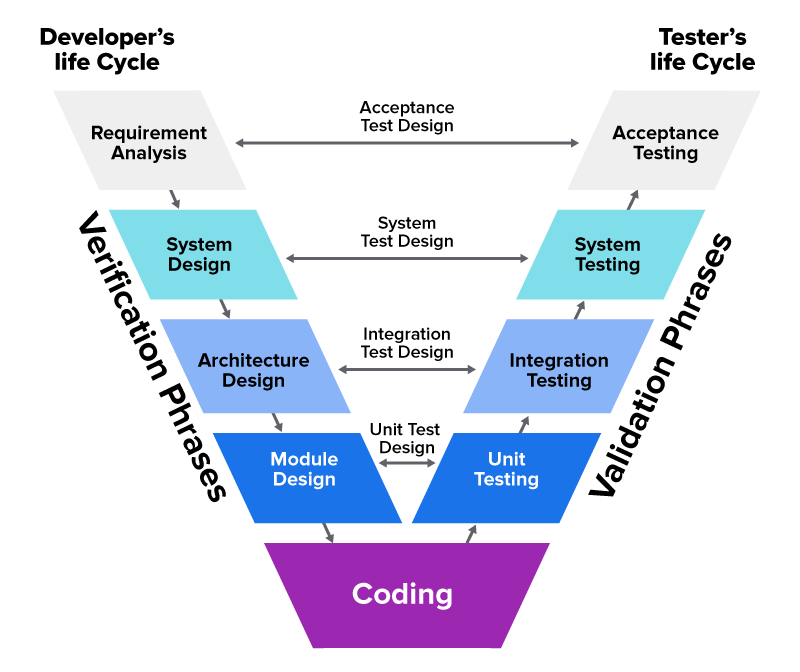
A V-shaped diagram representing the V-Model in software development. The left side details the developer’s life cycle: requirement analysis, system design, architecture design, module design, and coding. The right side shows the tester’s life cycle: unit testing, integration testing, system testing, and acceptance testing. Arrows connect corresponding phases, highlighting the relationship between development and validation activities.

While Waterfall and the V-Model provide strong documentation and clear structure, they are not a good fit for projects where requirements change often. Adjustments late in the process are costly.

terms to know
Software Development Methodology
A structured approach to organizing and managing the phases of software development, guiding how teams plan, build, test, and deliver applications.
Waterfall
A software development approach where development phases occur sequentially, with each stage completed before the next begins.
V-Model
A software development approach that maps each development phase to a corresponding testing phase.


2. Rapid Application Development

Rapid Application Development (RAD) emphasizes speed and user feedback. Unlike Waterfall, which waits until the end for user feedback, RAD builds prototypes early, and often feedback is then incorporated into subsequent iterations, allowing the system to evolve rapidly toward a final product.

RAD typically includes phases of requirements planning, user design, construction, and cutover (release). By encouraging early and frequent user involvement, RAD reduces the risk of delivering a system that does not meet expectations. It works well for projects with tight deadlines, active stakeholders, and technologies that support rapid prototyping. However, RAD may be less effective for large, highly complex systems where performance or scalability requires extensive upfront planning.

term to know
Rapid Application Development (RAD)
A software development approach that emphasizes quick prototyping and iterative feedback.


3. Agile Development

Agile is one of the most widely used modern software development methodologies because it emphasizes flexibility, collaboration, and delivering value in small, usable increments. Unlike Waterfall, which produces a complete product only at the end, Agile delivers frequent updates so users can provide feedback throughout the process. This makes Agile particularly effective when requirements change often or when stakeholders want to see steady progress.

One popular Agile framework is Scrum. Scrum organizes work into short cycles called sprints, usually lasting 1 to 4 weeks. Each sprint includes a planning meeting, daily check-ins to track progress, and a final review to demonstrate results. This cycle creates frequent opportunities to adjust to new priorities and ensures that the team is always delivering something usable.
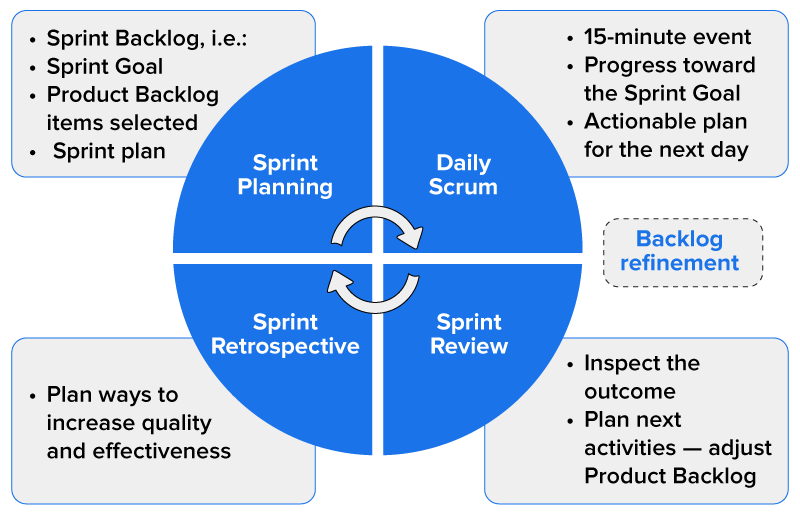
Diagram of the Scrum framework showing a cycle with four phases: Sprint Planning, Daily Scrum, Sprint Review, and Sprint Retrospective, surrounded by notes on goals, outcomes, and backlog refinement

Another widely used Agile framework is Kanban. Kanban manages work as a continuous flow rather than in fixed time periods. Tasks move visually across a board from “To do” to “In progress” to “Done,” giving the team a clear picture of progress and potential bottlenecks. This focus on visualization and flow makes Kanban well suited for teams that want steady, flexible progress without the structure of sprints.
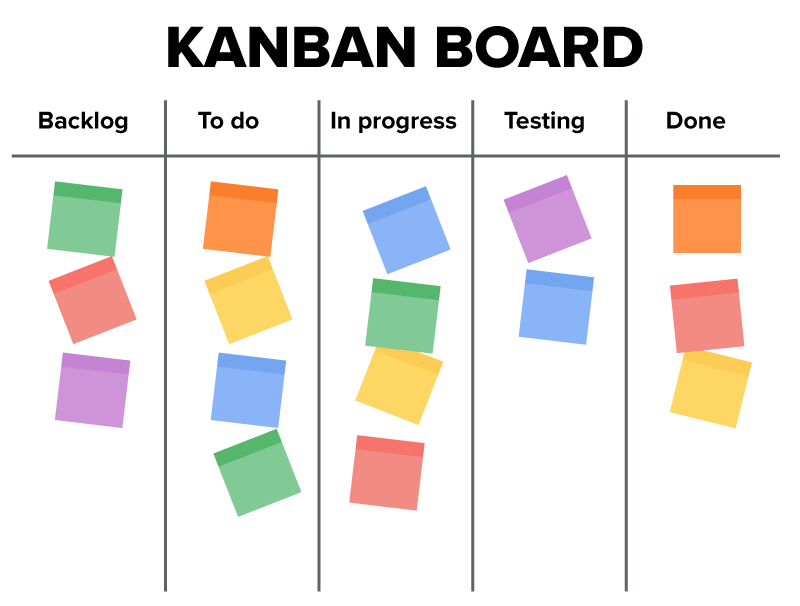
Kanban board with five columns labeled Backlog, To do, In progress, Testing, and Done, each containing colorful sticky notes representing tasks

By focusing on teamwork, adaptability, and iterative progress, Agile reduces wasted effort and keeps projects closely aligned with business needs. It bridges the gap between traditional models like Waterfall and newer approaches like Lean, which extend Agile ideas to emphasize efficiency and waste reduction.

try it
Draw a simple Kanban board on paper with three columns: “To do,” “In progress,” and “Done.” List three everyday tasks (like homework, chores, or errands) and move them across the board as you complete them.

terms to know
Agile
A flexible software development approach that delivers software in small, iterative increments, emphasizing collaboration, customer feedback, and adapting to changing requirements.
Sprint
A short, fixed period in Agile development during which a team works to complete a set of planned tasks and deliver a usable increment of the product.
Scrum
An Agile framework that organizes work into short cycles called sprints, using defined roles and short frequent meetings.
Kanban
An Agile method that visualizes work on a board, tracking each task’s progress as it moves toward completion.


4. Lean Development

Lean development grew out of lean manufacturing principles. Like Agile, Lean favors adaptability and iteration, but it goes further by focusing on efficiency and eliminating waste. The central idea is to create a minimum viable product (MVP), a version of the software with just enough features to be useful, and then measure how users respond. Based on this feedback, the team decides whether to refine the product, change direction (pivot), or continue with the current approach.

This cycle of build, measure, and learn helps teams avoid wasting time on features that users don’t want. Lean is particularly effective for startups and innovative projects, where speed and adaptability are more important than rigid structure. It also aligns closely with Agile values, and many teams use Lean and Agile practices together.

think about it
Imagine you are part of a small startup with limited funding creating a mobile app for a specialized audience. Why might a startup choose Lean over Waterfall or Agile, and what trade-offs might that involve?

While Lean focuses on efficiency and avoiding waste, DevOps expands this idea by integrating development with operations to speed up delivery even further

terms to know
Lean Development
A software development approach based on lean manufacturing principles, focused on eliminating waste, maximizing value, and delivering faster through continuous improvement.
Minimum Viable Product (MVP)
The simplest version of a product that includes only its core features, released to early users to gather feedback and validate ideas before investing in full development.


5. DevOps

In recent years, DevOps has emerged as a powerful extension of Agile and Lean practices. While Agile and Lean emphasize collaboration and iteration during development, DevOps carries these principles into deployment and operations, ensuring software can be released rapidly and reliably. It combines development (Dev) and operations (Ops) into a unified culture and toolset.

Traditionally, developers focused on writing code, while operations teams were responsible for deploying and maintaining it. This separation often led to delays, miscommunication, and inefficiency. DevOps bridges the gap by encouraging collaboration, automation, and continuous workflows across the entire software development life cycle.

Key DevOps practices include continuous integration (CI), in which developers frequently merge code changes into a shared repository where automated tests verify quality. This ensures that problems are caught early and the codebase remains stable. Continuous deployment (CD) builds on CI by automatically delivering those tested changes into production environments, making updates available to users without delay. Together with monitoring tools, cloud platforms, and infrastructure-as-code technologies, these practices allow teams to release updates daily or even multiple times per day. DevOps reflects the growing expectation that software should evolve continuously, with faster feedback loops and greater reliability.

did you know
Amazon practices DevOps at scale to keep Prime Video and other services running smoothly while delivering new features rapidly. Their engineering teams use CI to test and validate thousands of small code changes daily. Then, through CD, those changes can be automatically rolled out to production across their global infrastructure.

terms to know
DevOps
A cultural and technical approach that integrates software development and IT operations, emphasizing collaboration, automation, and continuous delivery.
Continuous Integration (CI)
The practice of frequently merging code changes from multiple developers into a shared repository.
Continuous Deployment (CD)
Automatically delivering tested code to production or to a staging environment.


6. Prototyping

The prototyping methodology centers on building early, simplified models of an application that users can interact with. Unlike RAD, which uses prototypes primarily to accelerate development toward a finished product, the prototyping model emphasizes experimenting with multiple alternatives before committing to a final design. These early models give users a tangible sense of how the system might work and help developers validate or adjust design choices. Like Agile and Lean, prototyping values early user feedback, but its focus is on exploring design options rather than on continuous delivery of working software.

Prototyping is rarely used on its own as a full methodology. On its own, prototyping lacks structure for full development, which is why it is usually integrated into other models. By showing users a tangible product early in the process, prototyping reduces miscommunication and builds confidence that the final system will meet expectations.

term to know
Prototyping Methodology
An approach that creates early, simplified versions of an application so users can provide feedback and guide refinements before full development begins.

summary
In this lesson, you learned that Waterfall and V-Model offer structured, step-by-step processes with strong documentation but limited flexibility when requirements change. You saw how Rapid Application Development sped delivery through quick prototypes and user feedback, while Agile development built on iteration and collaboration with frameworks like Scrum and Kanban. You also explored how Lean development emphasized efficiency and MVPs to avoid waste, and how DevOps extended Agile and Lean ideas into deployment through automation and continuous delivery. Finally, you learned that prototyping provided early models to explore design options and reduce miscommunication, often combined with other approaches for stronger results.

Source: This tutorial was authored by Sophia Learning. Please see our Terms of Use.

Terms to Know
Agile

A flexible software development approach that delivers software in small, iterative increments, emphasizing collaboration, customer feedback, and adapting to changing requirements.

Continuous Deployment (CD)

Automatically delivering tested code to production or to a staging environment.

Continuous Integration (CI)

The practice of frequently merging code changes from multiple developers into a shared repository.

DevOps

A cultural and technical approach that integrates software development and IT operations, emphasizing collaboration, automation, and continuous delivery.

Kanban

An Agile method that visualizes work on a board, tracking each task’s progress as it moves toward completion.

Lean Development

A software development approach based on lean manufacturing principles, focused on eliminating waste, maximizing value, and delivering faster through continuous improvement.

Minimum Viable Product (MVP)

The simplest version of a product that includes only its core features, released to early users to gather feedback and validate ideas before investing in full development.

Prototyping Methodology

An approach that creates early, simplified versions of an application so users can provide feedback and guide refinements before full development begins.

Rapid Application Development (RAD)

A software development approach that emphasizes quick prototyping and iterative feedback.

Scrum

An Agile framework that organizes work into short cycles called sprints, using defined roles and short frequent meetings.

Software Development Methodology

A structured approach to organizing and managing the phases of software development, guiding how teams plan, build, test, and deliver applications.

Sprint

A short, fixed period in Agile development during which a team works to complete a set of planned tasks and deliver a usable increment of the product.

V-Model

A software development approach that maps each development phase to a corresponding testing phase.

Waterfall

A software development approach where development phases occur sequentially, with each stage completed before the next begins.

