Table of Contents |
Software developers are the creative problem solvers behind the applications, websites, and systems we use every day. They design, build, test, and maintain software that helps people accomplish tasks—anything from checking the weather on a mobile app to running a business’s inventory system, and even running the device you are currently working on.
At its core, software development is the process of using programming languages, tools, and logic to build digital solutions. Software developers apply both technical knowledge and problem-solving skills to turn user needs into functioning applications or systems.
Software developers may work on a variety of tasks depending on the project or their role on the team. Common responsibilities include the following:
The job title “software developer” is commonly used, and professionals in this field often specialize based on the kind of software they create. One common path is front-end development, which focuses on the parts of a website or application that users interact with, such as buttons, navigation menus, and page layouts. Front-end developers use languages such as HTML, CSS, and JavaScript to design clear, responsive user interfaces.
Back-end developers work behind the scenes to build the systems, databases, and logic that support the application. They often use programming languages such as Python, Java, Ruby, or Node.js to manage how data moves through the system and ensure that everything runs smoothly.
Some developers are full-stack developers, which means that they work on both the front end and the back end. This role requires a broader set of skills and allows them to build complete features from start to finish.
Another area of specialization is mobile app development. Mobile app developers create software specifically for smartphones and tablets, often using Swift for iOS or Kotlin and Java for Android. They focus on how digital products function and appear on mobile devices. Each of these roles contributes to the overall software development process, and many developers build their careers by focusing on one of these key areas. Understanding these different types of software developers sets the stage for exploring how their roles, along with roles such as UX/UI developer, DevOps engineer, and QA tester, fit into the larger software development process.
Software developers work in nearly every industry. In technology and software firms, they build applications and services for clients or consumers. In fields such as finance and health care, developers create secure systems for handling transactions, managing patient records, and analyzing large sets of data. In education and nonprofit organizations, they may develop learning platforms, communication tools, or data tracking systems. Government and defense sectors also rely on software developers to manage public infrastructure, secure sensitive information, and support national defense technologies. Many developers work collaboratively on in-house teams, while others find roles in consulting firms or as independent freelancers. These roles reflect flexible and diverse career options.
As software developers work on creating, troubleshooting, or testing software, they follow a consistent process known as the software development life cycle (SDLC). This cycle provides a structured framework for planning, building, and maintaining high-quality software.
The SDLC is cyclical, meaning that the process doesn’t necessarily start and stop at the same point every time. The process often begins at the planning stage; it doesn’t always move in a straight line. Depending on the nature of the project, teams may revisit earlier stages or start mid-cycle when modifying or updating existing systems.
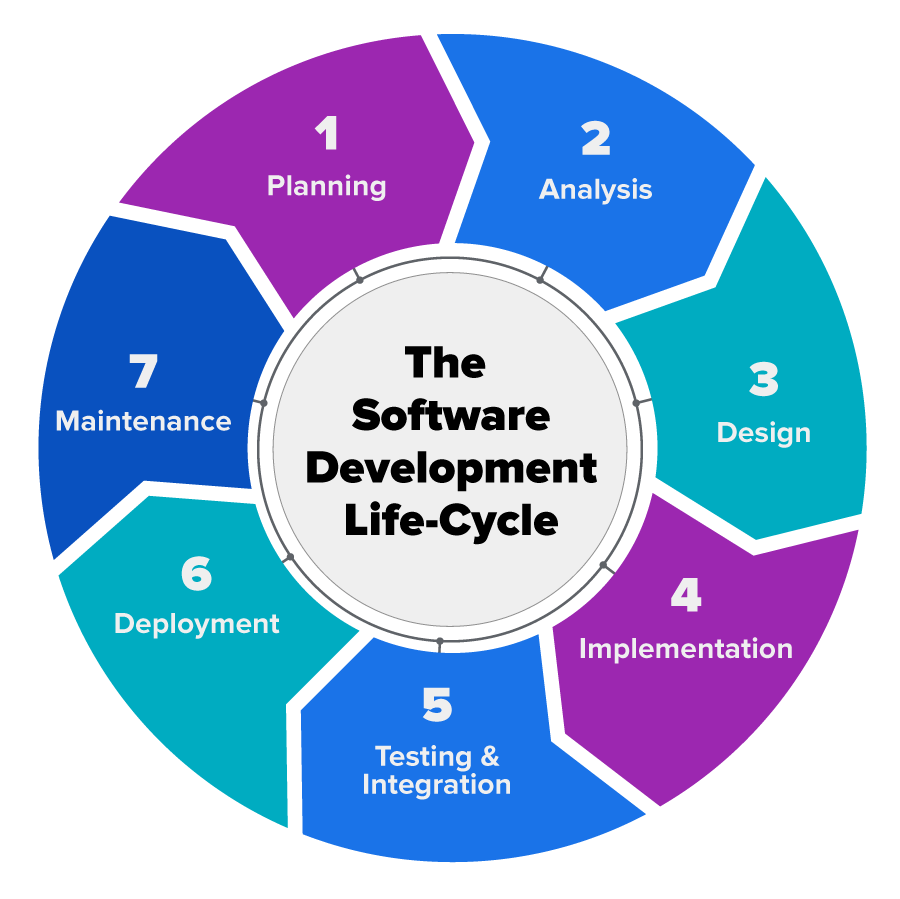
Let’s examine the cycle steps from the perspective of how software evolves from an idea to a working product. The planning stage is where the foundation is laid. Developers and stakeholders define the purpose of the software; set project goals; and identify constraints such as timelines, budgets, and available resources. This creates a clear overview of what the development process will look like.
EXAMPLE
When planning a food delivery app, the team might define a goal such as allowing users to place an order from a local restaurant in just a few steps. This creates a clear overview of what the development process will look like.Once planning is in place, the cycle moves into the analysis phase. This is a deeper investigation into what the software needs to accomplish. Here, developers work closely with users and stakeholders to gather requirements and understand the core problems the software is meant to solve. These requirements help shape the functionality, usability, and overall direction of the product.
EXAMPLE
In the food delivery app example, this could include identifying requirements such as user accounts, secure payment processing, and real-time order tracking. These requirements help shape the functionality, usability, and overall direction of the product.Following analysis, the design stage takes those requirements and begins to translate them into a concrete plan for how the software will work. This includes outlining the structure of the user interface, selecting appropriate technologies, mapping out data flow, and planning how the system components will interact. Design serves as the blueprint that guides the next step: implementation.
EXAMPLE
For a food delivery app, this might involve designing the layout of the home screen, deciding where menus and buttons appear, and planning how orders move from the app to the restaurant.During the implementation stage, developers begin writing the actual code based on the design specifications. This is where the product takes shape, feature by feature, with developers building, integrating, and documenting the software as it evolves.
EXAMPLE
In this stage, developers of the food delivery app might code features such as restaurant listings, checkout functionality, and order confirmation messages.After implementation, the software must be carefully tested to ensure that it functions correctly and meets the original requirements. The testing phase includes finding and fixing bugs, checking for security and performance issues, and validating that all parts of the system work together as intended.
EXAMPLE
Testers of the food delivery app may verify that payments process correctly, screens load properly, and orders are not duplicated or lost.Once the software has passed through testing, it enters the deployment stage. At this point, the product is released to users, either as a full launch or in stages, depending on the strategy. Even after release, the cycle continues. The maintenance stage ensures that the software stays up to date, secure, and functional over time. Developers may update the software, resolve issues that emerge during use, or introduce new features as needed. Depending on the task, they might reenter the development cycle at different stages, such as design, testing, or analysis, rather than beginning again with planning. Regardless of a software developer’s role or where they need to start, this cycle remains a critical part of their daily work.
Team structure and collaboration play a vital role in supporting this cycle. Development teams are often organized around a product or functional area. The number and size of teams vary based on the organization, scope of software, and available resources. For example, an e-commerce platform might include dedicated teams for search, checkout, and item detail pages. Each team is responsible for all aspects of its feature wherever it appears in the application. This approach promotes a consistent user experience but may require developers to work across multiple technologies.
Equally important is the central role of communication throughout the SDLC. Whether in planning, analysis, or testing, developers must engage in frequent, meaningful dialogue with users, stakeholders, and other team members. These conversations help ensure that the software meets its intended goals and allow teams to make better decisions, identify and resolve issues early, and deliver more effective and user-centered solutions. In this way, collaboration, coordination, and shared feedback are essential to successful software development.
Because software development involves many moving parts, it’s important to understand the different roles that contribute to the process. Each team member typically specializes in a particular area, such as design, coding, testing, or system support, but many roles are involved in multiple phases of the SDLC. Understanding these contributions helps reveal how collaboration leads to more successful software outcomes.
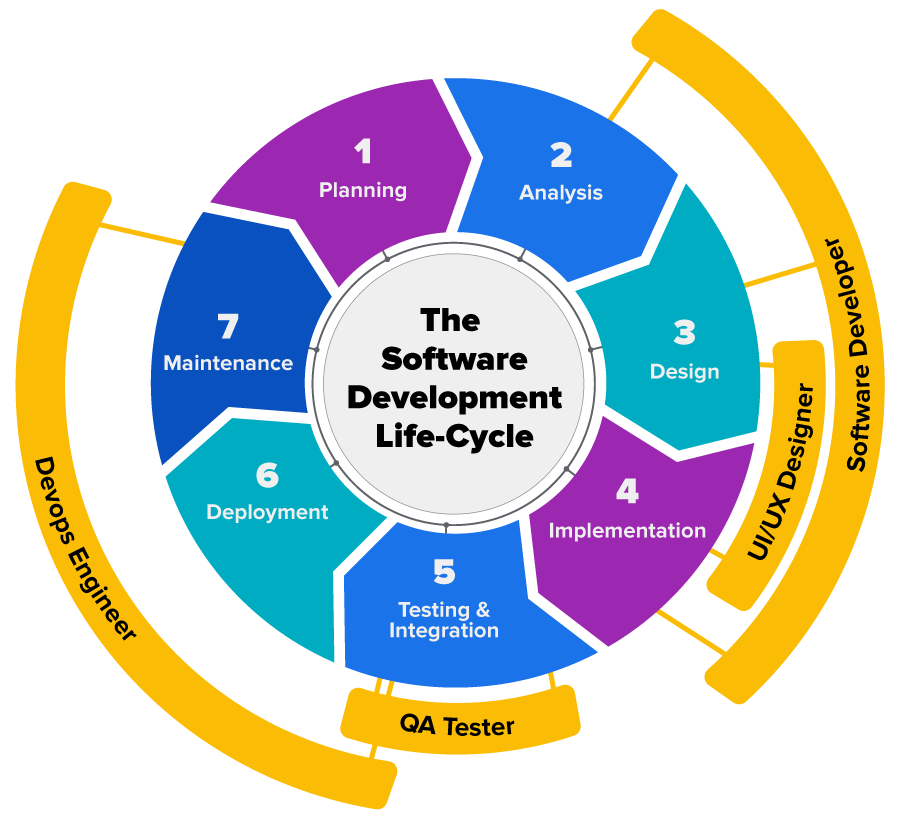
Software developers are the creators behind the applications and systems we use every day. They write and maintain the code that brings software to life. Their involvement often begins during the requirements analysis phase, where they help interpret user needs and technical goals. They also play a key role in the design phase, contributing to how the system will function and how different components will work together.
The core of their work happens during implementation, where they write, test, and debug code based on the design specifications. To do this, they use programming languages, code editors, and version control tools such as Git to track and manage their work. Coding is central to their job, but developers rarely work alone. They frequently collaborate with designers, testers, project managers, and sometimes even end users to make sure that the software meets real-world needs.
Because technology evolves quickly, developers are lifelong learners. They often adapt to new languages, frameworks, and tools based on the specific needs of a project. Some developers focus on mobile platforms like iOS or Android, others build web-based applications, and some work on desktop software. Despite these differences in specialization, the job title of software developer is commonly used across all of these areas.
 The first software developer was a woman, and this was long before modern computers existed.
In the 1800s, mathematician Ada Lovelace created a detailed set of instructions for a mechanical computer called the analytical engine. Her work showed how the machine could be used to solve complex math problems, making her the world’s first computer programmer.
The first software developer was a woman, and this was long before modern computers existed.
In the 1800s, mathematician Ada Lovelace created a detailed set of instructions for a mechanical computer called the analytical engine. Her work showed how the machine could be used to solve complex math problems, making her the world’s first computer programmer.
UX/UI developers focus on how users interact with software. UX stands for user experience, and UI stands for user interface. The user interface refers to the part of the software that users see and interact with, such as buttons, menus, screens, and layouts. The user experience, on the other hand, is about how the user feels while navigating the software. It includes factors such as ease of use, efficiency, and overall satisfaction. Together, these roles ensure that software is not only functional but also visually appealing, easy to navigate, and accessible to all users.
UX/UI developers are most active during the design phase, where they create mock-ups and layout plans that guide how the interface will look and feel. They often collaborate with users, stakeholders, and developers to understand project goals and user behaviors. Using tools such as Figma or other design software, they apply design principles to create interfaces that are clear and intuitive. Many UX/UI developers use HTML, CSS, and JavaScript to help bring their designs to life during the implementation phase, but they are not always responsible for writing all the code.
Their role bridges the gap between design and development, ensuring that what gets built not only works well but also provides a positive experience for users.
DevOps engineers help manage how software is delivered, deployed, and maintained. Their work connects development (“Dev”) and operations (“Ops”), making sure that updates and new features can be released quickly, safely, and reliably. They are most active during the deployment and maintenance phases of the SDLC.
DevOps engineers focus on automation, system integration, and performance monitoring. They build and maintain pipelines that automatically test and deploy code, reducing the chances of errors and speeding up delivery. After software is released, DevOps engineers continue to support it by monitoring issues, managing infrastructure, and helping ensure that systems stay online and up to date.
This role requires a strong understanding of both software and system administration. DevOps professionals often work behind the scenes but are essential to keeping software running smoothly in the real world.
Quality assurance (QA) testers focus on making sure that software works as intended. Their main involvement happens during the testing phase, where they carefully review the software to find bugs, glitches, or issues that could affect performance or user experience. QA testers run different types of tests, including functional tests (does the feature work?) and usability tests (is it easy to use?), and they document anything that needs fixing.
Although testing is their primary focus, QA testers may also be involved earlier in the cycle. For example, during the analysis phase, they might help clarify requirements to ensure that the software can be tested effectively later on. QA testers often work closely with developers to report problems and retest features once changes are made.
In many teams, QA is essential for maintaining the quality, reliability, and stability of the final product. Some QA testers specialize in manual testing, while others use automated testing tools to streamline the process. Regardless of the method, their goal remains the same: to make sure that the software is ready for real-world use before it’s released.
Source: THIS TUTORIAL WAS AUTHORED BY SOPHIA LEARNING. PLEASE SEE OUR TERMS OF USE.



