Table of Contents |
The term "entrepreneur" is often used in a broad sense to include most small business owners. The two groups share some of the same characteristics, and we’ll see that some of the reasons for becoming an entrepreneur or a small business owner are very similar. But there is a difference between entrepreneurship and small business owners. Entrepreneurship involves taking a risk, either to create a new business or to greatly change the scope and direction of an existing one. Entrepreneurs typically are innovators who start companies to pursue their ideas for a new product or service. They are visionaries who spot trends. Thus, we can define an entrepreneur as a person who organizes and operates a business and has a willingness to take on financial risk. A small business owner, on the other hand, may or may not have started a business but takes on the responsibility of the day-to-day operations of the business, and rather than focus on innovation, focuses on profitability and stability.
Given these definitions, an entrepreneur might be someone who designs and manufactures equipment for a new way to cut hair, whereas a small business owner might be someone who rents a station within a salon and runs their own business, including the finances and scheduling.
 Entrepreneur |
 Small Business Owner |
|
|---|---|---|
| Example | App developer or tech start-up | Local hair salon, plumbing, or a car wash |
| Goal | Innovation and disruption in the market, along with scalability | Creating market presence, reliable revenue streams, and business sustainability and stability |
| Exit Strategy | Attaining IPO status, selling the business, and franchising | Transmitting to the next generation and managing a long-term business with a strategy for adaptability |
| Growth Approach | Expansion on both national and international levels for scalability | Frequently constrained by its regional economy |
| Risk Tolerance | Moderate to high | Low to moderate |
Although entrepreneurs may be small business owners, not all small business owners are entrepreneurs. Small business owners are managers or people with technical expertise who started a business or bought an existing business and made a conscious decision to stay small.
EXAMPLE
The proprietor of your local independent bookstore is a small business owner. Jeff Bezos, founder of Amazon.com, also sells books. But Bezos is an entrepreneur: he developed a new model of selling goods that revolutionized the retail world.Entrepreneurs are less likely to accept the status quo, and they generally take a longer-term view than small business owners with a focus on innovation.
The main difference between an entrepreneur and a small business owner is their end goal:
| Example Characteristic | Picture | Details |
|---|---|---|
| Ambitious |

|
They are competitive and have a high need for achievement. |
| Independent |

|
They are individualists and self-starters who prefer to lead rather than follow. |
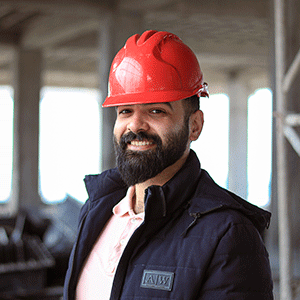
| Self-Confident |
|
They understand the challenges of starting and operating a business, are decisive, and are confident in their ability to solve problems. |
| Risk-Taking |

|
Although they are not averse to risk, most successful entrepreneurs favor business opportunities that carry a moderate degree of risk, where they can better control the outcome over highly risky ventures where luck plays a large role. |
| Forward-Thinking |

|
Their ability to spot trends and act on them sets entrepreneurs apart from small business owners and managers. |
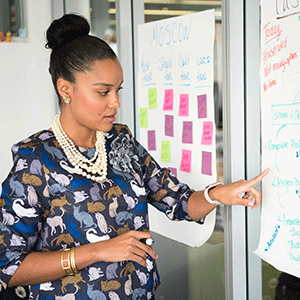
| Creative |
|
To compete with larger firms, entrepreneurs need to have creative product designs, bold marketing strategies, and innovative solutions to managerial problems. |
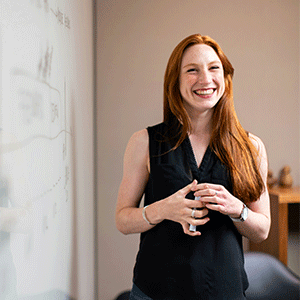
| Energetic |
|
Starting and operating a business takes long hours. Even so, some entrepreneurs start their companies while still employed full-time elsewhere. |
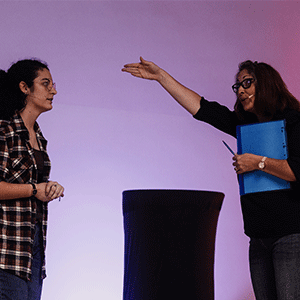
| Passionate |
|
Entrepreneurs love their work and have a passion for the industry they are involved in. |
| Committed |

|
Because they are so committed to their companies, entrepreneurs are willing to make personal sacrifices to achieve their goals. |
Now that we’ve addressed the difference between small business owners and entrepreneurs, let’s look at the categories of entrepreneurs:
EXAMPLE
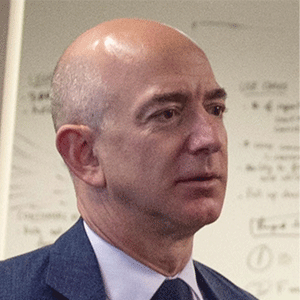 Jeff Bezos recognized that with internet technology, he could compete with large chains of traditional book retailers. Bezos’s goal was to build his company into a high-growth enterprise—and he chose a name that reflected his strategy: Amazon.com. Once his company succeeded in the book sector, Bezos applied his online retailing model to other product lines, from toys and house and garden items to tools, apparel, music, and services. In partnership with other retailers, Bezos is well on his way to making Amazon’s vision—“to be Earth’s most customer-centric company; to build a place where people can come to find and discover anything they might want to buy online”—a reality.

Then there are multipreneurs, entrepreneurs who start a series of companies. They thrive on the challenge of building a business and watching it grow. In fact, over half of the chief executives at Inc. 500 companies say they would start another company if they sold their current one.
EXAMPLE
Richard Branson, the founder of Virgin Group, would be considered a multipreneur because he has started over 400 companies under the Virgin brand, including Virgin Atlantic Airlines, Virgin hotels and many others.Some entrepreneurs don’t own their own companies but apply their creativity, vision, and risk-taking within a large corporation. Called intrapreneurs, these employees enjoy the freedom to nurture their ideas and develop new products, while their employers provide regular salaries and financial backing. Intrapreneurs have a high degree of autonomy to run their own minicompanies within the larger enterprise. They share many of the same personality traits as classic entrepreneurs, but they take fewer personal risks. According to Gifford Pinchot, who coined the term “intrapreneur” in his book of the same name, large companies provide seed funds that finance in-house entrepreneurial efforts. Sometimes, those companies don’t provide seed funds, and a person that works for a company just decides to innovate anyway.
EXAMPLE
Paul Buchheit, an employee at Google, created Gmail as a side project. Now, that project is one of the world’s most used platforms.But a person does not need to work for a huge organization to be an intrapreneur—small incremental innovations and ideas within a company could be considered entrepreneurship too.
EXAMPLE
 Barry Lawson Williams of the Bechtel group, one of the largest engineering and construction firms, led many internal ventures related to energy and infrastructure development, which allowed new markets and innovation to flourish in this company under his leadership.
The bottom line is the fact that any individual (including you!) can be any of these types of entrepreneur by applying their skills and knowledge, even if they don’t have millions of dollars to invest.
Let’s compare the different types of entrepreneurs you’ve seen in this lesson:
| Definition | Features | Risk Level | Funding Source | |
|---|---|---|---|---|
| Classic Entrepreneur | Sometimes referred to as solopreneurs and known for establishing a successful small-scale business | Hands-on or bootstrapped leadership | Moderate to high | Sweat capital or business loan |
| Multipreneur | Also referred to as serial entrepreneurs and recognized for launching several ventures | Rapid execution with a focus on patterns | High | Self-funding or venture capital |
| Intrapreneur | Corporate innovators who drive change to the status quo | Change agents and resource utilization | Low to moderate | Corporate budget |
Source: THIS CONTENT HAS BEEN ADAPTED FROM OPENSTAX "INTRODUCTION TO BUSINESS". ACCESS FOR FREE AT openstax.org/details/books/introduction-business. LICENSE: CREATIVE COMMONS ATTRIBUTION 4.0 INTERNATIONAL. Accessed by May 2025.
REFERENCES:
Spanx, LLC. (n.d.). About us. spanx.com/pages/about-us
U.S. Small Business Administration, Office of Advocacy. (2023, March 7). Frequently asked questions about small business, 2023. advocacy.sba.gov/2023/03/07/frequently-asked-questions-about-small-business-2023/



