Use Sophia to knock out your gen-ed requirements quickly and affordably. Learn more
×

Shifting and Stretching Graphs

Author: Sophia

what's covered
In this lesson, you will investigate how translations affect the graph of a function. Specifically, this lesson will cover:

Table of Contents

1. Commonly Used Basic Functions and Their Graphs

Here are the most commonly used graphs that are encountered in a typical algebra course. There are others as well, which will be investigated in future challenges.

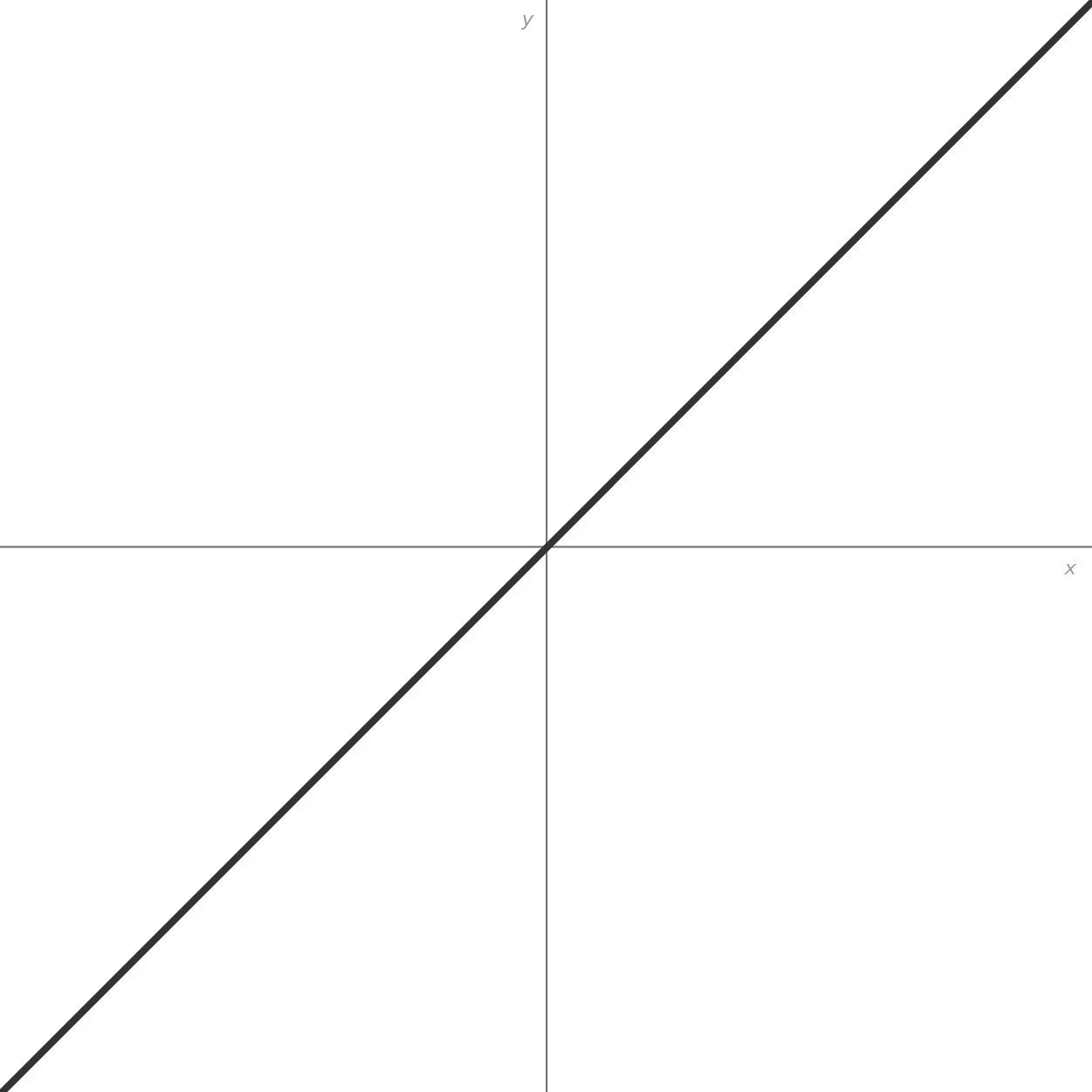
Linear Function
bold italic f open parentheses bold x close parentheses bold equals bold italic x
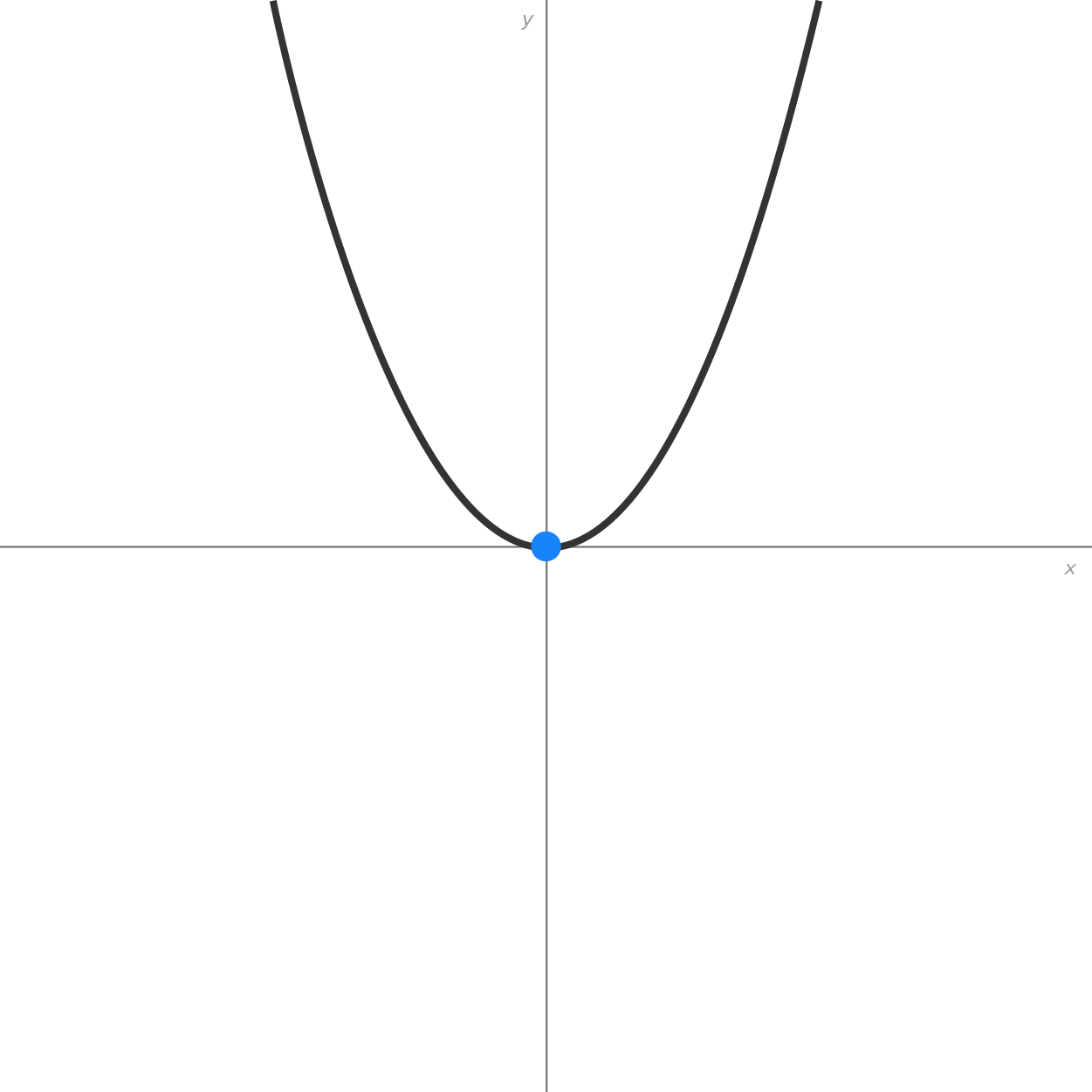
Quadratic Function
bold italic f open parentheses bold x close parentheses bold equals bold italic x to the power of bold 2
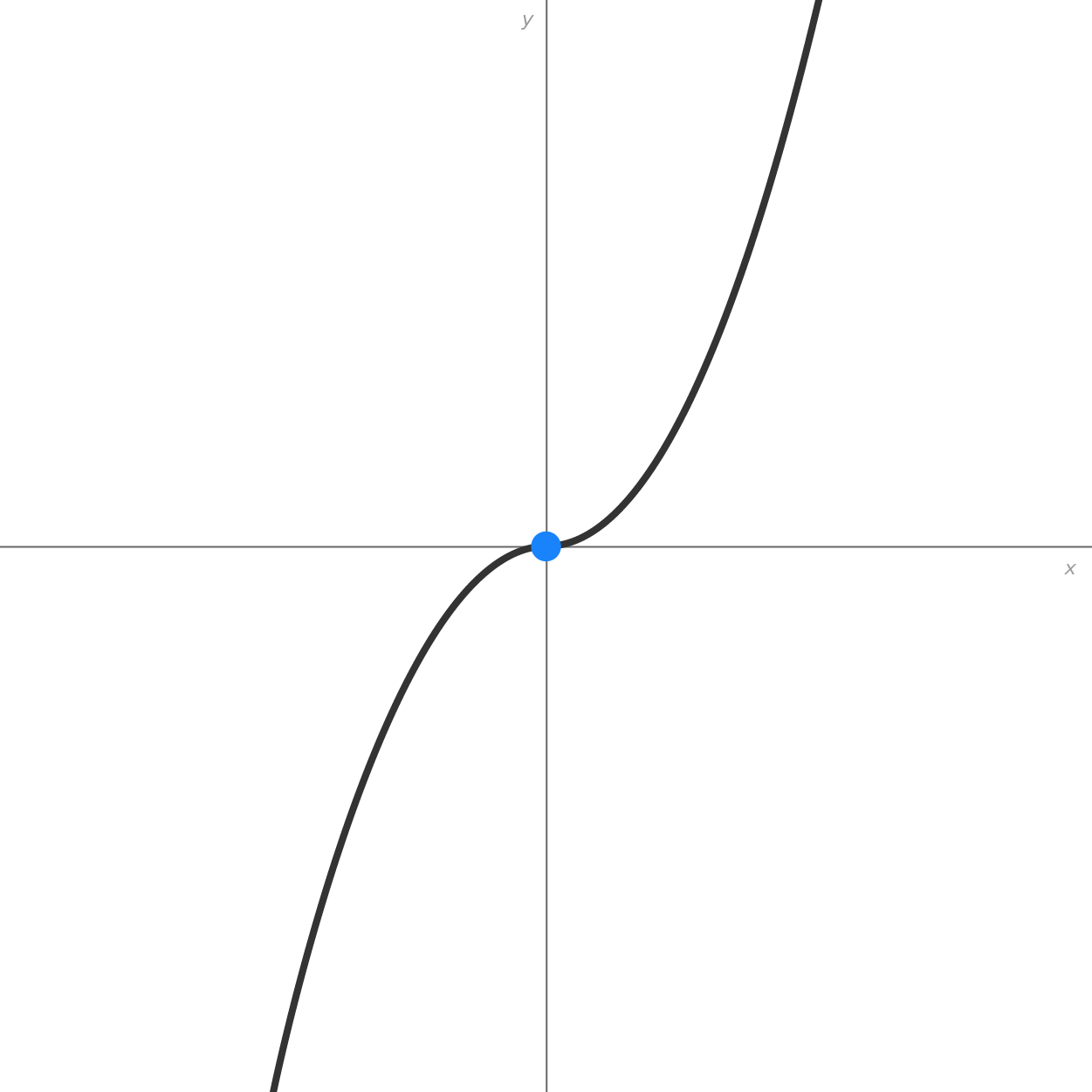
Cubic Function
bold italic f open parentheses bold x close parentheses bold equals bold italic x to the power of bold 3
A graph with an x-axis and a y-axis intersecting at the origin. A line slants upward from left to right, passing through the origin, representing a linear function f(x) equals x. A graph with an x-axis and a y-axis intersecting at the origin. A parabolic curve opens upward, passing through the marked point at the origin, representing a quadratic function f(x) equals x squared. A graph with an x-axis and a y-axis intersecting at the origin. A curve begins in the third quadrant, passes through a marked point at the origin, and rises into the first quadrant, forming an S-shape. The graph represents a cubic function, f(x) equals x cubed.
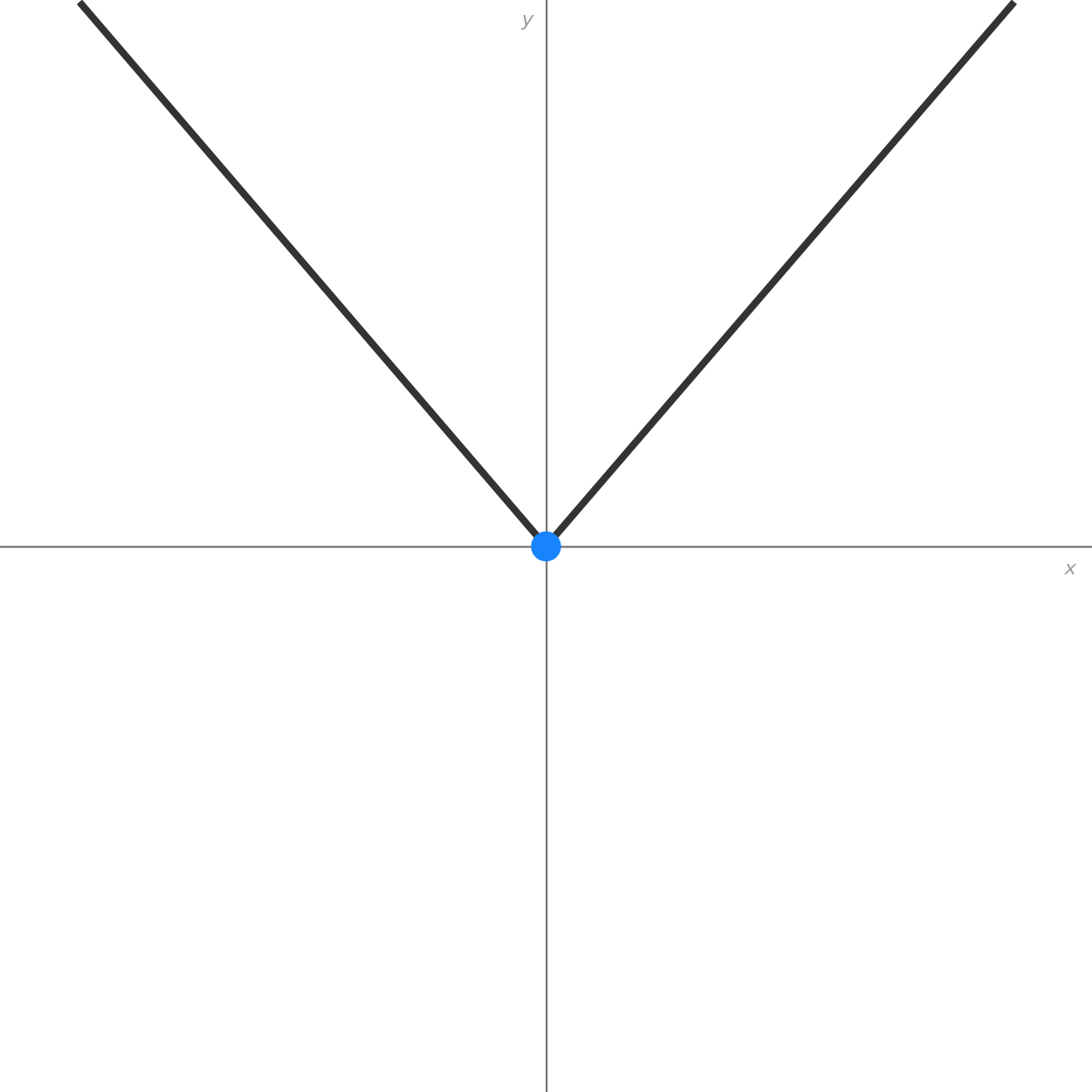
Absolute Value Function
bold italic f open parentheses bold x close parentheses bold equals open vertical bar bold x close vertical bar
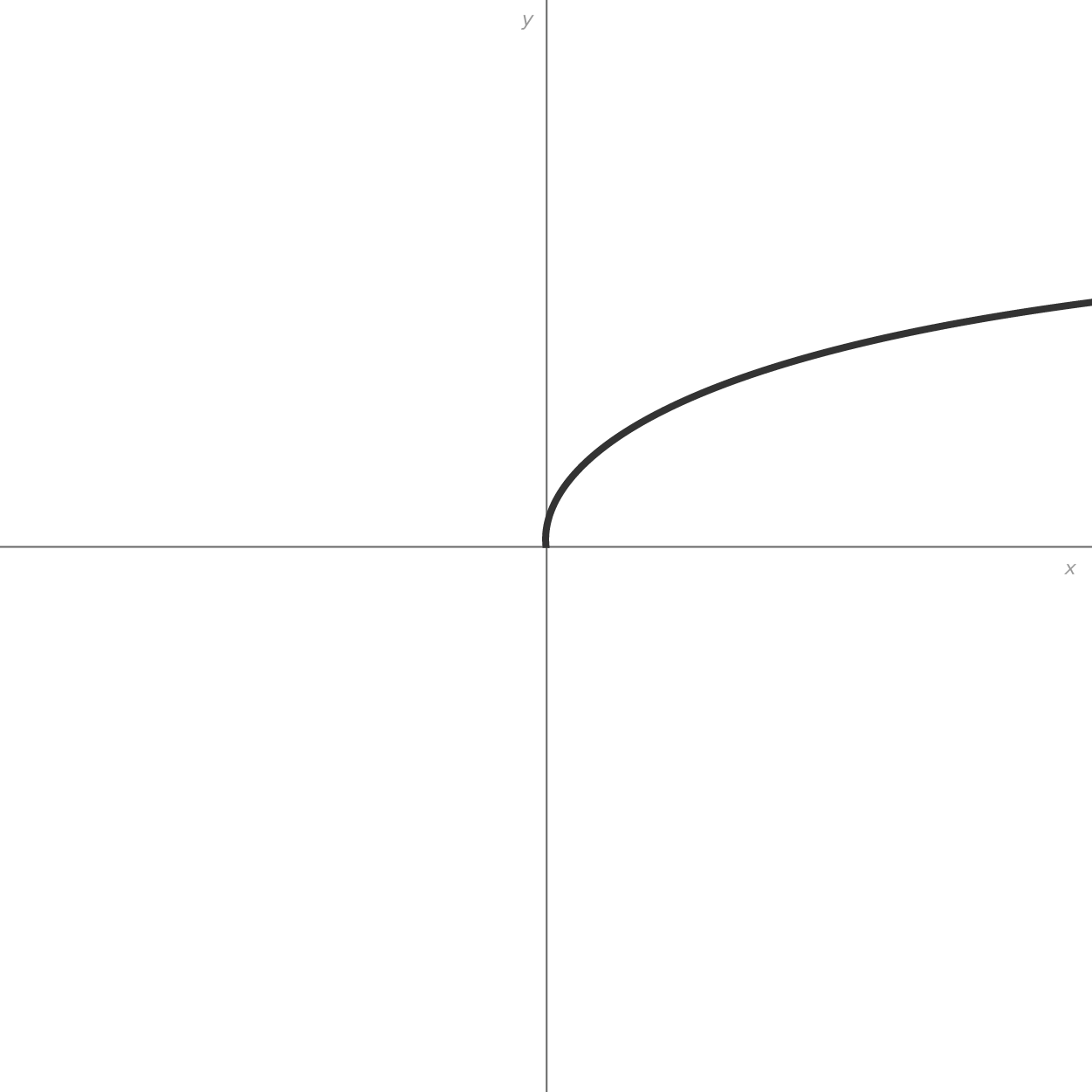
Square Root Function
bold italic f open parentheses bold x close parentheses bold equals square root of bold x
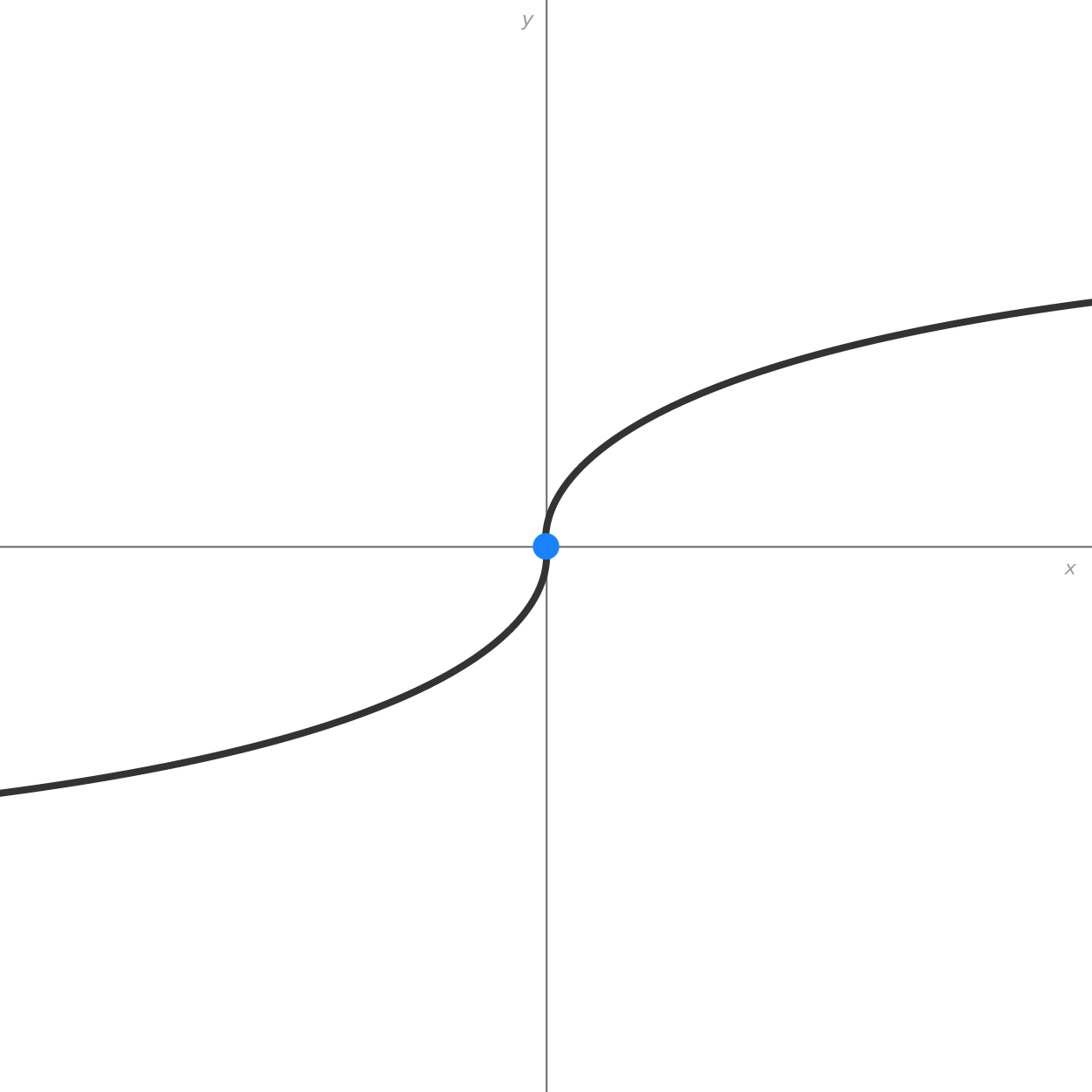
Cube Root Function
bold italic f open parentheses bold x close parentheses bold equals root index bold 3 of bold x
A graph with an x-axis and a y-axis intersecting at the origin. The graph depicts a V-shaped curve starting from the second quadrant, passing through the marked point at the origin, and extending into the first quadrant. The two arms of the curve extend symmetrically into the first and second quadrants, sloping upward as they move away from the y-axis, representing an absolute value function f(x) equals absolute value of x. A graph with an x-axis and a y-axis intersecting at the origin. A curve begins at the origin and extends upward into the first quadrant, flattening out as the curve rises to the right. This curve represents the square root function f(x) equals square root of x. A graph with an x-axis and a y-axis intersecting at the origin. A curve begins in the third quadrant, passes through a marked point at the origin, and extends upward into the first quadrant, representing the cube root function f(x) equals cube root of x.
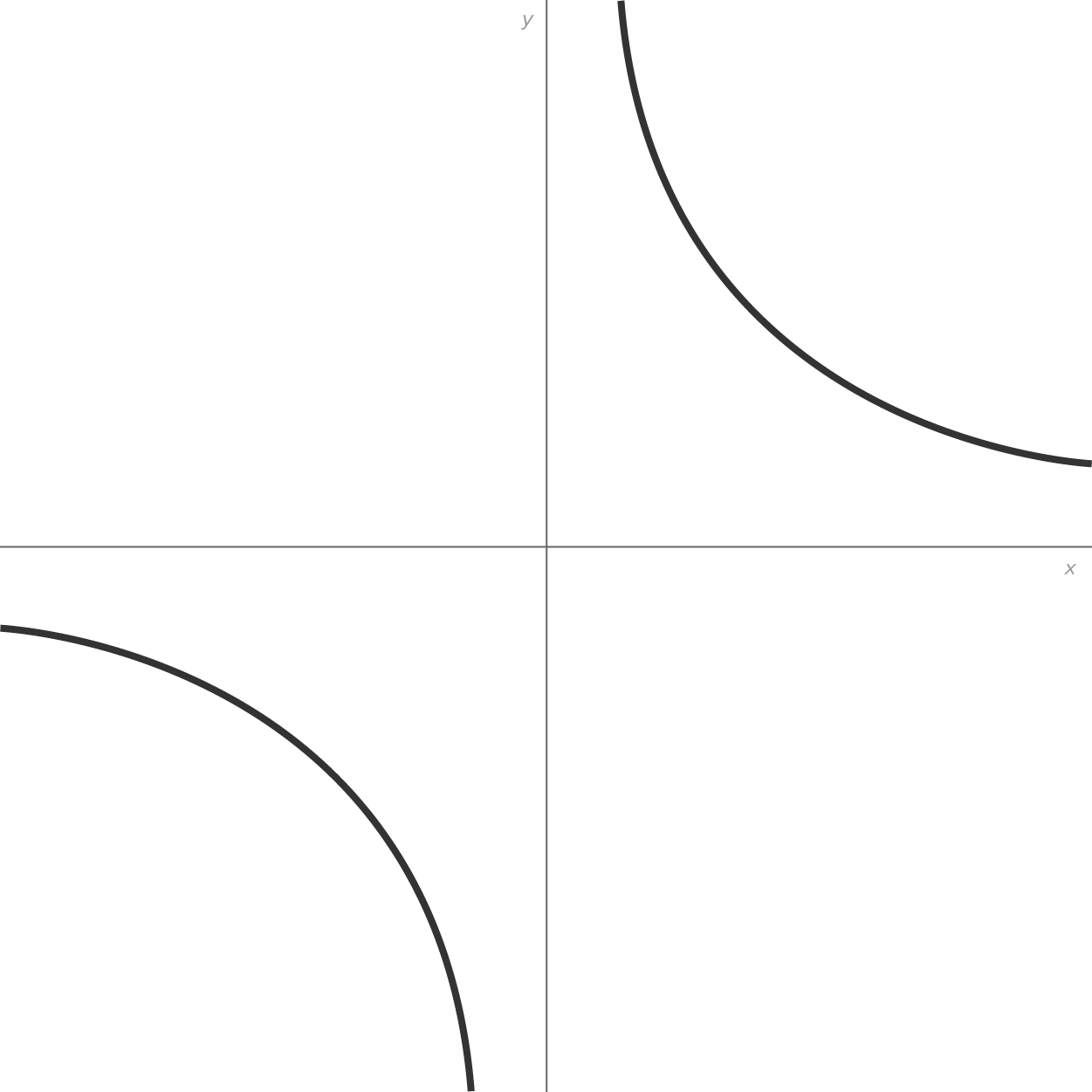
Reciprocal Function
bold italic f open parentheses bold x close parentheses bold equals bold 1 over bold x
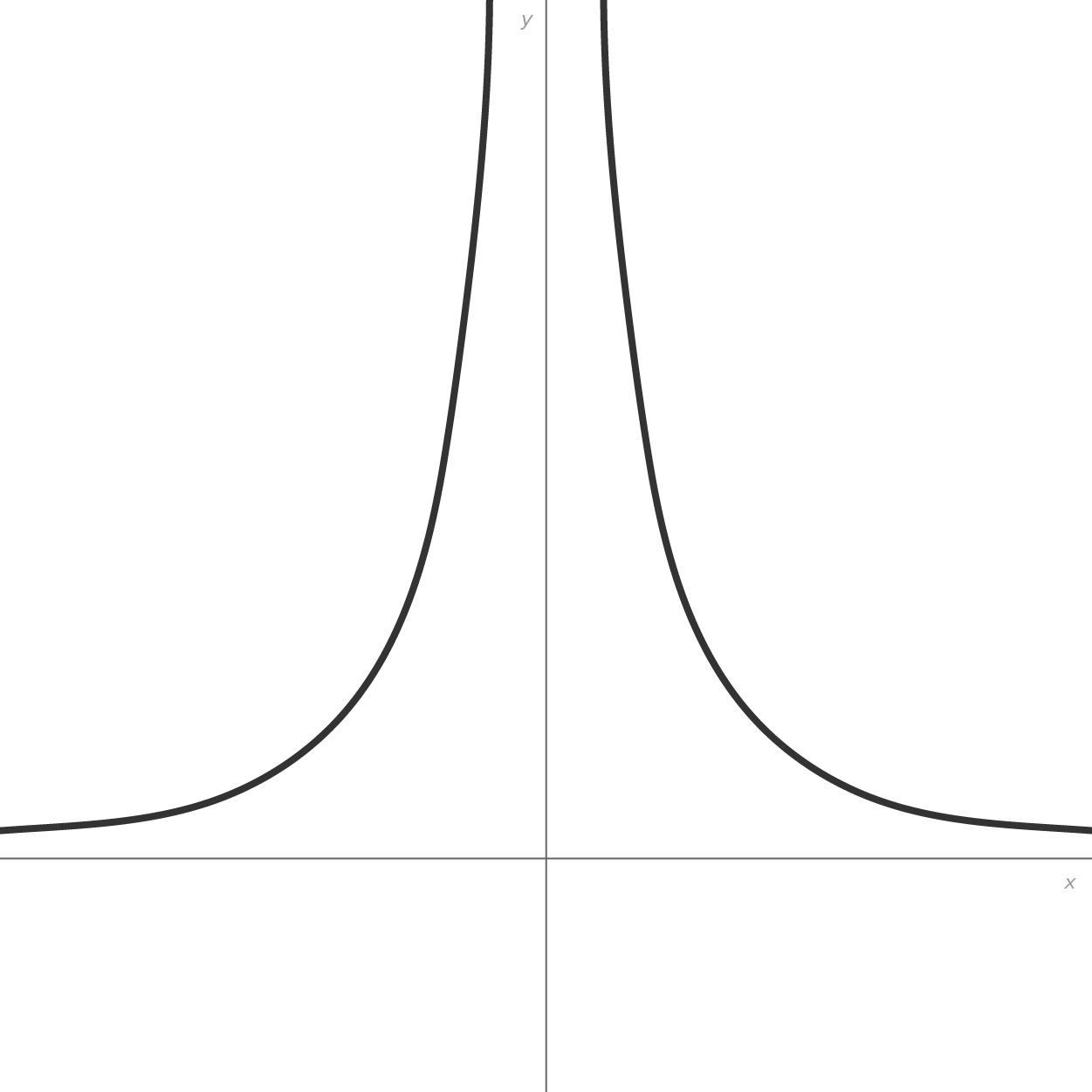
Reciprocal Square Function
bold italic f open parentheses bold x close parentheses bold equals bold 1 over bold x to the power of bold 2
A graph with an x-axis and a y-axis intersecting at the origin. The graph contains two open curves. One curve is in the first quadrant, curving downward and to the right. The other curve is in the third quadrant, curving upward to the left. Both the curves do not touch the vertex and represent a reciprocal function f(x) equals 1/x. A graph with an x-axis and a y-axis intersecting at the origin. The graph contains two curves. One curve begins in the second quadrant, extends downward toward the x-axis, and curves toward the left in the same quadrant. The other curve begins in the first quadrant, extends downward toward the x-axis, and curves toward the right in the same quadrant. Both the curves do not touch the vertex and represent the reciprocal square function f(x) equals 1 / x squared.

In this challenge, we will investigate translations to an equation and how they affect the graph of said equation.


2. Applying Basic Translations to y = f (x)

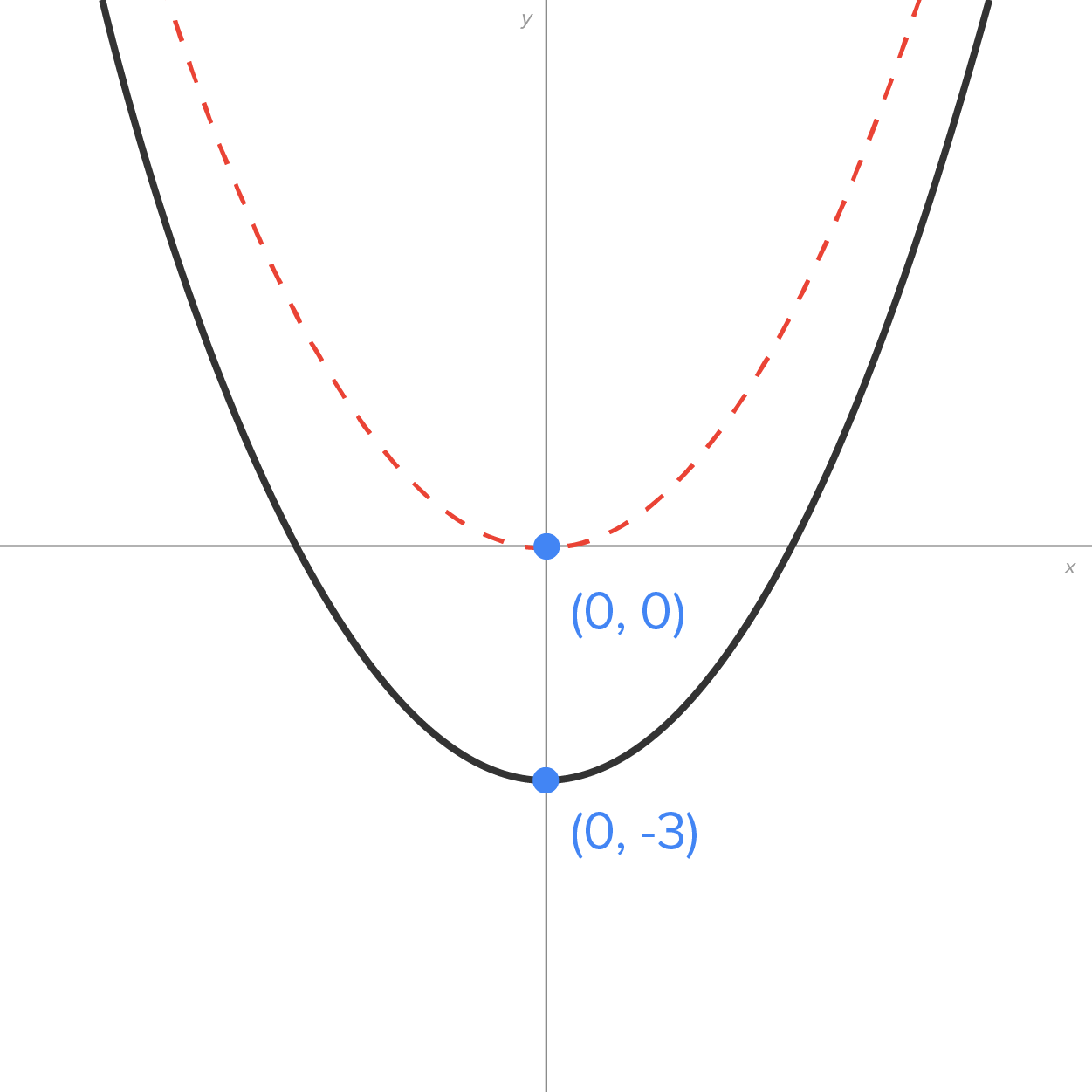
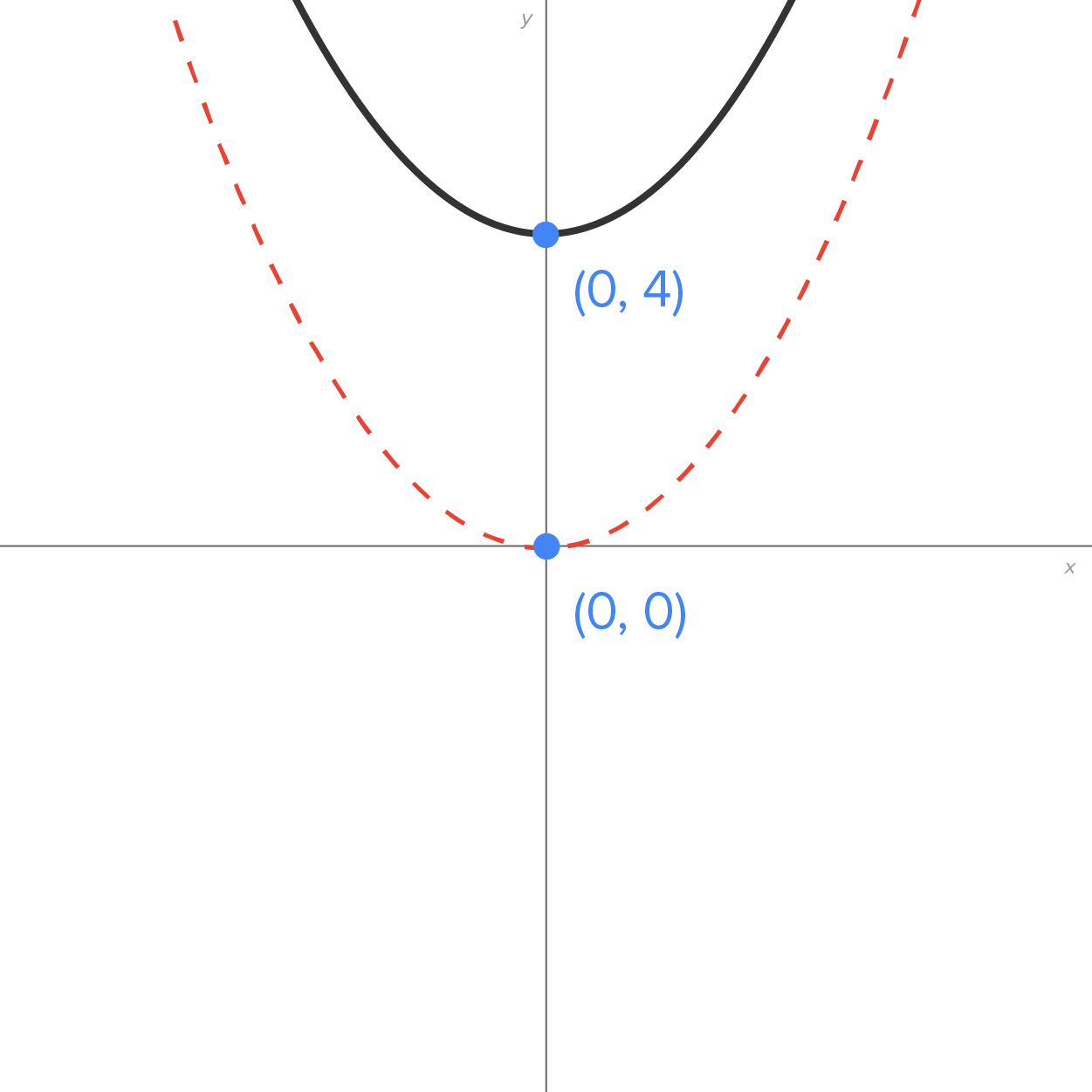
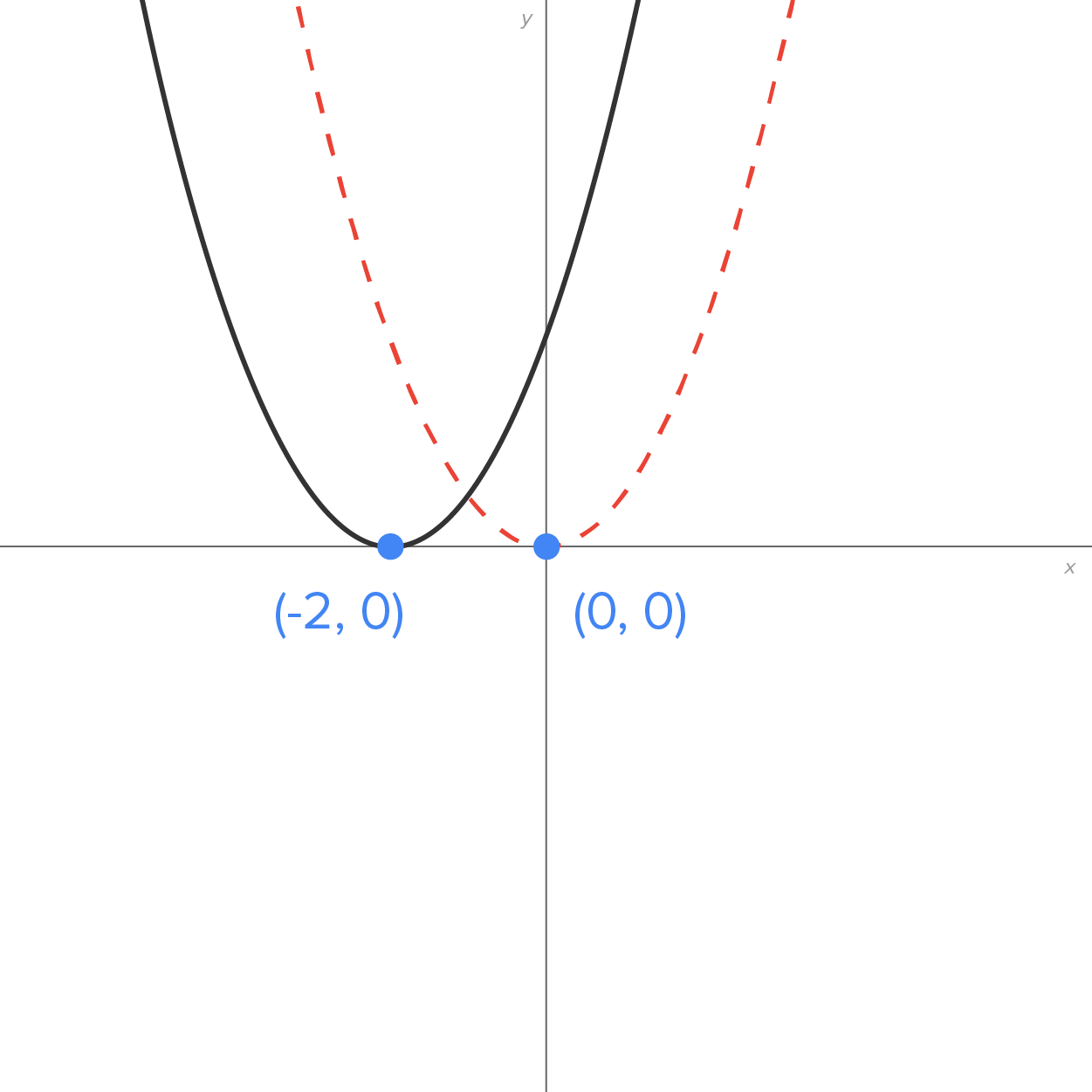
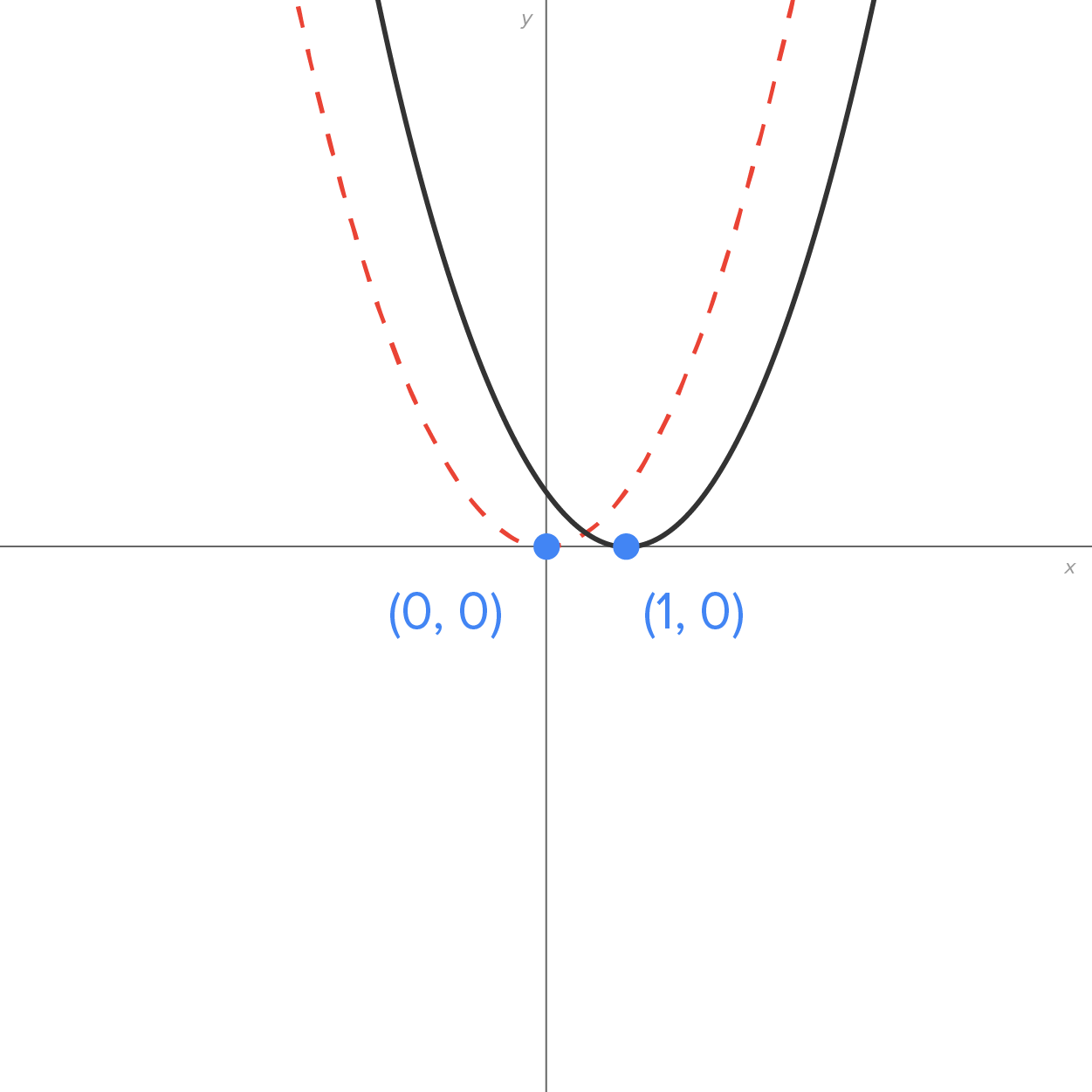
Shown below are several functions which are translations of f open parentheses x close parentheses equals x squared. In each graph, the graph of f open parentheses x close parentheses equals x squared is shown with a dashed line.

bold italic y bold equals bold italic x to the power of bold 2 bold minus bold 3
Shifted Down 3 Units
bold italic y bold equals bold italic x to the power of bold 2 bold plus bold 4
Shifted Up 4 Units
bold italic y bold equals open parentheses bold x bold plus bold 2 close parentheses to the power of bold 2
Shifted Left 2 Units
A graph with an x-axis and a y-axis intersecting at the origin. The graph contains two parabolic curves. The dashed parabolic curve, which represents the quadratic function f(x) equals x squared, opens upward evenly on both sides of its vertex, which is labeled (0, 0). The solid parabolic curve also opens upward, is shifted 3 units downward relative to the dashed parabolic curve, and passes through its vertex labeled (0, −3). A graph with an x-axis and a y-axis intersecting at the origin. The graph contains two parabolic curves. The dashed parabolic curve, which represents the quadratic function f(x) equals x squared, opens upward evenly on both sides of its vertex, which is labeled (0, 0). The solid parabolic curve also opens upward, is shifted 4 units upward relative to the dashed parabolic curve, and passes through its vertex labeled (0, 4). A graph with an x-axis and a y-axis intersecting at the origin. The graph contains two parabolic curves. The dashed parabolic curve, which represents the quadratic function f(x) equals x squared, opens upward evenly on both sides of its vertex, which is labeled (0, 0). The solid parabolic curve also opens upward, is shifted 2 units to the left of the dashed parabolic curve, and passes through its vertex labeled (-2, 0).
bold italic y bold equals open parentheses bold x bold minus bold 1 close parentheses to the power of bold 2
Shifted 1 Unit Right
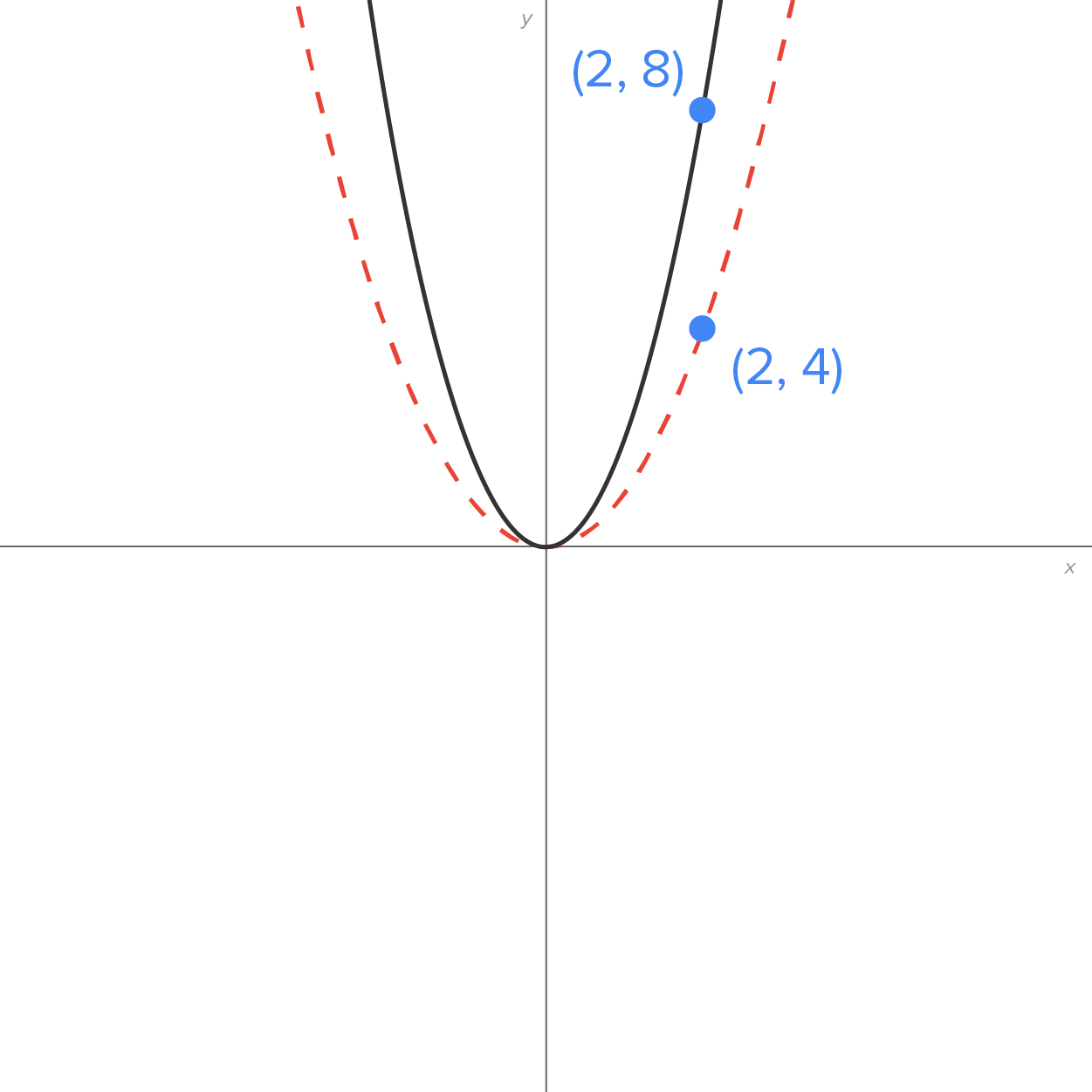
bold italic y bold equals bold 2 bold italic x to the power of bold 2
Vertical Stretch
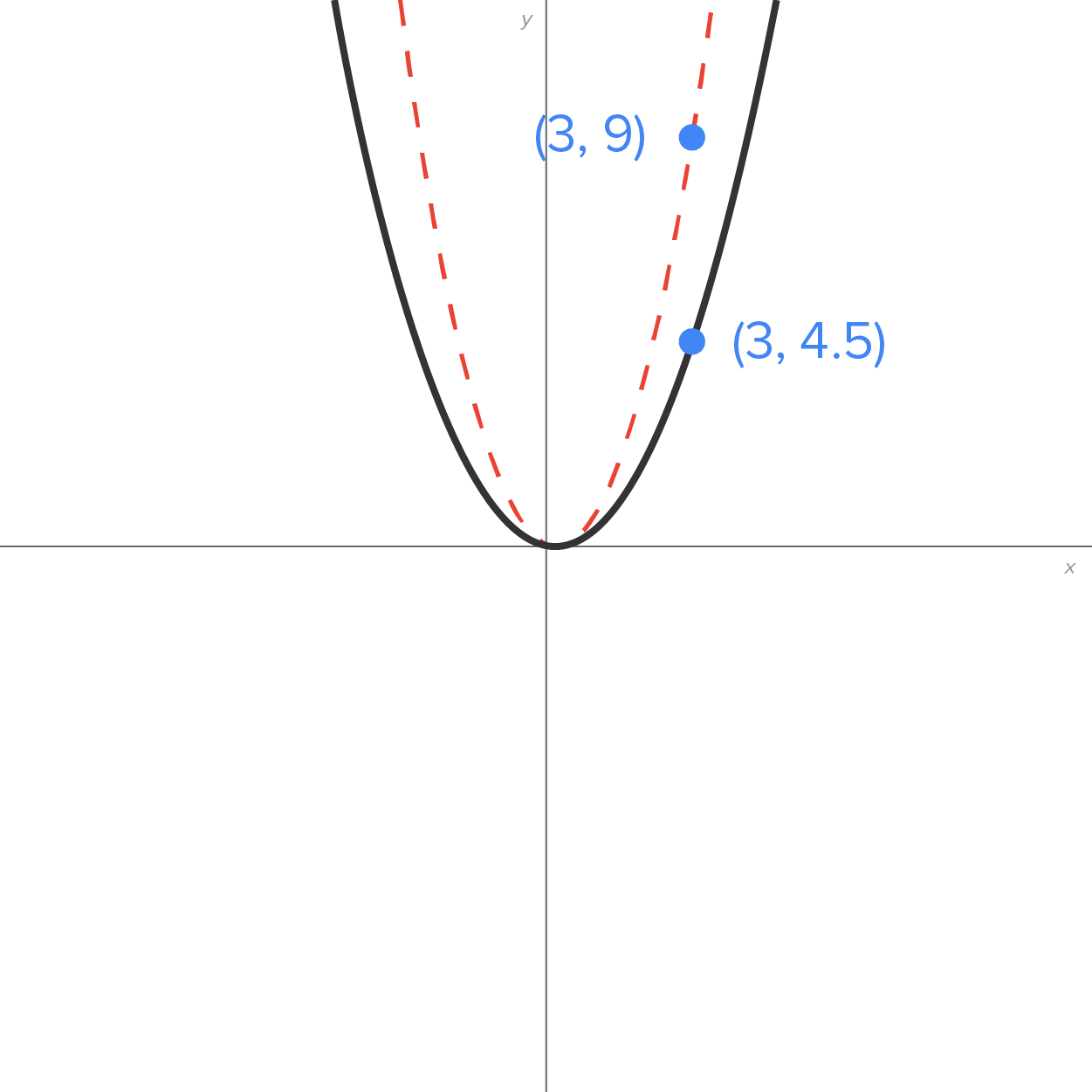
bold italic y bold equals bold 0 bold. bold 5 bold italic x to the power of bold 2
Vertical Compression
A graph with an x-axis and a y-axis intersecting at the origin. The graph contains two parabolic curves. The dashed parabolic curve, which represents the quadratic function f(x) equals x squared, opens upward evenly on both sides of its vertex, which is labeled (0, 0). The solid parabolic curve also opens upward, is shifted 1 units to the right of the dashed parabolic curve, and passes through its vertex labeled (1, 0). A graph with an x-axis and a y-axis intersecting at the origin. The graph contains two parabolic curves. The dashed parabolic curve opens upward, passing through the origin and a marked point labeled (2, 4), representing a quadratic function f(x) equals x squared. The solid parabolic curve also opens upward and is a vertically stretched version of the dashed curve. It passes through the origin and a marked point labeled (2, 8). A graph with an x-axis and a y-axis intersecting at the origin. The graph contains two parabolic curves. The dashed parabolic curve opens upward and passes through the origin and a marked point labeled (3, 9), representing a quadratic function f(x) equals x squared. The solid parabolic curve also opens upward, and it is a vertically compressed version of the dashed curve. It passes through the origin and a marked point labeled (3, 4.5).
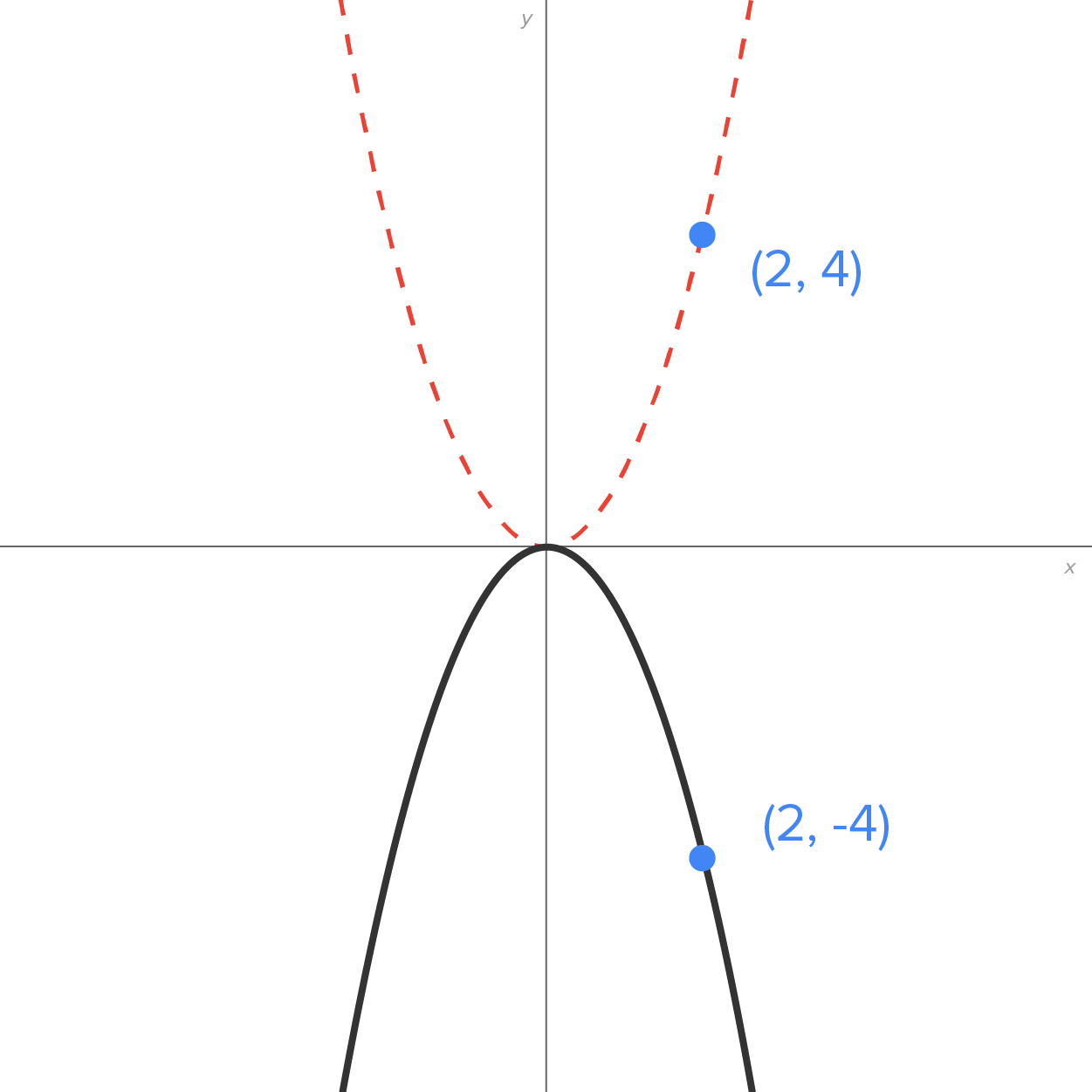
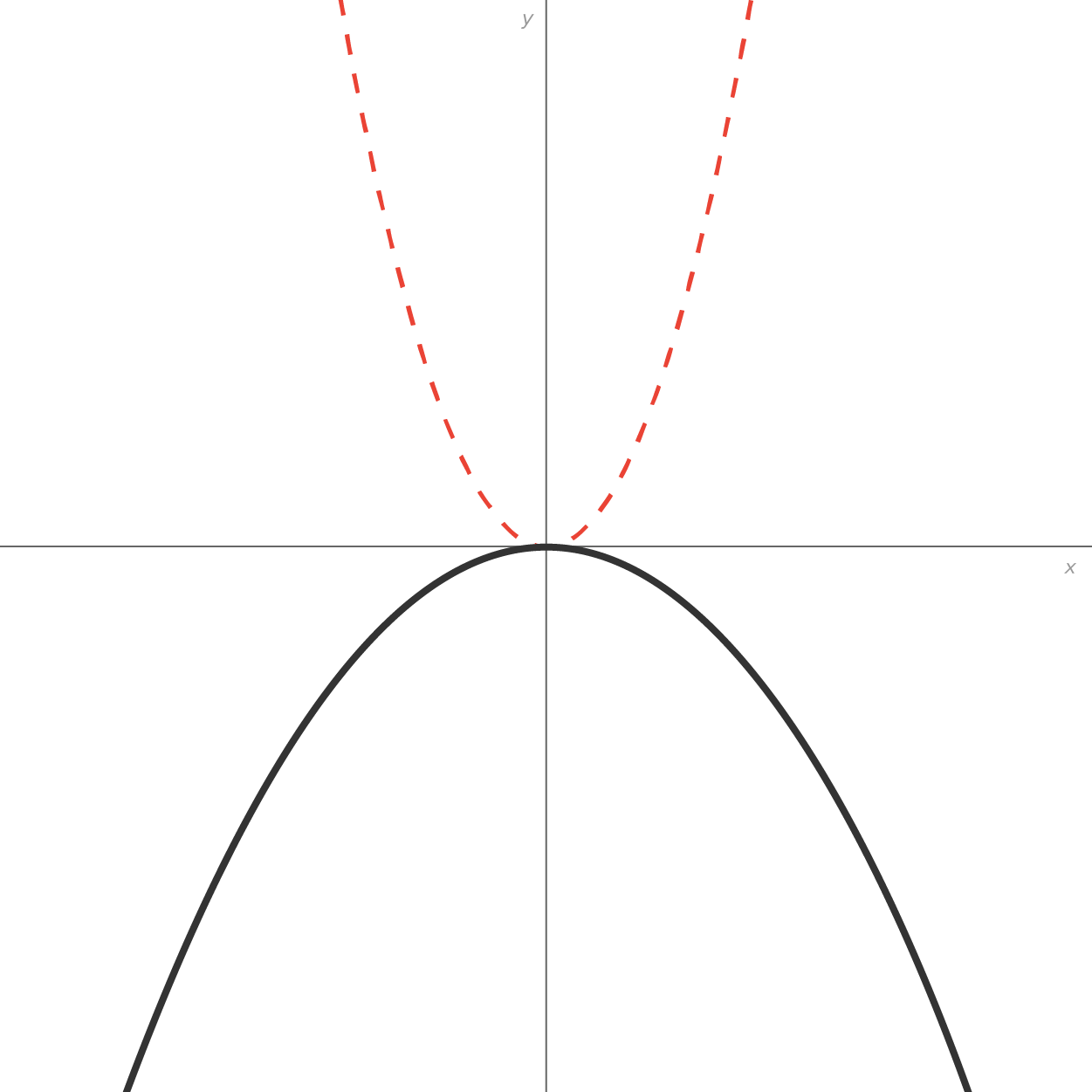
bold italic y bold equals bold short dash bold italic x to the power of bold 2
Reflection Across the x-axis
bold italic y bold equals bold short dash bold 3 bold italic x to the power of bold 2
Vertical Stretch and Reflection Across the x-axis
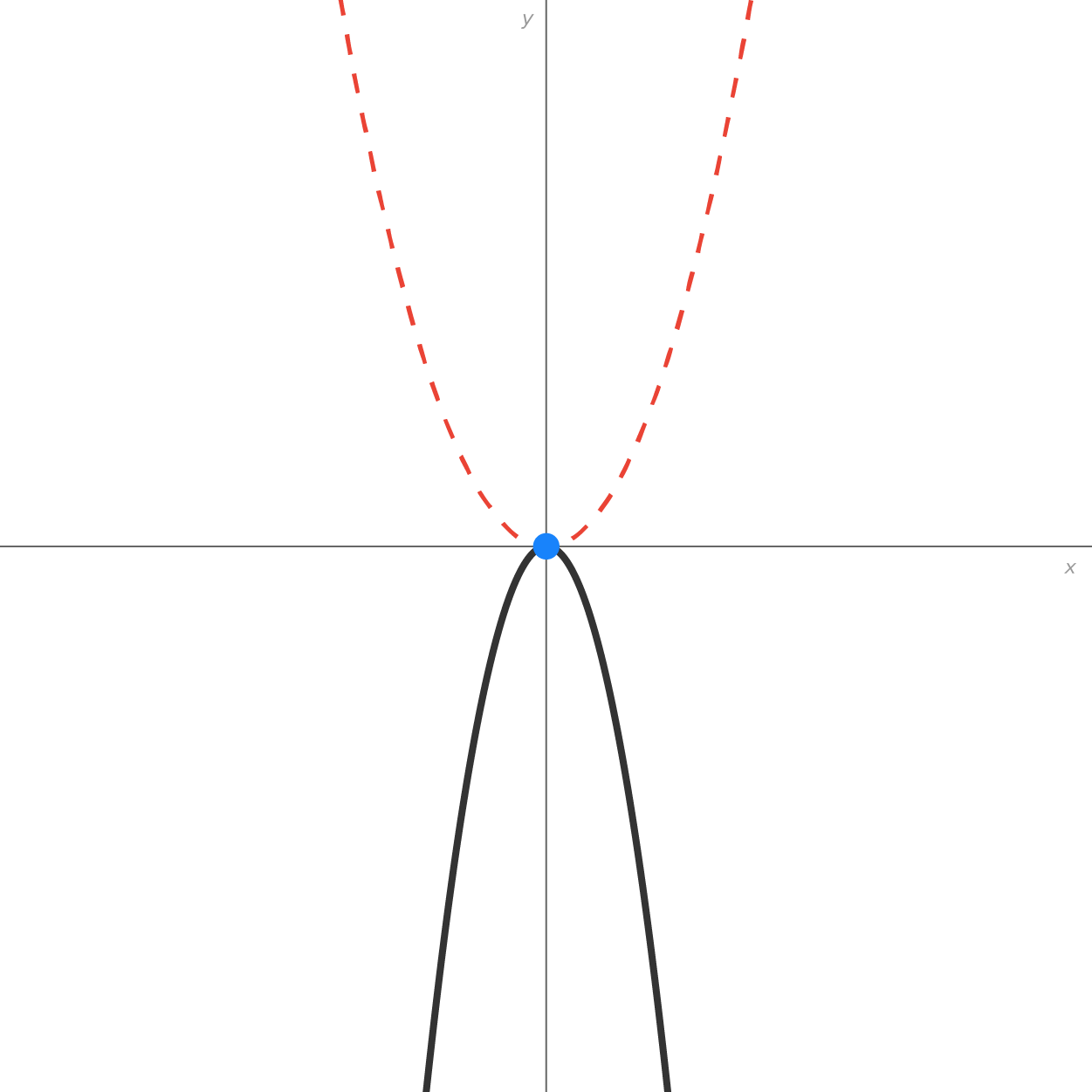
bold italic y bold equals bold short dash bold 0 bold. bold 25 bold italic x to the power of bold 2
Vertical Compression and Reflection Across the x-axis
A graph with an x-axis and a y-axis intersecting at the origin. The graph contains two parabolic curves. The dashed parabolic curve opens upward, passing through the origin and a marked point labeled (2, 4), representing a quadratic function f(x) equals x squared. The solid parabolic curve opens downward, as a reflection of the dashed curve across the x-axis. It passes through the origin and a marked point labeled (2, −4). A graph with an x-axis and a y-axis intersecting at the origin. The graph contains two parabolic curves. The dashed parabolic curve opens upward and passes through the origin, representing a quadratic function f(x) equals x squared. The solid parabolic curve opens downward, representing the vertically stretched reflection of the dashed curve across the x-axis. A graph with an x-axis and a y-axis intersecting at the origin. The graph contains two parabolic curves. The dashed parabolic curve opens upward and passes through the origin, representing a quadratic function f(x) equals x squared. The solid parabolic curve opens downward, representing the vertically compressed reflection of the dashed curve across the x-axis.

big idea
Given the graph of y equals f open parentheses x close parentheses and a positive constant k:
  • The graph of y equals f open parentheses x close parentheses plus k shifts the graph up k units.
  • The graph of y equals f open parentheses x close parentheses minus k shifts the graph down k units.
  • The graph of y equals f open parentheses x minus k close parentheses shifts the graph right k units.
  • The graph of y equals f open parentheses x plus k close parentheses shifts the graph left k units.
  • The graph of y equals a times f open parentheses x close parentheses is a vertical stretch if open vertical bar a close vertical bar greater than 1 and a vertical compression if open vertical bar a close vertical bar less than 1. Also, if a is negative, the graph also reflects over the x-axis.

terms to know
Vertical Compression
A translation that makes all y-values of a graph smaller in magnitude, pulling a graph toward the x-axis. This is represented by y equals a times f open parentheses x close parentheses, where open vertical bar a close vertical bar less than 1.
Vertical Stretch
A translation that makes all y-values of a graph larger in magnitude, pulling a graph toward the y-axis. This is represented by y equals a times f open parentheses x close parentheses, where open vertical bar a close vertical bar greater than 1.


3. Applying Several Translations to y = f (x)

Given the translations discussed in the previous section, it is possible to apply several to one function.

EXAMPLE

Consider the function g open parentheses x close parentheses equals square root of x minus 2 end root plus 4 comma which is related to the function f open parentheses x close parentheses equals square root of x.

  • There is an “x – 2” under the radical where the “x” is in the base function, indicating that the graph is moved to the right two units.
  • The “+ 4” outside of the radical indicates that the graph is shifted up 4 units.
The graphs of f open parentheses x close parentheses and g open parentheses x close parentheses are shown on the same axes below. The graph of f open parentheses x close parentheses is dashed to show its relationship to g open parentheses x close parentheses.
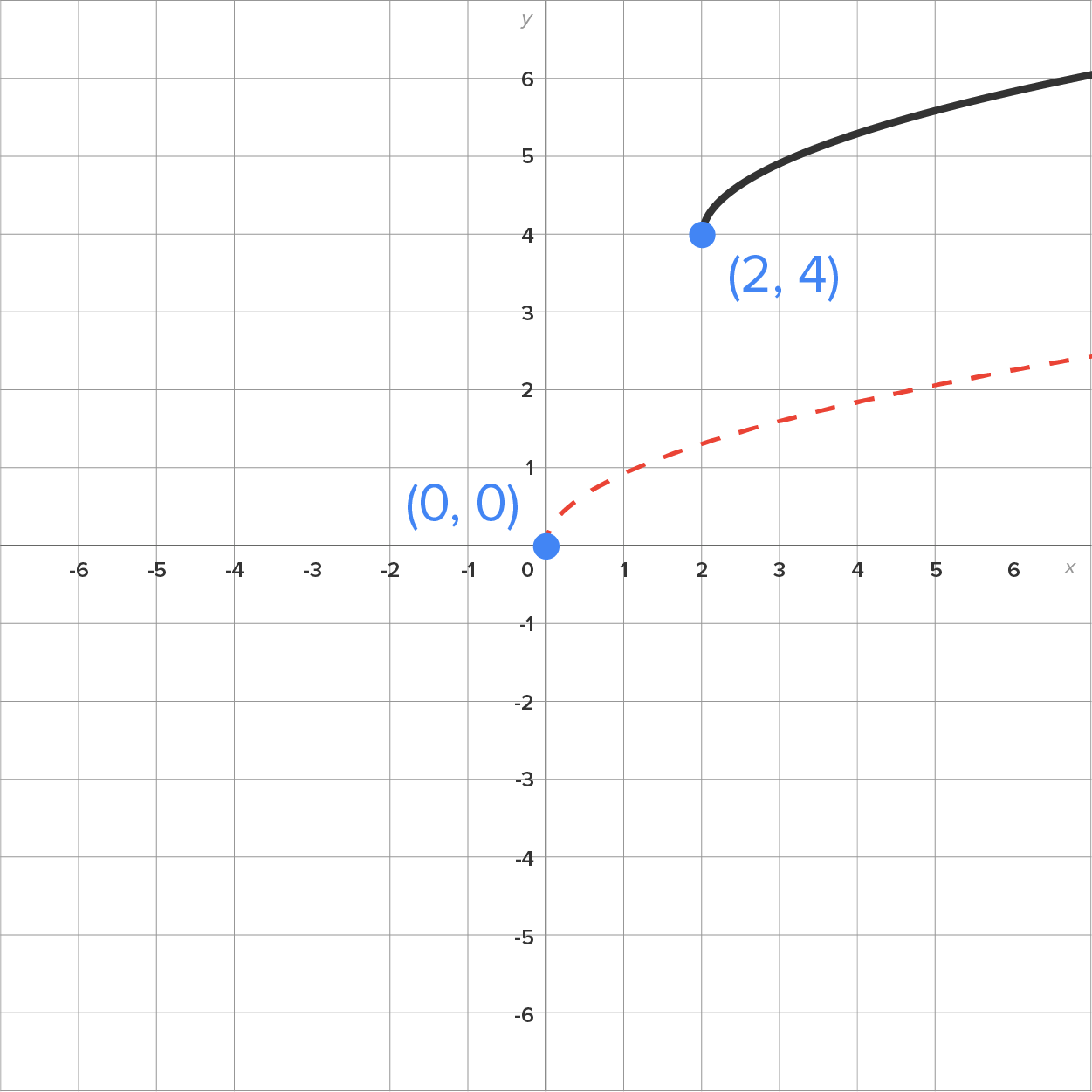
A graph with an x-axis and a y-axis ranging from −6 to 6 and intersecting at the origin. The graph contains two curves. The dashed curve begins from the origin (0, 0) and extends into the first quadrant, representing a square root function. The solid curve starts from a marked point labeled (2, 4) and extends into the first quadrant.

The graph of g open parentheses x close parentheses is obtained by moving the graph of f open parentheses x close parentheses to the right 2 units and up 4 units.

EXAMPLE

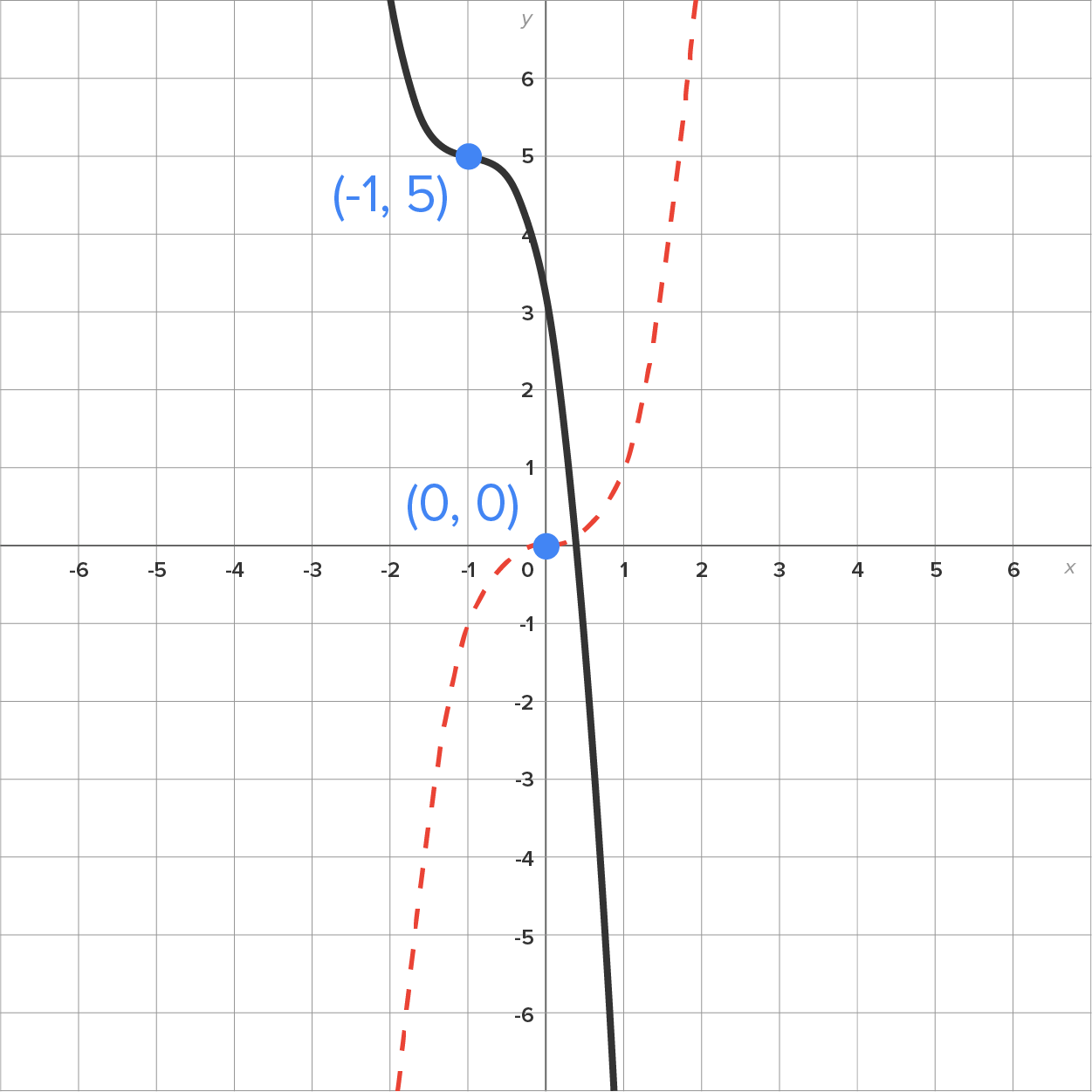
Describe the sequence of transformations that are required to graph g open parentheses x close parentheses equals short dash 2 open parentheses x plus 1 close parentheses cubed plus 5 based on f open parentheses x close parentheses equals x cubed.

  • The “x + 1” tells us that the graph is shifted to the left by 1 unit.
  • The “-2” multiplied to the cubed term tells us that the graph is reflected around the x-axis and stretched vertically (since 2 > 1).
  • The “+ 5” tells us that the graph is then shifted up five units.
The graph is shown here, with f open parentheses x close parentheses equals x cubed dashed.

A graph with an x-axis and a y-axis ranging from −6 to 6 and intersecting at the origin. The graph contains two curves. The dashed curve extends from the third to the first quadrant and passes through a marked point at the origin labeled (0, 0). The solid curve is a shifted and reflected version of the dashed curve, passing through the marked point labeled (−1, 5).

big idea
The order in which translations are applied only matters when there is a vertical shift. Here is the order in which translations should be applied:
  1. Horizontal Translations
  2. Vertical Compressions/Stretches/Reflections
  3. Vertical Translations

try it
Consider the equation g open parentheses x close parentheses equals 0.75 open parentheses x plus 4 close parentheses squared minus 3.
Identify the basic function.
The basic function is f open parentheses x close parentheses equals x squared.
List the sequence of translations required to graph g (x) based on the basic function.
The graph is shifted to the left by 4 units, vertically compressed by a factor of 0.75, and shifted down 3 units.

summary
In this lesson, you began by exploring commonly used basic functions and their graphs. You investigated several types of translations to an equation and how they affect the graph of said equation, applying basic translations to bold italic y bold equals bold italic f bold left parenthesis bold italic x bold right parenthesis to shift, stretch, compress, and reflect its graph. You also learned how to graph a function g (x) by applying several translations to bold italic y bold equals bold italic f bold left parenthesis bold italic x bold right parenthesis, noting the order in which translations should be applied.

SOURCE: THIS TUTORIAL HAS BEEN ADAPTED FROM CHAPTER 0 OF "CONTEMPORARY CALCULUS" BY DALE HOFFMAN. ACCESS FOR FREE AT WWW.CONTEMPORARYCALCULUS.COM. LICENSE: CREATIVE COMMONS ATTRIBUTION 3.0 UNITED STATES.

Terms to Know
Vertical Compression

A translation that makes all y-values of a graph smaller in magnitude, pulling a graph toward the x-axis. This is represented by y equals a times f open parentheses x close parentheses, where open vertical bar a close vertical bar less than 1.

Vertical Stretch

A translation that makes all y-values of a graph larger in magnitude, pulling a graph toward the y-axis. This is represented by y equals a times f open parentheses x close parentheses, where open vertical bar a close vertical bar greater than 1.