Table of Contents |
Whether a product is new to the market or established, marketers face the challenge of setting prices. Recall that the main objective for pricing is for the buyer to perceive value in the product while the company maximizes profits.
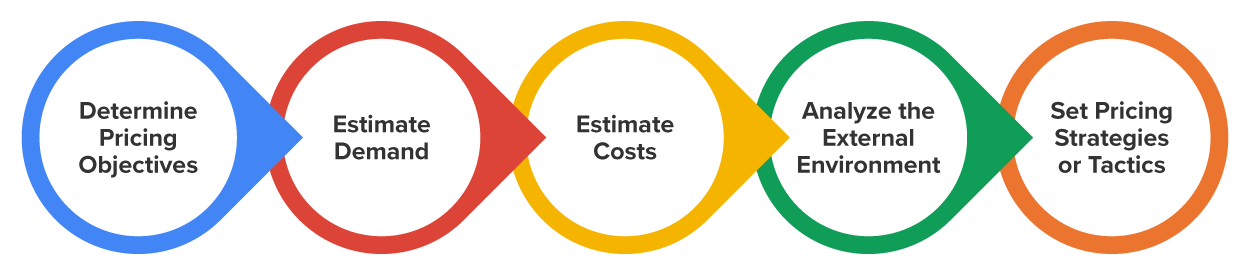
During the first step in establishing pricing policies, the marketing team will set the pricing objectives. The most common pricing objectives are based on customer value, cost, sales orientation, market share, target return, competition, and being customer-driven. It is common for more than one objective to be set within the company. Let’s take a look at each of the pricing objectives in more detail.
Customer Value-Based Objective: As you’ve already learned, it’s essential to have a deep understanding of the value a product will provide for customers. Before Jim Semick and his team launched GoToMeeting, a conferencing app, they developed the pricing of $49 “all you can meet flat-rate pricing.” This pricing was unique to the industry, and Semick stated that they determined this pricing structure based on dozens of interviews with potential customers. From these interviews, the GoToMeeting team discovered key areas that would provide value to customers not only through the product itself but also through the flat-rate price structure that was easy to understand. Semick utilized the customer value-based objective, one in which the company has a good understanding of the value-added benefits of a product and sets its price accordingly.
Cost-Based Objective: A fairly simple way to price products and services is using the cost-based objective, in which prices are based on the costs of doing business. The biggest pitfall of utilizing this pricing objective is that it might not align well with the customer’s value perception. Remember, customers don’t know (or care) what the cost of doing business is, so long as they receive value in their purchase. Therefore, marketers run the risk of overpricing the product. Marketers using this objective also run the risk of pricing their products too low and failing to maximize profits.
EXAMPLE
Consider the manufacturing of a smartphone. Assume the total cost to the manufacturer to produce one smartphone is $3,000. This cost includes all expenses to the company for producing this one smartphone (product costs, variable and fixed expenses). The company chooses to set the selling price of this smartphone to include these costs plus a profit of 10 percent, which sets the final price at $3,300 (3,000 + 10% × 3,000).Sales-Oriented Objective: The goal of a sales-oriented objective is to increase the volume, or units sold, of a product against the company’s sales over a period of time. This objective is achieved by raising or lowering prices to increase sales. An increase in sales assumes a direct impact on profits, thus maximizing profits.
Market Share-Oriented Objective: A market share-oriented objective is one in which the goal is to set prices based on those of the competition. This strategy involves comparing similar products being offered in the market and pricing at, below, or above those prices depending on the product offering. The cell phone market is one example of an industry that leans on market share orientation. The biggest suppliers of cell phones—Apple, Google, and Samsung—take their pricing cues from one another and are priced very similarly.
Target Return Objective: A target return objective is one in which marketers calculate the price so that it returns a specific profit in a given period of time. Let’s assume that a company has invested $1 million into a new product. Company executives wish to recuperate 10 percent of those costs in year one of sales. If it costs the company $2 to manufacture one unit of product and marketers estimate that it will sell 50,000 products in the first year, marketers know they will need to price the product high enough that it will yield the desired results. The obvious drawback to this objective is that much of the decision is based on estimates of units sold in a given time frame.
Competition-Based Objective: A competition-based objective, as its name suggests, is when a company sets its prices according to the prices of its competitors. Amazon uses this pricing objective often with some of its most popular products. Using data intelligence, the company gathers the prices of its competitors' products and sets its prices just below the price set by competitors.
Customer-Driven Objective: Some companies choose to set prices based on a customer-driven objective such as what they are willing to pay for a product or service. Auctions, e-trades, and bids are common examples of customer-driven objectives. eBay, for example, allows a company (or individual) to place an item for sale on its website. Often, the interested buyer will bid on the item, thus stating what they are willing to pay. The highest bidder is then able to buy the product.
| Pricing Objectives | |
|---|---|
| Objective | Description |
| Customer value | Based on a product's added value |
| Cost | Based on the cost to produce a product |
| Sales orientation | Developed to boost sales volume(s) of a product |
| Market share | Focused on increasing market share |
| Target return | Focused on a specific profit at a specific time |
| Competition | Developed based on competitors' prices |
| Customer driven | Focus on what the customer is willing to pay |
After setting the pricing objectives, marketers will estimate the product or service demand. Demand is an economic term that refers to the buyer’s desire and willingness to purchase a product or service at various prices. All other factors being consistent, an increase in price will result in a decrease in demand.
Prestige Products: Prestige pricing is a strategy that marketers use to set high prices knowing that demand will increase with higher prices because the higher price increases the perceived value of the product. Prestige pricing is closely tied to brand image and appeals to buyers who see value in elevated status. Consider these brands of shoes.
EXAMPLE
In 2015, The Adidas Yeezy Boost 750 cost around $76 to produce but sometimes sold for over $1,000, while the D Rose 5 Boost cost around $43 and sold for around $100. So why the large price difference? The Yeezy Boost 750 pricing strategy is that of prestige pricing. The allure and exclusivity of the Yeezy Boost 750 allowed the company to price the shoes at a much higher price.Demand Elasticity: The concept of demand elasticity helps marketers determine how a price change of a product affects its demand. Demand elasticity is a measure of the change in the quantity demanded for a product in relation to the change in its price. If a product is determined to be inelastic, the quantity demanded does not change with a change in price.
EXAMPLE
Since we need gasoline to get to work, school, the grocery store, and meetups with friends, it is considered relatively inelastic. There are very few substitutes for gasoline. Because gasoline has inelastic demand, the price may fluctuate considerably, but the demand for gasoline remains relatively the same.Conversely, if a product is elastic, the quantity demanded will change with a change in price. Home prices are considered elastic because the price has a huge impact on the demand for new homes. Additionally, there are many options for housing, including apartments, roommates, living with relatives, condos, etc.
When determining the demand elasticity of products and services, there are several factors to keep in mind. These include availability of substitutes, the effect of income, time, and cross-elasticity of demand. Let’s explore each of these in depth.
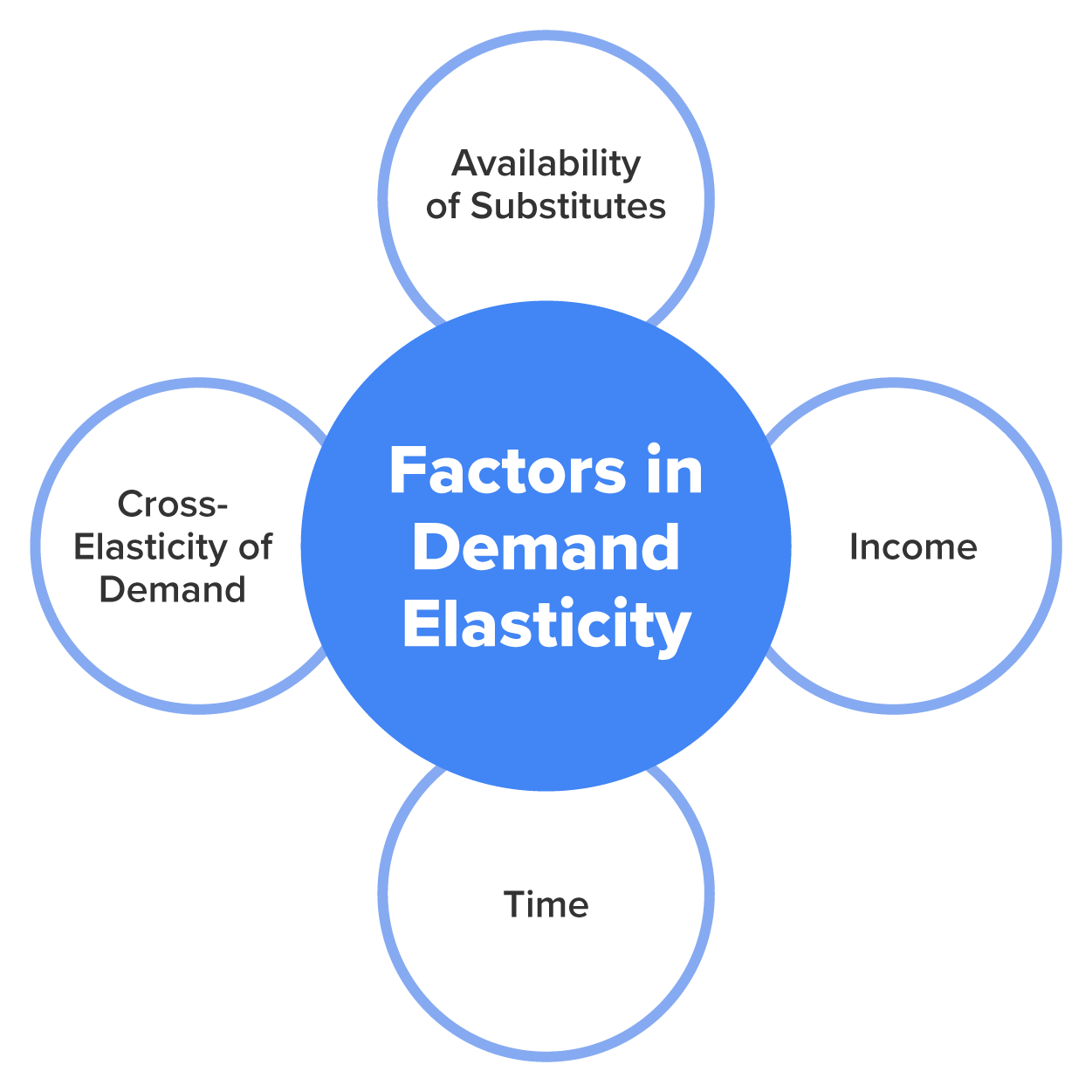
Availability of Substitutes: Substitutes are products and services that are similar to the one being offered. If a buyer can easily choose a different product when the prices change, the demand will be more elastic.
EXAMPLE
If you are at the grocery store to buy English muffins but the store is out, you can easily choose to purchase bagels instead. Conversely, if there are relatively few or no alternatives, demand will be more inelastic.Income: Buyers have limited money to spend on their needs and must make decisions on how the purchase of goods and services will impact their total income. The income effect is the way in which buyers see the change in price affecting their real income. Generally, an increase in price indicates that the buyer will have less money left over to spend; therefore, they will choose to buy less of a product, decreasing demand. The opposite is also true: the lower a price, the more money buyers have to buy more of the product, thus increasing demand.
Time: When the price of a good or service is changed, it takes time for buyers to adjust to the change in price. The time factor of price elasticity indicates that the product’s elasticity of demand is dependent upon the time it takes buyers to adjust to the new prices.
EXAMPLE
If there is a sharp decrease in the price of automobiles, buyers would not immediately go out and buy a new vehicle. Rather, it would take some time to save money for a down payment, secure a loan, and generally go through the buying process. Therefore, the demand for automobiles would increase over time rather than immediately.Cross-Elasticity of Demand: What happens when one of two similar products has a price increase or decrease? If the price of coffee increases, it would be expected that the demand for tea (a substitute product) would also increase. Buyers see the price increase and look for lower-priced substitutes to replace the higher-priced item. The cross-elasticity of demand measures the amount demanded of one good when the price for a similar good or service changes.
The next step in determining a pricing policy is to estimate the total cost of producing a product or service. Recall that maximizing profits is the goal of a pricing strategy and marketers must factor the cost of doing business into pricing considerations. When estimating total costs, it is important to divide costs into fixed and variable costs.
Fixed and Variable Costs: As mentioned earlier, costs are categorized as either fixed or variable. Fixed costs are those expenses that do not change regardless of the number of units sold. Consider the example used previously of manufacturing a smartphone. If the company manufactures 1,000 or 100,000 smartphones, the company must pay the same amount for its lease on the property the plant is located on. The lease payment does not change based on the number of units produced. Alternatively, variable costs do change based on the number of units produced. In this same example, the amount manufacturing spends is dependent on the number of smartphones produced.
The fourth step in determining prices is to analyze the external environment. The external environment is comprised of factors outside of the organization that impact marketing decisions. While marketers cannot directly change these factors, they should be aware of how they might impact pricing decisions.
| PESTLE Factors | ||
|---|---|---|
| Factors | Question | Example |
| Political | What is the current political situation as it relates to the market? | A price cap on certain pharmaceuticals would limit the price a company could charge. |
| Economic | What is the current economic climate? | During inflation or deflation, prices may need to increase or decrease. |
| Social | How is culture changing or shaping the industry? | During the latter months of the year, the Indian market purchases more vehicles than at other times of the year |
| Technological | What technologies are trending? | If technology for a product is becoming obsolete, a decrease in price may be necessary. |
| Legal | What current legislation is impacting the industry? | A new vehicle emission law may require new technology, thus increasing the price of vehicles. |
| Environmental | What are the environmental concerns of the product? | A highly toxic product or process may need to have a higher price to properly and safely dispose of byproducts. |
Competitors’ Costs, Prices, and Products: It probably seems obvious by now that analyzing the competition is key in setting prices. Marketers must constantly analyze both current and potential competition in the market to understand how their products will measure up to that of the competition. If a competitor is planning to introduce a nearly identical product to one that your organization already has on the market—but at a much lower price—you will need to.
Stage in the Product Life Cycle: How long a product—and its substitutes—have been in the market will have an impact on the marketer’s choice of pricing strategies. Recall that the product life cycle consists of four stages: introduction, growth, maturity, and decline. During the introduction stage, marketers must choose pricing strategies wisely to capture the intended market and begin recuperating research and development costs. As a product moves through the other stages of the life cycle, prices may need to be changed in order to stay relevant to consumers.
Status of the Economy: As you can imagine, the state of the economy at any given time will have an impact on the buyer’s ability to purchase products as well as their willingness to spend. Economic factors that marketers should specifically be aware of when considering demand for products include employment, inflation, interest rates, and consumer confidence.
IN CONTEXT
One of the main factors that influences consumer demand is the employment rate. The unemployment rate is a measure of the number of people who are not employed but are actively seeking work in a given period—usually one month. When buyers are employed and receiving steady income, they are more likely to use discretionary income. Discretionary income is the money left over after all taxes and necessities—such as food and housing—are paid. When discretionary income decreases, demand for nonessential items also decreases.
Inflation is an economic measure of the rate of rising prices of goods and services in an economy. When inflation incurs, prices for most goods and services rise. Therefore, the amount of discretionary income a buyer has decreases, and demand for nonessential goods and services also decreases. Because of the higher price of goods and services within the economy, consumers are spending more of their earned income on necessities such as food and shelter. This, in turn, causes them to purchase fewer nonessential items such as vacations, toys, and the like.
After gathering all the data explained in previous steps, marketers are ready to set specific pricing strategies or tactics. The strategies and tactics chosen for a product or service should align with the other marketing mix elements, create value for the customer, and maximize profits for the company.
Source: THIS TUTORIAL HAS BEEN ADAPTED FROM OPEN STAX’S PRINCIPLES OF MARKETING COURSE. ACCESS FOR FREE AT https://openstax.org/details/books/principles-marketing. LICENSE: CREATIVE COMMONS ATTRIBUTION 4.0 INTERNATIONAL.



