Table of Contents |
In the last lesson, you learned about putting the recipient at the center of a message. Closely related to this idea is using positive language. This doesn’t mean soaking each letter in flattery, but being thoughtful about the way things are worded and emphasizing the options or opportunities that are available.
For example, say you need to advise staff on parking restrictions while a lot is being resurfaced. “Parking Lot C is off limits during the resurfacing!” would communicate the message, but it does not put the recipient at the center, and is communicated as a negative. By contrast, you could say “Please use Parking Lots A and B, while Parking Lot C is being resurfaced.” The information is the same, but this directly addresses the audience and is phrased as a positive (what they can do) rather than a negative (what they cannot do).
As another example, say you are in Human Resources and have a problem with an employee’s automatic deposit payments. You might send this email:
EXAMPLE
Your banking info is incorrect. Payment is not possible until this is corrected.Notice how this message emphasizes what can’t happen and fails to put the recipient at the center of the message. In fact, it’s not clear if the recipient can do anything about it. Consider this alternative.
EXAMPLE
Please go to the employee portal and update your banking info. As soon as you do that we can remit payment.This message once again more directly tells the recipient what they can do and emphasizes that over the problem. The information is exactly the same, but this message takes a more user-centered and positive approach.
In the previous challenge, you learned about structuring messages to help communicate effectively and efficiently. However, this can vary based on these circumstances. For example, maintaining strict objectivity and formality would seem cold and uncaring if you were sharing good news. If your colleague gives birth, you wouldn’t want to send a curt email telling staff, “Lisa will be out of the office for the next four weeks on parental leave.” You would probably congratulate Lisa, give staff a few details about her new child, and maybe throw in a few happy-face emojis if your work culture allows it. In short, and as discussed before, context is crucial.
Presuming your news is good or neutral, you can structure your message directly. Note that in this case “neutral news,” is not simply informative—it is big news, but perhaps you are unsure how people will respond.
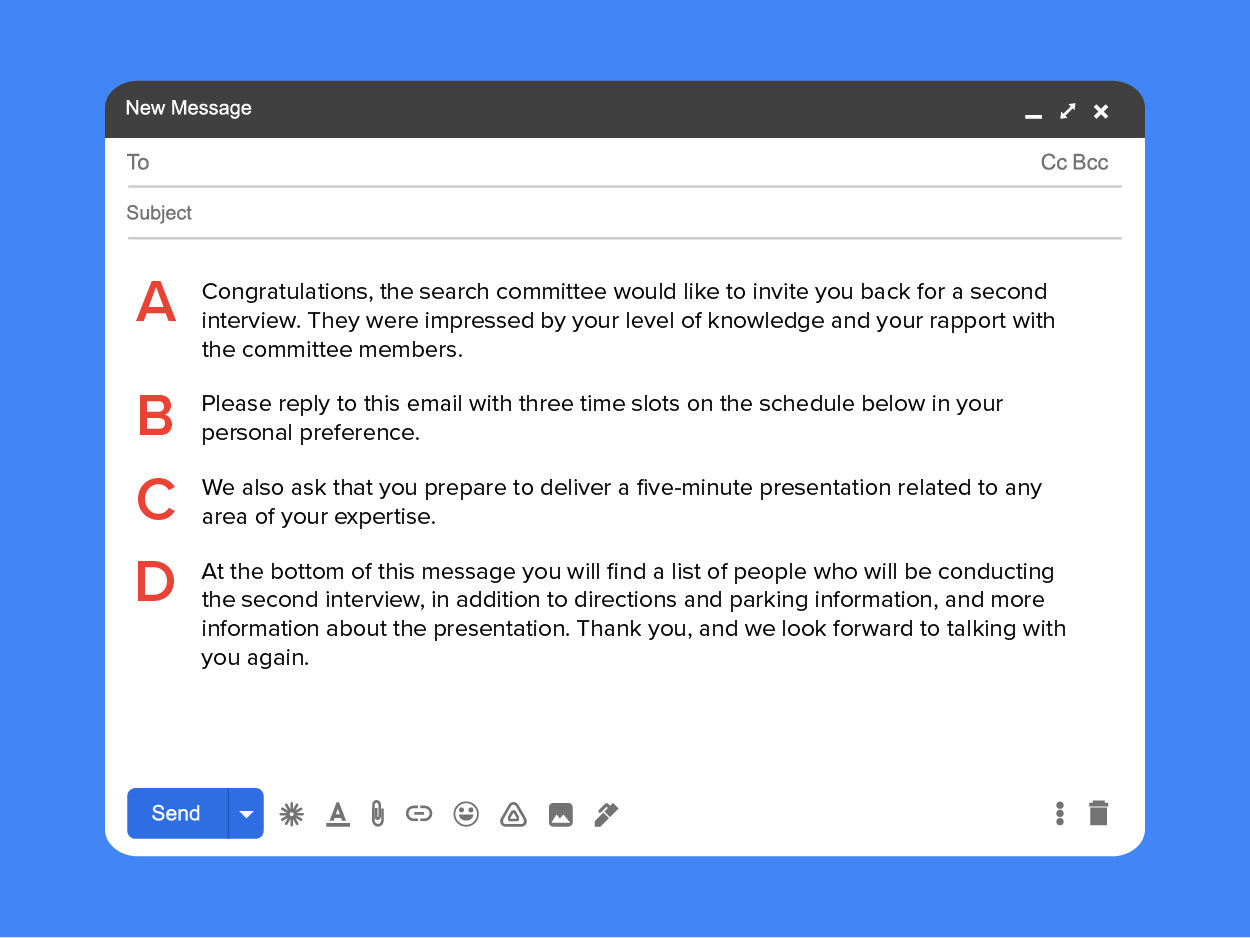
This gives the main idea right upfront (A) with reasoning (B), a call to action (C), and a final message of goodwill (D). There is further information (not shown here), but cues in the first paragraph of where to find it.
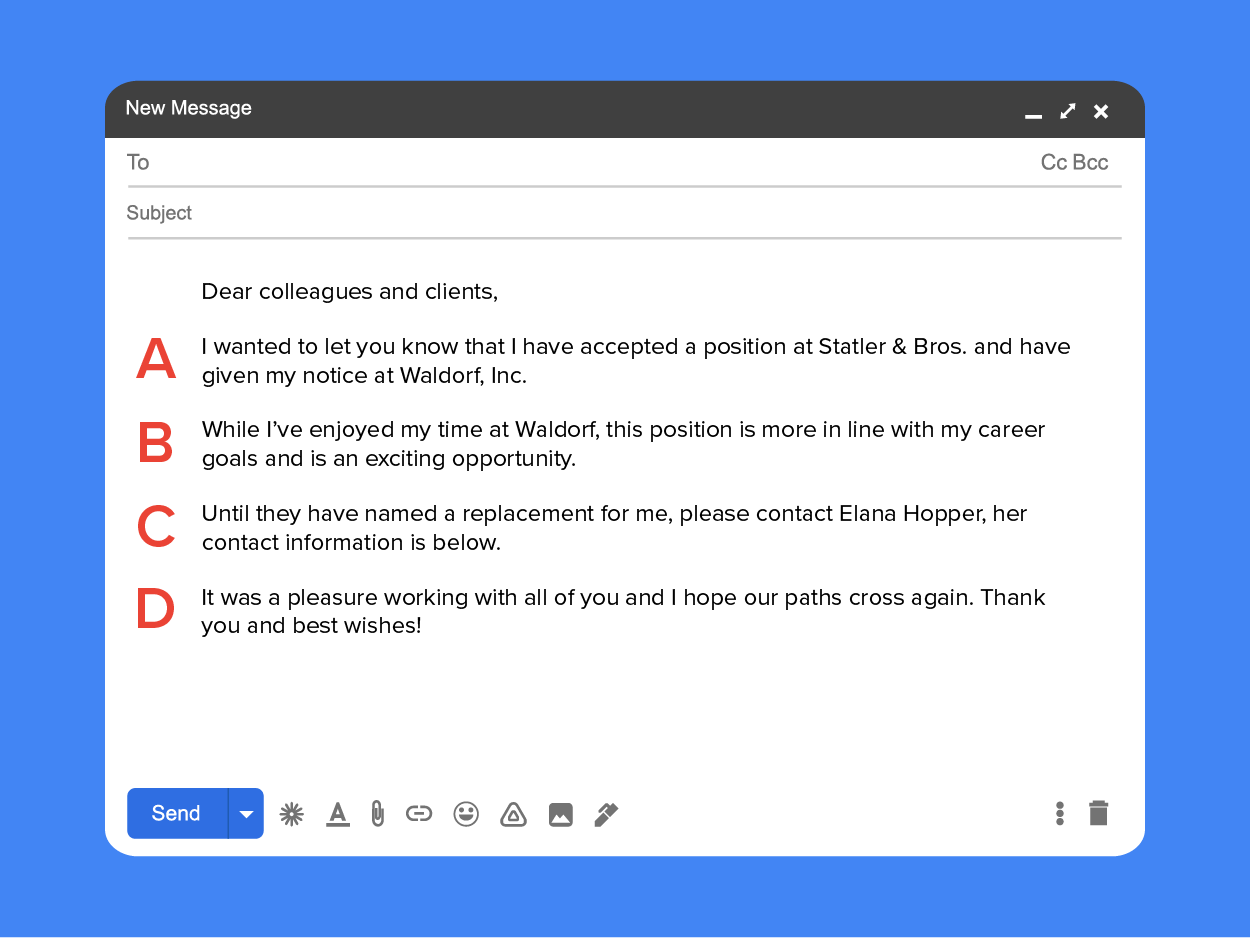
Similarly, say you are sending a message about your own departure from an organization. This is good news for you, assuming you’re moving up in the world, but for people you have a relationship with it is mostly neutral. At the same time, it’s too important to just treat matter-of-factly.
In any job with a lot of communication, you will have to pass on some bad news. As with good news, sending bad news may require you to waver from the usual principles of communication. For example, you normally use the subject line to clearly reflect the contents of your message. However, there are cases where this would be blunt and tactless. You probably won’t want to tell people “Joe was let go” in the subject line; indeed, it would be preferable to use a vague (but tactful) subject line to prepare them for the news, like: “Staff departure,” or “Sad news.” Moreover, while you usually want to begin emails with the most crucial information, sending bad news might require sufficient build up to prepare the recipient for an emotional blow.
A message with bad news usually has a more indirect structure that allows the writer to give that unambiguous message, while also being considerate of the recipient’s feelings.
Buffers must be more than an unrelated hello or small talk such as “How about those Broncos?” They must lead into the topic while avoiding negative overtones. At the same time, a buffer shouldn’t promote an untruth or raise the recipient’s hopes only to dash them. For example, in writing to a job applicant, the subject line, “You are our best candidate” only to follow in the body with “but unfortunately, we needed to hire from within the company, so you didn’t get the job” is needlessly cruel. On the other hand, “You are one of many impressive candidates,” is both honest and appropriately complimentary while serving as a buffer.
An earlier example showed a message inviting a job applicant back for a second interview. Here is a message for those who did not make the cut. Note that the structure is quite different.
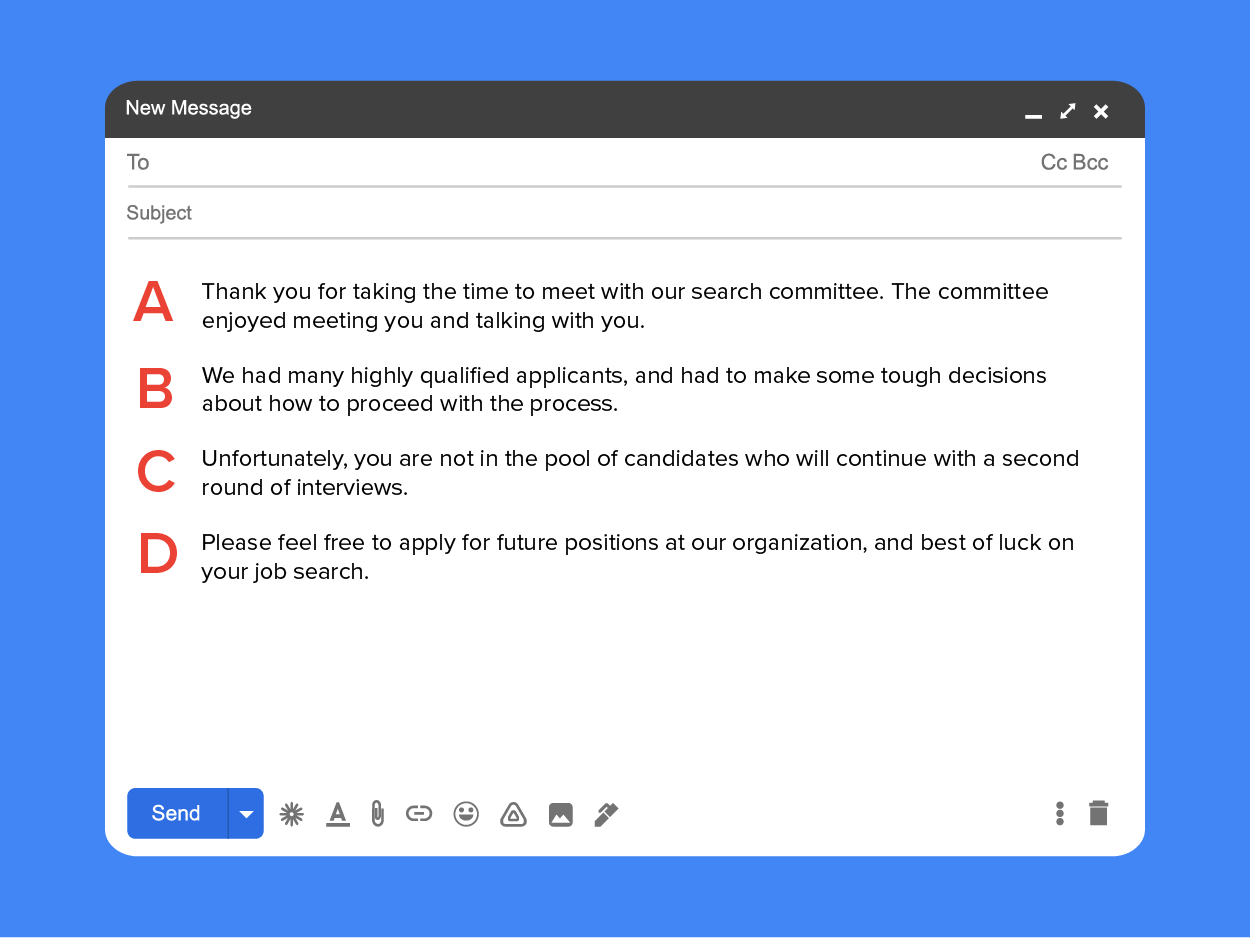
This message has a buffer (A) before the main idea. The reasoning behind the decision (B) precedes the news, which further prepares the recipient. Unlike most messages, the main idea (C) comes relatively late in the message, since consideration for the recipient’s feelings are prioritized over the news itself. Finally, while there isn’t a call to action, the final sentence suggests the person apply again for future positions and also has a note of building goodwill.
Two other considerations for sending bad news are to be both tactful and clear. The message should contain the appropriate amount of emotional consideration without being overly negative or reflecting poorly on your organization. “Your vacation request is declined,” is a little bit harsh, while “I'm so sorry; I really hate to have to decline your vacation request and I feel awful about it,” is a bit over the top. “Unfortunately, we can't accommodate this vacation request,” is a more appropriate level of acknowledgement of the bad news. However, the message should still be clear and unambiguous. For example, if you make it sound like you're still trying to arrange the vacation request, when you already know it isn't possible, you will confuse and mislead your colleague. Receiving bad news is hard enough without having to decipher the true answer from cagey and indirect messaging.
EXAMPLE
You’re asked for a professional reference from a former colleague. In your experience, the person was often late to work and off task when at work.Messages of apology are often a particular kind of bad news where you also have to accept (personal or organizational) responsibility for the problem. In these cases, the bad news may already be known to the recipient, but you have to follow up with an apology to begin mending your relationship.
In this case, your message will have a form closer to the “good news” model, because beginning with a buffer and explanations will feel evasive.
For example, say you accidentally miss a meeting with a client. Following the usual “bad news” model, your email might look like this:
EXAMPLE
John, I know we had a meeting scheduled earlier today and that you probably showed up for it. I hope the drive was at least uneventful and you found a good parking place. As luck would have it, I switched calendar systems last month and tried to import all my appointments but I guess it didn’t work because I didn’t have our appointment on the calendar and I only know you arrived because Brenda told me, I’d stepped out for coffee. Anyway, I’m really sorry.If you’re John, this might annoy you. In fact, the sender is wasting even more of his time with lame excuses. Instead, try beginning your message with an unambiguous apology, taking responsibility for the mix-up. Keep any explanations brief and avoid the appearance of passing on the blame.
EXAMPLE
Dear John,If the apology also has urgent news, you will again need to follow the “good news” model so it does not feel evasive.
EXAMPLE
Dear customers,Source: This tutorial has been adapted from Lumen Learning's "Business Communication Skills for Managers." Access for free at https://courses.lumenlearning.com/wm-businesscommunicationmgrs. License Creative Commons Attribution 4.0 International.



