In this lesson, you will learn how scientists use the scientific method to explore questions and solve problems. You will be introduced to the scientific method and understand its role in guiding scientific inquiry. Next, you will examine each step of the method, from making observations to drawing conclusions. Finally, you will apply the scientific method to real-world examples by forming and testing hypotheses. Specifically, this lesson will cover:
There are many fields of science, and while different, they also have some similarities. There are life sciences such as biochemistry, biology, and neuroscience. Chemistry, physics, and geology are natural sciences. Social sciences are fields such as anthropology, archaeology, economics, geography, history, political science, and psychology. All of these fields of science have at least one thing in common: the scientists in those fields use the scientific method as part of their research.
IN CONTEXT From Lab to Field: The Universal Language of the Scientific Method
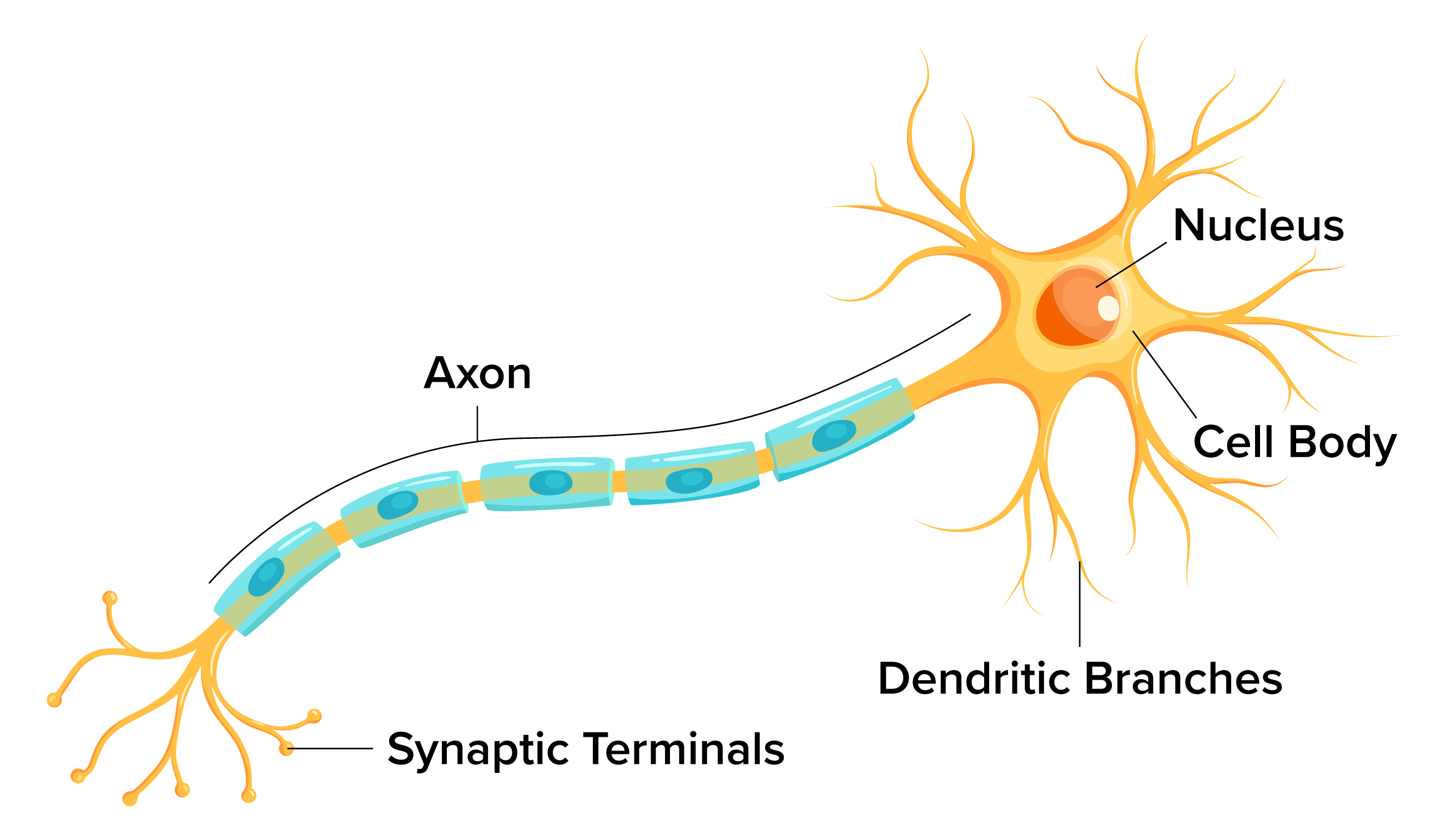
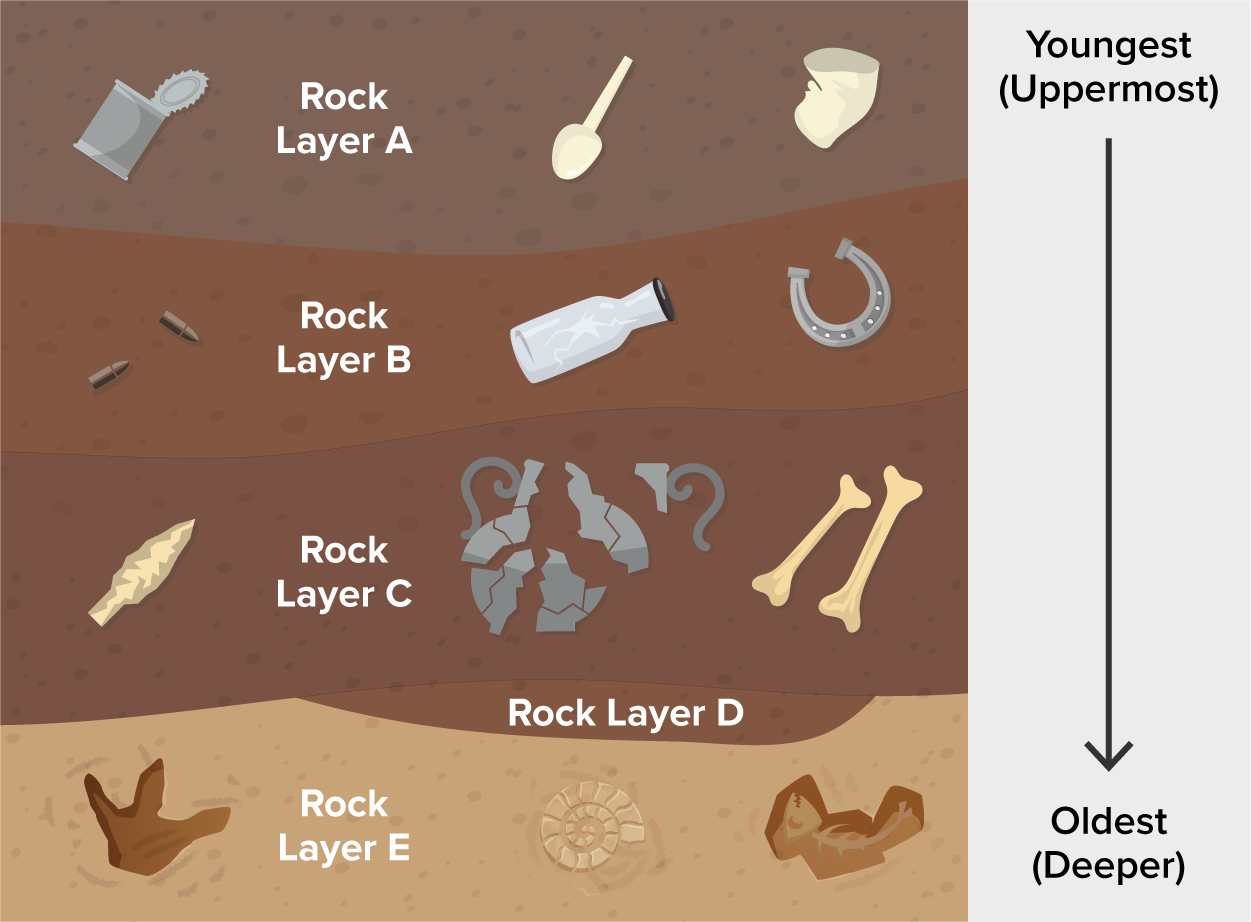
Dr. María Torres, a neuroscientist studying memory loss, and Dr. Malik Okafor, an archaeologist analyzing soil layers at a dig site in Nigeria, both use the scientific method—though in very different ways. Dr. Torres designs controlled experiments in a lab to test how certain proteins affect neurons, while Dr. Okafor forms hypotheses based on artifact placement and tests them through excavation and carbon dating. Despite their different questions and tools, both rely on observation, hypothesis formation, testing, and revision, which are hallmarks of the scientific method.
On the left, an illustration shows a neuron, cells that play a key role in brain function and communication. On the right, layered rock formations reveal how artifacts are found and dated based on their depth, with carbon dating helping scientists determine their age.
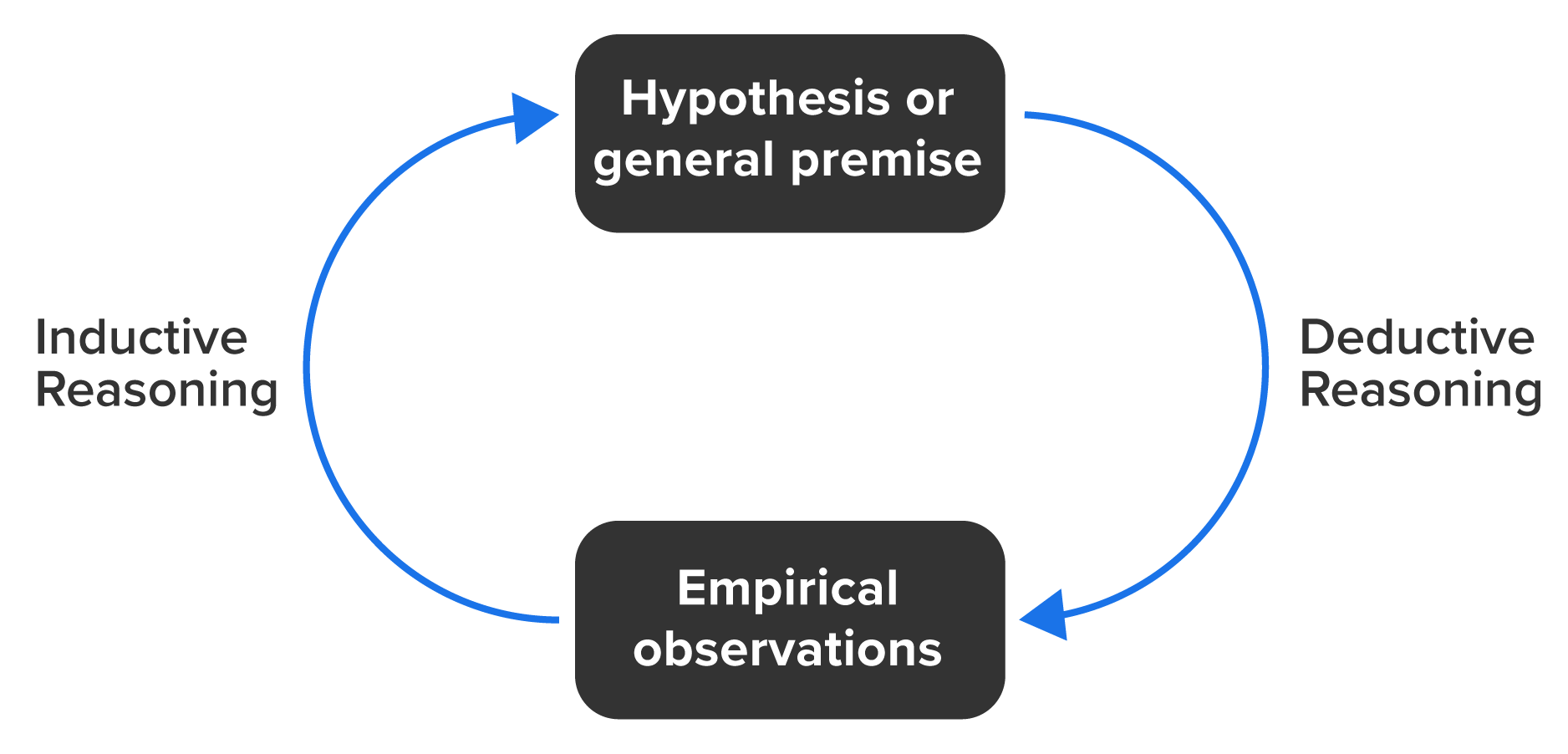
The scientific method is the path of discovery that uses experiments to test hypotheses, educated guesses or proposed explanations that can be tested. In this process, ideas like theories and hypotheses are compared with the real world through observations, which means using our senses or tools to gather information about what’s actually happening. Those observations then lead to new questions and ideas, helping science keep growing and improving. Consequently, this process is considered circular, with two basic types of reasoning: deductive and inductive. Deductive reasoning, or deduction, refers to using a general principle or law to predict specific results, and ideas are tested in the real world. Given the law of gravity, we can deduce that a dropped object will fall toward the Earth; this prediction can be directly tested. Inductive reasoning, or induction, refers to the formulation of generalizations from specific observations and is used to develop new ideas based on real-world observations. For instance, after observing that metal objects like copper and aluminum allow electricity to flow through them, one might conclude that all metals are electrical conductors—a general idea derived from specific cases. These processes are inseparable, similar to inhaling and exhaling. However, deductive reasoning is the type of logic used in hypothesis-based scientific research.
A flowchart showing how empirical observations shape a general premise, which then guides deductive reasoning and illustrates the layered connection between evidence and logic in scientific thinking.
terms to know
Hypothesis
Educated guesses or proposed explanations that can be tested.
Observation
Using our senses or tools to gather information about what’s happening.
Deductive Reasoning
Reasoning in which a general principle or law is used to predict specific results.
Inductive Reasoning
Generalizations are made from specific observations.
2. Steps of the Scientific Method
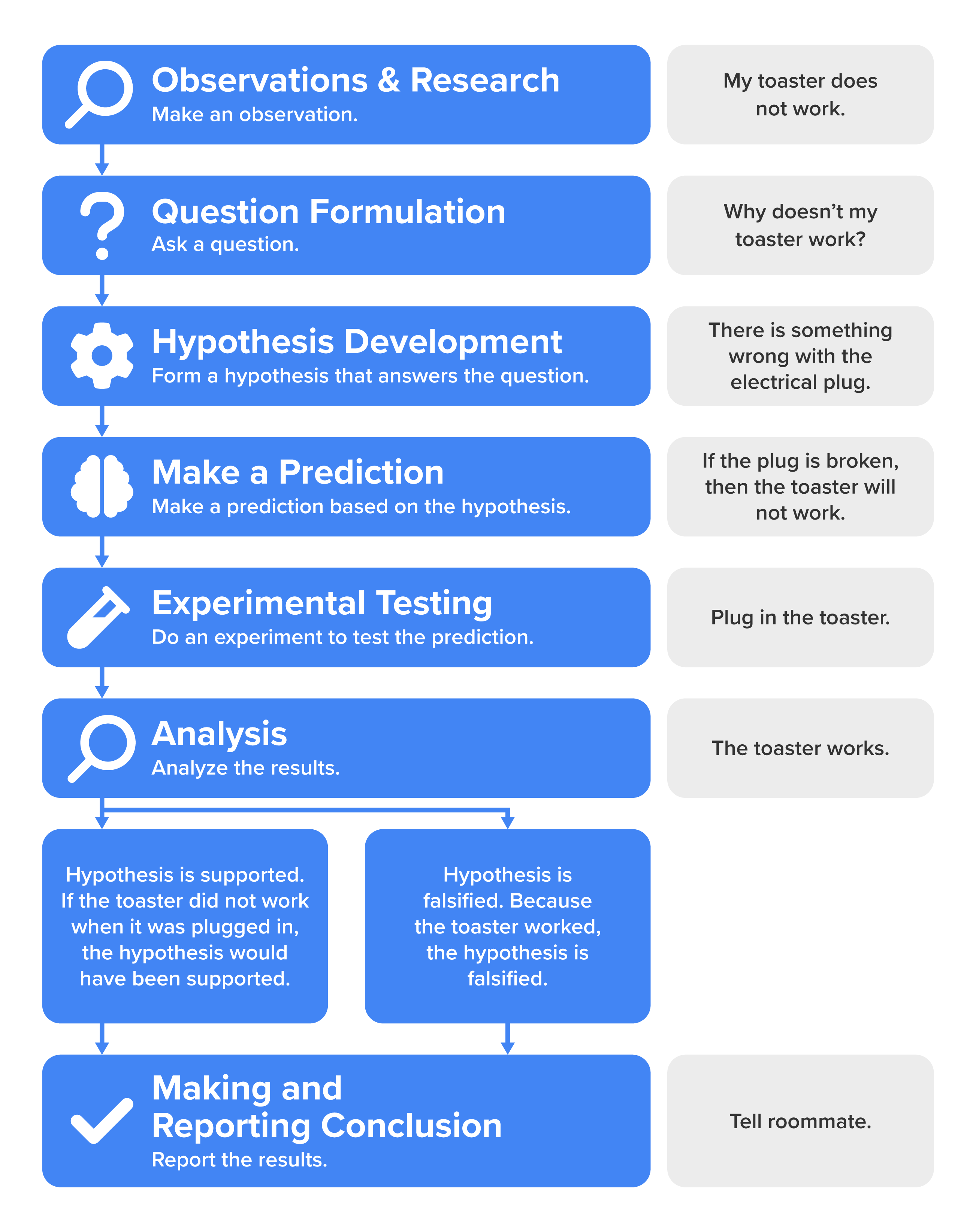
When scientists use the scientific method, there is a general set of steps they follow to arrive at reliable and reproducible results. The basic steps of the scientific method include: observation and research, question formulation, hypothesis development, experimental testing, analysis, and drawing and reporting conclusions. These steps are outlined in the table below.
Step
Description
Observation & Research
An observation can be something that you see, hear, or experience, and involves using your senses to take in information about your surroundings.
Scientists examine and make observations about the way the world and the universe around them work. One way they research is through peer-reviewed, scientific journals to gather as much information about a particular phenomenon as they can to try and objectively answer the question.
Question Formulation
Once a scientist has researched a particular phenomenon, they will ask a question about that phenomenon and what they observed.
Hypothesis Development
Scientists will formulate a hypothesis that addresses the question and make a prediction about how the phenomenon works.
A hypothesis should always be testable. You also want to make sure that your hypothesis explains what you think is happening.
Two hypotheses are usually considered when developing an experiment. They are called the null hypothesis and the alternative hypothesis, and they contain opposing viewpoints. The null hypothesis is a statement that there is no significant difference between specified groups. The alternative hypothesis (or research hypothesis) is a claim that there is a difference between specified groups. The alternative hypothesis is usually what the researcher is trying to test. The alternative hypothesis is contradictory to the null hypothesis and what we conclude when we reject the null hypothesis.
Make a Prediction
Once scientists have a hypothesis that addresses their question, they make a prediction, or a specific, testable statement about the expected outcome of an experiment. A prediction translates the hypothesis into measurable terms and guides the design of the study. For example, if the hypothesis is that a new fertilizer helps plants grow taller, the prediction might be that plants treated with this fertilizer will be taller on average than plants without it. Making clear predictions is important because it allows researchers to collect data that can support or contradict their hypothesis, helping to draw meaningful conclusions from their experiments.
Experimental Testing
Scientists will use experimentation to collect data to test their falsifiable hypothesis and their question.
Most data can be considered qualitative or quantitative data.
Quantitative data are the result of counting or measuring and are always numerical. Some examples of quantitative data include age, distance, or amount of time. Qualitative data (also called categorical data) come from categorizing or describing attributes and are usually described with words or letters. Examples of qualitative data include eye color, blood type, and gender, while examples of quantitative data include height, test scores, and the number of siblings. While researchers often prefer quantitative data because it’s easier to analyze mathematically, qualitative data can sometimes be explained using averages of related numerical information. For example, instead of averaging hair color itself (which doesn’t make sense), researchers might look at the average age or test score within groups defined by eye color. This helps connect qualitative categories to meaningful numerical summaries.
They will make a prediction about what they expect to observe when they test their hypothesis. They test their prediction with an experiment, a test that’s done under controlled conditions in which you can manipulate things to try to explain the phenomenon that’s happening. You will set up an experiment, and then you will collect data. In an experiment, you will always have variables, which are factors that can change.
The purpose of an experiment is to investigate the relationship between two variables. An independent variable (or explanatory variable) causes a change in another variable. The affected variable is called the dependent variable (or response variable).
In an experiment, the samples being tested are split into two groups: an experimental group and a control group. The experimental group receives the treatment whose effect the scientist is studying. The control group does not receive this treatment, so it stays under normal or unchanged conditions. If the hypothesis is correct, there will be a difference in the results—called the dependent variable—between the experimental group and the control group.
Analysis
Scientists evaluate the empirical data from their testing. When necessary, they will repeat the experiment to improve the data.
If your results are consistent with your hypothesis, you will repeat your test. You want to make sure that you repeat it several times because the more you repeat it and the more data that you have, the more accurate your results will be. Repeating the test will also help ensure that the results you get are not just a fluke; the more a study is replicated, the more reliable the results.
Maybe the results that you get are different from what you were expecting. You can either repeat the test to make sure or make new tests using a different variable to try and figure out what's going on to explain the observed phenomenon.
Making and Reporting Conclusion
Based on the collected data and information, scientists determine whether their hypothesis was rejected (or falsified) or supported by the results, and they communicate their results to the wider scientific community with the goal of contributing to a general theory describing the phenomenon. Generally, scientists will report their results by publishing them in a peer-reviewed scientific journal.
key concept
Not every idea can—or should—be tested right away. Sometimes it’s too unsafe, like testing new chemicals that might cause harmful reactions without proper safety measures. Other times, the technology isn’t ready, such as when scientists want to grow fully functional human organs in the lab; right now, we don’t have the tools to do that safely and reliably. And sometimes it’s unethical, like experimenting on animals or people without strict rules to protect their well-being. Knowing when not to test is just as important as knowing how to test!
IN CONTEXT
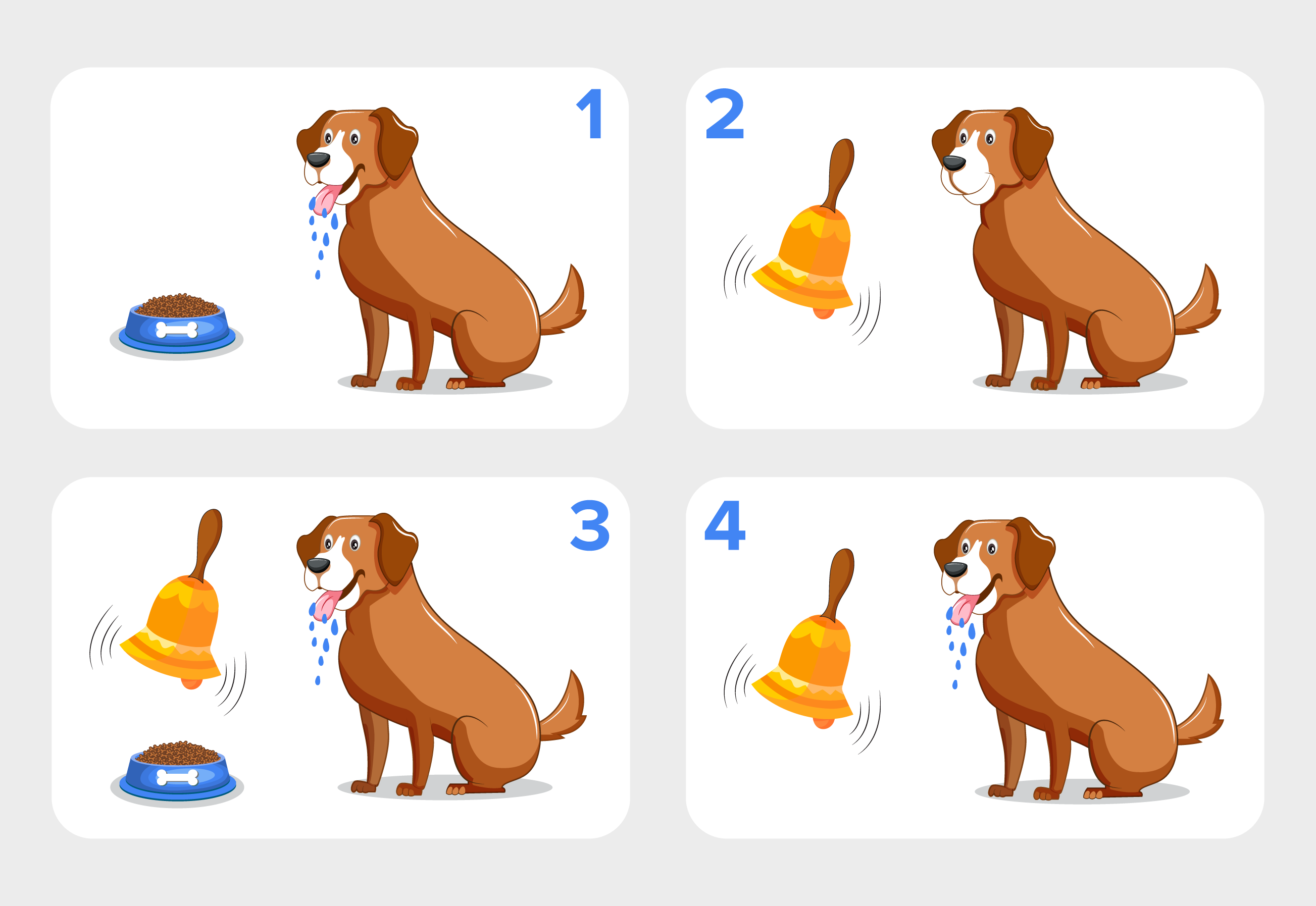
Ivan Pavlov’s famous experiment demonstrated how animals can learn to associate one stimulus with another through a process called conditioning.
Observation – Pavlov noticed that dogs began salivating not just at food, but also at things associated with feeding, like footsteps or a lab coat.
Hypothesis – He predicted that if a neutral stimulus (like a bell) was paired with food, the dogs would eventually salivate at the sound alone.
Experiment – Pavlov rang a bell just before feeding the dogs, repeating this several times.
Conclusion – Eventually, the dogs began to salivate at the sound of the bell alone, showing they had learned to associate the bell with food.
Pavlov’s dog experiment demonstrated four steps: (1) Dogs naturally salivated at food, (2) a bell alone caused no reaction, (3) the bell was repeatedly paired with food, and (4) eventually, the bell alone triggered salivation, showing the dog had learned to associate the sound with food.
terms to know
Null Hypothesis
A hypothesis that there is no significant difference between specified groups.
Alternative Hypothesis
A research hypothesis; usually what the researcher is trying to test.
Prediction
A specific, testable statement about the expected outcome of an experiment.
Quantitative Data
Numerical data that are the result of counting or measuring.
Qualitative Data
Data that are generally described by words or letters and are the result of categorizing or describing attributes.
Experiment
A test that’s done under controlled conditions in which you can manipulate things to try to explain the phenomenon that’s happening.
Variable
A factor in an experiment that can be changed or manipulated.
Independent Variable
A variable that causes a change in another variable in an experiment.
Dependent Variable
The affected variable in an experiment.
Experimental Group
The group that receives the treatment whose effect the scientist is studying in an experiment.
Control Group
A group included in an experiment that does not receive treatment, so it stays under normal or unchanged conditions.
3. Applying the Scientific Method
The scientific method can be applied to reliably answer questions about the phenomena around you. You can use it to answer questions about your everyday life (such as figuring out why your toaster does not work) or scientific phenomena. Below are examples of how you can apply the scientific method.
step by step
Suppose a soda company has consumers who report nausea after drinking their soda. Let's apply the steps of the scientific method.
Observation and Research: An observation, in this case, could simply be: "Soda drinkers report feeling nauseous after drinking a particular brand of soda, Science Cola." The research, in this case, is stated above, that a soda company has consumers who report nausea after drinking their soda.
Question Formulation: Is it actually Science Cola that's causing the problem? Or could it be something else? Is it possible that some people feel nauseous after drinking any kind of soda, rather than just one particular brand?
Hypothesis Development: An alternative hypothesis might be that Science Cola correlates with more nausea than other brands. The null hypothesis might be that Science Cola is not correlated with nausea more than any other brands.
Make a Prediction: A prediction could be that many more people experience nausea after drinking Science Cola than all other brands.
Experimental Testing: To test this, a large number of participants could be recruited. Each person would drink a particular brand of soda and report their reaction. The larger the group, the more accurate the test. For example, if only two people participate and one has the flu, it might mistakenly appear that Science Cola causes nausea in half of its consumers. However, with 100 participants and one having the flu, this would not significantly affect the conclusion.
In this example, suppose 200 people are recruited. Half are given one can of Science Cola a day for six weeks as the experimental group. The other half received a different brand, Regular Cola, as the control group. All participants record their results daily.
If any digestive upset occurs, it must be documented. In this experiment, the independent variable is the type of soda consumed (Science Cola or Regular Cola), and the dependent variable is whether digestive upset occurs.
Comparing the two groups allows the determination of whether Science Cola is causing the sickness.
Repeat the Test or Conduct New Tests: Suppose the same rate of nausea (1 out of 100) is observed for both Science Cola and Regular Cola. This outcome supports the null hypothesis (“Science Cola is not correlated with nausea more than any other brands”) and does not support the alternative hypothesis ("Science Cola correlates with more nausea than other brands"). It is possible that the alternative hypothesis was incorrect, or that the control soda used also causes nausea. Additional testing comparing Science Cola against other brands is necessary to gather sufficient data to accept or reject the alternative hypothesis.
Analysis and Conclusion: Analyze the results of the study and report back to Science Cola, Inc. To share findings with the public, submission to a peer-reviewed journal for publication may also be considered.
summary
In this lesson, you had an introduction to the scientific method as a way to help explain a phenomenon or event. You learned the steps of the scientific method and about applying the scientific method in real life. As an example, we discussed testing a brand of soda to determine how, or if, it caused stomach upsets.