Use Sophia to knock out your gen-ed requirements quickly and affordably. Learn more
×

Scatterplot

Author: Sophia

what's covered
This tutorial will discuss the topic of scatterplots. Our discussion breaks down as follows:

Table of Contents

1. Scatterplots

Scatterplots are ways that you can show more than one quantitative attribute at a time for a particular data set. In the past, you’ve been using something like dot plots, where you have a particular quantitative attribute about a data set. In addition, you've been making dot plots where you stack up dots at a particular value, and you look at it that way.

However, scatterplots allow you not only to see how those values compare along with one attribute but also along with a different attribute.

EXAMPLE

You might put the two variables cigarette consumption and cancer death in a scatterplot. Perhaps certain states or countries have low cigarette consumption and maybe, correspondingly, low cancer deaths. Each dot would correspond to one single state or one single country.
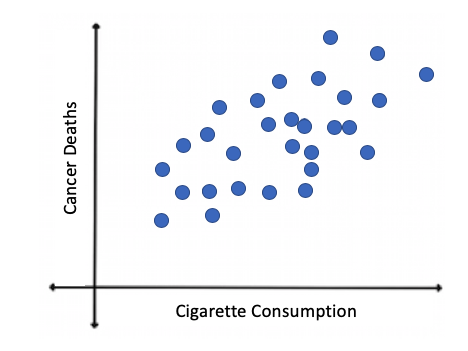
Scatterplot with the horizontal x-axis labeled 'Cigarette Consumption' and the vertical y-axis labeled 'Cancer Deaths.' The graph contains multiple individual data points scattered from the lower left to the upper right of the plot area, forming an overall upward pattern. Most points are clustered near the center of the graph, with lower cigarette consumption associated with lower cancer deaths and higher cigarette consumption associated with higher cancer deaths. The axes do not display numeric scales or tick marks.

EXAMPLE

If you were going with a sports team, maybe you'd want to know if spending a lot of money on your team payroll causes them to win more. Each dot, in that case, would correspond to a single team.
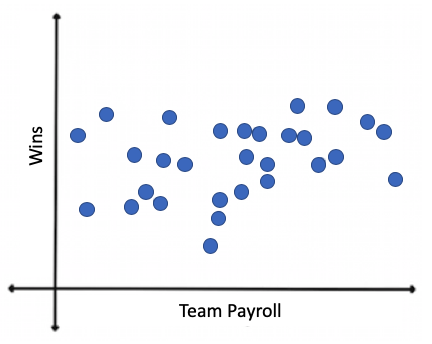
A scatterplot graph depicting the relationship between ‘Team Payroll’ on the horizontal axis and ‘Wins’ on the vertical axis. The data points represent different values of team payroll and the corresponding number of wins. There is no specific pattern, suggesting no clear linear relationship between the two factors. The points are distributed more or less evenly across the graph.
IN CONTEXT

This was the 1992 payrolls for the National Football League for their quarterback, who's usually their most expensive player, and for the entire team. The values are in thousands of dollars.

Team QB Salary Total Payroll
49ers 900 17,256
Falcons 2,250 25,642
Bears 3,000 23,074
Giants 1,600 23,258
Bengals 1,050 20,666
Jets 800 19,063
Bills 650 24,249
Lions 1,525 24,644
Broncos 500 21,992
Oilers 1,700 21,399
Browns 967 19,413
Packers 1,500 23,245
Buccaneers 675 19,545
Patriots 2,250 23,294
Cardinals 1,450 20,397
Raiders 1,300 20,390
Chargers 1,200 18,698
Rams 1,500 24,378
Chiefs 1,100 25,859
Redskins 1,450 20,780
Colts 2,000 22,022
Saints 1,200 23,695
Cowboys 1,750 28,349
Seahawks 1,250 25,348
Dolphins 1,400 23,728
Steelers 3,500 30,131
Eagles 425 19,325
Vikings 1,250 23,246


Next, let's put this on a scatterplot. The value that should go on the x-axis, or the horizontal axis, should be the one that you think helps to explain the other variable. It is most likely the quarterback salary that helps to contribute to a high or low team salary.

Start with the first team, the 49ers. Find that $900,000 for the quarterback and $17.2 million for the team payroll and put a dot there. That's one of the many dots that we're going to end up with.
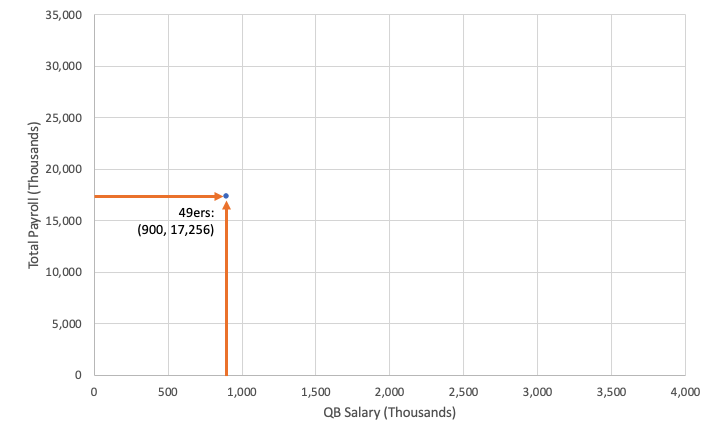
A graph across a grid chart depicting the relationship between ‘QB Salary, in Thousands’, ranging from 0 to 4,000 at intervals of 500 on the x-axis, and ‘Total Payroll, in Thousands’, ranging from 0 to 35,000 at intervals of 5,000 on the y-axis. A data point marked at (900, 17,256) on the graph is labeled ‘49ers’. Two arrows, one from (900, 0) and another from (0, 17,256), extend till the data point.

The next team, the Bears, had a quarterback salary of $3 million and a total payroll of about $23 million. As you continue with the rest of the teams, you’re going to end up with one dot for each team. The final version looks like this:
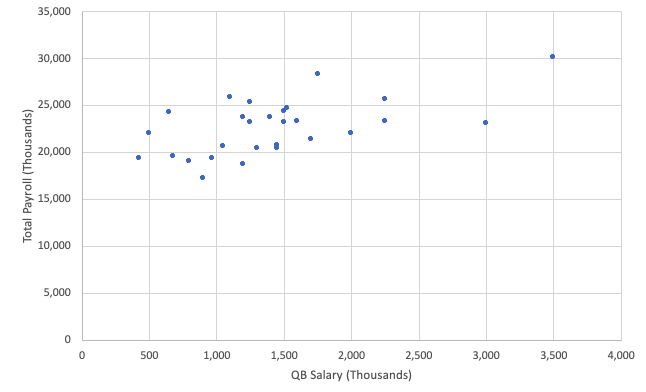
A scatterplot graph across a grid chart depicting the relationship between ‘QB Salary, in Thousands’, ranging from 0 to 4,000 at intervals of 500 on the x-axis, and ‘Total Payroll, in Thousands’, ranging from 0 to 35,000 at intervals of 5,000 on the y-axis. The data points marked are (900, 17,256), (3,000, 23,074), (1,050, 20,666), (650, 24,249), (500, 21,992), (967, 19,413), (675, 19,545), (1,450, 20,397), (1,200, 18,698), (1,100, 25,859), (2,000, 22,022), (1,750, 28,349), (1,400, 23,728), (425, 19,325), (2,250, 25,642), (1,600, 23,258), (800, 19,063), (1,525, 24,644), (1,700, 21,399), (1,500, 23,245), (2,250, 23,294), (1,300, 20,390), (1,500, 24,378), (1,450, 20,780), (1,200, 23,695), (1,250, 25,348), (3,500, 30,131), and (1,250, 23,246).

It seems that as the quarterback salary increases, as it moves to the right, the total payroll tends to increase as well.

hint
You can also see this using technology. If you want to use Excel, all you have to do is enter the data, select the area that you want, and pick the correct graph of scatterplot.

You may need to add labels to the axes, and sometimes there's a bit of extraneous stuff that you can get rid of. Overall, though, you can see that same set of data.

term to know
Scatterplot
A graphical display that allows us to see the relationship between two quantitative variables.


2. Multiple Data Sets

A great thing about scatterplots is that you can easily show multiple data sets onto one plot. The way this is done is by using different symbols to represent the different data sets.

EXAMPLE

Recall the in-context scenario from the previous section that compared quarterback salary to total team payroll. Suppose that you wanted to add an additional categorical variable. You want to know if the payrolls are different depending on conferences. There are two conferences in the National Football League, the NFC and the AFC.
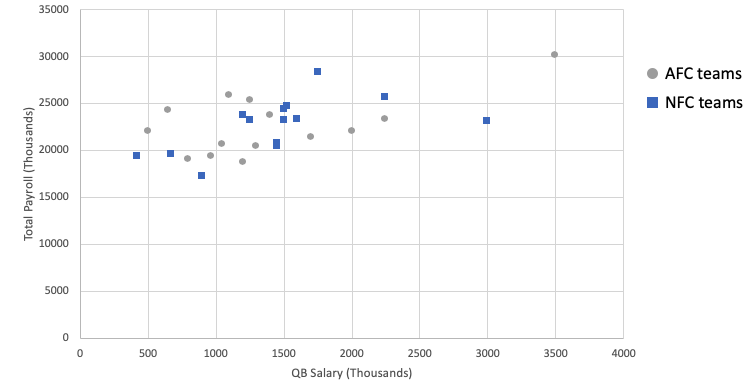
What you can do is use the same data, split the data between the two conferences, and use different symbols for AFC (a gray circle) or NFC (a blue square).

A scatterplot graph across a grid chart depicting the relationship between ‘QB Salary, in Thousands’, ranging from 0 to 4,000 at intervals of 500 on the x-axis, and ‘Total Payroll, in Thousands’, ranging from 0 to 35,000 at intervals of 5,000 on the y-axis. The plot contains two data sets identified by symbol shape. AFC teams are shown with circles at the points (1,050, 20,666), (650, 24,249), (500, 21,992), (967, 19,413), (675, 19,545), (1,100, 25,859), (2,000, 22,022), (1,400, 23,728), (425, 19,325), (1,600, 23,258), (800, 19,063), (1,700, 21,399), (2,250, 23,294), and (3,500, 30,131). NFC teams are shown with square markers at the points (900, 17,256), (3,000, 23,074), (1,450, 20,397), (1,200, 18,698), (1,750, 28,349), (2,250, 25,642), (1,525, 24,644), (1,500, 23,245), (1,300, 20,390), (1,500, 24,378), (1,450, 20,780), (1,200, 23,695), (1,250, 25,348), and (1,250, 23,246). A legend on the right identifies circles as AFC teams and squares as NFC teams.
You'll notice that it is the same scatterplot as before; however, the data points are separated by the two conferences, and this is visible with the two different symbols.

term to know
Multiple Data Sets
Plotting more than one data set on a scatterplot requires that we use different colors or symbols for the different data sets so we can see the relationships separately.


summary
Scatterplots are ways that you can show more than one quantitative attribute at a time for a particular data set. It is a way to show the relationship between two quantitative variables, which are paired data sets. These are two attributes for the same individuals in the data set. One variable, typically the one that we think might cause the other to happen, is assigned to the x-axis. The other is assigned to the y-axis. It's also possible to put in multiple data sets, using different symbols or different colors to denote the different sets.

Good luck!

Source: THIS TUTORIAL WAS AUTHORED BY SOPHIA LEARNING. PLEASE SEE OUR TERMS OF USE. Done X

Terms to Know
Multiple Data Sets

Plotting more than one data set on a scatterplot requires that we use different colors or symbols for the different data sets so we can see the relationships separately.

Scatterplot

A graphical display that allows us to see the relationship between two quantitative variables.

