Table of Contents |
A central task in social psychological research is developing tools that can capture complex social phenomena in a systematic and reliable way. Scale construction provides a framework for moving from theoretical ideas about thoughts, feelings, and behaviors to measurements that can be analyzed scientifically.
Scale construction begins with the challenge of translating psychological constructs—abstract concepts such as prejudice, self‑esteem, moral identity, or group cohesion—into concrete, measurable indicators. Because constructs are not directly observable, researchers must operationalize them through observable responses, such as answers to self‑report items, reaction times, behavioral choices, or physiological signals. Effective item creation is therefore not simply a matter of writing survey questions; it is a conceptual process grounded in theory.
A strong item‑writing process begins with a precise construct definition, which includes a clear articulation of the phenomenon the scale intends to measure.
EXAMPLE
Developing a measure of “perceived discrimination” requires specifying whether the focus is on frequency of discriminatory events, emotional impact, perceived intent, or some combination of these dimensions.Many psychological constructs are multidimensional, meaning they include several distinct but related components.
EXAMPLE
Anxiety may include physiological arousal, cognitive worry, and avoidance behaviors.Understanding whether a construct has one or multiple dimensions helps researchers create items that capture all of its important aspects.
Item creation also involves deciding between two basic types of scales. In a reflective model, the underlying trait influences how people respond to each item.
EXAMPLE
People with high self‑esteem tend to agree with many positive statements about themselves.In a formative model, the items work together to form the construct itself.
EXAMPLE
Socioeconomic status is made up of education, income, and occupation.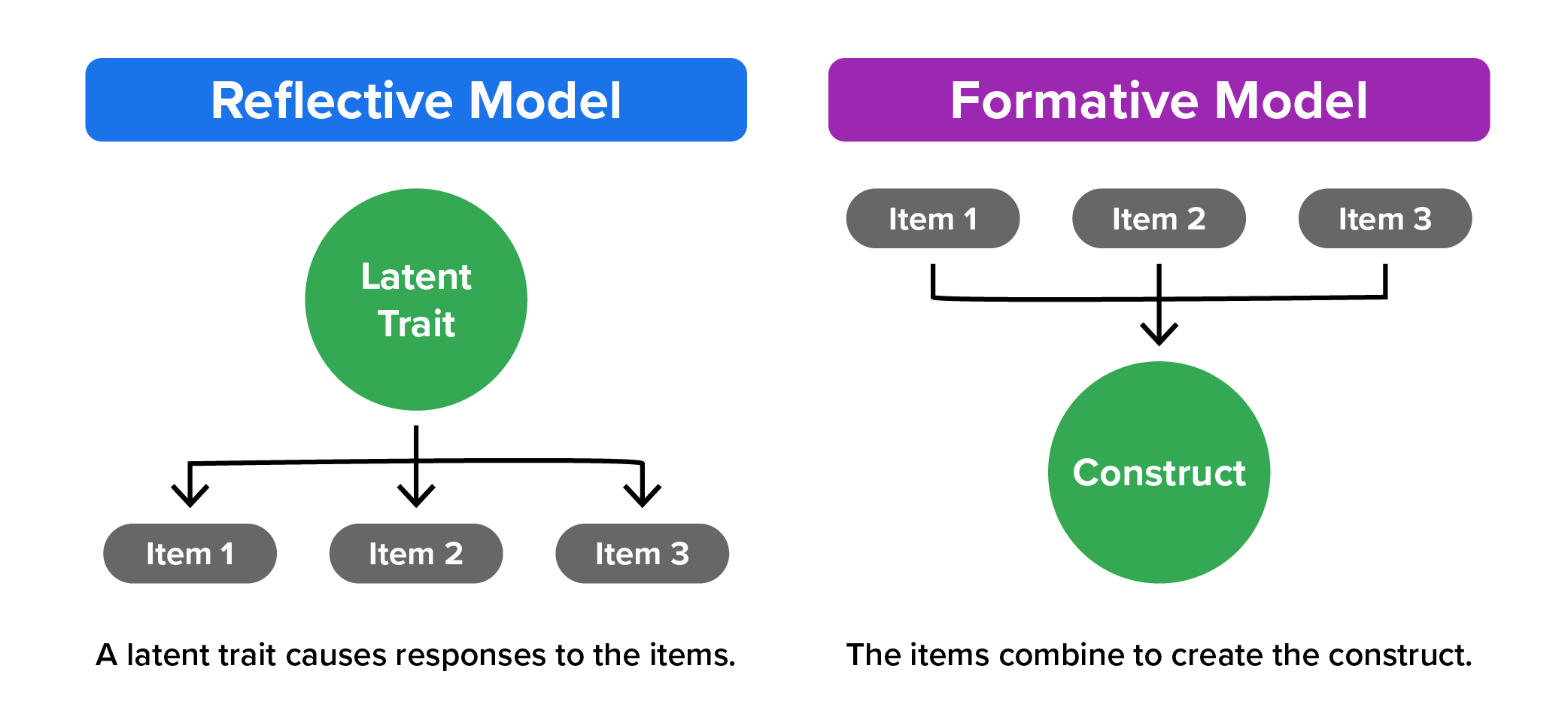
Confusing these two scale models can result in weak or inaccurate measures. Reflective constructs require items that show strong internal consistency, meaning the items should be closely related to one another, whereas formative constructs do not. After establishing the theoretical structure, researchers usually create more items than they plan to keep. These items are often based on previous research, existing scales, and input from experts to ensure that the construct is represented broadly and accurately.
Clear and precise wording is essential for minimizing measurement error, which refers to the gap between the construct a researcher intends to measure and the responses that are actually obtained. Well‑designed items use straightforward, everyday language and avoid double‑barreled items, which ask about more than one idea at the same time (for example, “I feel anxious and angry around groups”). Researchers also avoid leading or loaded wording, which subtly pushes respondents toward a particular answer (such as “Any reasonable person would agree that…”). These issues can introduce systematic bias and distort the measurement of the intended construct.
Before formal study data is collected, items should go through pilot testing, a process used to evaluate whether items function as intended. Two common pilot testing methods are cognitive interviewing, in which participants explain how they interpret and respond to each item, and expert review, in which knowledgeable researchers evaluate the items’ clarity and validity. Cognitive interviewing is especially important when working with diverse populations, because differences in culture, identity, and lived experience can affect how participants understand language, concepts, and response options.
IN CONTEXT
Cognitive Interviewing in a Variable Sample
Imagine a research team is developing a new scale to measure perceived microaggressions in academic settings among college students. After defining the construct and generating an initial pool of 35 items, the team conducts a pilot test with a small, variable sample of 25 students drawn from the target population.
The first phase involves cognitive interviewing, where participants are asked to “think aloud” as they respond to items.
Item: “I feel subtly excluded during group discussions.”
As participants verbalize their thoughts, the researchers discover that some students interpret “subtly excluded” as being ignored, others interpret it as not being invited, and a few interpret it as being interrupted.
Because the students’ interpretations vary widely, the researchers flag this item for revision to ensure a clearer, more consistent meaning.
Careful item creation helps researchers capture the subtle features of social psychological constructs and produces scales that are reliable and valid. When researchers combine clear theory, simple and precise wording, and careful pilot testing, they are better able to measure complex psychological ideas accurately.
Once strong items have been developed, the next step is evaluating how well a scale performs as a measurement tool. One of the most important qualities researchers examine is reliability.
Reliability refers to the consistency of a measurement, or whether a scale produces stable, dependable scores when the underlying attitude or trait has not actually changed. In social psychology, reliability matters because researchers must distinguish real psychological differences from random measurement error. Three major forms of reliability are especially important when evaluating a new scale.
Internal consistency assesses whether items intended to measure the same construct are closely related. Often summarized with Cronbach’s alpha, it reflects how well items “hang together.”
EXAMPLE
Items measuring ethnic identity should all be related; items that behave differently may reflect an unrelated construct.Test–retest reliability examines whether people obtain similar scores when they complete the same measure again after a reasonable interval, assuming the construct is stable. A prejudice scale, for instance, should yield similar scores across two administrations unless the person’s attitude has genuinely changed.
Inter‑rater reliability applies when human coders evaluate social behavior. It reflects the degree of agreement among raters, which is critical for studies involving behavioral observations, such as judging warmth, dominance, or aggression. Low agreement means conclusions about those behaviors are unreliable.
| Type | What It Means | Key Question | Example |
|---|---|---|---|
| Internal Consistency | Items measuring the same construct correlate well. | Do the items “hang together”? | Items about ethnic identity are all related to one another. |
| Test–Retest Reliability | Scores remain stable across time when the trait hasn’t changed. | Would someone get a similar score next week? | Prejudice scores remain similar 2 weeks later. |
| Inter-Rater Reliability | Independent observers agree in their ratings. | Do raters see behavior the same way? | Two coders rate the same interaction as equally warm. |
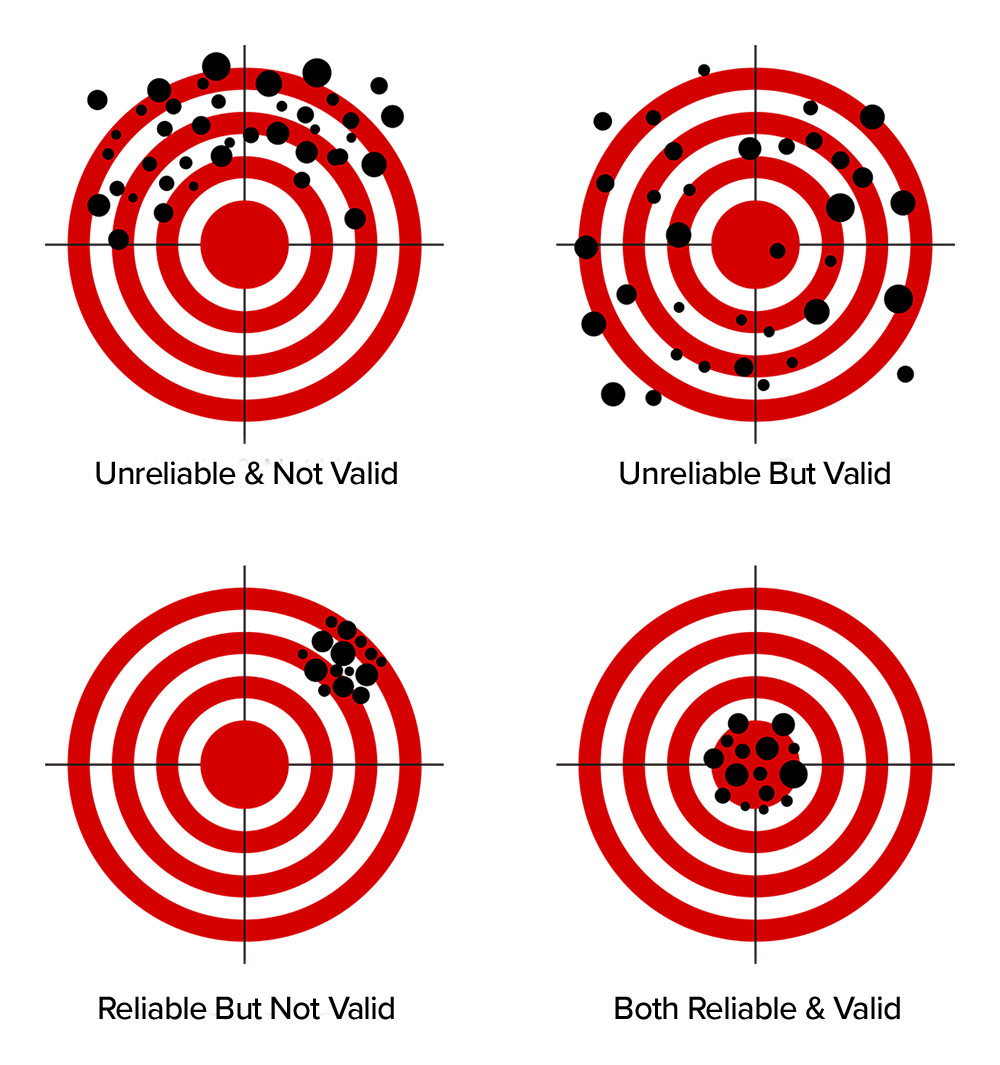
While reliability tells us whether a scale is consistent, consistency alone is not enough. Researchers must also examine validity. Validity refers to the accuracy of a measurement, or whether a scale truly captures the social psychological construct it claims to measure. Whereas reliability focuses on consistency, validity asks whether the measure reflects the right thing. In social psychology, strong validity ensures that researchers are measuring constructs such as belonging, prejudice, or social dominance orientation rather than unintended traits such as general negativity or anxiety.
One major form is content validity, which concerns how well the items represent the full conceptual range of the construct. A scale measuring “belonging in college,” for example, should include academic, social, and institutional components rather than focusing narrowly on comfort or enjoyment. Content validity is strengthened by psychological theory, expert review, and input from community stakeholders, who help ensure that important perspectives are not overlooked in sensitive domains such as discrimination or identity threat.
A second form, construct validity, evaluates whether the scale behaves as the theory predicts in relation to other variables. Convergent validity is demonstrated when a measure correlates with related constructs. Discriminant validity requires low correlations—a relationship showing how two things change together, with unrelated constructs; a prejudice scale should not simply duplicate personality traits such as neuroticism. Criterion‑related validity assesses whether a measure predicts relevant outcomes.
| Type | What It Evaluates | Example |
|---|---|---|
| Content Validity | Whether all important aspects of the construct are adequately covered | A “belonging in college” scale includes academic, social, and institutional belonging, not just comfort in class. |
| Construct Validity | Whether the scale fits into the broader theoretical network of related constructs | A discrimination scale relates to stress and identity threat but not to unrelated traits. |
| Convergent Validity | Whether measures that should be related are related | A new implicit racism measure shows moderate correlations with established implicit bias tasks. |
| Discriminant Validity | Whether the scale avoids measuring something else | A prejudice scale does not correlate strongly with neuroticism or general negativity. |
| Criterion-Related Validity | Whether scores relate meaningfully to real-world behaviors or performance | Early stereotype scores predict later hiring bias. |
Ultimately, validity is demonstrated through patterns of evidence, not a single statistic. A valid scale shows broad and appropriate content coverage, aligns with theory, correlates with related constructs, diverges from unrelated ones, and predicts meaningful behaviors. Together, these elements provide confidence that the measure accurately reflects the psychological construct of interest.
Many social psychological constructs are multidimensional, meaning they consist of several related but distinct components (e.g., warmth vs. competence in impression formation, admiration vs. contempt in intergroup emotions). Because these underlying dimensions, called latent constructs, cannot be observed directly, researchers use factor‑analytic models to examine whether items cluster together in the way theory predicts. Factor analysis helps determine the factor structure, or the pattern by which items load onto one or more latent dimensions.
Exploratory Factor Analysis (EFA) is used when researchers do not yet know how many dimensions the construct contains or how items should be grouped together. EFA helps uncover the natural structure within a set of items. EFA is therefore useful early in scale development when theory is still being refined.
EXAMPLE
An initial pool of 20 attitude items may split into factors representing blatant prejudice and subtle, symbolic prejudice, or into emotional dimensions.In contrast, Confirmatory Factor Analysis (CFA) is used when researchers have a specific theoretical model and want to test whether the data fit that structure. CFA evaluates whether items designed to measure a particular construct “hang together” and remain distinct from items measuring another construct.
Structural Equation Modeling (SEM) extends CFA by examining how multiple latent constructs relate to one another in a larger causal or correlational system. SEM allows researchers to test path models, where relationships among constructs are specified.
EXAMPLE
An SEM might test whether perceived discrimination increases identity threat, which in turn predicts depressive symptoms, with each construct measured by multiple items.SEM is particularly valuable in social psychology because it can evaluate complex theoretical mechanisms that involve several hidden psychological processes.
IN CONTEXT
From EFA to CFA to SEM: Testing a Measurement and Structural Model
Imagine researchers who want to measure students’ attitudes toward group work in college classes. They begin by writing 20 items that ask about students’ experiences during group projects, such as how comfortable they feel speaking up, whether they trust their group members, and how frustrated they feel when work is divided unfairly.
Because the researchers are not yet sure how these items relate to one another, they first conduct an Exploratory Factor Analysis (EFA). The EFA shows that the items fall into two clear groups. One group reflects positive group experiences, such as feeling supported, comfortable, and included. The other group reflects negative group experiences, such as frustration, conflict, and unequal effort. This result suggests that the scale measures two underlying dimensions instead of just one.
Next, the researchers collect data from a new group of students and run a Confirmatory Factor Analysis (CFA). CFA tests whether the two‑factor structure found earlier holds up. In other words, it asks whether the positive items group together as expected and whether the negative items form their own separate group. When the model fits well, it means the proposed structure makes sense.
Finally, the researchers use Structural Equation Modeling (SEM) to examine a larger question. They test whether having more positive group experiences predicts higher class engagement, which then leads to better course grades. SEM allows researchers to examine these relationships between underlying factors and outcomes within a single model.
When researchers compare scores across groups, they must ensure that the scale measures the same underlying construct in each group. This principle is called measurement invariance, and it asks whether score differences reflect true psychological differences rather than differences in how groups understand or respond to the items. Without invariance, a comparison like “Group X is more collectivistic than Group Y” may be misleading, because the scale itself may function differently across groups.
Measurement invariance is typically evaluated at several levels. Configural invariance checks whether the basic factor structure (which items belong to which factors) is the same across groups. Metric invariance examines whether items contribute to the construct to the same degree (e.g., by evaluating whether “assertiveness” items carry the same meaning for men and women in cultures with different gender norms). Scalar invariance asks whether groups share similar baseline levels on the items, ensuring that score differences represent real differences rather than response‑style artifacts. Together, these levels help researchers determine whether a scale is comparable across populations or across time.
Beyond invariance, several common measurement pitfalls can distort results in social psychology. Acquiescence bias is the tendency to agree with items regardless of content. This form of bias can inflate scores unless researchers include both positively and negatively worded items. Social desirability bias leads participants to underreport socially sensitive attitudes, such as prejudice. Poor item discrimination occurs when items fail to differentiate between people (e.g., universal statements like “Murder is bad”), offering little useful information. Finally, cultural or linguistic mismatch arises when translated or culturally transported items lose nuance.
In practice, any time a study claims that one group “scores higher” or “differs” on a construct, readers should ask, “Did the scale work the same way for all groups?” Without measurement invariance, cross‑group comparisons may reflect measurement artifacts and not true psychological differences.
Source: THIS TUTORIAL HAS BEEN ADAPTED FROM 1. OPENSTAX “INTRODUCTORY STATISTICS 2E.” ACCESS FOR FREE AT OPENSTAX.ORG/DETAILS/BOOKS/INTRODUCTORY-STATISTICS-2E, 2. OPENSTAX “LIFESPAN DEVELOPMENT.” ACCESS FOR FREE AT OPENSTAX.ORG/DETAILS/BOOKS/LIFESPAN-DEVELOPMENT. LICENSING: CREATIVE COMMONS ATTRIBUTION 4.0 INTERNATIONAL. ACCESSED BY JANUARY 2026.



