Table of Contents |
After the Great Depression, economists realized that they needed a better way to keep track of the U.S. economy. Even though it is normal to go through fluctuations of growth and contraction, they wanted a better way to predict when a major depression was coming and to measure economic growth over time.
The answer was to calculate gross domestic product (GDP), a term you should be quite familiar with at this point. Thus, they developed national income accounting.
So, to look at overall economic activity, we can consider two aspects:
Let’s start by discussing output.
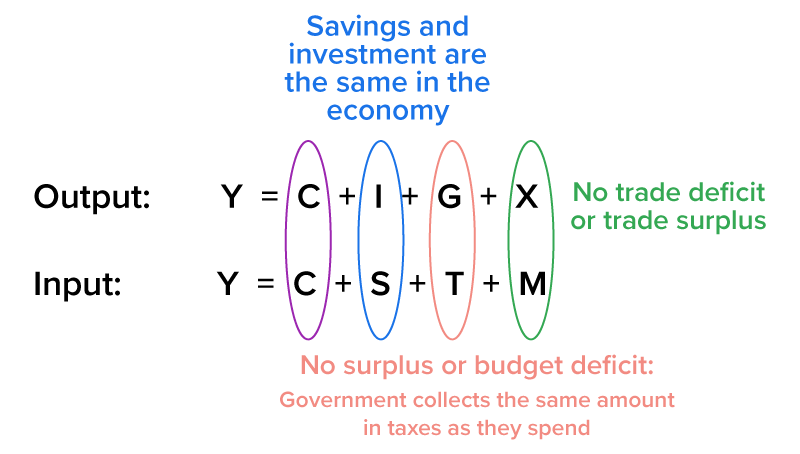
When we find output, we use the following equation. This is because when things are produced, the output can either be consumed, invested, purchased by the government, or exported to other nations.
 , where:
Now, let’s consider the other aspect, income. When income is earned, what can be done with it?
It can be consumed, saved, paid in taxes, or paid to other nations for imports.
 , where:
So, if we compare these two, we know that, clearly, consumption is consumption, and we have already covered how savings and investment are the same in the economy.
However, when will G be equal to T? That will be the case when the government collects in taxes exactly what it spends. This means it is running neither a surplus nor a budget deficit.
In this case, it means that X will have to be equal to M, or exports will be equal to imports, with no trade deficit or trade surplus.
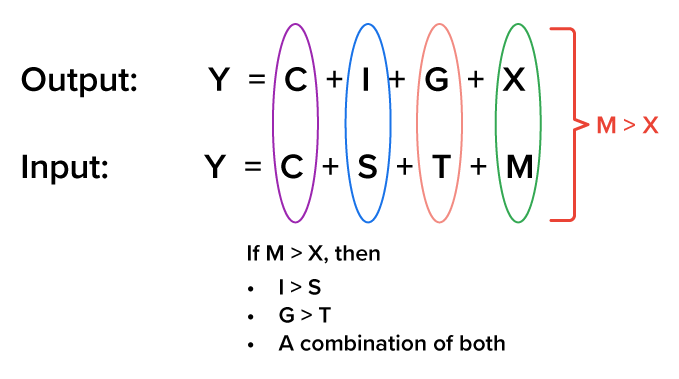
However, X does not usually equal M. Typically, we run a trade deficit. In other words, we import more than we export; that is, M > X.
This is called a trade deficit or current account deficit (which we will discuss shortly). A deficit refers to shortages that result from spending in excess of revenue.
If this is the case, then it means one of the following:
One way to measure the economic impact of international trade is to measure the balance of payments, which involves comparing our demand and supply of foreign exchange.
Balance of payments is defined as a record of all monetary transactions that flow across a country’s border, and its two major components are the current account and the capital account.
Related to the balance of payments is the balance of trade (BoT).
This is the key component of the balance of payments. It measures the difference between net export and import.
Factors that influence the balance of trade include the following:
The current account represents the sum of all recorded transactions, including traded goods, services, income, and net transfer payments.
It shows how much a nation has spent on foreign goods, services, income, and transfer payments compared to how much it has earned on all of those things.
So, we previously learned that a trade deficit means that we are running a current account deficit because we are spending more on the items that we are trading than we are receiving. We are importing more than we are exporting.
However, every transaction in the current account is going to be offset by a recorded transaction in the capital account, which captures investment and financing flows, not the actual physical flow of goods and services.
Inflows in the capital account have an appreciating impact on a given currency, whereas outflows have the opposite, or depreciating, impact.
This compares a nation’s ownership of foreign assets and foreign ownership of that nation’s assets.
EXAMPLE
The purchase or construction of machinery, buildings, and plants in other nations or investment in a foreign nation’s shares and bondsCircling back to the issue of a trade deficit, when our imports are greater than our exports, there is a current account deficit.
What this means is that more U.S. currency is being used to purchase items from foreigners than other currencies are being used to purchase U.S. goods.
This excess currency has to be used, and it will be used by foreigners to invest in the United States, both in private investments and in public U.S. Treasury securities.
This results in a capital account surplus, summarized in this chart:
| Trade Deficit | |
|---|---|
| Current Account | Capital Account |
| United States has spent more than it has made on goods and services, so there is a deficit in its current account. | Foreigners are investing in U.S. capital/securities with extra U.S. currency from the trade situation, so the United States has a surplus in the capital account. |
A current account deficit, or trade deficit, will cause a nation’s currency to depreciate or get weaker over time.
If we are running a trade deficit, it means that our nation’s currency is being supplied to purchase things from other nations. This weakens our currency. Once our currency is weaker, we do not want to buy foreign products as much, so the imports decrease.
Now, as soon as our currency is weaker, foreigners will want to purchase more U.S. goods, and exports will increase. The end result is that the current account deficit tends to disappear because of the impact on our currency.
Let’s wrap up today’s lesson by discussing the impact of international trade on economic growth.
Trading with other nations allows a country to focus on those goods and services in which it enjoys a comparative advantage because of its own particular resources, workforce skill level, or education.
The country, then, can trade in goods and services in which other nations enjoy a comparative advantage. (Note: Other lessons cover actual examples in greater detail.)
When both countries specialize in what they enjoy a comparative advantage in and trade, they are both better off than before.
Because international trade can increase production efficiency, it can actually increase the rate of economic growth, which is a good thing.
However, keep in mind that we have also learned that trade deficits and fiscal deficits create a need to borrow money, and when nations borrow money, it leads to foreign purchases of Treasury bonds.
The interest from those bonds is then paid to foreigners and must be subtracted from the GDP.
Therefore, while international trade can contribute to economic growth, in this aspect, the interest paid to foreigners can have a negative impact.
Source: THIS TUTORIAL WAS AUTHORED BY KATE ESKRA FOR SOPHIA LEARNING. PLEASE SEE OUR TERMS OF USE.



