Use Sophia to knock out your gen-ed requirements quickly and affordably. Learn more
×

Right Triangle Trigonometry

Author: Sophia

what's covered
In this lesson, you will use trigonometric functions to solve problems involving right triangles. Specifically, this lesson will cover:

Table of Contents

1. Finding Approximate Values of Trigonometric Functions

With the exception of multiples of 30 degree and 45 degree comma most other function values are more convenient to use when approximated by using your calculator.

Your calculator should have buttons labeled “SIN,” “COS,” and “TAN.” To evaluate one of these functions at a specific angle, it is important to make sure that your calculator is set to the appropriate angle mode.

Degree mode: the angle input of a sine or cosine function is treated as a degree measure. For example, when you evaluate sin open parentheses 25 close parentheses on your calculator, you will get the value of sin open parentheses 25 degree close parentheses.

Radian mode: the angle input of a sine or cosine function is treated as a radian measure. For example, when you evaluate sin open parentheses 25 close parentheses on your calculator, the angle is measured in radians.

EXAMPLE

Using a calculator, we’ll approximate the following values to four decimal places.

sin open parentheses 1.2 close parentheses almost equal to 0.9320 (The angle 1.2 is measured in radians, so be sure to put your calculator in radian mode before evaluating.)

cos open parentheses 72 degree close parentheses almost equal to 0.3090 (The angle 72 degree is measured in degrees, so be sure to put your calculator in degree mode before evaluating.)

tan open parentheses 3.78 close parentheses almost equal to 0.7421 (The angle 3.78 is measured in radians, so be sure to put your calculator in radian mode before evaluating.)

tan open parentheses 3.78 degree close parentheses almost equal to 0.0661 (The angle 3.78 degree is measured in degrees, so be sure to put your calculator in degree mode before evaluating.)

Some calculators have an angle feature that allows you to add a “degree” symbol at the end of the angle. If your calculator is in radian mode and you type in cos open parentheses 50 degree close parentheses, for example, it will return the cosine function of 50 degree. Check to see if your calculator has this feature, and use it if this makes things easier for you. It might be easier than switching the mode all the time.

Notice that your calculator does not have the reciprocal functions (secant, cosecant, and cotangent) as dedicated buttons. Remember that each of these functions is the reciprocal of one other trigonometric function. This will help to evaluate function values of secant, cosecant, and cotangent.

EXAMPLE

Evaluate sec open parentheses 2.3 close parentheses comma csc open parentheses 1.45 close parentheses comma and cot open parentheses short dash 2.17 close parentheses to four decimal places.

First, evaluate sec open parentheses 2.3 close parentheses.

sec open parentheses 2.3 close parentheses equals fraction numerator 1 over denominator cos open parentheses 2.3 close parentheses end fraction Use the identity sec theta equals fraction numerator 1 over denominator cos theta end fraction.
fraction numerator 1 over denominator cos open parentheses 2.3 close parentheses end fraction almost equal to short dash 1.5009 Approximate using a calculator.

Thus, sec open parentheses 2.3 close parentheses almost equal to short dash 1.5009.

Next, evaluate csc open parentheses 1.45 close parentheses.

csc open parentheses 1.45 close parentheses equals fraction numerator 1 over denominator sin open parentheses 1.45 close parentheses end fraction Use the identity csc theta equals fraction numerator 1 over denominator sin theta end fraction.
fraction numerator 1 over denominator sin open parentheses 1.45 close parentheses end fraction almost equal to 1.0073 Approximate using a calculator.

Thus, csc open parentheses 1.45 close parentheses almost equal to 1.0073.

Lastly, evaluate cot open parentheses short dash 2.17 close parentheses.

cot open parentheses short dash 2.17 close parentheses equals fraction numerator 1 over denominator tan open parentheses short dash 2.17 close parentheses end fraction Use the identity cot theta equals fraction numerator 1 over denominator tan theta end fraction.
fraction numerator 1 over denominator tan open parentheses short dash 2.17 close parentheses end fraction almost equal to 0.6830 Approximate using a calculator.

Thus, cot open parentheses short dash 2.17 close parentheses almost equal to 0.6830.

try it
Consider the expression sec open parentheses 40 degree close parentheses.
Evaluate the expression to four decimal places.
Remember that sec open parentheses 40 degree close parentheses equals fraction numerator 1 over denominator cos open parentheses 40 degree close parentheses end fraction. Using this fact, you should get approximately 1.3054 as your answer.

try it
Consider the expression cot open parentheses 321 degree close parentheses.
Evaluate the expression to four decimal places.
Remember that cot open parentheses 321 degree close parentheses equals fraction numerator 1 over denominator tan open parentheses 321 degree close parentheses end fraction. Using this fact, you should get approximately -1.2349 as your answer.


2. The Trigonometric Functions as They Relate to Sides of a Right Triangle

Now that we know how to approximate trigonometric functions of any angle, we are ready to solve application problems that involve right triangles.

Since a triangle’s angles have a sum of 180 degree comma a right triangle has two angles whose sum is 90 degree. These angles are called complements, and are described as complementary. Since the angles must be positive, they must have measures that are less than 90 degree comma which makes them acute angles.

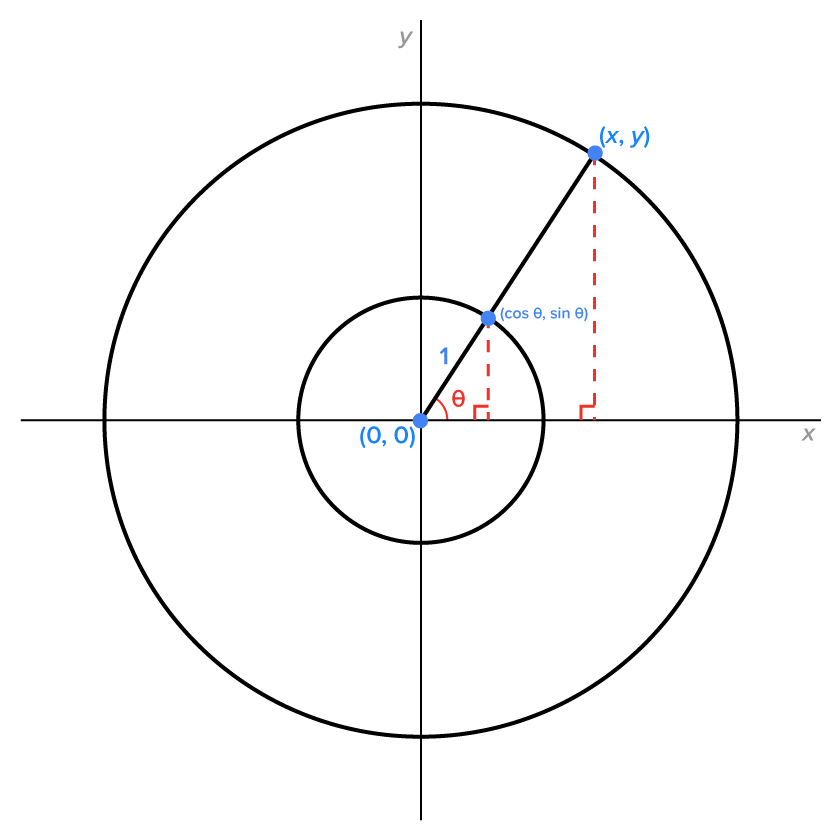
Consider the following picture, which shows two circles centered at the origin, with angle theta that terminates in the first quadrant.

  • The inner circle has radius 1, with angle theta having terminal point open parentheses cos   theta comma space sin   theta close parentheses.
  • The outer circle has radius r, where r greater than 0 comma with angle theta having terminal point open parentheses x comma space y close parentheses.
A graph with an x-axis and a y-axis showing two concentric circles centered at the origin. A line slants upward in the first quadrant from the origin passing through a marked point labeled ‘(cos theta, sin theta)’ on the inner circle and reaches the marked point (x, y) on the outer circle. A dashed vertical line extends downward from the point (x, y) to the x-axis, forming a right triangle. Another dashed vertical line extends downward from the point ‘(cos theta, sin theta)’ to the x-axis, forming another right triangle. The angle ‘theta’ is marked between the positive x-axis and the line, and the line segment from the origin to the inner circle is labeled ‘1'.

As it turns out, knowing the point open parentheses x comma space y close parentheses and its distance r from the origin, we can find the values of cos   theta and sin   theta comma and as a consequence, the value of each of the other trigonometric functions of angle theta.

Since the triangle is contained in the first quadrant, we know that 0 degree less than theta less than 90 degree comma meaning that theta is an acute angle. Note now the similar right triangles that are formed by dropping vertical lines from the points open parentheses cos   theta comma space sin   theta close parentheses and open parentheses x comma space y close parentheses.

Here is a closer look at these triangles, with the lengths of their sides labeled:
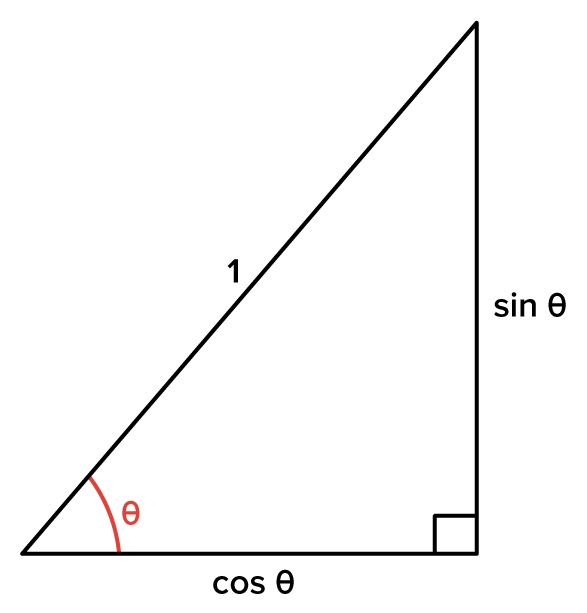
A right-angled triangle with the base labeled ‘cos theta’, the height labeled ‘sin theta’, and the hypotenuse labeled ‘1’. The right angle between the height and base is represented by a small square. The angle between the hypotenuse and the base is labeled ‘theta’. A right-angled triangle with the base labeled ‘x’, the height labeled ‘y’, and the hypotenuse labeled ‘r’. The angle between the hypotenuse and the base is labeled ‘theta’. The right angle between the height and base is represented by a small square.

Since these triangles are similar, we know that the lengths of the corresponding sides are in proportion to one another. This means that the ratio of any two sides in one triangle is equal to the ratio of the same two sides in the other triangle.

Using the base and the hypotenuse of each triangle, fraction numerator cos   theta over denominator 1 end fraction equals x over r comma which gives cos   theta equals x over r.

Using the height and hypotenuse from each triangle, fraction numerator sin   theta over denominator 1 end fraction equals y over r comma which means sin   theta equals y over r.

Thus, given that angle theta has a terminal side that contains the point open parentheses x comma space y close parentheses comma cos   theta equals x over r and sin   theta equals y over r.

Note: if r equals 1 comma as with the unit circle, we have cos   theta equals x and sin   theta equals y.

Recall also that tan   theta is the slope of the line containing the origin and the terminal point of the angle. It follows that tan   theta equals y over x.

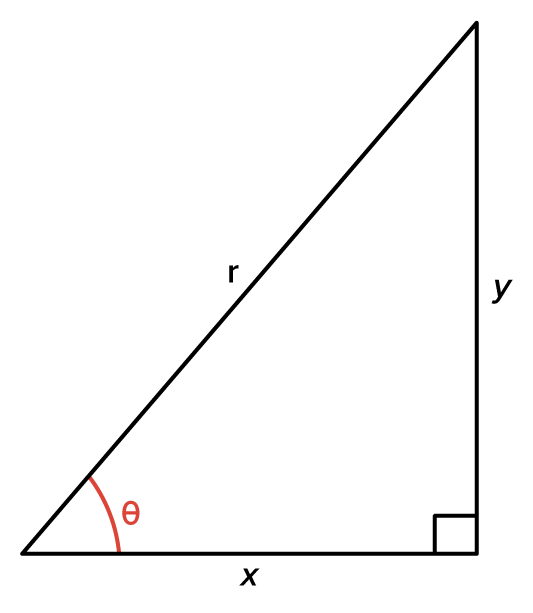
Given a right triangle as shown in the figure, we can find the sine, cosine, and tangent functions of the angle as follows.

A right-angled triangle with horiuzontal base labeled ‘x’, the vertical height labeled ‘y’, and the hypotenuse labeled ‘r’ The angle between the hypotenuse and the base is represented by ‘theta’. The right angle between the opposite and adjacent sides is represented by a small square.

  • sin theta equals y over r
  • cos theta equals x over r
  • tan theta equals y over x
To make the ratios more meaningful, notice that y is the side opposite angle theta and x is the side adjacent to theta. The side r is called the hypotenuse of the triangle.

Then, we can label the triangle this way.
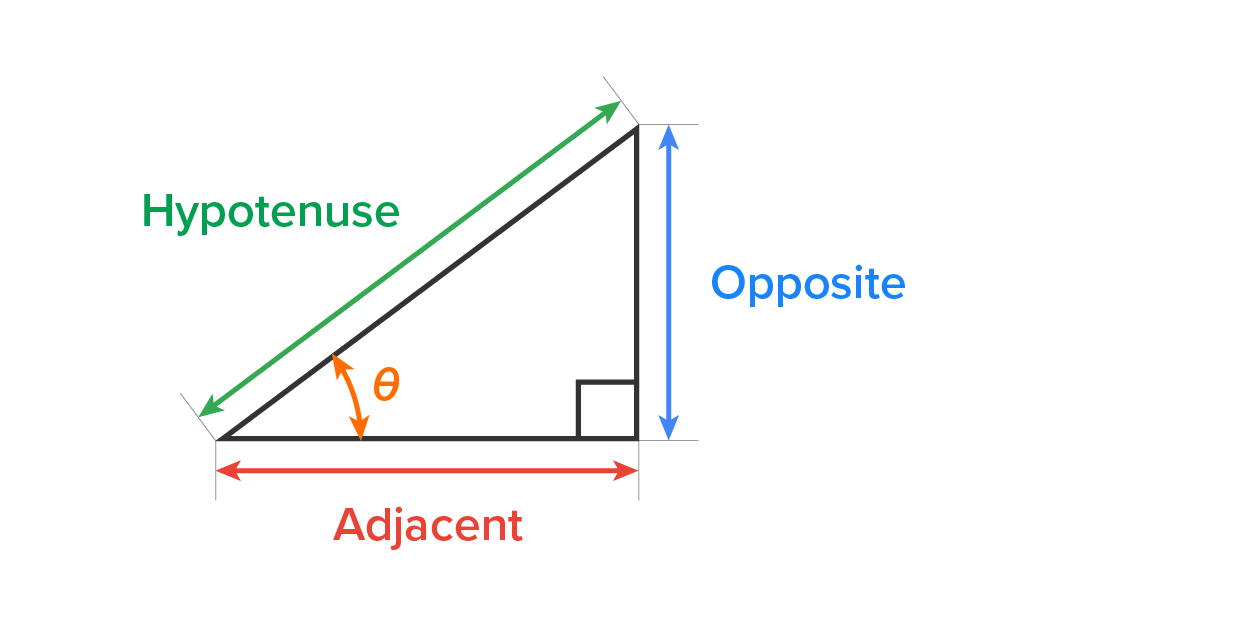
A right-angled triangle with its longest side labeled ‘Hypotenuse’, the vertical side labeled ‘Opposite’, and the horizontal side labeled ‘Adjacent’. The angle between the hypotenuse and the adjacent side is labeled theta (‘θ’). The right angle between the opposite and adjacent sides is represented by a small square.


The values of sin theta comma cos theta comma and tan theta are found as follows:

formula to know
Sine of an Angle in Terms of Sides of a Right Triangle
sin theta equals opposite over hypotenuse
Cosine of an Angle in Terms of Sides of a Right Triangle
cos theta equals adjacent over hypotenuse
Tangent of an Angle in Terms of Sides of a Right Triangle
tan theta equals opposite over adjacent

One way to remember these ratios is by the mnemonic “SohCahToa.” The S, C, and T stand for trig functions, and the lowercase letters after each capital letter are the sides that are used to compute the value of each function.

The sine, cosine, and tangent functions are the most commonly used. The value of each of the other trigonometric functions is computed by calculating the appropriate reciprocal.

watch
Given a right triangle, we’ll find the values of all six trigonometric functions of theta.

EXAMPLE

Consider the right triangle shown below.

A right-angled triangle with horizontal base labeled ‘12’, the vertical height labeled ‘5’, and the hypotenuse unlabeled. The angle between the hypotenuse and the base is represented by ‘theta’. The right angle between the opposite and adjacent sides is represented by a small square.

Use the triangle to find all six trigonometric functions of theta.

First, notice that the length of the hypotenuse is unknown. Since this is a right triangle, the Pythagorean theorem is used to find the unknown side.

a squared plus b squared equals c squared This is the Pythagorean theorem, where a and b are the lengths of the legs and c is the length of the hypotenuse.
5 squared plus 12 squared equals c squared Let a equals 5 and b equals 12.
169 equals c squared Simplify.
13 equals c Apply the square root property. Since c is the length of a side of a triangle, only the positive solution is considered.

Thus, the length of the hypotenuse is 13 units.

Now, we can compute the values of all trigonometric functions of theta.

Note: the opposite side has length 5 units, the adjacent side has length 12 units, and the hypotenuse has length 13 units.

sin theta equals 5 over 13           csc theta equals 13 over 5
cos theta equals 12 over 13          sec theta equals 13 over 12
tan theta equals 5 over 12           cot theta equals 12 over 5

try it
Consider the triangle shown below.
A right-angled triangle with base labeled '5', vertical height that is not labeled, and hypotenuse is labeled '6'. The angle alpha is presented, showing the angle between the base and the hypotenuse. A square between the base and height is drawn to show the right angle between them.
Find the values of all six trigonometric functions of the labeled angle.
First, find the unknown side using the Pythagorean Theorem.

Let y = the unknown side.

5 squared plus y squared equals 6 squared Set up the Pythagorean Theorem with sides 5 and 6 known.
25 plus y squared equals 36 Simplify.
y squared equals 11 Subtract 25 from both sides.
y equals square root of 11 Apply the square root principle. Since a side cannot have a negative value, only the positive solution is considered.

Thus, the unknown side opposite alpha is square root of 11.

Then, we have the following:

sin   alpha equals opp over hyp equals fraction numerator square root of 11 over denominator 6 end fraction csc   alpha equals fraction numerator 6 over denominator square root of 11 end fraction equals fraction numerator 6 square root of 11 over denominator 11 end fraction
cos   alpha equals adj over hyp equals 5 over 6 sec   alpha equals 6 over 5
tan   alpha equals opp over adj equals fraction numerator square root of 11 over denominator 5 end fraction cot   alpha equals fraction numerator 5 over denominator square root of 11 end fraction equals fraction numerator 5 square root of 11 over denominator 11 end fraction

Note: While we could remember the right-triangle ratios for csc, sec, and cot, it is usually easier to just remember that csc, sec, and cot are the reciprocals of sin, cos, and tan respectively.

Now we will look at problems in which the measure of an angle is known, and we wish to find the other sides and angles of a triangle.

EXAMPLE

Consider the triangle shown below.

A right-angled triangle with base labeled 'x', vertical height labeled 'y', and hypotenuse labeled '25'. The angle alpha is presented, showing the angle between the side marked 'y' and the hypotenuse. Another angle is labeled '18 degrees' and measures the angle between the base and the hypotenuse. A square is labeled where the base and height meet, indicating that the angle is 90 degrees.

Find the values of x, y, and alpha comma rounded to the nearest whole number.

First, remember that the sum of the measures of the angles in a triangle is 180 degree. Then, 90 degree plus 18 degree plus alpha equals 180 degree comma which means alpha equals 72 degree.

To find the lengths of the unknown sides, we’ll use the given 18 degree as reference.

This means that sin   18 degree equals y over 25 comma cos   18 degree equals x over 25 comma and tan   18 degree equals y over x. The last equation is not very helpful since it has two variables in it.

Consider the equation sin   18 degree equals y over 25.

Multiplying both sides by 25, we have 25 sin   18 degree equals y. Using a calculator in degree mode, y almost equal to 8.

Next, consider the equation cos   18 degree equals x over 25.

Multiplying both sides by 25, we have 25 cos   18 degree equals x. Using a calculator in degree mode, x almost equal to 24.

Note: once you have the lengths of two sides of a right triangle, the Pythagorean theorem can be used to find the third side, but be sure to use all the decimal places, since using the rounded value of a side can result in a rounding error.

think about it
Do you feel that using a trigonometric function was easier?

watch
In this video, we will find the unknown sides and angles of a given right triangle by using trigonometric functions.

try it
Consider the right triangle given below.
A right-angled triangle with base labeled ‘x’, the height labeled ‘8’, and the hypotenuse labeled ‘r’. The right angle between the base and height is represented by a small square. The angle between the hypotenuse and the base is labeled ‘64 degrees’.
Find the approximate lengths of the unknown sides, rounded to the nearest whole number.
There are several ways to solve this problem. Here is one strategy:

Relative to angle 64 degree comma x is the adjacent side and 8 is the opposite. These can all be related by the tangent function:

tan 64 degree equals 8 over x tan   theta equals opp over adj
x   tan 64 degree equals 8 Multiply both sides by x.
x equals fraction numerator 8 over denominator tan 64 degree end fraction Divide both sides by tan 64 degree.
x almost equal to 4 Round to the nearest whole number.

Next, there are several ways to find r, but since we want to practice trigonometric functions, we’ll use the sin function since 8 is opposite the given angle and we wish to find the hypotenuse.

sin 64 degree equals 8 over r sin   theta equals opp over hyp
r   sin 64 degree equals 8 Multiply both sides by r.
r equals fraction numerator 8 over denominator sin 64 degree end fraction Divide both sides by sin 64 degree.
r almost equal to 9 Round to the nearest whole number.

To the nearest whole number, x almost equal to 4 and r almost equal to 9.

terms to know
Right Triangle
A triangle that contains a right angle.
Complementary Angles, Complements
Two acute angles whose sum is 90 degree comma or in radians, their sum is straight pi over 2.
Acute Angle
Angle whose measure is positive and less than 90 degree comma or in radians, less than straight pi over 2.


3. Cofunction Identities

The two acute angles in a right triangle are complementary. It turns out that trigonometric functions of complementary angles are related. Consider the right triangle shown below.

A right-angled triangle with base labeled 'a', vertical height labeled 'b', and hypotenuse labeled 'c'. The angle theta is presented, showing the angle between the side marked 'a' and the hypotenuse. Another angle is labeled '90 degrees minus theta' and measures the angle between the sides marked 'b' and 'c'. A square is labeled where the base and height meet, indicating that the angle is 90 degrees.

If theta is the measure of one acute angle, then the measure of the other is 90 degree minus theta.

Here are the six trigonometric functions evaluated for theta and its complement, 90 degree minus theta.

Trigonometric Functions of bold italic theta Trigonometric Functions of bold 90 bold degree bold minus bold italic theta
sin theta equals b over c sin open parentheses 90 degree minus theta close parentheses equals a over c
cos theta equals a over c cos open parentheses 90 degree minus theta close parentheses equals b over c
tan theta equals b over a tan open parentheses 90 degree minus theta close parentheses equals a over b
cot theta equals a over b cot open parentheses 90 degree minus theta close parentheses equals b over a
csc theta equals c over b csc open parentheses 90 degree minus theta close parentheses equals c over a
sec theta equals c over a sec open parentheses 90 degree minus theta close parentheses equals c over b

By comparing values of the trig functions, we have six pairs of expressions that are equal:

formula to know
Cofunction Identities
table attributes columnalign left end attributes row cell sin theta equals cos open parentheses 90 degree minus theta close parentheses end cell row cell cos theta equals sin open parentheses 90 degree minus theta close parentheses end cell row cell tan theta equals cot open parentheses 90 degree minus theta close parentheses end cell row cell cot theta equals tan open parentheses 90 degree minus theta close parentheses end cell row cell csc theta equals sec open parentheses 90 degree minus theta close parentheses end cell row cell sec theta equals csc open parentheses 90 degree minus theta close parentheses end cell end table

The first two equations tell us that the sine of one angle is the cosine of its complement, and vice versa. The functions sine and cosine are called “cofunctions” since one has a “co” and the other doesn’t. Notice that secant and cosecant are cofunctions, as well as tangent and cotangent.

The main idea is that cofunctions of complementary angles are equal.

One can also write the cofunction identities in terms of radians. To do so, replace 90 degree with straight pi over 2.

In order to use the cofunction identities effectively, we need to know how to find complementary angles, more specifically with radians.

EXAMPLE

Find the complement of straight pi over 5.

Two acute angles are complements if their sum is straight pi over 2.

Thus, the complement of straight pi over 5 is straight pi over 2 minus straight pi over 5 equals fraction numerator 5 straight pi over denominator 10 end fraction minus fraction numerator 2 straight pi over denominator 10 end fraction equals fraction numerator 3 straight pi over denominator 10 end fraction.

try it
Consider the angle 31.2 degree.
What is its complement?
Since complements add up to 90 degree comma the complement of 31.2 degree is 90 degree minus 31.2 degree equals 58.8 degree.

try it
Consider the angle fraction numerator 3 straight pi over denominator 7 end fraction.
What is its complement?
The complement is straight pi over 2 minus fraction numerator 3 straight pi over denominator 7 end fraction equals fraction numerator 7 straight pi over denominator 14 end fraction minus fraction numerator 6 straight pi over denominator 14 end fraction equals straight pi over 14.

Using complements, we can rewrite trigonometric expressions using cofunction identities.

EXAMPLE

The expressions sin   42 degree and cos   48 degree are equal by the cofunction identities, since sine and cosine are cofunctions, and 42 degree and 48 degree are complements.

The expressions tan open parentheses straight pi over 14 close parentheses and cot open parentheses fraction numerator 3 straight pi over denominator 7 end fraction close parentheses are equivalent since tangent and cotangent are cofunctions, and straight pi over 14 and fraction numerator 3 straight pi over denominator 7 end fraction are complements.

try it
Consider the expression sec open parentheses 78 degree close parentheses.
Using cofunction identities, write an equivalent expression.
The appropriate cofunction identity is sec   theta equals csc open parentheses 90 degree minus theta close parentheses.

Using theta equals 78 degree comma we have 90 degree minus 78 degree equals 12 degree comma and thus the identity tells us that sec open parentheses 78 degree close parentheses equals csc open parentheses 12 degree close parentheses.

try it
Consider the expression cos open parentheses straight pi over 6 close parentheses.
Using cofunction identities, write an equivalent expression.
The cofunction identity states that cos   theta equals sin open parentheses straight pi over 2 minus theta close parentheses.

Therefore, to complete this identity, cos open parentheses straight pi over 6 close parentheses equals sin open parentheses straight pi over 2 minus straight pi over 6 close parentheses equals sin open parentheses straight pi over 3 close parentheses.


4. Solving Real-Life Problems Using Right Triangles

Trigonometric functions are useful in determining the height of very tall objects.

Consider the figure below.
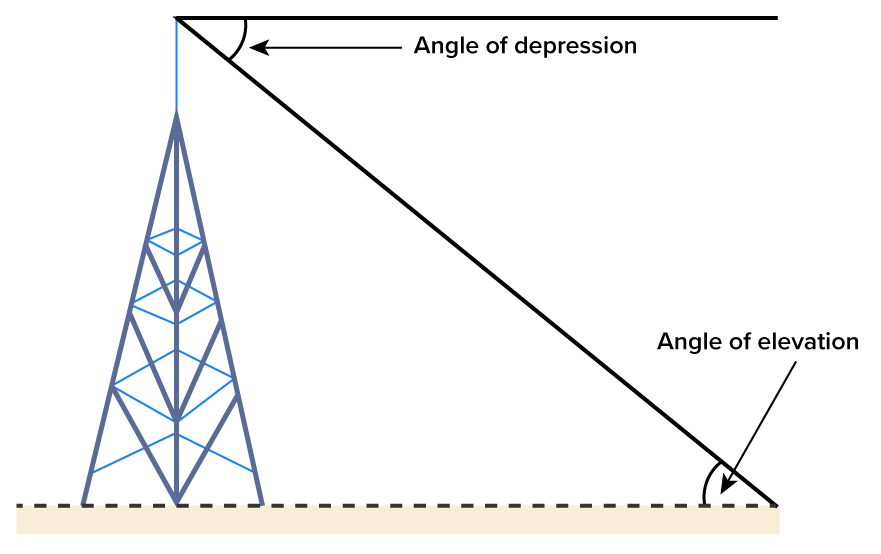
A horizontal dashed line represents the ground level, and a tower is drawn with its base on the grround . From the top of the tower, two solid lines extend: one line extends horizontally to the right, and the other slants downward toward the ground and meets the end of the horizontal dashed line. The angle formed between the solid horizontal line at the top and the downward slanting line is labeled ‘Angle of depression’, and the angle formed between the slanted line and the dashed horizontal line is labeled ‘Angle of elevation’.

To measure the height of the tower, it would be dangerous to climb the structure with a tape measure in one hand to measure the height. As the picture suggests, one could stand a distance away from the base of the tower and determine the angle of elevation to the top of the building, then use trigonometry to find the height of the building. The angle of depression is made with the horizontal that points downward toward an object

In order to solve problems in this lesson, you’ll need to do the following:

step by step
  1. Draw a right triangle that represents the situation.
  2. Label all known sides and angles.
  3. Label the side you wish to find.
  4. Use an appropriate trigonometric function to solve for that side.

EXAMPLE

From a point 30 feet away from the base of a tree, the angle of elevation to the top of the tree is 42 degree. What is the height of the tree, to the nearest foot?

Here is a picture of this situation:

A right-angled triangle with a tree representing the vertical side of the triangle. The ground represents the horizontal base of the triangle, which is labeled ‘30 ft’. The hypotenuse is represented by a line slanting upward from the ground to the top of the tree. The angle between the hypotenuse and the ground is labeled ‘42 degrees’. The vertical side is labeled ‘Height’ to indicate the height of the tree.

Notice that the hypotenuse is not known, and it is not needed. Let h equals the height of the tree.

Referencing the given angle 42 degree comma we want to find its opposite side, and we know the length of its adjacent side. This means we should use the tangent function.

tan   42 degree equals h over 30 tan theta equals opposite over adjacent
30   tan   42 degree equals h Multiply both sides of the equation by 30.
h almost equal to 27 Approximate the solution.

The height of the tree is approximately 27 feet.

try it
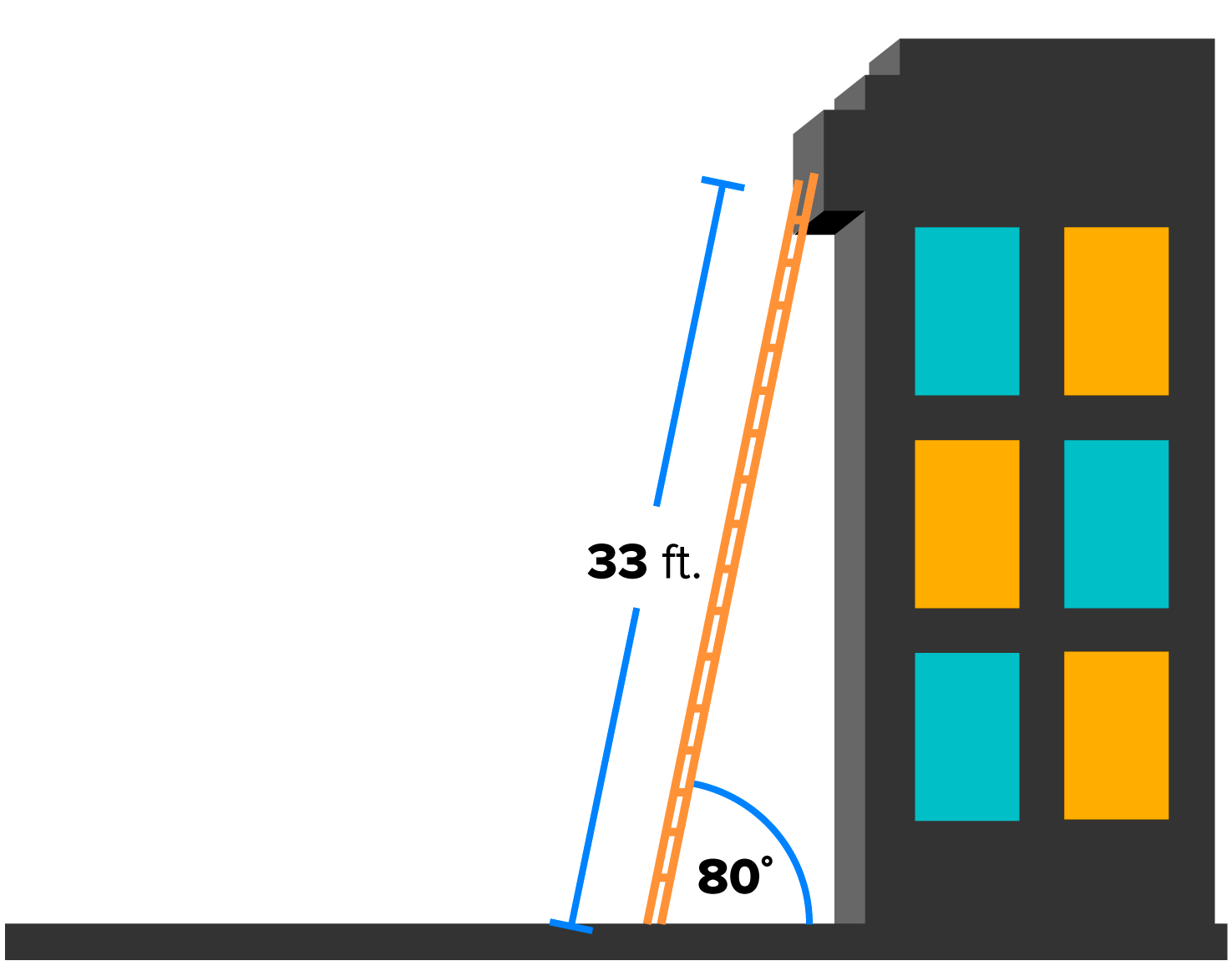
A 33-ft ladder leans against a building so that the angle between the ground and the ladder is 80 degree.

A ladder leans against a building. The length of the ladder is 33 feet and the angle between the ladder and the ground is 80 degrees.

To the nearest tenth of a foot, how high does the ladder reach up the side of the building?
From the picture, we can see that the hypotenuse is the length of the ladder, which is 33 ft, and the angle opposite the height is 80 degree.

This means that the sin function is appropriate to solve this problem. Let h equals the height of the ladder against the building:

sin   80 degree equals h over 33 sin   theta equals opp over hyp
33   sin   80 degree equals h Multiply both sides by 33.
h almost equal to 32.4987... Approximate h.

To the nearest tenth, the ladder reaches a height of 32.5 feet.

Sometimes two right triangles are needed to solve problems.

watch
In this video, we’ll solve the following problem.

A radio tower is located 400 feet from a building. From a window in the building, a person determines that the angle of elevation to the top of the tower is 36 degree comma and that the angle of depression to the bottom of the tower is 23 degree. How tall is the tower to the nearest tenth of a foot?

try it
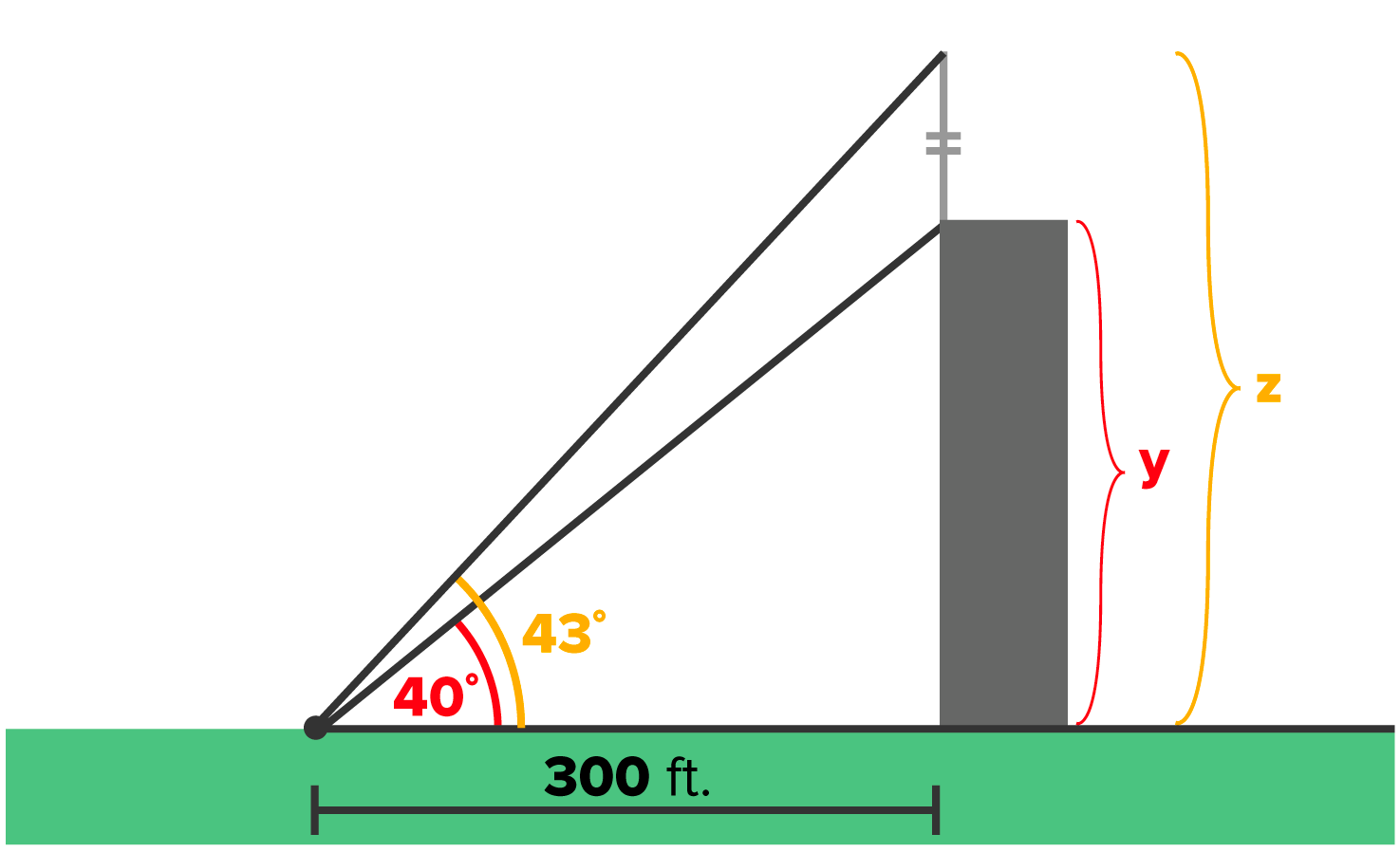
There is an antenna on top of a building. From a point 300 feet from the base of the building, the angle of elevation to the top of the building is measured to be 40 degree. The angle of elevation to the top of the antenna is measured to be 43 degree.

A vertical rectangle depicts a building and its height is marked ‘y’. A marked point on the ground, 300 feet from the base of the building, has two slanted lines drawn upward to the right: one making a 40 degree angle with the ground level that ends at the top of the building, and the other makes a 43 degree angle with the ground level, and ends directly above the previous line, and is marked with having height ‘z’.

To the nearest foot, how tall is the antenna?
The base of the triangle is 300 feet.

Let y equals the height of the building.

Let z equals the height of the building and the antenna combined.

Then, we want to find z minus y.

To find y, notice that y is the side opposite the 40 degree angle. Since the adjacent side is known, use the tangent function:

tan   40 degree equals y over 300 tan   theta equals opp over adj
300   tan   40 degree equals y Multiply both sides by 300 to solve for y.
y almost equal to 251.73 Approximate y.

Now, follow a similar idea to find z:

tan   43 degree equals z over 300 tan   theta equals opp over adj
300   tan   43 degree equals z Multiply both sides by 300 to solve for z.
z almost equal to 279.75 Approximate z.

Next, find the difference, then round to the nearest whole number.

279.75 minus 251.73 equals 28.02 comma which rounds to 28 feet.

This means that the height of the antenna is approximately 28 feet.

terms to know
Angle of Elevation
An angle made with the horizontal that points upward toward an object.
Angle of Depression
An angle made with the horizontal that points downward toward an object.

summary
In this lesson, you began by understanding that the most convenient way to find approximate values of trigonometric functions is by using your calculator, making sure that your calculator is set to the appropriate angle mode (degree or radian). Next, you learned that in order to solve problems involving the trigonometric functions as they relate to sides of a right triangle, one must know how to approximate trigonometric functions of angles other than the special angles left parenthesis 0 degree comma 30 degree comma 45 degree comma 60 degree comma 90 degree right parenthesis. Then, you apply the trigonometric functions to right triangles, where the value of a trigonometric function is the ratio of two sides. You also learned that the relationship between the two acute angles in a right triangle (as complementary angles) gives way to the cofunction identities, the main idea being that cofunctions of complementary angles are equal. Finally, you learned that you can solve many real-life problems, particularly with angles of depression and elevation, by using a right triangle as a model.

SOURCE: THIS TUTORIAL HAS BEEN ADAPTED FROM OPENSTAX "PRECALCULUS” BY JAY ABRAMSON. ACCESS FOR FREE AT OPENSTAX.ORG/DETAILS/BOOKS/PRECALCULUS-2E. LICENSE: CREATIVE COMMONS ATTRIBUTION 4.0 INTERNATIONAL.

Terms to Know
Acute Angle

Angle whose measure is positive and less than 90 degree comma or in radians, less than straight pi over 2.

Angle of Depression

An angle made with the horizontal that points downward toward an object.

Angle of Elevation

An angle made with the horizontal that points upward toward an object.

Complementary Angles, Complements

Two acute angles whose sum is 90 degree comma or in radians, their sum is straight pi over 2.

Right Triangle

A triangle that contains a right angle.

Formulas to Know
Cofunction Identities

sin theta equals cos open parentheses 90 degree minus theta close parentheses</p>
<p>cos theta equals sin open parentheses 90 degree minus theta close parentheses</p>
<p>tan theta equals cot open parentheses 90 degree minus theta close parentheses</p>
<p>cot theta equals tan open parentheses 90 degree minus theta close parentheses</p>
<p>csc theta equals sec open parentheses 90 degree minus theta close parentheses</p>
<p>sec theta equals csc open parentheses 90 degree minus theta close parentheses

Cosine of an Angle in Terms of Sides of a Right Triangle

cos theta equals adjacent over hypotenuse

Sine of an Angle in Terms of Sides of a Right Triangle

sin theta equals opposite over hypotenuse

Tangent of an Angle in Terms of Sides of a Right Triangle

tan theta equals opposite over adjacent