Table of Contents |
Revenue is the income a firm generates from selling its products. Total revenue depends on the quantity sold and the price charged for a product. If the firm sells a higher quantity of output at a given price, then total revenue will increase. If the market price of the product increases for a given quantity of output, then total revenue also increases. Total sales revenue (TR) is the price (P) of an item multiplied by the number of units sold (Q).

EXAMPLE
C&C Family Farm sells strawberries by the pound. How can the firm maximize its sales revenue? If the firm decides to produce 1000 pounds of strawberries, and sells them for $2 a pound, then total sales revenue is $2000. If the price doubles, to $4 per pound, then total sales revenue for 1000 pounds will double to $4000. On the other hand, if C&C Family Farm doubles output to 2000 pounds, but sells at the $2 price, then total sales revenue still doubles to $4000. Either higher prices or a higher quantity of output sold will increase sales revenue.Consider the total sales revenue table below. Notice that a pound of strawberries is priced at $1.67 (column 2), and that the price does not change in this example. In the third column the total revenue is reported for each level of output. We will assume if a given level of output has been produced then it will also be sold.
The firm earns no revenue when it produces no product for sale. In the second row, total revenue is $167.00 (100 units sold * $1.67 per pound). The total revenue increases for each quantity of total output from 100 units sold onward. The highest revenue is earned from selling 400 pounds of strawberries. But is 400 pounds the profit-maximizing output level?
|
Total Output (Q) (in Pounds) (1) |
Price per Pound (2) |
Total Sales Revenue (TR = P * Q) (3) |
|---|---|---|
| 0 | $1.67 | $0.00 |
| 100 | $1.67 | $167.00 |
| 230 | $1.67 | $384.10 |
| 290 | $1.67 | $484.30 |
| 350 | $1.67 | $584.50 |
| 380 | $1.67 | $634.60 |
| 400 | $1.67 | $668.00 |
Do you remember learning about price elasticity in the first Challenge of this Unit? Price elasticity measures the sensitivity of quantity demanded to changes in a product’s price.
Price Elastic Demand: If demand for the concert tickets is price elastic, buyers are sensitive to a price change. A price change of 1% causes a change in quantity demanded of more than 1%. Since sales revenue is price (P) times quantity sold (Q), a price decrease will increase the quantity sold, and increase total revenue for the band,
Price Inelastic Demand: If demand for the concert tickets is price inelastic, buyers are less responsive to a price change. A price change of 1% causes a change in quantity demanded of less than 1%. Since sales revenue is price (P) times quantity sold (Q), a price increase will have a lesser effect on the quantity sold, and increase total revenue for the band.
Unit Elastic Demand: If demand for the concert tickets is unit elastic, buyers are responsive to a price change. A price change of 1% causes a change in quantity demanded of 1%. Since sales revenue is price (P) times quantity sold (Q), an increase in price will cause an equal change in quantity sold, and total revenue will remain the same.
Measuring revenue in multiple ways is beneficial, because each way provides the firm with insights into its operation. Another way to measure revenue on a per unit basis is to calculate it as an average. The average revenue is the revenue earned, on average, from selling a specific level of output. Average revenue is total revenue divided by the quantity of output produced. We will assume if a given level of output has been produced that it will also be sold.

Let’s consider the revenue for the strawberry farm. The table shows sales revenue figures for C&C Family Farm. Column 1 is total output and column 3 is total sales revenue. As stated, we will assume that if a given level of output has been produced then it will also be sold. While we cannot calculate average revenue for the first row, because we don’t divide by zero, we can calculate average revenue for rows two through seven. In column 5, notice that the average revenue for row two is $167.00 / 100 units, or $1.67. This is the same value for all rows in column 5.
|
Total Output (Q) (in Pounds) (1) |
Price per Pound (2) |
Total Revenue (TR = P * Q) (3) |
Marginal Revenue
(MR = Change in TR/ Change in Total Output) (4) |
Average Revenue (AR = TR / Total Output) (5) |
|---|---|---|---|---|
| 0 | $1.67 | $0.00 | - | - |
| 100 | $1.67 | $167.00 | $1.67 | $1.67 |
| 230 | $1.67 | $384.10 | $1.67 | $1.67 |
| 290 | $1.67 | $484.30 | $1.67 | $1.67 |
| 350 | $1.67 | $584.50 | $1.67 | $1.67 |
| 380 | $1.67 | $634.60 | $1.67 | $1.67 |
| 400 | $1.67 | $668.00 | $1.67 | $1.67 |
Did you notice that three of the five columns’ variables in the table have the same value? Price, marginal revenue, and average revenue have the same numeric value of $1.67 per pound.
The graph below shows a price of $1.67 extending horizontally across all quantities of output. The relationship between average revenue and the quantity of output produced begins at 100 units of output (same as in the chart above). The average revenue curve represents the average revenue per unit for a given quantity of output. Marginal revenue represents the added revenue from selling the unit of output. Notice that the marginal revenue curve and the average revenue curve are both red, and that there is only one red line representing both AR and MR. This is because the AR curve and the MR curve are the same. So how do we explain this? When all customers are charged the same price, average revenue and marginal revenue are equal to the price. Price, average revenue, and marginal revenue are represented by the same curve.
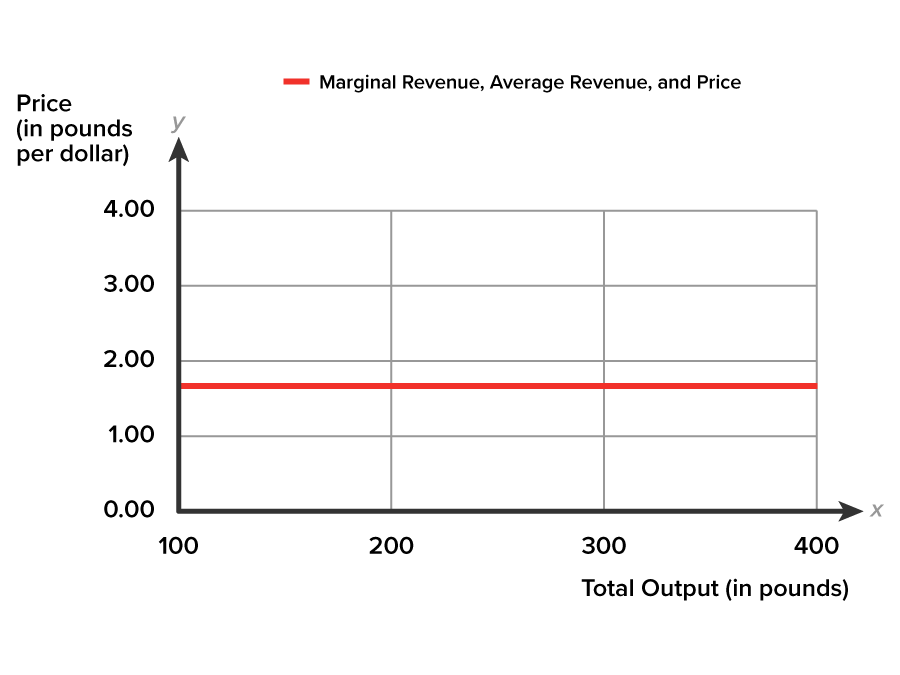
Each point on the average revenue curve represents the price of the product and the quantity sold in the market. Recall that a demand curve represents the price of the product and the quantity sold in the market. In this case the demand curve is horizontal at one price ($1.67). The average revenue curve is the firm’s product demand curve in the market.
Knowing that its demand curve is horizontal gives C&C Family Farm an important piece of information. In this scenario, the elasticity of demand for strawberries is perfectly elastic. C&C Family Farm cannot raise its price above $1.67, or its sales revenue will plunge to zero. The firm’s price is set by the market.
In the next Unit, you will learn about market environments, and how firms profit even when the price is determined by the market.
Source: THIS TUTORIAL HAS BEEN ADAPTED FROM OPENSTAX “PRINCIPLES OF ECONOMICS 2E”. ACCESS FOR FREE AT https://openstax.org/books/principles-economics-2e/pages/1-introduction. LICENSE: CC ATTRIBUTION 4.0 INTERNATIONAL.






