Table of Contents |
As you learned in the last tutorial, people can respond to conflict through competition, collaboration, avoidance, accommodation, or compromise. These represent different balances of one party’s assertiveness (desire for satisfaction from whatever is frustrating their plans, goals, or peace of mind) and cooperativeness (desire for other parties to also be satisfied with the outcome).
In the subsequent tutorials, we will take the manager’s perspective in being aware of the conflict but not usually a party to it. When managers don’t have a stake in the conflict itself, their main goal is to minimize the harm to the rest of the organization. That is, they will have a low need for assertiveness or cooperation and favor the “avoidance” technique. However, not only do avoidance techniques seldom work, in many cases, they actually serve to increase the problem. Nonetheless, they are found with some frequency in a wide array of business and public organizations. We can further describe some ineffective avoidance strategies below.
| Ineffective “Strategy” | Description |
|---|---|
| Nonaction | Perhaps the most common managerial response when conflict emerges is nonaction—doing nothing and ignoring the problem. It may be felt that if the problem is ignored, it will go away. Unfortunately, that is not often the case. In fact, ignoring the problem may only serve to increase the frustration and anger of the parties involved. |
| Administrative Orbiting | In some cases, managers will acknowledge that a problem exists but then take little serious action. Instead, they continually report that a problem is “under study” or that “more information is needed.” Telling a person who is experiencing a serious conflict that “these things take time” hardly relieves anyone’s anxiety or solves any problems. This ineffective strategy for resolving conflict is aptly named administrative orbiting. |
| Due Process Nonaction | A third ineffective approach to resolving conflict is to set up a recognized procedure for redressing grievances but at the same time to ensure that the procedure is long, complicated, costly, and perhaps even risky. The due process nonaction strategy is to wear down the dissatisfied employee while at the same time claiming that resolution procedures are open and available. This technique has been used repeatedly in conflicts involving discrimination or sexual harassment. |
| Secrecy | Oftentimes, managers will attempt to reduce conflict through secrecy. Some feel that by taking secretive actions, controversial decisions can be carried out with a minimum of resistance. A major problem of this approach is that it leads to distrust of management. When managerial credibility is needed for other issues, it may be found lacking. |
| Character Assassination | Perhaps the worst way to avoid conflict is character assassination. For example, if a person goes to the manager claiming sex discrimination, they are labeled a troublemaker. The manager conspires to discredit the person and distance the complainant from the others in the group. The implicit strategy here is that if the person can be isolated and stigmatized, they will either be silenced by negative group pressures or will leave. In extreme cases, they will be dismissed. In either case, the problem is “solved.” |
On the more positive side, there are many things that managers can do to reduce or actually solve dysfunctional conflict when it occurs. In this tutorial, we will look at broad managerial strategies: actions directed at conflict prevention and actions directed at conflict reduction. In subsequent tutorials, we will look at the process for negotiation. We shall start by examining conflict prevention techniques because preventing conflict is often easier than reducing it once it begins.
| Strategy | Description |
|---|---|
| Emphasizing organization-wide goals and effectiveness | Focusing on organization-wide goals and objectives should prevent goal conflict. If larger goals are emphasized, employees are more likely to see the big picture and work together to achieve corporate goals. |
| Providing stable, well-structured tasks | When work activities are clearly defined, understood, and accepted by employees, conflict should be less likely to occur. Conflict is most likely to occur when task uncertainty is high; specifying or structuring jobs minimizes ambiguity. |
| Facilitating intergroup communication | Misperception of the abilities, goals, and motivations of others often leads to conflict, so efforts to increase the dialogue among groups and to share information should help eliminate conflict. As groups come to know more about one another, suspicions often diminish, and greater intergroup teamwork becomes possible. |
| Avoiding win-lose situations | If win-lose situations are avoided, less potential for conflict exists. When resources are scarce, management can seek some form of resource sharing to achieve organizational effectiveness. Moreover, rewards can be given for contributions to overall corporate objectives; this will foster a climate in which groups seek solutions acceptable to all. |
These points bear a close resemblance to descriptions of the so-called Japanese management style. In Japanese firms, considerable effort is invested in preventing conflict. In this way, more energy is available for constructive efforts toward task accomplishment and competition in the marketplace.
Where dysfunctional conflict already exists on an organizational scale (such as feuds between two departments, not just rancor between individuals), it can’t be avoided or ignored, and it can’t be “solved” by disciplining individuals.
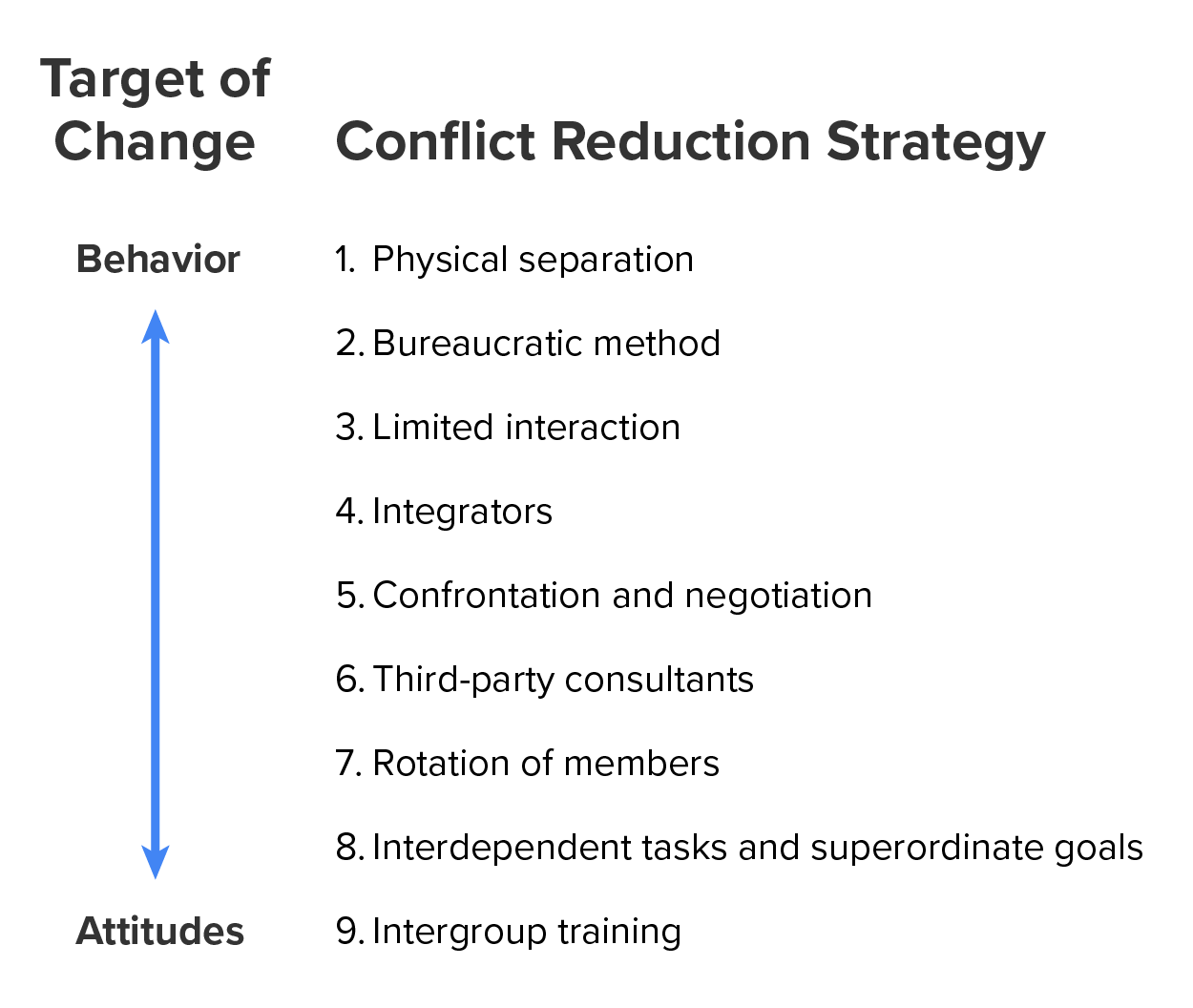
Managers can pursue different approaches based on the situation and nature of the conflict. These can broadly be categorized as changing attitudes, or as changing behaviors. If they change behavior (by laying down new rules, or by separating the people in conflict), open conflict is often reduced, but groups may still dislike one another; the conflict simply becomes less visible as the parties either “play nice,” per managerial orders, or are separated. Changing attitudes, on the other hand, often leads to fundamental changes in the ways that groups get along. However, it also takes considerably longer to accomplish than behavior change because it requires a fundamental change in social perceptions.
The nine techniques below should be viewed as a continuum, ranging from strategies that focus on changing behaviors near the bottom of the scale progressing to strategies that focus on changing attitudes near the top of the scale.
Source: THIS TUTORIAL HAS BEEN ADAPTED FROM OPENSTAX "ORGANIZATIONAL BEHAVIOR". ACCESS FOR FREE AT OPENSTAX.ORG/BOOKS/ORGANIZATIONAL-BEHAVIOR/PAGES/1-INTRODUCTION. LICENSE: CREATIVE COMMONS ATTRIBUTION 4.0 INTERNATIONAL.



