Table of Contents |
In the lesson titled “Cardiovascular Training Principles”, you learned about type I, aerobic ‘slow twitch’ fibers, and type II, anaerobic ‘fast twitch’ fibers. This concept is also relevant to resistance training. Recall that type I fibers are suited for endurance-type activities by being more fatigue resistant and able to work at lower intensities for long periods of time. Conversely, type II fibers are used in high-intensity activities of short duration. Everyone has both type I and type II muscle fibers in their bodies, though the proportion can differ based on genetics and training. Certain muscles in your body have higher densities of one type than the other.
EXAMPLE
The muscles that support your posture all day, such as muscles along the spine, have higher densities of type I fibers, since they need to work at low levels constantly to keep you upright. Two examples of muscles with higher densities of type II fibers are the triceps and gastrocnemius. These are recruited in activities with higher speed and power, such as throwing or jumping.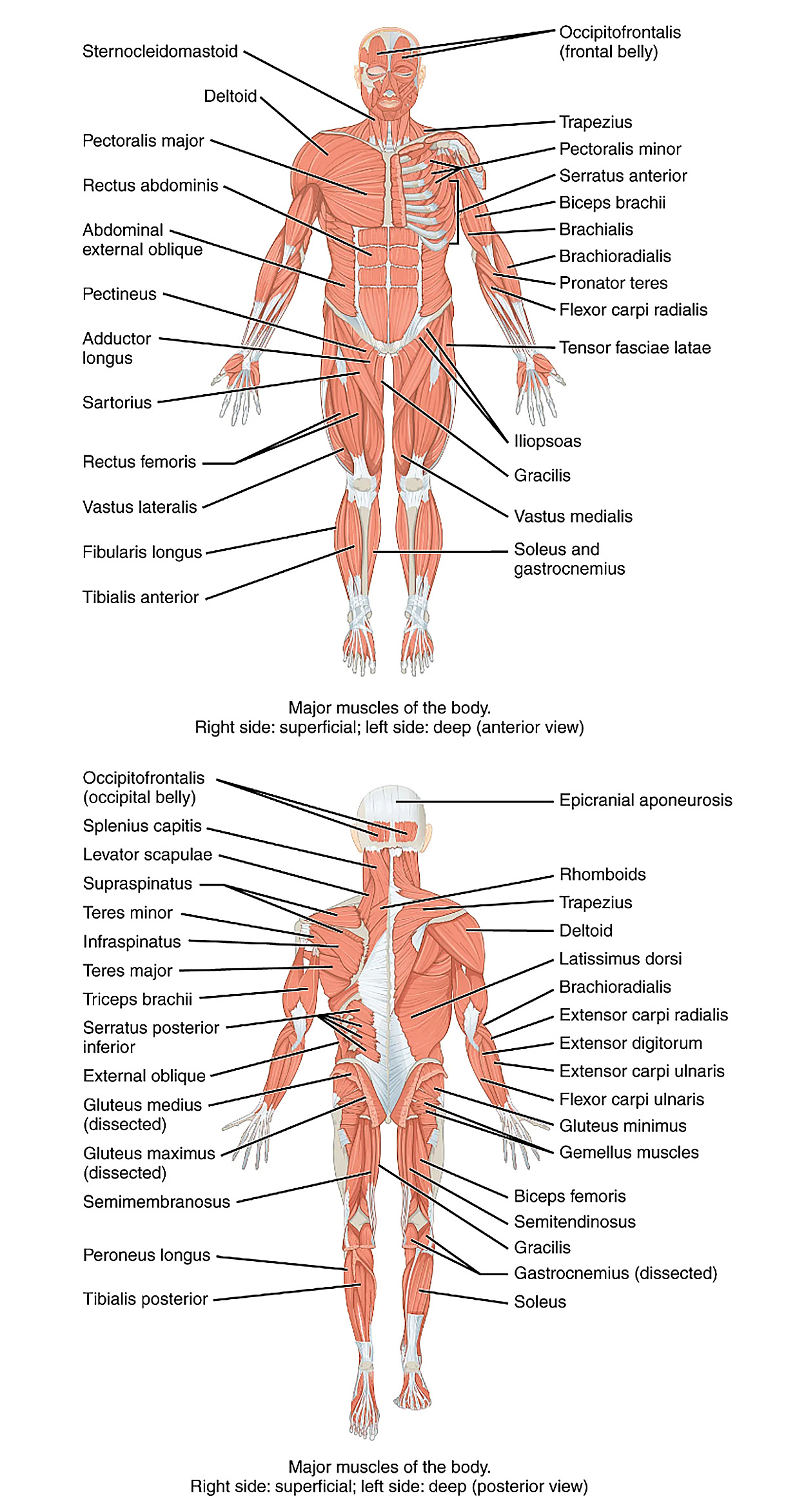
The concept of fiber types is relevant to resistance training principles like specificity, as you will see shortly, because the adaptations will depend on the primary fiber types and energy system used. Type II fibers are not only responsible for producing large amounts of force, but they also have a greater cross-section than type I fibers and are responsible for hypertrophy, or increased muscle size.
Remembering back to the lessons on stress, recall that the body can handle stress through adaptation, as long as the stressor isn’t too severe or too chronic. Since exercise is a type of stress, the body can adapt to this stress and change positively in becoming more fit. The principle of specificity means that the body’s adaptations depend on what the exercise stress is and how it is applied (American Council on Exercise, 2020). Specificity is often further described by the acronym SAID, or Specific Adaptations to Imposed Demands.
If a person wants to get stronger and build more muscle, they will need to do resistance training, not just cardiovascular exercise. The specificity principle applies to any type of exercise, not just resistance training. If a person wants to become faster at sprinting, they will need to regularly incorporate sprint training at high intensities. This goal will not be achieved with something like long moderate-intensity running, because the body will not adapt in the same way.
IN CONTEXT
Based on what we’ve learned about fiber types and specificity, if a person has a goal for hypertrophy, muscle definition, or building strength, they will need to do resistance training that mainly activates type II fibers (McCall, 2015a). This may include lifting heavy weights or doing explosive power-based movements (McCall, 2015b). In applying the principle of specificity to a goal for muscular endurance, this is best achieved through lighter weights or bodyweight movements and higher repetitions, or circuit training, where a person goes from one exercise to the next over multiple exercises with little to no rest (McCall, 2015b).

Overload dictates that a person needs to continue implementing changes in their training if they want to continue seeing fitness gains (Newell, 2015). A person who begins a resistance training program will often see rapid gains in their first few weeks or months. These gains are mainly caused by improvements in muscular coordination where the muscles learn to work together efficiently (Delavier & Gundill, 2011). However, gains will decrease or hit a plateau if the resistance training program is not structured to continue overloading the muscles, which is called diminishing returns. If a person always does the same exercise routine, they will not see any results beyond what they’ve already achieved.
IN CONTEXT
The concept of diminishing returns also applies to people who already have a high level of fitness or are elite athletes. If you consider a world-class sprinter or weightlifter, they are already at or near their pinnacle with speed or strength. Therefore, it’s not feasible to continue making significant improvements—any improvements will be relatively small.
Related to the body adapting to exercise stress and becoming more fit, the opposite is also true. If a person stops exercising, their body will eventually lose the adaptations it has made. This principle is called reversibility, which you can also think of as “use it or lose it”. The loss of adaptations due to the reversibility is described as detraining. Detraining can occur across any type of exercise. A runner who gets injured and cannot run will experience decreased VO₂ max, or a weightlifter who takes time away from their training program will lose some strength and muscle mass. Flexibility can decrease in major joints of the body with a few weeks of inactivity as well (Mujika & Padilla, 2000).
However, your body does not lose all adaptations after just a few days of not exercising, like a busy weekend or going on vacation. Short-term detraining is considered anything 4 weeks or less, while long-term detraining is anything longer than 4 weeks (Mujika & Padilla, 2000). Research generally shows that a week or two without training does not typically result in significant fitness decreases (Mujika & Padilla, 2000). In fact, strength can be maintained for up to 4 weeks (Haff & Triplett, 2016). Aerobic adaptations, like VO₂ max, seem to be more sensitive to reversibility (Haff & Triplett, 2016).
IN CONTEXT
A study sponsored by the American Council on Exercise put inactive adults through a 13-week exercise program that included both cardiovascular training and resistance training. After the 13 weeks, one group continued their exercise for 4 more weeks, and the other group stopped doing any structured exercise for 4 weeks. The second group experienced their fitness decreasing back to where it was before the study, essentially erasing their progress (Nolan et al., 2019).
One way to reduce the effects of reversibility and detraining is to continue doing at least some small amount of physical activity. If you know that you will be taking extended time away from your exercise routine due to travel, vacation, or busy life circumstances, see where you can fit in short bouts of movement, like a brisk walk or a few minutes of bodyweight movements (Green, 2017). Some movement is better than none!
Progression is how variables in a resistance training program are manipulated over time to reach training goals and avoid overtraining (Kraemer & Ratamess, 2004). Progression and overload are directly related because progression refers to the stepwise increases that occur over time to create overload (Newell, 2015). In a future lesson, we’ll talk more about how you might implement progression for your own exercise program.
EXAMPLE
Von can back squat 205 lbs (93 kg) for 6 repetitions. He wants to get stronger, so the next time he trains, he increases the weight by 5%, which is 215 lbs (97.5 kg). This weight increase is how Von is applying overload in his session. To apply progression over the long term, Von could continue to overload by increasing his weight by 5% every other week for the next four weeks.
IN CONTEXT
Based on information from the National Strength and Conditioning Association, there are multiple ways to apply the principles of overload and progression to resistance training (Haff & Triplett, 2016). Which ones to use depends on many factors, like an individual’s training experience or goals.
- Increase load, such as using more weight on a weight machine, a barbell, or choosing heavier dumbbells. Like the example with Von above, a general guideline is to increase the weight by 5% once the person gets to the end of the repetition range for their goals. We’ll discuss resistance training for specific goals in a future lesson.
- Increasing the number of training sessions per week. While the Physical Activity Guidelines recommend 2 days, this is the minimum for health. People training for specific goals of building strength or increasing muscle mass will benefit from more frequent sessions to reach their goals.
- Adding sets. A person new to resistance training might do a single set for their first few weeks, and then progress to doing two sets.
- Decreasing the length of the rest period between exercises. In some contexts of resistance training, adequate rest is essential so that muscles can perform at their peak. However, in resistance training with lighter weight and higher reps, or circuit training, gradually decreasing rest can help muscles adapt to being more fatigue resistant. A circuit might start with 30 seconds of rest between exercises and progress over time to only 10 seconds.
- Exercise selection. A person might choose a different exercise for the sake of variety in working the same muscle group. Another person might choose a more complex or challenging exercise once they have mastered good form on a simpler one. We’ll talk more about types of resistance training exercises in a future lesson.
The principle of individualization states that training should be modified to account for an individual’s unique abilities, goals, and characteristics. Factors in individualization include current fitness, age, training history, and even psychological factors like confidence (Kasper, 2019). Medical conditions or previous injuries also factor into individualization since not all exercises are suitable for all people.
EXAMPLE
The training program for a 75-year-old inactive woman with arthritis will likely look very different from the training program for a 22-year-old female college student, even if both have the same general goal like building endurance or building strength.A closely related concept to individualization is individual differences, meaning that not everyone responds to the same training stimulus in the same way. Since the proportion of muscle fiber types is based on genetics, a person with more type II fibers has a greater potential for hypertrophy than a person with more type I (American Council on Exercise, 2020). Males have a greater potential for muscle mass and overall strength than females, in part because they have larger muscle fiber cross-sectional area and have higher levels of muscle-building hormones, such as testosterone and growth hormone (Schoenfeld et al., 2010). Older people can still gain muscle and strength with training but have less hypertrophy potential because these hormone levels decrease with age (American Council on Exercise, 2020).
Source: THIS TUTORIAL WAS AUTHORED BY Anna Caggiano FOR SOPHIA LEARNING. PLEASE SEE OUR TERMS OF USE. Markup: THIS TUTORIAL WAS AUTHORED BY Anna Caggiano FOR SOPHIA LEARNING. PLEASE SEE OUR TERMS OF USE.
REFERENCES
American Council on Exercise (2020). The exercise professional’s guide to personal training: A client-centered approach to inspire active lifestyles. Jo, S., Bryant, C.X., Dalleck, L.C., Gagliardi, C.S., and Green, D.J. (eds). ISBN: 9781890720766
Delavier, F., & Gundill, M. (2011). The strength training anatomy workout: starting strength with bodyweight training and minimal equipment. Human Kinetics.
Green, D. (2017). Reversing reversibility: how to help clients get back on track. American Council on Exercise. www.acefitness.org/continuing-education/certified/march-2017/6268/reversing-reversibility-how-to-help-clients-get-back-on-track/
Haff, G., & Triplett, N. T. (2016). Essentials of strength training and conditioning (4th ed). National Strength and Conditioning Association. Champaign, IL, Human Kinetics.
Kasper, K. (2019). Sports training principles. Current Sports Medicine Reports, 18(4), 95-96. doi.org/10.1249/JSR.0000000000000576
Kraemer, W. J., & Ratamess, N. A. (2004). Fundamentals of resistance training: progression and exercise prescription. Medicine and Science in Sports and Exercise, 36(4), 674–688. doi.org/10.1249/01.mss.0000121945.36635.61
McCall, P. (2015a). 10 things to know about muscle fibers. American Council on Exercise. www.acefitness.org/resources/pros/expert-articles/5411/10-things-to-know-about-muscle-fibers/
McCall, P. (2015b). Muscle fiber types: fast-twitch vs. slow-twitch. American Council on Exercise. www.acefitness.org/resources/pros/expert-articles/5714/muscle-fiber-types-fast-twitch-vs-slow-twitch/
Mujika, I., & Padilla, S. (2000). Detraining: loss of training-induced physiological and performance adaptations. Part I: short term insufficient training stimulus. Sports Medicine, 30, 79-87. doi.org/10.2165/00007256-200030020-00002
Newell, J. (2015). The basics of exercise science (part 5). American Council on Exercise. www.acefitness.org/fitness-certifications/ace-answers/exam-preparation-blog/5371/the-basics-of-exercise-science-part-5/
Nolan, P.B., Keeling, S.M., Robitaille, C.A., Buchanan, C.A., Dalleck, L.C., & Green, D.J. (2019). How fast does fitness fade? American Council on Exercise. acewebcontent.azureedge.net/March2019/ACE_FitnessFadeStudy.pdf
Schoenfeld, B. J. (2010). The mechanisms of muscle hypertrophy and their application to resistance training. Journal of Strength and Conditioning Research, 24(10), 2857–2872. doi.org/10.1519/JSC.0b013e3181e840f3



