Table of Contents |
As you may recall, reinforcement is the feedback that encourages or discourages a behavior and is a crucial part of any learning theory. Thorndike’s Law of Effect, as mentioned earlier, states that behavior that is positively reinforced tends to be repeated, whereas behavior that is not reinforced will tend not to be repeated. Hence, reinforcement can be understood as anything that causes a certain behavior to be repeated or inhibited.
It is important to differentiate reinforcement from the concept of employee motivation. Motivation, in terms of organizational behavior, represents the consistent and internal reasons people want to perform well at work. That is, motivation is experienced by the employee, and we can see only subsequent manifestations of it in actual behavior. Reinforcement, on the other hand, is typically observable and most often externally administered. A supervisor may reinforce what is considered desirable behavior without knowing anything about the underlying motives that prompted it. For example, a supervisor who has a habit of showing interest and enthusiasm whenever she is presented with a new idea may be reinforcing innovation on the part of the subordinates without the supervisor really knowing why this result is achieved. The distinction between theories of motivation and reinforcement should be kept in mind when we examine behavior modification and behavioral self-management later in this chapter.
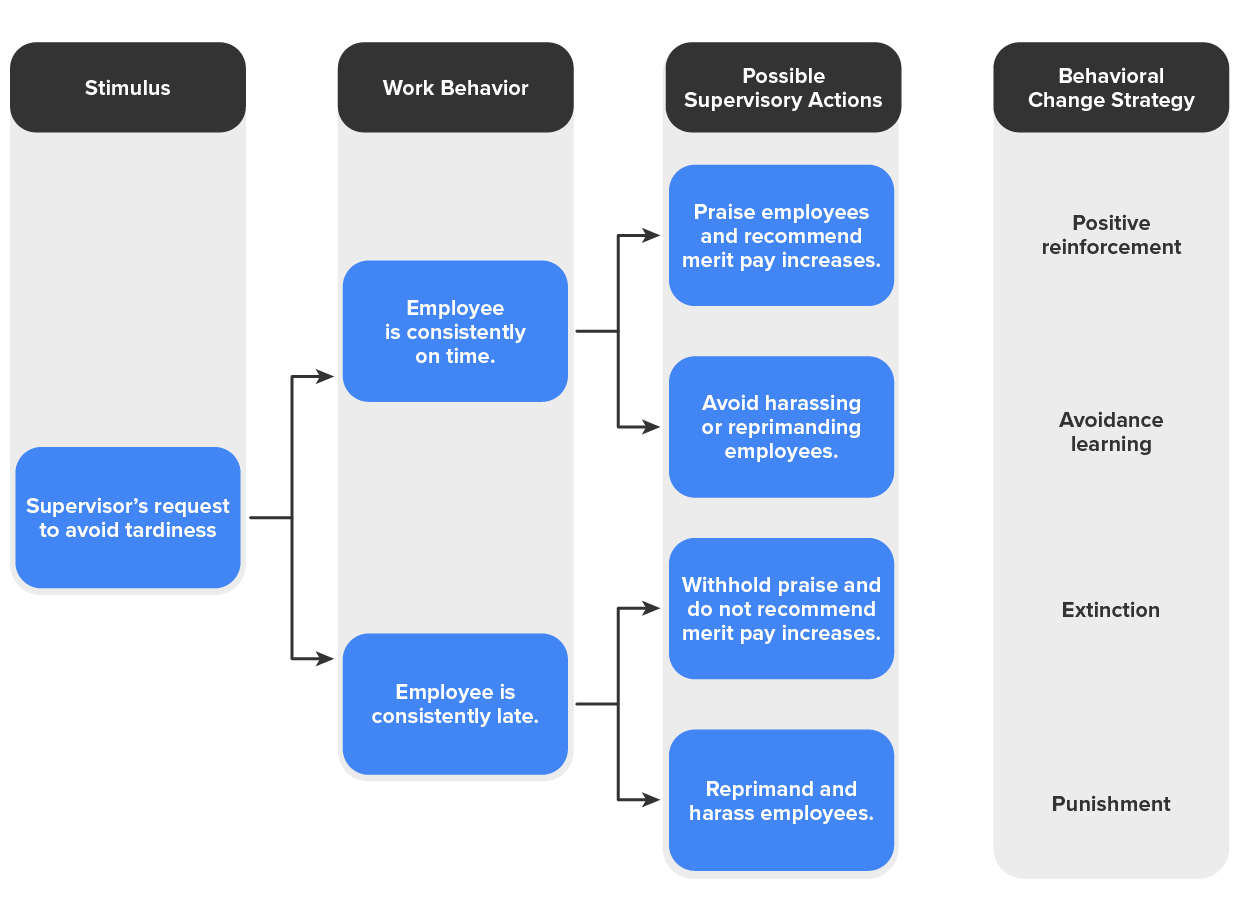
From a managerial standpoint, several strategies for behavioral change are available to facilitate learning in organizational settings. At least four different types should be noted. Each type plays a different role in both the manner in which and extent to which learning occurs. Each will be considered separately below.
Positive reinforcement consists of presenting someone with an attractive outcome following a desired behavior. As noted by Skinner, “A positive reinforcer is a stimulus which, when added to a situation, strengthens the probability of an operant response.” A simple example of positive reinforcement is supervisory praise for subordinates when they perform well in a certain situation. That is, a supervisor may praise an employee for being on time consistently. This behavior-praise pattern may encourage the subordinate to be on time in the future, in the hope of receiving additional praise.
| Common Rewards |
|---|
|
Pay raise Bonus Promotion Praise and recognition Awards Self-recognition Sense of accomplishment Increased responsibility Time off |
In order for positive reinforcement to be effective in facilitating the repetition of desired behavior, several conditions must be met.
IN CONTEXT
Suppose a manager of a customer service hotline wants to improve customer interactions. The manager decides on a reward program where employees receive “points” that can be cashed in for gift cards.
The manager should carefully select the rewards so that all staff find them desirable, such as cards being available for a wide range of stores and restaurants. The rewards should be available only for above-average performance (say, a customer rating average of “pleased”), but greater for those who receive more “very pleased” ratings. Finally, the manager should be sure to back this program with coaching for effective customer service (reminders of good customer service habits, availability of training materials, etc.)
- If the prizes themselves are not valued (for instance, they are for expensive restaurants, but not high enough to pay for the entire meal), staff will not respond to this system.
- If the employees only need a baseline of performance to receive the reward (say, an average customer rating of “average” or higher) and all receive the same rewards each month, they are also less likely to be helpful. Rather, rewards should be given only for high performance and in scale with performance.
- However, the rewards cannot be so hard to achieve that employees can rarely receive them (say, a perfect record of “very pleased” ratings).
A second method of reinforcement is avoidance learning, or negative reinforcement. Avoidance learning refers to seeking to avoid an unpleasant condition or outcome by following a desired behavior. Employees learn to avoid unpleasant situations by behaving in certain ways. If an employee correctly performs a task or is continually prompt in coming to work, the supervisor may refrain from reprimanding or otherwise embarrassing the employee. Presumably, the employee learns over time that engaging in correct behavior diminishes admonition from the supervisor. In order to maintain this condition, the employee continues to behave as desired.
The principle of extinction suggests that undesired behavior will decline as a result of a lack of positive reinforcement. If the perpetually tardy employee consistently fails to receive supervisory praise and is not recommended for a pay raise, we would expect this nonreinforcement to lead to an “extinction” of the tardiness. The employee may realize, albeit subtly, that being late is not leading to desired outcomes, and she may try coming to work on time.
Finally, a fourth strategy for behavior change used by managers and supervisors is punishment. Punishment is the administration of unpleasant or adverse outcomes as a result of undesired behavior. An example of the application of punishment is for a supervisor to publicly reprimand or fine an employee who is habitually tardy. Presumably, the employee would refrain from being tardy in the future in order to avoid such an undesirable outcome.
| Common Punishments |
|---|
|
Oral reprimands Written reprimands Ostracism Criticism from superiors Suspension Demotion Reduced authority Undesired transfer Termination |
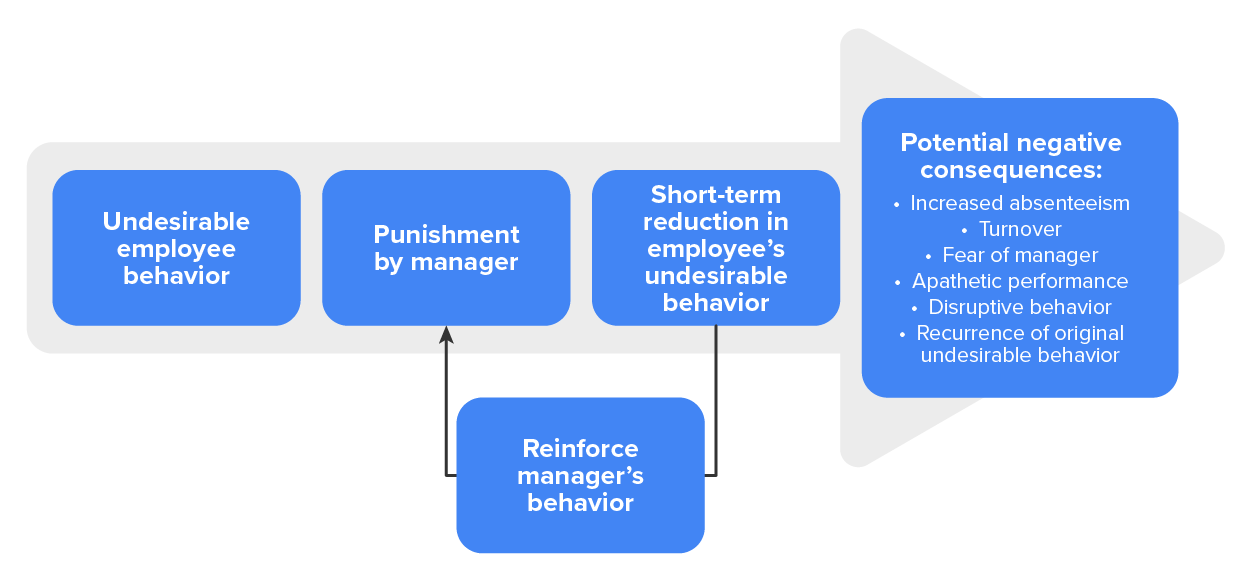
The use of punishment is one of the most controversial issues of behavior change strategies. Although punishment can have positive work outcomes—especially if it is administered in an impersonal way and as soon as possible after the transgression—negative repercussions can also result when employees either resent the action or feel they are being treated unfairly. These negative outcomes from punishment are shown below. Crucial to the concept is that while a manager reinforces behavior, their own behavior is also being reinforced. This leads to a bit of a trap. Either punishment is ineffective, or it is effective, and the manager is in essence rewarded, making them more likely to use punishment in the future. This will make for a less appealing work environment, with employees calling in absent, leaving their job, poor performance, or anxiety.
Thus, although punishment represents a potent force in corrective learning, its use must be carefully considered and implemented. In general, for punishment to be effective, the punishment should “fit the crime” in severity, should be given in private, and should be explained to the employee, including a discussion of what exactly needs to be done to improve. It should be used rarely or as a last resort.
In summary, positive reinforcement and avoidance learning focus on bringing about the desired response from the employee. With positive reinforcement, the employee behaves in a certain way in order to gain desired rewards, whereas with avoidance learning, the employee behaves in a certain way in order to avoid certain unpleasant outcomes. In both cases, however, the behavior desired by the supervisor is enhanced. In contrast, extinction and punishment focus on supervisory attempts to reduce the incidence of undesired behavior. That is, extinction and punishment are typically used to get someone to stop doing something the supervisor doesn’t like. It does not necessarily follow that the individual will begin acting in the most desired, or correct, manner.
Two factors are important to keep in mind when we look at the distinction between avoidance and extinction. The first, we will simply call the “history effect,” or past experiences impacting current behaviors.
EXAMPLE
Say an employee used to be “in trouble” for showing up late. “In trouble” might mean being scolded by the boss, docked pay, or passed over for promotion. Arriving on time and thereby avoiding the past punishment would reinforce arriving on time. This same dynamic would hold true for extinction. If the employee had been praised in the past for arriving on time, then arrived late and was not praised, this would weaken the tendency to arrive late.The second factor, we will call the “social effect,” or past experiences of others in the social group impacting individual choices and behaviors.
EXAMPLE
If employees see others in trouble when they arrive late, this could reinforce arriving at work on time. Again, this same dynamic would hold true for extinction. If an employee has observed others being praised for always arriving on time, this would weaken their tendency to arrive late. Even if they are never actually punished (even verbally) for arriving late, the lack of positive reinforcement encourages the desirable behavior.From a managerial perspective, questions arise about which strategy of behavioral change is most effective. Advocates of behavioral change strategies, such as Skinner, answer that positive reinforcement combined with extinction is the most suitable way to bring about desired behavior. There are several reasons for this focus on the positive approach to reinforcement. First, although punishment can inhibit or eliminate undesired behavior, it often does not provide information to the individual about how or in which direction to change. Also, the application of punishment may cause the individual to become alienated from the work situation, thereby reducing the chances that useful change can be effected. Similarly, avoidance learning tends to emphasize the negative; that is, people are taught to stay clear of certain behaviors, such as tardiness, for fear of repercussions. In contrast, it is felt that combining positive reinforcement with the use of extinction has the fewest undesirable side effects and allows individuals to receive the rewards they desire. A positive approach to reinforcement is believed by some to be the most effective tool management has to bring about favorable changes in organizations because it can help boost morale and improve performance and make better employee engagement.
Source: THIS TUTORIAL HAS BEEN ADAPTED FROM OPENSTAX "ORGANIZATIONAL BEHAVIOR". ACCESS FOR FREE AT OPENSTAX.ORG/BOOKS/ORGANIZATIONAL-BEHAVIOR/PAGES/1-INTRODUCTION. LICENSE: CREATIVE COMMONS ATTRIBUTION 4.0 INTERNATIONAL. Accessed by August 2023.