Use Sophia to knock out your gen-ed requirements quickly and affordably. Learn more
×

Regional and Directional Terms

Author: Sophia

what's covered
In this lesson, you will learn more about how to describe parts of the body. You will learn how to describe the body using directional terms that explain the position of one body part relative to another body part. You will also learn about regional terms that describe specific regions of the body. Specifically, this lesson will cover:

Table of Contents

1. Directional Terms

Directional terms describe relative body positions. These terms are used to describe the location of one body part in relation to another. These are extremely important for documentation. You need to learn the terms, and also how to use them correctly. Directional terms can be easy to confuse, so make sure to practice. Always describe directions from the patient's perspective, not your own. For example, when a patient is facing you, the patient’s left side is not the same as your left side. Remember that you must use the patient’s position; in this case, the patient’s left side, in documentation.

Here are some examples of terms describing body directions.

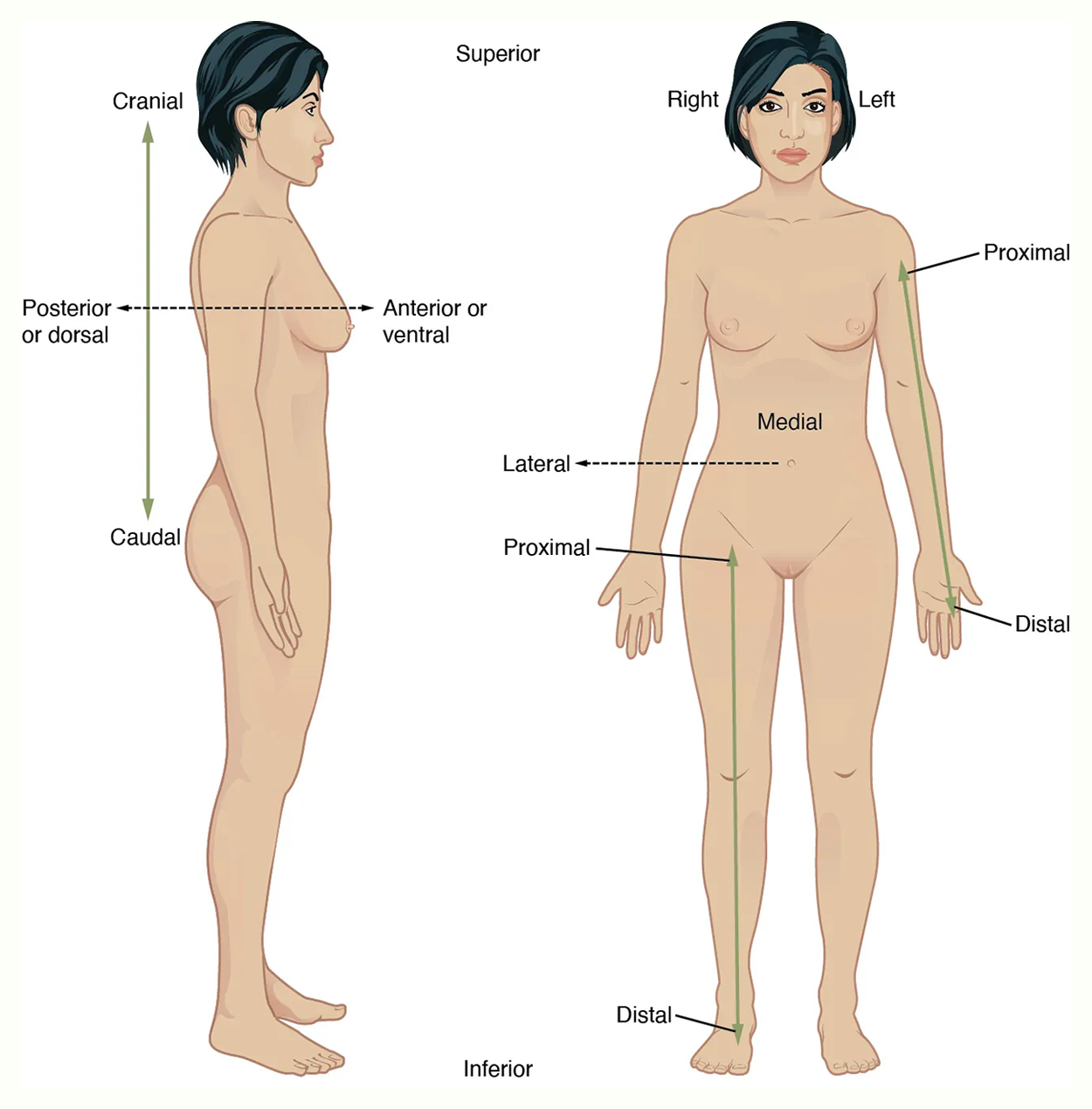
  • Superior (Cranial) – Toward the head (cranial) or upper part of the body (superior).
The brain is superior to the heart.

  • Inferior (Caudal) – Away from the head (caudal), toward the lower body (inferior).
The stomach is inferior to the lungs.

  • Anterior (Ventral) – Toward the front of the body (anterior); toward the abdomen (ventral).
The sternum (breastbone) is anterior to the heart.

  • Posterior (Dorsal) – Toward the back of the body (posterior); toward the top/back (dorsal).
The spine is posterior to the stomach.

  • Medial – Toward the midline of the body.
The nose is medial to the ears.

  • Lateral – Away from the midline of the body.
The arms are lateral to the chest.

  • Proximal – Closer to the point of attachment to the body.
The elbow is proximal to the wrist.

  • Distal – Farther from the point of attachment to the body.
The fingers are distal to the elbow.

  • Superficial – Closer to the surface of the body.
The skin is superficial to the muscles.

  • Deep – Further away from the surface of the body.
The bones are deep to the skin.

Illustration of a female body from side and front views showing anatomical directional terms: cranial, caudal, anterior (ventral), posterior (dorsal), superior, inferior, medial, lateral, proximal, and distal. Arrows indicate each direction relative to the body.

did you know
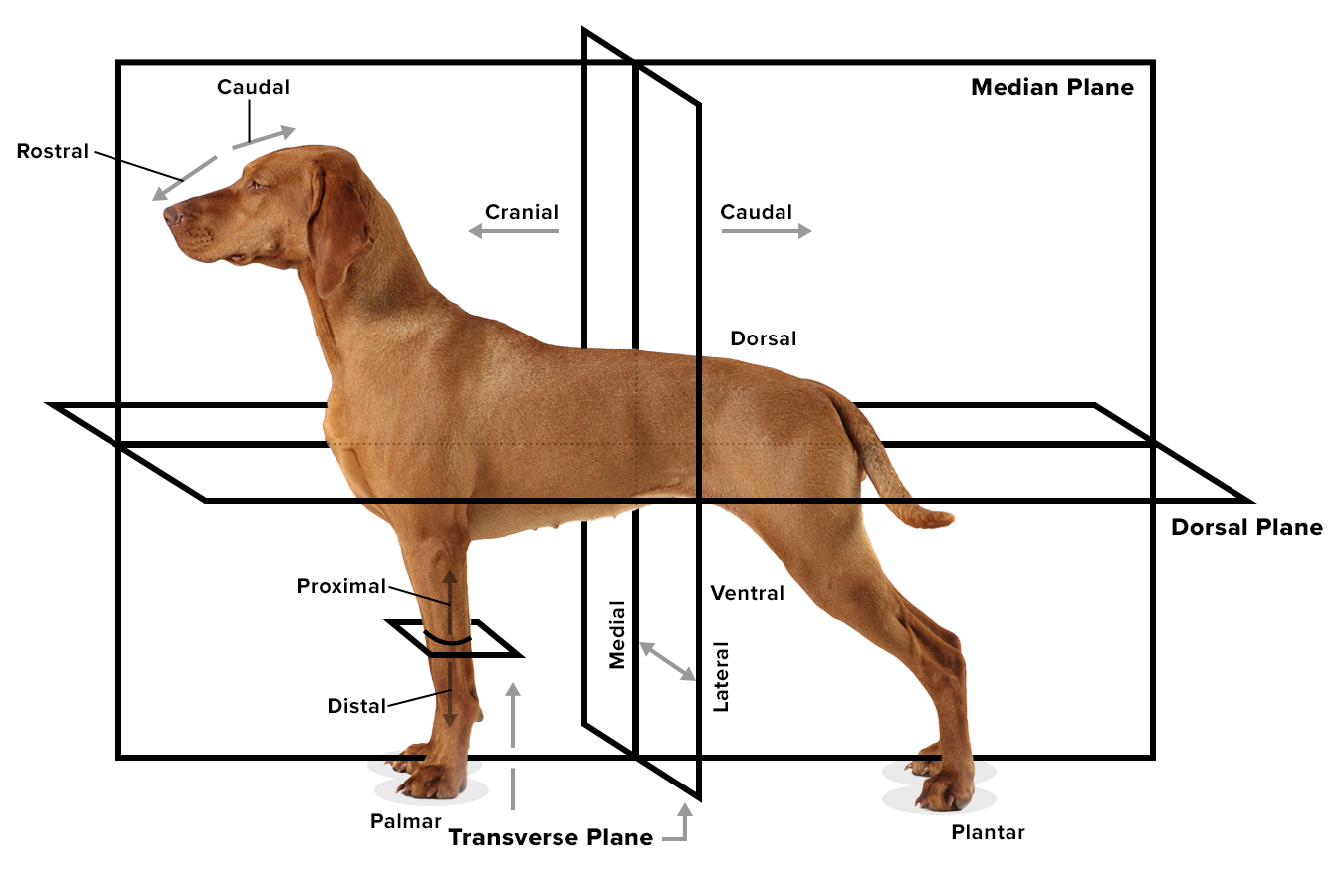
Superior and inferior are commonly used with humans, but don’t get confused if you ever take a class involving the anatomy of other types of animals. In humans, the head is at the top of the body, so cranial and superior mean the same thing. In a four-legged animal like a cat, the head is in front of the body. So the head is cranial, but not superior. The same thing is true for inferior and caudal. The terms work for humans, but not for cats. In the same way, anterior and ventral work versus posterior and dorsal work for humans, but not for other species. Using a cat as an example again, anterior is toward the head while dorsal is toward the back, and posterior is toward the tail while ventral is toward the abdomen.

In this course, you will use terms as they are applied to humans. So double check yourself if you take a veterinary course or otherwise work with animals.

Diagram of a dog showing anatomical directional terms and planes. Rostral indicates toward the nose, caudal toward the tail, and cranial toward the head. Dorsal refers to the back or spine side, while ventral indicates the belly side. Medial means toward the midline of the body, and lateral means away from the midline. Proximal is used for parts closer to where a limb attaches to the body, and distal for parts farther from the attachment point. Palmar refers to the underside of the front paw, and plantar to the underside of the hind paw. The median plane divides the body into left and right halves, the dorsal plane divides it into back and belly portions, and the transverse plane divides it into front and rear sections.

try it
Now let’s try using these terms.

There are also some special directional terms to know for the hands and feet.

  • Palmar refers to the palm of the hand.
  • Plantar refers to the sole of the foot.
Other specialized terms include:

  • Ipsilateral means on the same side of the body.
The right lung is ipsilateral to the right kidney.

  • Contralateral means on the opposite side of the body.
The right hand is contralateral to the left foot.


2. Regional Terms

In addition to having directional terms, healthcare professionals use regional terms to refer to specific parts of the body.

Axial refers to a body axis. The axial region is the main body including the head, neck, and trunk. The appendicular region includes the appendages (arms and legs).

2a. Axial Region

The axial region includes terms related to the head (cephalic region), neck (cervical region), and thoracic region (chest), abdominal region, pelvic region, and dorsal region.
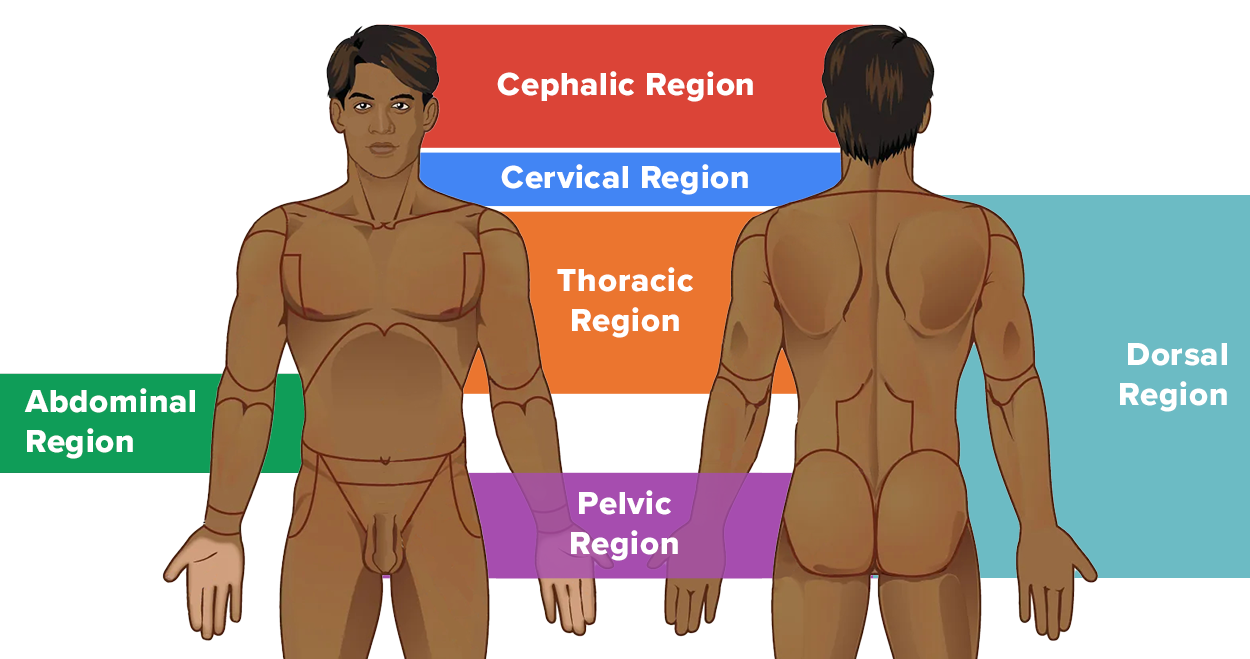
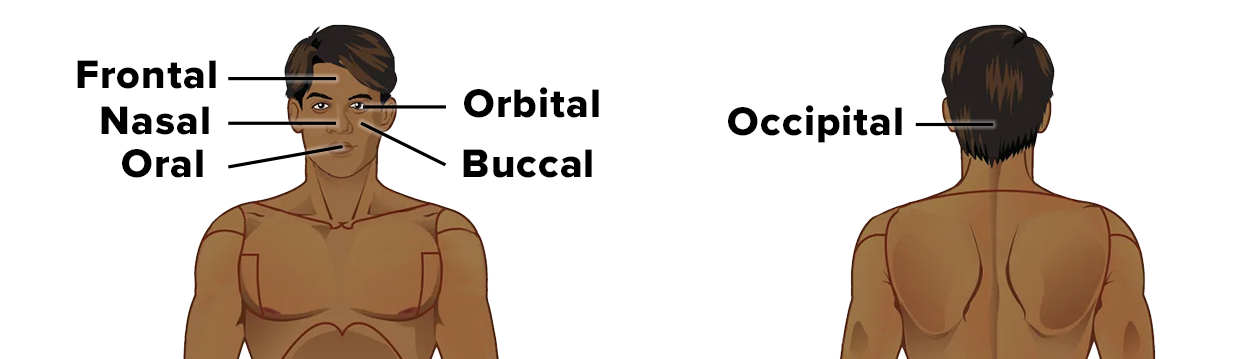
Here are some terms relating to the cephalic region:

  • Frontal – Forehead.
  • Orbital – Eye socket.
  • Buccal – Cheek.
  • Nasal – Nose.
  • Oral – Mouth.
  • Occipital – Back of the head.

Diagram of the human head and upper torso from front and back views, with labeled anatomical regions. The front view includes labels for Frontal (forehead), Nasal (nose), Oral (mouth), Orbital (eye area), and Buccal (cheek). The back view includes a label for Occipital (back of the head).

Below are some terms relating to the thoracic region:

  • Pectoral – Chest region.
  • Mammary – Breast.
  • Sternal – Middle of the chest (sternum).
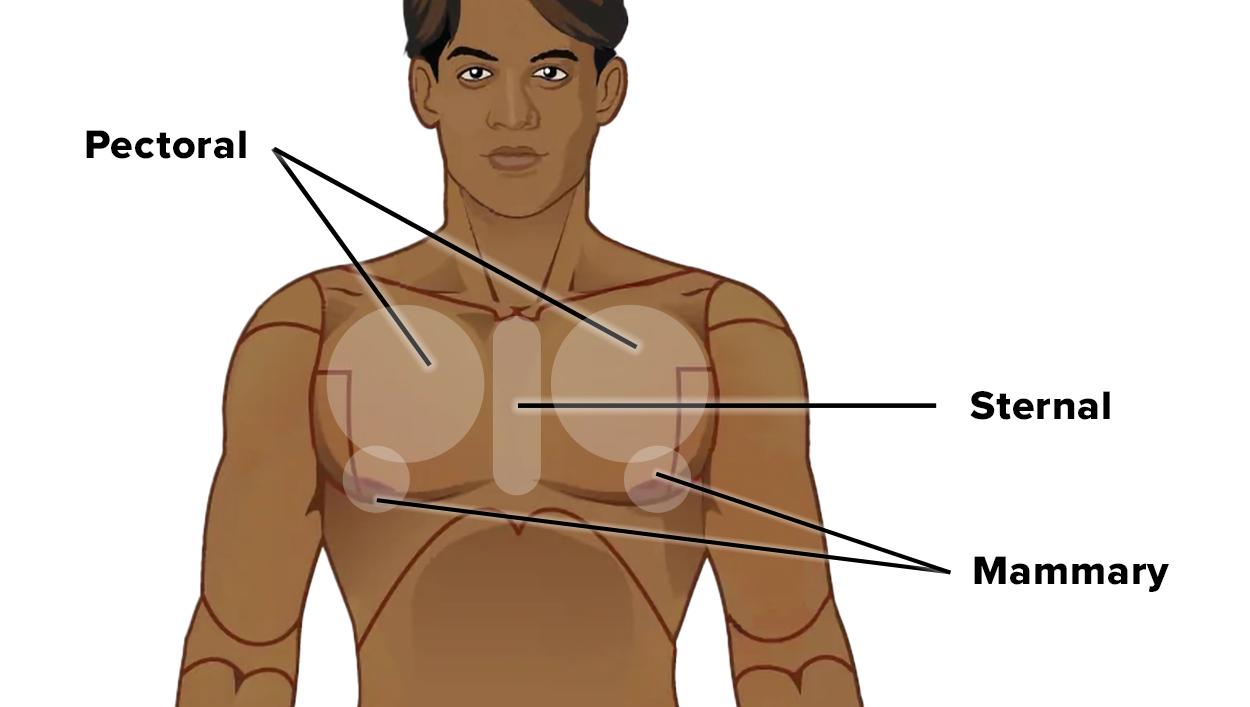
Diagram of the upper torso of a human body with labels pointing to different regions: 'Pectoral' pointing to the chest muscles, 'Sternal' pointing to the central part of the chest along the breastbone, and 'Mammary' pointing to the breast area.

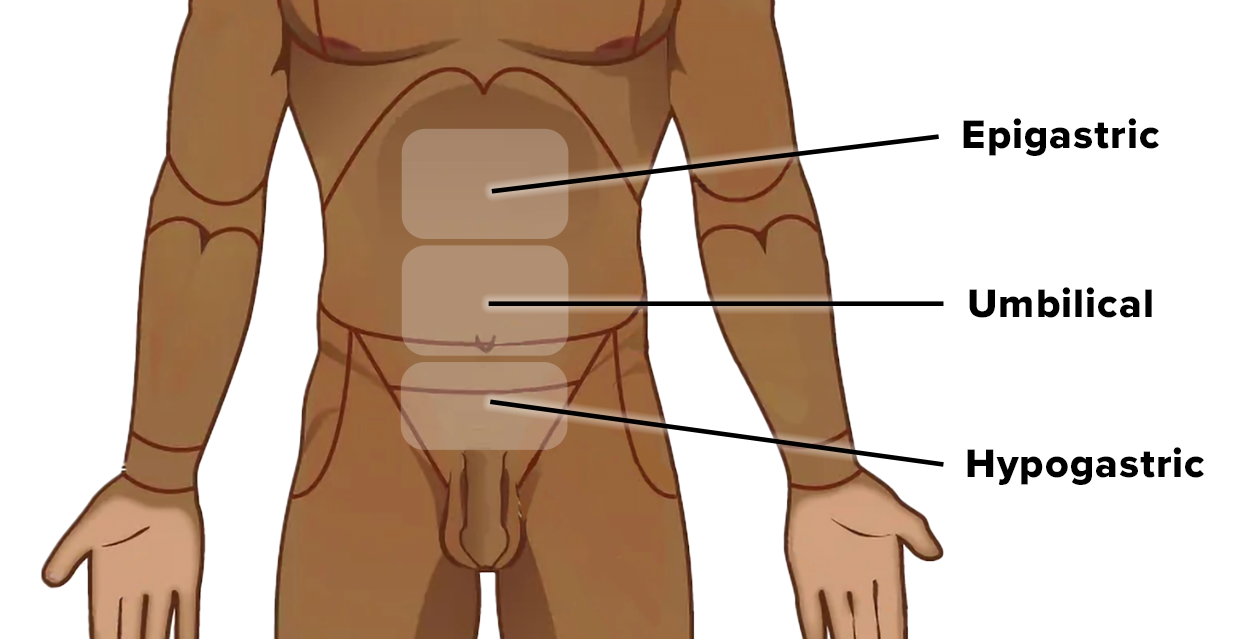
Here are some terms related to the abdominal region:

  • Umbilical – Area around the navel (belly button).
  • Epigastric – Above the stomach.
  • Hypogastric – Below the stomach.

A diagram of the human torso with labeled anatomical regions: Epigastric (upper central abdomen), Umbilical (center of the abdomen around the navel), and Hypogastric (lower central abdomen below the navel).

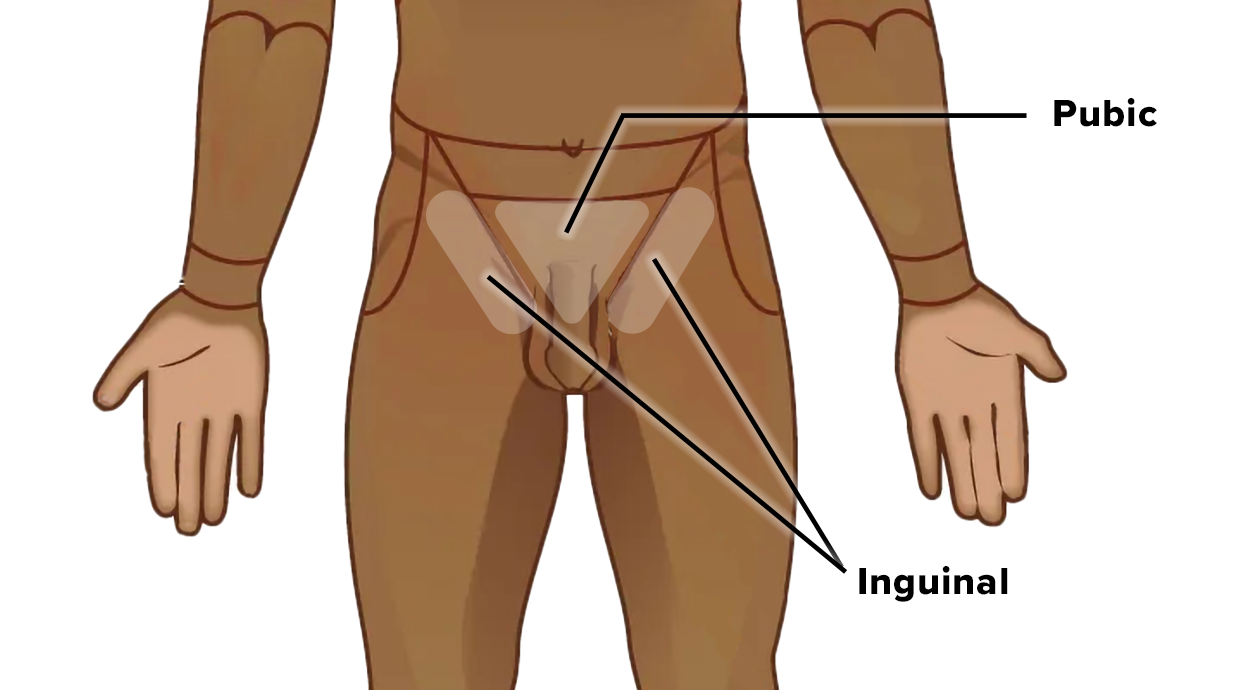
Here are some terms related to the pelvic region:

  • Inguinal – Groin area.
  • Pubic – Area around the genitals.

Diagram of the lower torso and upper legs showing labeled anatomical regions: Pubic (lower central abdomen above the genital area) and Inguinal (left and right sides where the thighs meet the torso).

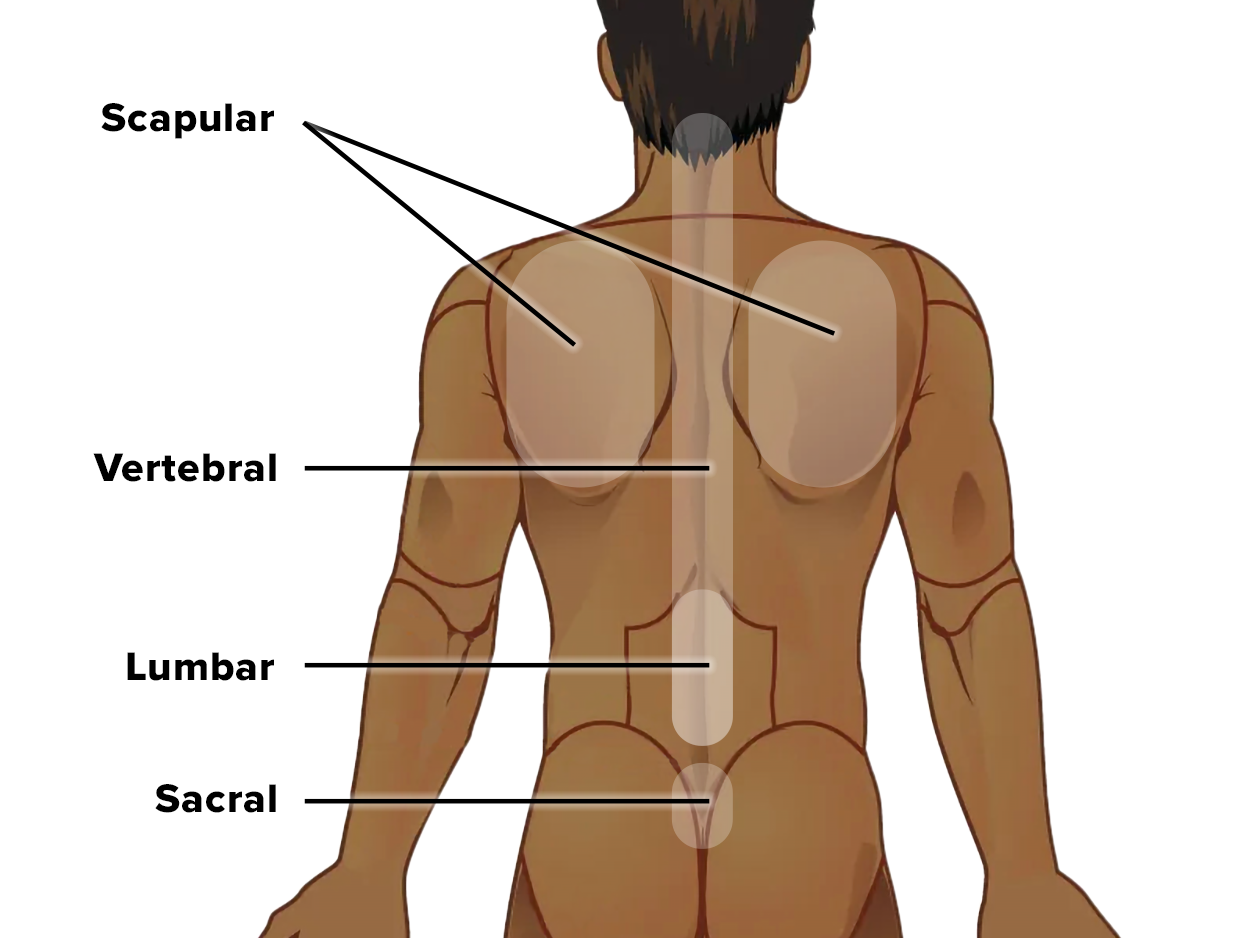
Finally, here are some terms related to the dorsal region (back):

  • Scapular – Shoulder blade area.
  • Vertebral – Spinal column.
  • Lumbar – Lower back.
  • Sacral – Area between the hips.

Diagram of the human back with labeled anatomical regions: Scapular (shoulder blade area), Vertebral (spinal column), Lumbar (lower back), and Sacral (area above the tailbone).

2b. Appendicular Region

The appendicular region includes the upper appendages (arms) and lower appendages (legs). There are terms to know for both of these regions.

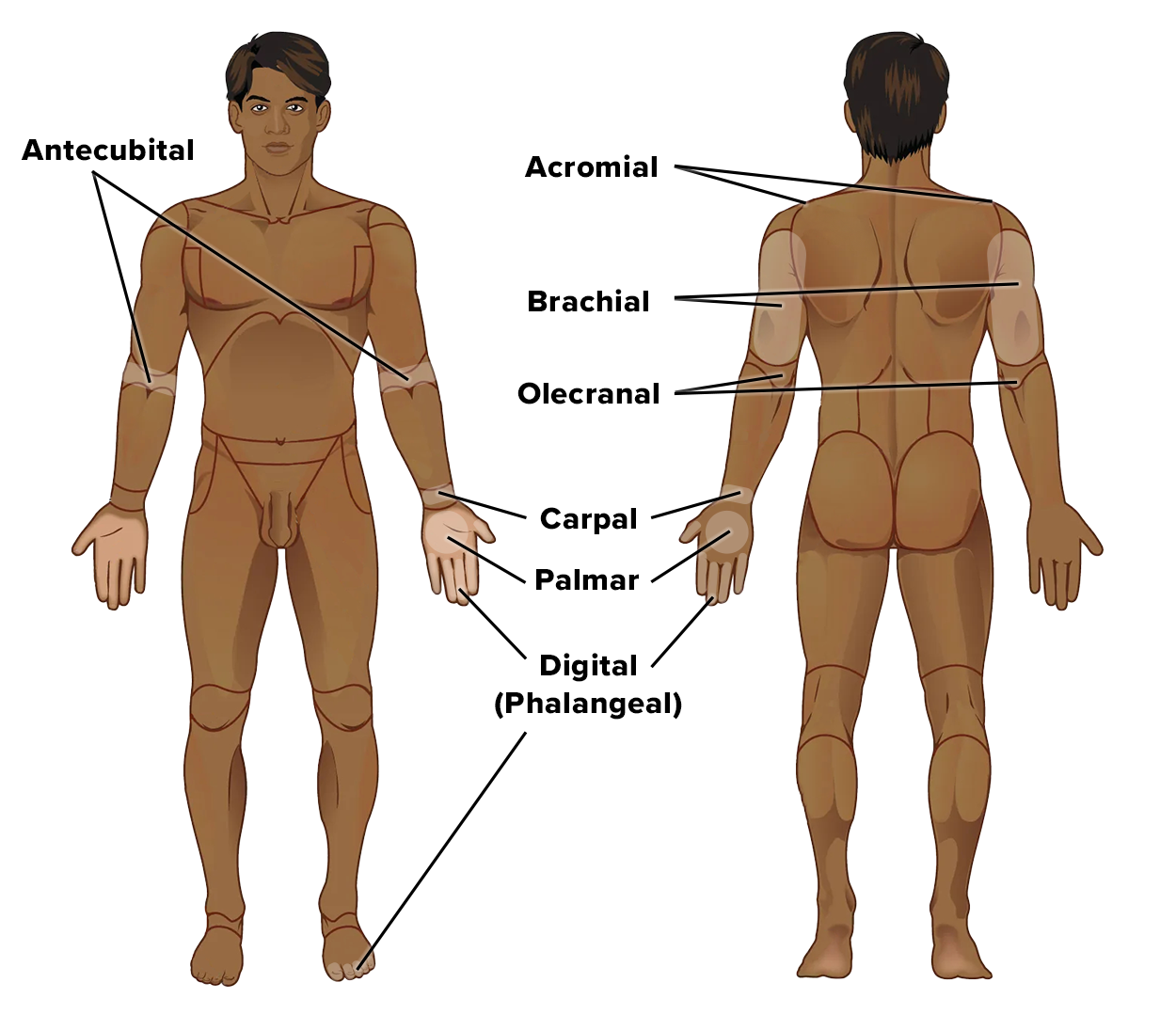
Here are some terms related to the upper limb:

  • Acromial – Shoulder.
  • Brachial – Upper arm.
  • Antecubital – Front of elbow.
  • Olecranal – Back of elbow.
  • Carpal – Wrist.
  • Palmar – Palm.
  • Digital (Phalangeal) – Fingers.

Diagram of the human body from front and back views with labeled anatomical regions. The front view highlights the Antecubital region (inner elbow). The back view includes Acromial (shoulder), Brachial (upper arm), Olecranal (back of the elbow), Carpal (wrist), Palmar (palm), and Digital or Phalangeal (fingers).

And here are some terms related to the lower limb:

  • Gluteal – Buttock.
  • Femoral – Thigh.
  • Patellar – Front of knee.
  • Popliteal – Back of knee.
  • Crural – Shin (front of the lower leg).
  • Sural – Calf (back of the lower leg).
  • Tarsal – Ankle.
  • Plantar – Sole of the foot.
  • Hallux – Big toe.
  • Digital (Phalangeal) - Toes (Note that this term refers to both the fingers and toes).
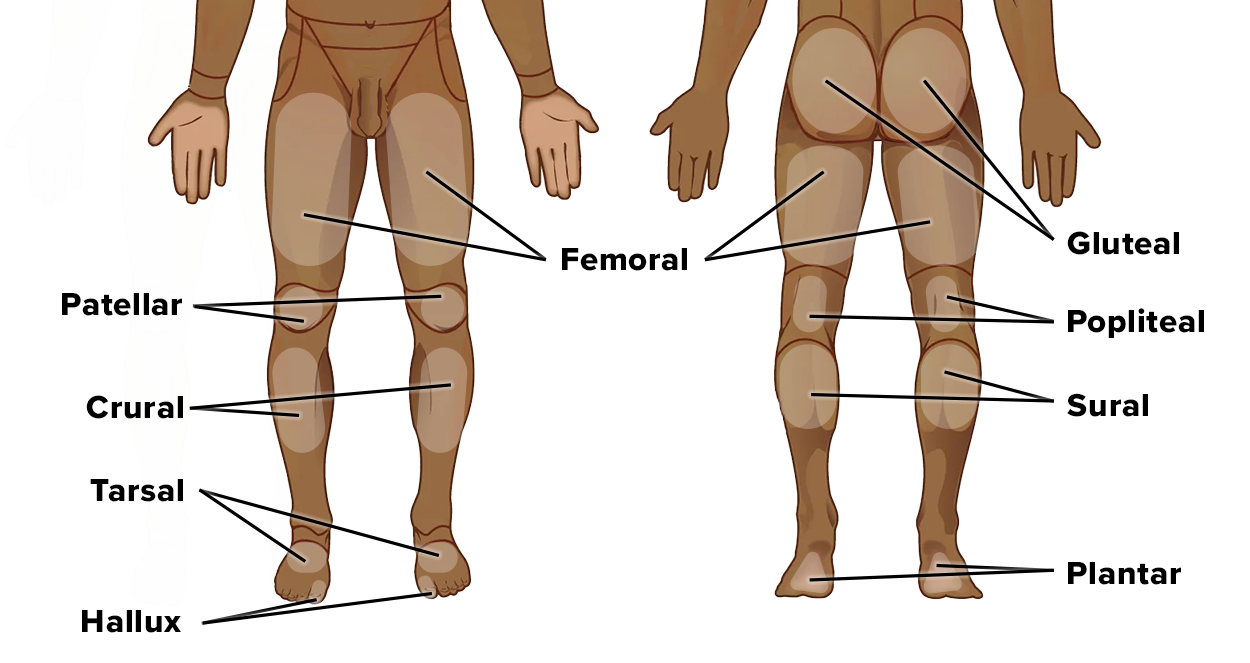
Anatomical diagram of the human lower extremities from front and back views, with labeled regions: Patellar (kneecap), Crural (lower leg), Tarsal (ankle), Hallux (big toe), Femoral (thigh), Gluteal (buttocks), Popliteal (back of the knee), Sural (calf), and Plantar (sole of the foot).

watch
View this video to explore basic regional and directional terms.

summary
In this lesson, you learned about ways to carefully and accurately describe the locations and positions of the patient’s body. You learned about directional terms that give the relative position of body parts, and about regional terms that describe different regions of a patient’s body, including terms for parts of the axial region and parts of the appendicular region. These terms are exceptionally important for documentation and to order scans and procedures to make sure that the right body parts are targeted. As you learn more about different types of testing, think about how you might use these terms.

Source: THIS TUTORIAL HAS BEEN ADAPTED FROM “OPEN RN | MEDICAL TERMINOLOGY – 2e” BY ERNSTMEYER & CHRISTMAN AT OPEN RESOURCES FOR NURSING (Open RN). ACCESS FOR FREE AT https://wtcs.pressbooks.pub/medterm/ LICENSING: CREATIVE COMMONS ATTRIBUTION 4.0 INTERNATIONAL.

Terms to Know
Abdominal Region

Region of the abdomen.

Acromial

Shoulder.

Antecubital

Front of elbow.

Appendicular Region

The region including the appendages (arms and legs).

Axial Region

The region including the main body (head, neck, and trunk).

Brachial

Upper arm.

Buccal

Cheek.

Carpal

Wrist.

Caudal

Away from the head, toward the tail.

Cephalic Region

Region of the head.

Cervical Region

Region of the neck.

Contralateral

On opposite sides of the body.

Cranial

Toward the head.

Crural

Shin (front of lower leg).

Deep

Further away from the surface of the body.

Digital

Fingers.

Distal

Farther from the point of attachment to the body.

Dorsal

Toward the upper part of the body or back (for humans).

Epigastric

Above the stomach.

Femoral

Thigh.

Frontal

Forehead.

Gluteal

Buttock.

Hallux

Big toe.

Hypogastric

Below the stomach.

Inferior

Toward the lower part of the body.

Inguinal

Groin area.

Ipsilateral

On the same side of the body.

Lateral

Away from the midline of the body.

Lumbar

Lower back.

Mammary

Breast.

Medial

Toward the midline of the body.

Nasal

Nose.

Occipital

Back of head.

Olecranal

Back of elbow.

Oral

Mouth.

Orbital

Eye socket.

Patellar

Front of knee.

Pectoral

Chest.

Pelvic Region

Region of the pelvis.

Phalangeal

Fingers.

Plantar

Refers to the sole of the foot.

Popliteal

Back of knee.

Posterior

Toward the back of the body.

Proximal

Closer to the point of attachment to the body.

Pubic

Around the genitals.

Sacral

Area between the hips (where the sacrum bone is located).

Scapular

Region of the shoulder blades.

Sternal

Center of the chest (in the region of the sternum).

Sternum

Breastbone.

Superficial

Closer to the surface of the body.

Superior

Toward the upper part of the body.

Sural

Calf (back of lower leg).

Tarsal

Ankle.

Thoracic Region

Region of the chest.

Umbilical

Area around the navel.

Ventral

Toward the abdomen.

Vertebral

Region of the vertebral column.