In this lesson, you will learn how to identify the makeup of proteins and about their functions in the human body. Specifically, this lesson will cover:
You might associate proteins with muscle tissue, but in fact, proteins are critical components of all tissues and organs. A protein is an organic molecule composed of amino acids.
Proteins include the keratin (which you will learn more about later in this lesson) that protects underlying tissues and the collagen found in the skin, in bones, and in the meninges that cover the brain and spinal cord. Proteins are also components of many of the body’s functional chemicals, including digestive enzymes in the digestive tract, antibodies that help fight infections, neurotransmitters that neurons use to communicate with other cells, and hormones that regulate certain body functions (for instance, growth hormone). Whereas carbohydrates and lipids are composed of hydrocarbons and oxygen, proteins contain nitrogen (N), and many contain sulfur (S), in addition to carbon, hydrogen, and oxygen.
term to know
Protein
An organic macromolecule composed of amino acids linked by peptide bonds.
1a. Structure of Proteins
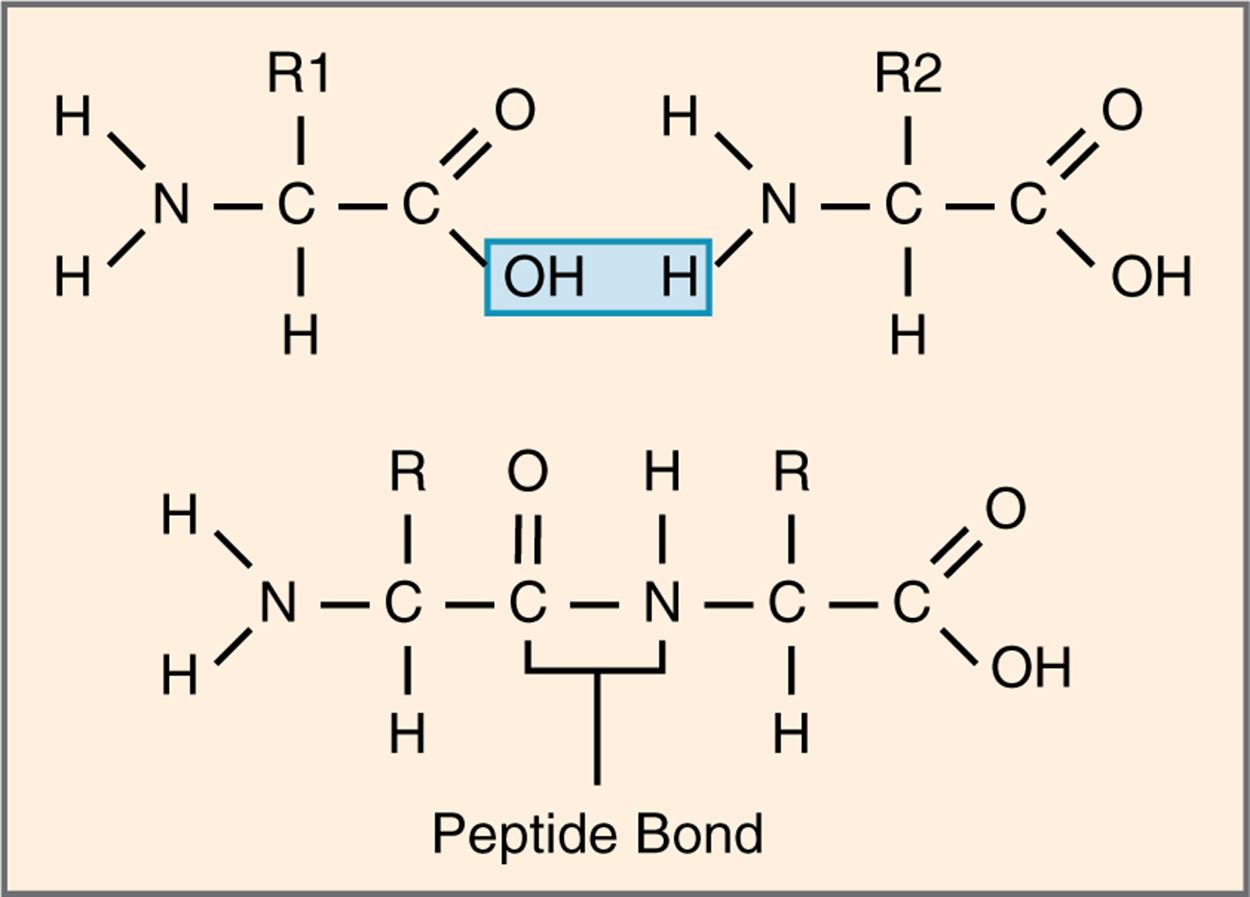
Proteins are polymers made up of nitrogen-containing monomers called amino acids. As shown in the image below, an amino acid is a molecule composed of an amino group and a carboxyl group together with a variable side chain.
There are 20 different amino acids used in the human body. Linked together in chains, amino acids contribute to nearly all of the thousands of different proteins important in human structure and function. Body proteins contain a unique combination of a few dozen to a few hundred of these 20 amino acid monomers.
All 20 of these amino acids share a similar structure. All consist of a central carbon atom to which the following are bonded:
A hydrogen atom
An alkaline (basic) amino group NH₂
An acidic carboxyl group COOH
A variable side (R) group
The Structure of an Amino Acid.
Notice that all amino acids contain both an acid (the carboxyl group) and a base (the amino group) (amine, nitrogen-containing). For this reason, they make excellent buffers by helping the body regulate acid–base balance. What distinguishes the 20 amino acids from one another is their variable group, which is referred to as a side chain or an R-group. This group can vary in size, shape, and polarity (polar or nonpolar), giving each amino acid its unique characteristics.
Amino acids are joined together via dehydration synthesis to form protein polymers. The unique bond holding amino acids together is called a peptide bond. A peptide bond is a covalent bond between two amino acids that forms by dehydration synthesis. A peptide, in fact, is a very short chain of amino acids. Strands containing fewer than about 100 amino acids are generally referred to as polypeptides. Strands 100 amino acids or longer are referred to as proteins.
Peptide Bond—Different amino acids join together to form peptides, polypeptides, or proteins via dehydration synthesis. The bonds between the amino acids are peptide bonds R1 and R2 and may be the same or different side chains.
When necessary, the body is capable of synthesizing 11 of the 20 amino acids from components of other molecules. However, the remaining nine amino acids must be consumed in the diet and are known as essential amino acids. If a particular essential amino acid is not available in sufficient quantities, the synthesis of proteins containing it can slow or even cease.
terms to know
Amino Acid
A molecule composed of an amino group and a carboxyl group, together with a variable side chain that functions as the monomer of protein.
Peptide Bond
A covalent bond between two amino acids that forms by dehydration synthesis.
Polypeptide
A protein strand containing fewer than about 100 amino acids.
1b. Shape of Proteins
Are you familiar with origami, the Japanese art of paper folding?
EXAMPLE
The function of proteins is highly dependent upon their shape. The folding of the amino acid chain into its specified final functional protein structure is much like origami—the paper being used must be folded in a precise order and at precise angles to be shaped correctly. The precise shape of a protein affects it functionality. Additionally, like proteins, if the origami bird starts to unfold, it may lose its recognizable shape and functionality. In proteins, this is called denaturation, which you will learn more about later in this lesson.
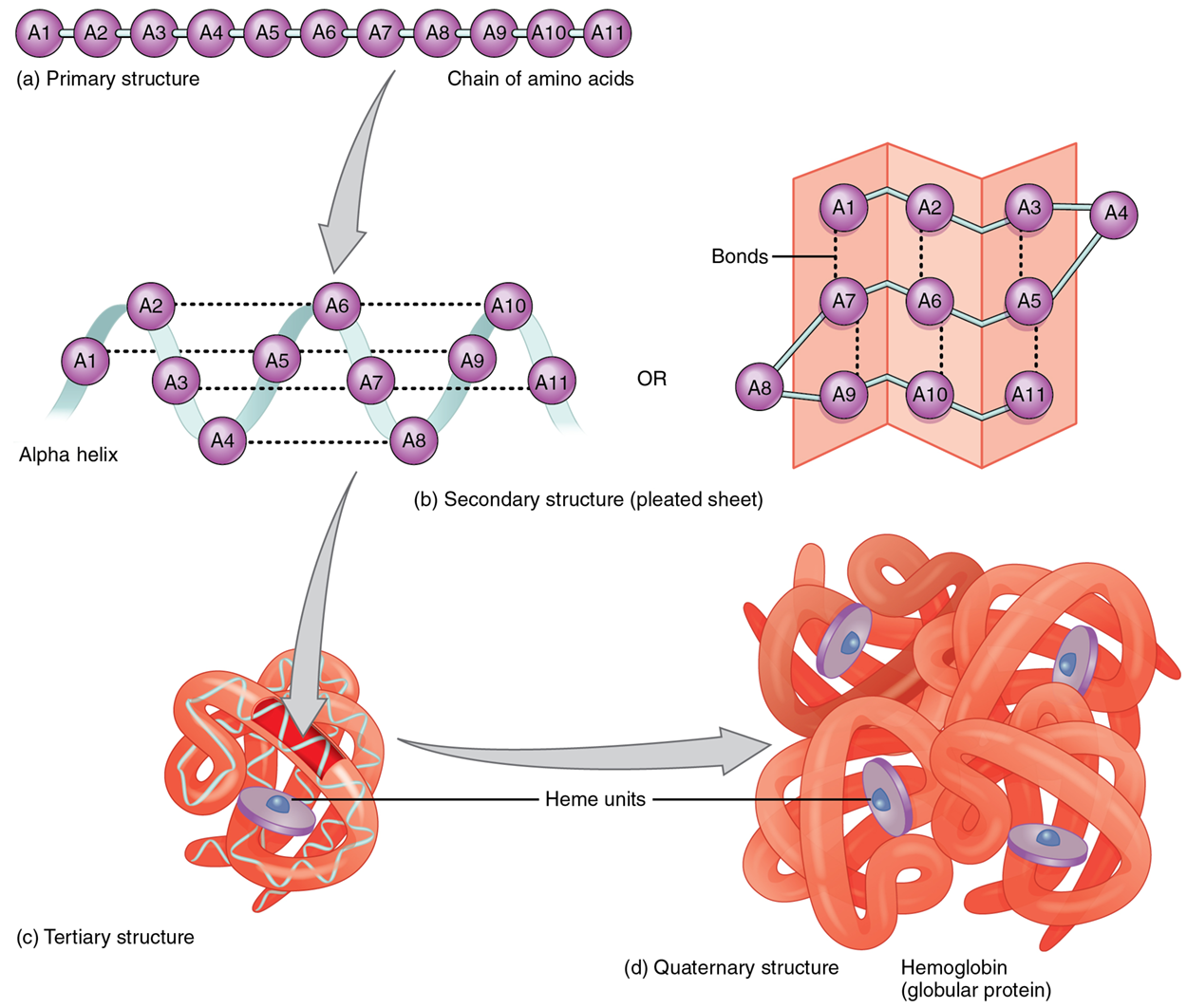
In the process of folding a protein into its final functional shape, there are four unique structures: (in order) primary, secondary, tertiary, and quaternary structure.
A protein’s final shape is determined, most fundamentally, by the sequence of amino acids that make it up. This sequence, shown in the image below, is called the primary structure of the protein.
The Shape of Proteins—(a) The primary structure is the sequence of amino acids that makes up the polypeptide chain. (b) The secondary structure, which can take the form of an alpha helix or a beta-pleated sheet, is maintained by hydrogen bonds between amino acids in different regions of the original polypeptide strand. (c) The tertiary structure occurs as a result of further folding and bonding of the secondary structure. (d) The quaternary structure occurs as a result of interactions between two or more tertiary subunits. The example shown here is hemoglobin, a protein in red blood cells that transports oxygen to body tissues.
Some polypeptides exist as linear chains and therefore do not undergo folding once their primary structure has been formed. However, most proteins require folding to be functional. A protein’s secondary structure forms when hydrogen bonds (weak bonds between polar covalently bonded hydrogen atoms and electronegative atoms) are formed between non-neighboring amino acids with different properties. The most common secondary structure is a spiral called an alpha helix, which resembles a spiral staircase or curved ribbon. Less commonly, a polypeptide chain can form a beta-pleated sheet that resembles a piece of paper loosely folded like an accordion.
The regions of a protein that have formed alpha helices, beta-pleated sheets, and other secondary structures then interact with one another, causing additional folding and hydrogen bonding. This forms a tertiary structure. In this configuration, amino acids that had been very distant in the primary chain can be brought quite close via hydrogen bonds or, in proteins containing cysteine, via disulfide bonds. A disulfide bond is a covalent bond between sulfur atoms in a polypeptide.
IN CONTEXT
Have you ever wondered what causes someone to have straight, wavy, or curly hair? Along with genetics and the shape of the hair follicle, disulfide and hydrogen bonds are major factors in the structure of hair.
Hair type and texture is dependent, in part, on differences in protein structure.
A protein called keratin is packed very densely into the cells that make up hair. The number of disulfide bonds between cysteines (sulfur-containing amino acids) in keratin determines the hair structure.
Few to no disulfide bonds create straight hair.
A moderate number of disulfide bonds create wavy hair.
A high number of disulfide bonds create curly hair.
Although genetics dictate your natural hair structure, there are ways to adjust the number of disulfide bonds semi-permanently. A perm will promote disulfide bond formation by increasing the curl of hair, whereas chemical straightening will break disulfide bonds and work to keep them from reforming.
Hydrogen bonds also play a role in forming curls on a more temporary basis. When the air is more humid (i.e., there is more water in the air), more hydrogen bonds can form, enhancing hair’s natural curl. In reverse, a dry environment will decrease the natural curl. This can also be manipulated by using a heated hair straightener or curler. These adjust the hydrogen bonding in hair to temporarily adjust hair structure.
Often, two or more separate polypeptides folded into their individual tertiary structures bond to one another, forming a final large complex known as a quaternary structure. The polypeptide subunits forming a quaternary structure can be identical or different. For instance, hemoglobin (the protein found in red blood cells) is composed of four tertiary polypeptides, two of which are called alpha chains and two of which are called beta chains.
When they are exposed to extreme heat, acids, bases, and certain other substances, proteins will denature or change shape. Denaturation is a change in the structure of a molecule through physical or chemical means. Denatured proteins lose their functional shape and are no longer able to carry out their jobs.
An everyday example of protein denaturation is the addition of lemon juice (an acid) to milk. The proteins in milk will denature and begin to stick together—this is what occurs when milk curdles. Another example is when you have a fever. At elevated temperatures, many proteins in your body partially unfold, causing them to be less functional. This contributes to your feelings of being tired, sluggish, and not well. At the same time, other proteins involved in ridding your body of the illness fold better and improve their function, helping you get better.
The contribution of the shape of a protein to its function can hardly be exaggerated, and proteins are found in a wide variety of shapes.
EXAMPLE
The long, slender shape of protein strands that make up muscle tissue is essential in their ability to contract (shorten) and relax (lengthen).
EXAMPLE
Bones contain long threads of a protein called collagen that acts as scaffolding upon which bone minerals are deposited. These elongated proteins, called fibrous proteins, are strong, durable, and typically hydrophobic.
In contrast, globular proteins are globes or spheres that tend to be highly reactive and are hydrophilic. The hemoglobin proteins packed into red blood cells are an example. However, globular proteins such as enzymes are abundant throughout the body because they play critical roles in most body functions.
term to know
Denaturation
A change in the structure of a molecule through physical or chemical means.
1c. Proteins Function as Enzymes
If you were trying to type a paper and every time you hit a key on your laptop, there was a delay of six or seven minutes before you got a response, you would probably get a new laptop. In a similar way, without enzymes to catalyze (speed up) chemical reactions, the human body would be nonfunctional. It functions only because enzymes function.
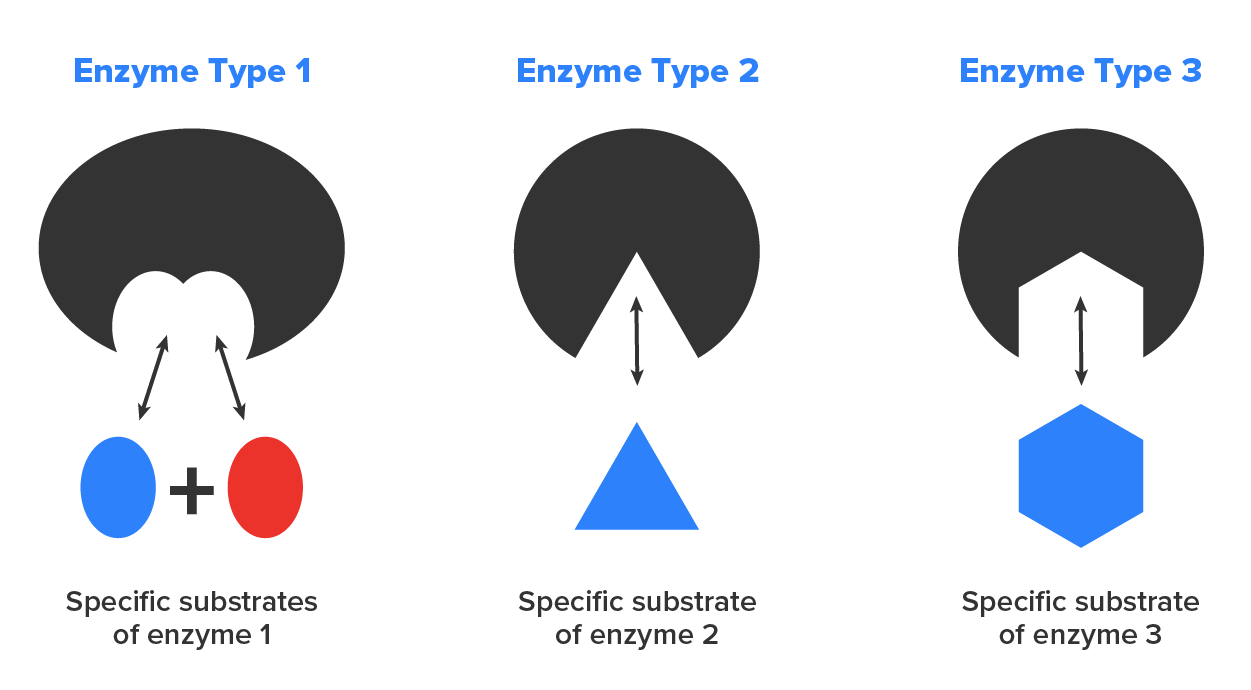
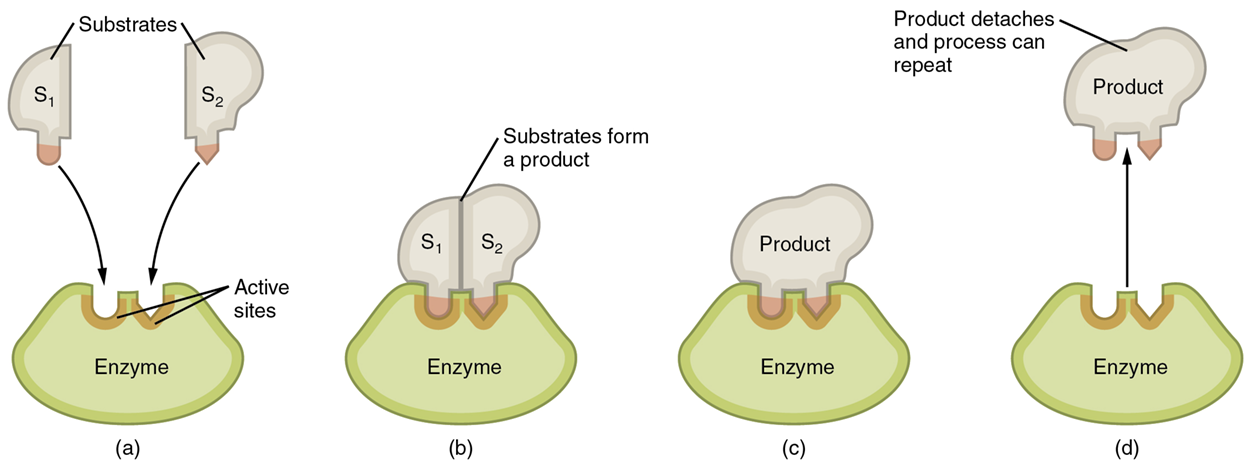
Enzymatic reactions—chemical reactions catalyzed by enzymes—begin when substrates bind to the enzyme. A substrate is a reactant in an enzymatic reaction. This occurs on regions of the enzyme known as active sites. Any given enzyme catalyzes just one type of chemical reaction. This characteristic, called specificity, is due to the fact that a substrate with a particular shape and electrical charge can bind only to an active site corresponding to that substrate (as shown below). However, there is some flexibility as well. Some enzymes have the ability to act on several different structurally related substrates.
Enzyme specificity is achieved through a match between the shape and chemical reactivity of the active site and the substrate(s).
The binding of a substrate produces an enzyme–substrate complex. It is likely that enzymes speed up chemical reactions in part because the enzyme–substrate complex undergoes a set of temporary and reversible changes that cause the substrates to be oriented toward each other in an optimal position to facilitate their interaction. This promotes increased reaction speed. The enzyme then releases the product(s) and resumes its original shape. The enzyme is then free to engage in the process again and will do so as long as the substrate remains.
Steps in an Enzymatic Reaction—(a) Substrates approach active sites on enzyme. (b) Substrates bind to active sites, producing an enzyme–substratee complex. (c) Changes internal to the enzyme–substrate complexes facilitate the interaction of the substrates. (d) Products are released, and the enzyme returns to its original form ready to facilitate another enzymatic reaction.
terms to know
Substrate
A chemical reactant that binds to an enzyme at its active site.
Active Site
The region of an enzyme where the substrate binds.
1d. Other Functions of Proteins
Advertisements for protein bars, powders, and shakes all say that protein is important in building, repairing, and maintaining muscle tissue. However, the truth is that proteins contribute to all body tissues, from skin to brain cells. Many of these functions will be detailed in future lessons.
Some proteins also act as hormones, which are chemical messengers that help regulate body functions. For example, growth hormone is important for skeletal growth, among other roles.
The basic and acidic components of a protein enable it to function as a buffer in maintaining acid–base balance.
Protein helps regulate fluid–electrolyte balance. Proteins attract fluid, and a healthy concentration of proteins in the blood, the cells, and the spaces between cells helps ensure a balance of fluids in these various “compartments.”
Proteins in the cell membrane help to transport substances in and out of the cell while keeping nutrient concentrations in a healthy balance.
Like lipids, proteins can bind with carbohydrates. They can thereby produce glycoproteins or proteoglycans, both of which have many functions in the body.
The body can use proteins for energy when carbohydrate and fat intake are inadequate, and stores of glycogen and adipose tissue become depleted. However, because there is no storage site for protein except functional tissues, using protein for energy causes muscle tissue breakdown and results in muscle or body wasting.
summary
In this lesson, you learned about proteins and some of the roles they play in the human body. First, you examined protein characteristics. Then, you explored the chemical structure of proteins and how amino acids are bound together by peptide bonds to form peptides, polypeptides, and proteins. You also learned about how the amino acids that make up a protein associate through bonding to fold in a series of structures that compose the distinct shape of proteins, which affects their function. You then learned about how proteins function as enzymes, binding substrates at their active site and inducing a conformational change to catalyze a chemical reaction. Finally, you learned that other functions of proteins contribute to all body tissues, from skin to brain cells.