In this lesson, you will learn about areas of focus for proofreading and how to ensure that your writing accurately reflects what you intend to say. Specifically, this lesson will cover:
1. Sentence Clarity and Errors
You’ve written your draft, following a structure that makes a strong argument with supporting points. You’ve worked out smooth transitions between paragraphs, and made sure your sentences are concise, varied, active, and put the emphasis on your strongest points. You’re ready for the last stage of editing: proofreading.
When you proofread, you check for small details, such as typing mistakes and misspellings, that need fixing. If you have to follow a given style guide, such as APA in this course, you will also make sure your paper follows those guidelines. You can use spellcheckers and other tools to help but also need to read each sentence carefully to make sure your spelling and punctuation are correct and word choices are appropriate for the audience.
-
Reading the paper backwards, sentence by sentence, helps focus your attention on each individual sentence.
Let's look at four common sentence-level errors you can watch for.
1a. Sentence Fragments
A sentence fragment is a group of words that lacks a subject, a verb, or both, or is a subordinate clause (a clause that begins with a subordinating word such as although, because, since, and so on) but is punctuated as though it were a sentence by itself. Here are some examples of different strategies for fixing sentence fragments.

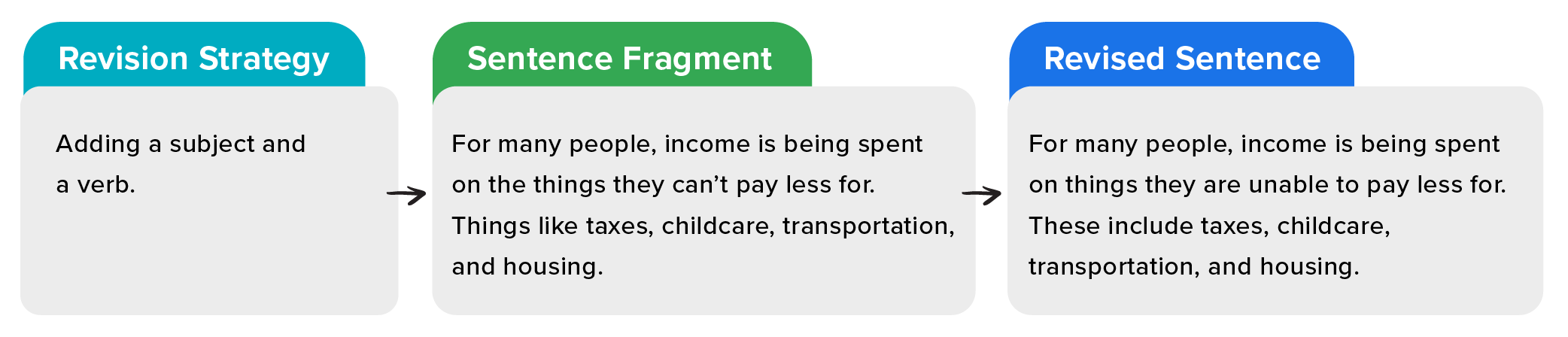
-
- Sentence Fragment
- A group of words that lacks a subject, a verb, or both, or is a subordinate clause (a clause that begins with a subordinating word such as although, because, since, and so on) but is punctuated as though it were a sentence by itself.
1b. Comma Splices
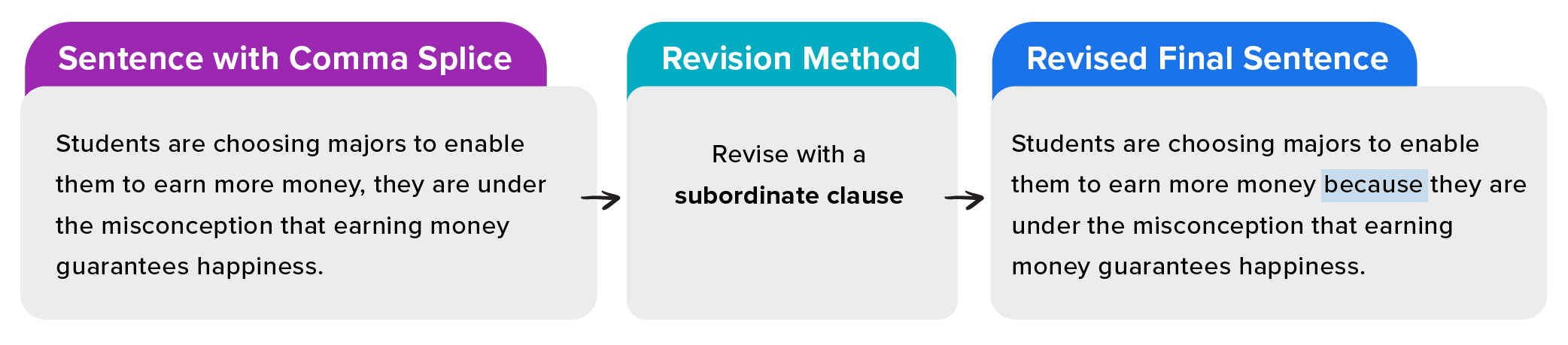
A comma splice is a common error that occurs when two complete sentences are joined by a comma. Here are some examples of different strategies for fixing comma splices.
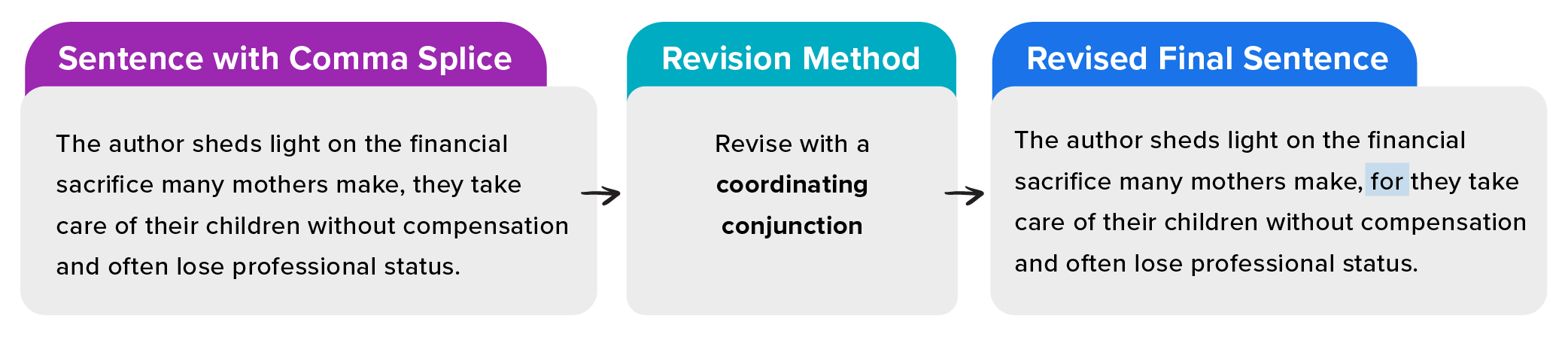
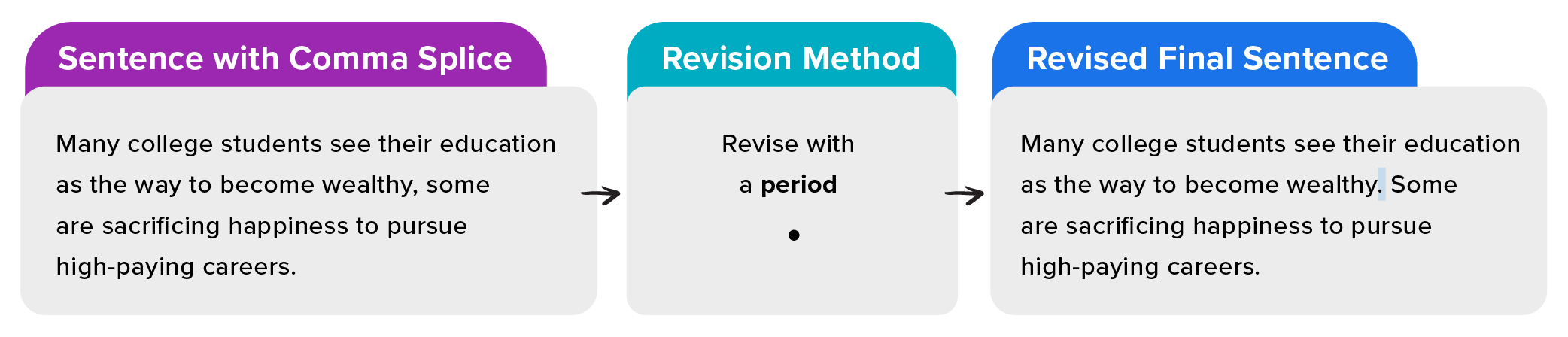
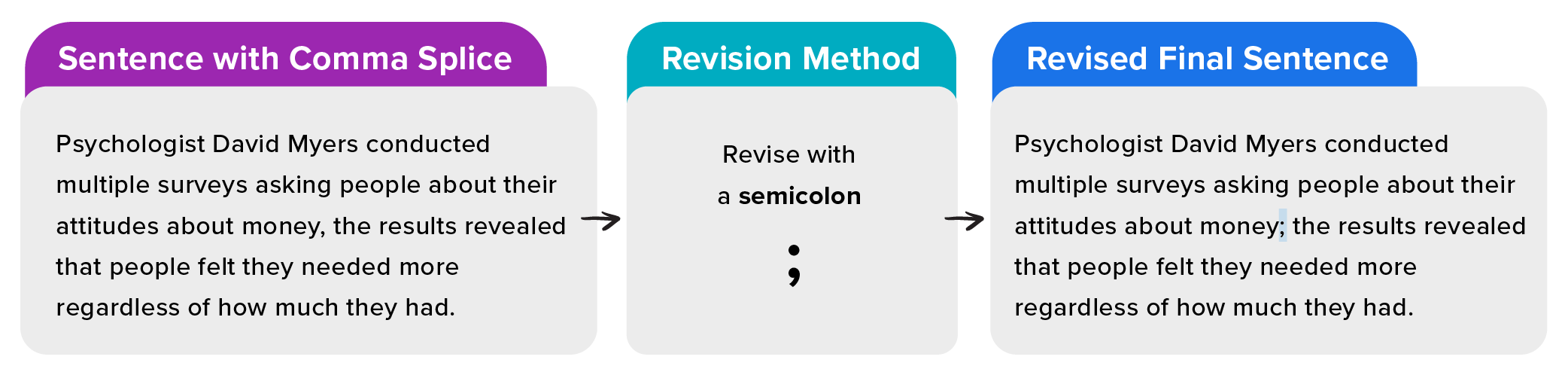
-
- Comma Splice
- A common error that occurs when two complete sentences are joined by a comma.
1c. Run-on Sentences
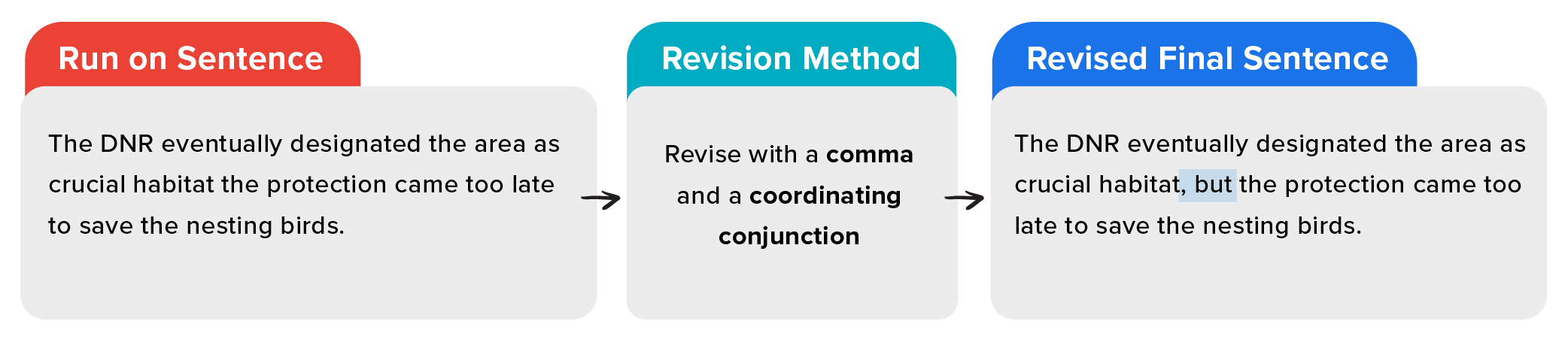
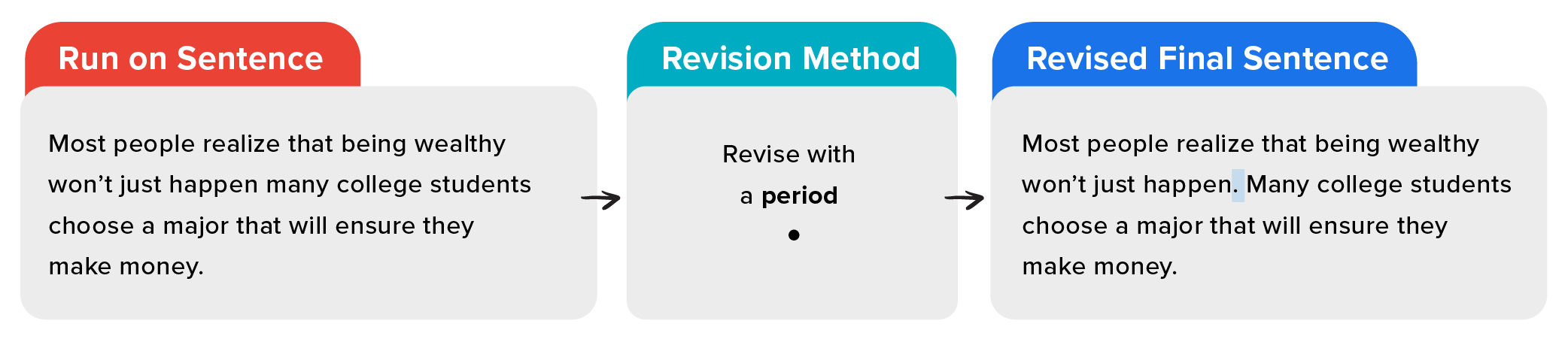
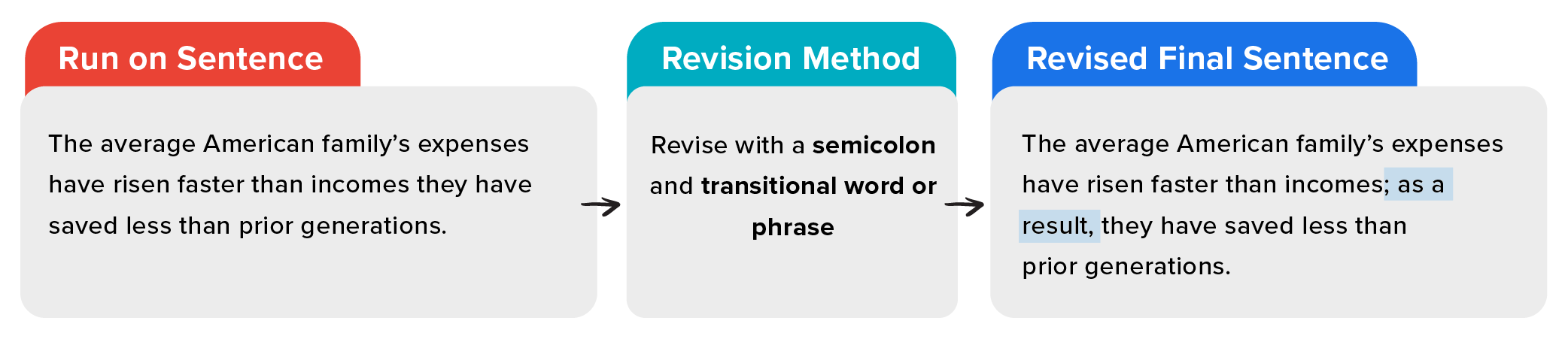
In a run-on sentence, two or more complete sentences are not separated by any punctuation. Here are some examples of different strategies for fixing ron-on sentences.

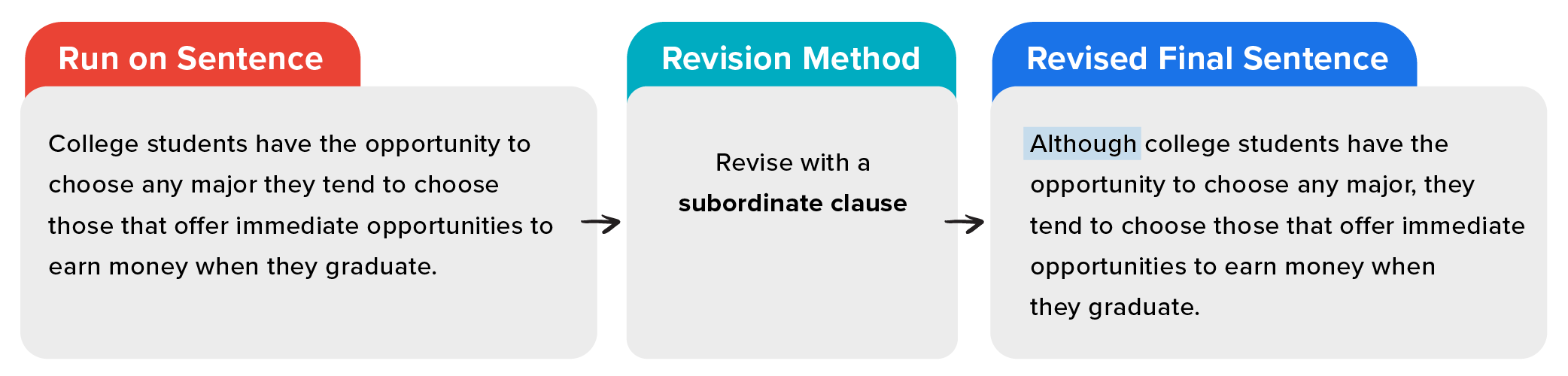
-
- Run-on Sentence
- When two or more complete sentences are not separated by any punctuation.
1d. Frequently Misused Words
The words in the following list are commonly confused or misused by writers. Keep a list of words that cause you trouble as you become aware of them. Then, after you draft a document, do a search for the words on your list.
- Accept vs. Except: Accept means “to receive willingly.” Except is used mostly as a preposition meaning “excluding.”
- Advice vs. Advise: Advice is a noun meaning “guidance.” Advise is a verb meaning “to recommend.”
- Affect vs. Effect: The verb affect means “to produce a change in.” The noun effect means “result.”
- All ready vs. Already: All ready means “completely prepared.” Already means “happened by or before now.”
- All right vs. Alright: All right is always two words meaning “acceptable” or “satisfactory.” Alright is an informal spelling.
- All together vs. Altogether: All together means “everyone or everything together.” Altogether means “completely” or “entirely.”
- Allusion vs. Illusion: An allusion is an indirect or implied reference. An illusion creates a false impression of reality.
- A lot: A lot is always two words meaning “much” or “many.” Alot is a misspelling.
- Apart vs. A part: Apart denotes a separation. A part denotes a segment of something.
- Bare vs. Bear: As verbs, bare means “to uncover.” Bear means “to endure.”
- Complement vs. Compliment: Complement means “to add to” or “to complete.” Compliment means “to make an approving remark.” Complimentary also means “free” or “without cost.”
- Conscience vs. Conscious: Conscience is a noun that refers to the awareness of one’s actions being right or wrong. Conscious is an adjective meaning “awake” or “alert.”
- Disinterested vs. Uninterested: Disinterested means “impartial.” Uninterested means “not interested.”
- Elicit vs. Illicit: Elicit is a verb meaning “to bring out.” Illicit means “unlawful.”
- Emigrate vs. Immigrate: People emigrate, or leave, one country. They immigrate to a new country to live.
- Everyday vs. Every day: Everyday is an adjective meaning “common,” “ordinary,” or “used daily.” Every day is a noun phrase meaning “each day” or “daily.”
- Farther vs. Further: Farther refers to distance. Further means “in addition,” “more,” and “to a greater extent” and refers to abstractions like time or amount.
- Fewer vs. Less: Fewer refers to items that can be counted. Less refers to items that cannot be counted.
- Good vs. Well: Good is an adjective. Well is an adverb.
- Imply vs. Infer: Imply means “to suggest.” Infer means “to conclude.”
- Its vs. It’s: Its is a possessive pronoun. It’s is a contraction of “it is” or “it has.” Its followed by an apostrophe is incorrect.
- Lay vs. Lie: Lay means “to put or set something down.” Lie means “to be in or move into a horizontal position” or “to be situated.”
- Lead vs. Led: The past tense of the verb to lead is led. The noun lead (rhymes with red) is the metal.
- Lose vs. Loose: Lose is a verb meaning to “mislay” or “not win.” Loose means “not tight” or “not secure.”
- Peak vs. Peek vs. Pique: Peak means “a highest point” or “to reach a highest point.” Peek means “a secretive look” or “to take a secretive look.” As a verb, pique means “to spark interest.”
- Precede vs. Proceed: Precede means “to go before.” Proceed means “to go forward.”
- Prejudice vs. Prejudiced: Prejudice is a noun that is sometimes used incorrectly in place of prejudiced, an adjective.
- Principal vs. Principle: Principal has several meanings: “a chief or head, particularly of a school,” “a capital sum of money,” or “first or highest in rank, importance, or value.” Principle refers to a “rule of conduct or action.”
- Raise vs. Rise: Raise means “to lift” or “to grow” and always takes an object. Rise means “to get up” and does not take an object.
- Than vs. Then: Than is used to compare. Then indicates time.
- That vs. Which: That is used to introduce information essential to the meaning of a sentence. Which is most often used to introduce information that is nonessential to the meaning of a sentence.
- Their vs. There vs. They’re: Their is a possessive pronoun. There indicates place. They’re is a contraction of “they are.”
- To vs. Too vs. Two: To can be a preposition indicating direction, or it can be part of an infinitive (the to form of a verb). Too means “also” or “excessively.” Two is a number.
- Weather vs. Whether: Weather refers to the state of the atmosphere. Whether refers to alternatives.
- Who’s vs. Whose: Who’s is the contraction of “who is” or “who has.” Whose is the possessive form of “who.”
- Your vs. You’re: Your is the possessive form of “you.” You’re is the contraction of “you are.”
2. Tense Consistency
Verbs are the words that express the action in a sentence. Their most distinguishing feature is that they change according to tense. That is, they take on different forms to express action that happened in the past, happens in the present, or will happen in the future.
In English, the form of the verb changes to indicate whether something is happening currently or has happened already. These changes that indicate time differences are called verb tenses. If an action or description occurs now or occurs regularly, in the present time, writers use the present tense. Conversely, if the action occurred in the past and no longer occurs, writers use the past tense.
-
EXAMPLE
-
Present tense: She walks to class.
-
Past tense: She walked to class yesterday.
In simple sentences such as these, choosing a verb tense is fairly straightforward. The author decides when to place the event in time and chooses the corresponding verb form. Although people easily use different verb tenses every day, getting them right in writing can be tricky at times. Writers may accidentally change from past to present tense within a text—or even within the same sentence—for no particular reason.
-
EXAMPLE
-
Tense mismatch: I lost a glove on my walk, but I find it later.
-
Tense match: I lost a glove on my walk, but I found it later.
In this example, the verb lost places the action in the past; the present-tense verb find is not consistent with that pattern. The revision places all of the action in the same time frame: the past. Because changing the tense for no reason can confuse the audience, be sure to use the same verb tense throughout, whether events happen in the past or they happen in the present.
However, you do need to change tenses to indicate a difference in time, and such differences occur often. This situation is why choosing verb tenses in writing can sometimes pose challenges for writers. If you are using the present tense in writing, but you want to describe something that happened in the past, you need to change tenses to make that time difference clear.
-
EXAMPLE
-
Tense mismatch: The artist uses bright colors in her paintings. She says that when she is a child, these colors attract her.
-
Tense match: The artist uses bright colors in her paintings. She says that when she was a child, these colors attracted her.
The writer is discussing the artist in the present tense, and the artist is speaking in the present tense. However, she is telling about her childhood, which took place in the past. Therefore, she and the writer use both past and present tense to make the time distinction clear. To put all events in the present tense would not make sense in such cases.
In this lesson, you have learned how to improve sentence clarity and correct common sentence errors, two essential components of polished, professional writing. During the final stage of editing, proofreading, you focus on small but important details such as spelling, punctuation, formatting, and common sentence errors. You reviewed how to identify and fix sentence fragments, comma splices, and run-on sentences, which can interfere with meaning and flow. In addition, you explored frequently misused words and learned to revise with greater precision by checking for these issues in your drafts.
You also learned the importance of maintaining tense consistency throughout a piece. Verbs must clearly reflect the time in which actions occur, whether past, present, or future. Inconsistent verb tense can confuse readers and weaken your message. By mastering sentence clarity and verb tense control, you can make your writing clearer, more engaging, and easier for your audience to follow.