Use Sophia to knock out your gen-ed requirements quickly and affordably. Learn more
×

Projects vs. Operations

Author: Sophia

what's covered
In this lesson, you will learn about the key differences between projects and operations within project management, including some examples of each.

Specifically, this lesson will cover the following:

Table of Contents

1. Introduction to the Course

A woman presents a website flow diagram to four colleagues in a modern office.

Welcome to the Project Management course! We are thrilled to have you join us on this exciting journey into the world of project management. Whether you are new to the field or looking to enhance your skills, this course is designed to provide you with a comprehensive understanding of project management principles and practices.

Throughout this course, you will learn about essential skills and methodologies to effectively plan, execute, and oversee projects from start to finish. This course covers key concepts such as:

  • Defining project goals, plans, and scope
  • Managing resources, project budget, and timelines
  • Using effective communication and leadership skills to enable you to collaborate with team members and stakeholders (a person or group that has an interest or concern in something)
  • Assessing and managing risks and solving problems
  • Ensuring projects align with organizational objectives
  • Preparing you to lead successful projects in any industry
This course is structured to offer a blend of theoretical knowledge and practical insights. We will explore various project management methodologies, tools, and techniques that will equip you to manage projects efficiently from inception to completion.

To make your learning experience better, we will use many examples and real-world stories (case studies) during the course. These will help you connect what you learn in theory to real-life situations, making the lessons more interesting and meaningful. By looking at case studies and completing assessments to check your understanding, you will learn important lessons about the challenges and solutions in project management across different industries. This approach will help you see how project management works in the real world, giving you useful insights and skills.

By the end of this course, you will have an understanding of project management principles, the ability to distinguish between projects and operations, and the skills to apply best practices in various situations. We are excited to embark on this educational journey with you and look forward to seeing you learn more about project management.

 Welcome aboard!


2. Definitions of Projects and Operations

In today’s dynamic marketplace, achieving operational excellence and maintaining a well-defined strategy are crucial for businesses to meet their goals. Two essential areas where these elements exist are:

  • Operations management
  • Project management
key concept
Though both operations and project management claim to optimize performance and ensure seamless processes, they cater to distinct functions and demand specific skills.

Operations Management

Operations management is essential in managing the continuous processes that produce and deliver a company’s goods or services. It encompasses a broad spectrum of activities, including planning, organizing, coordinating, and controlling the resources necessary for production. The core objective is to ensure that business operations are efficient, effective, and responsive to customer demands. Operations managers are tasked with managing supply chains, overseeing production processes, maintaining quality control, and optimizing inventory levels. Their role involves minimizing costs while maximizing productivity and quality. Through continuous improvement initiatives and best practices, operations managers strive to enhance processes, leading to increased customer satisfaction, waste reduction, and profitability.

Project Management

In contrast, project management is centered on the planning, initiation, execution, control, and closing of projects. These projects are temporary endeavors designed to create unique products, services, or results. Project management involves applying knowledge, skills, tools, and techniques to satisfy project requirements. It also follows a systematic approach to convert an idea into tangible deliverables, ensuring completion within time, budget, and quality constraints. Key aspects include defining the project scope, identifying deliverables, managing risks, and fostering effective communication across teams. By defining the project’s boundaries and deliverables, project managers manage stakeholder expectations and prevent scope creep. They identify potential risks, assess their impact, and develop strategies to mitigate them. Clear communication ensures collaboration and alignment with the project goals.

big idea
Understanding how operations management and project management differ and how they work together is key for businesses aiming to succeed. Operations management is all about keeping day-to-day activities running smoothly and efficiently to meet customer needs. In contrast, project management focuses on driving innovation and making strategic changes through specific projects. When businesses combine these two approaches, they can greatly improve their overall performance. This combination allows them to deliver more value, reach their goals, and stay competitive. By using both operations and project management effectively, organizations can make the best use of their resources, improve their processes, and encourage new ideas, helping them maintain a strong position in the market.

reflect
Reflect on a time in your daily life when you had to manage regular tasks while also working on a one-time project or goal. How did you balance the ongoing responsibilities (like operations management) with the demands of the special project (like project management), and what strategies helped you ensure both were successful?

Now that you have a basic understanding of the tasks behind operations and project management, you will explore some of the key differences.

terms to know
Operations Management
The management of resources to optimize productivity and quality, ensuring the business meets customer demands effectively. 
Project Management
The process of applying knowledge, skills, tools, and techniques to project tasks to achieve specific goals and requirements.


3. Key Differences Between Projects and Operations

As noted, there are many key differences and similarities between projects and operations management. Projects and operations are two distinct aspects of business activities. Let’s explore both based on the following factors: definition, objective, examples, duration, uniqueness, change, team structure, and success management.

Aspect Project Management Operations Management
Definition Temporary endeavor with a specific start and end, aimed at creating a unique product, service, or result. Ongoing, repetitive activities that produce goods or provide services.
Objective To achieve specific goals and deliverables within constraints of scope, time, and cost. To sustain business, maintain ongoing operations, and generate revenue.
Examples Building a new bridge, developing a software application, and launching a marketing campaign. Manufacturing cars, processing insurance claims, and running a customer service center.
Duration Finite duration; ends when the objectives are met. Indefinite; continues as long as the organization operates.
Uniqueness Unique; each project is different. Repetitive; processes are standardized and repeatable.
Change Embraces change; change is inherent to projects. Seeks stability and efficiency; change is minimized.
Team structure A temporary team assembled for the project. Permanent teams and functional departments.
Success measurement By completing the project scope on time and within budget. By efficiency, productivity, and consistency of output.

Project Managers vs. Operations Managers: Differences According to Roles

Project managers and operations managers have different but important roles within a company.

  • Project managers oversee finishing specific projects successfully. They set the project’s goals, plan the timeline, organize resources like people and money, and handle any risks that might come up to make sure the project is completed on time and meets the quality standards. They also communicate with everyone involved in the project and make sure everything is wrapped up properly in the end.
  • Operations managers focus on the daily activities and efficiency of the whole organization. They look after the processes that keep the company running smoothly, create plans to improve productivity, manage resources across different departments, and keep track of performance to make sure everything stays within budget. They also ensure that quality and safety standards are met and lead teams to create a positive and efficient work environment.

EXAMPLE

Here are some project management activities.
Note. All of these have a specific start and end date.
  • Designing a new product line
  • Implementing a new IT system
  • Organizing a company-wide training workshop
  • Relocating office headquarters
  • Conducting market research for a new region
Here are some operations management tasks.

Note. Each of them is ongoing and contributes to the day-to-day operations of the company.
  • Carrying out routine equipment maintenance
  • Scheduling employee shifts
  • Processing customer orders
  • Conducting quality control inspections
  • Managing inventory levels
  • Handling daily customer support calls

big idea
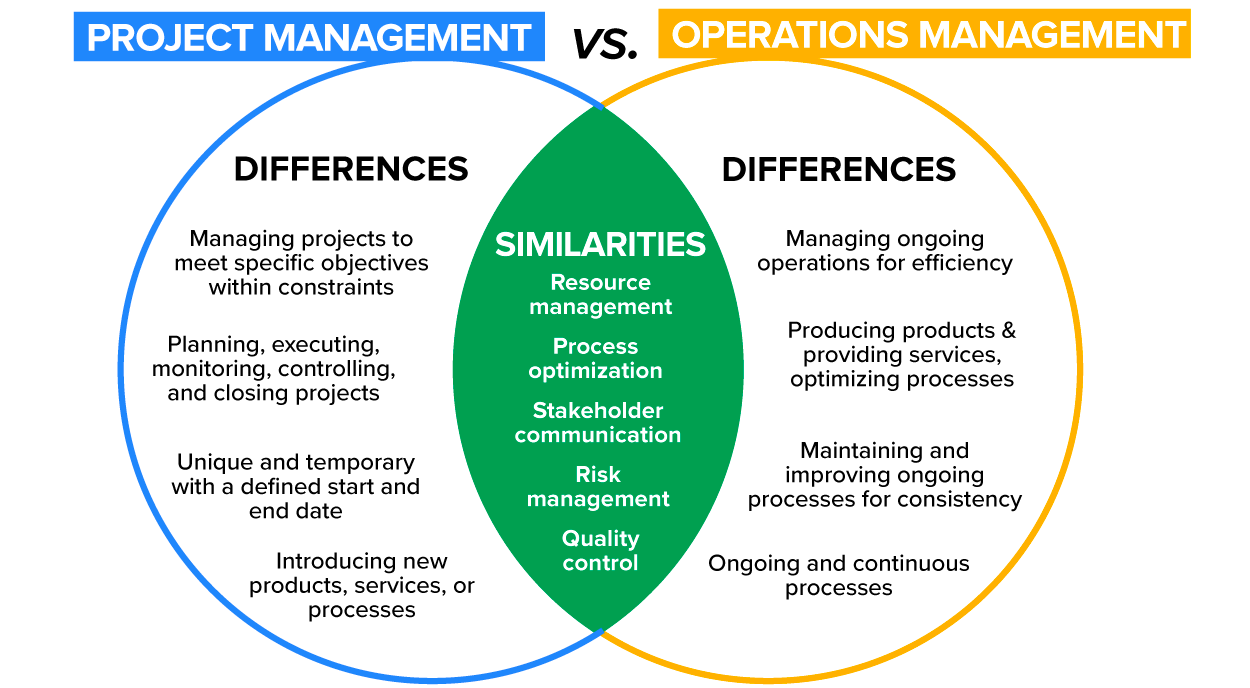
Project management and operations management share some similarities, like focusing on using resources and processes efficiently to achieve goals and deliver value. Both emphasize the effective management of resources, such as people and equipment, to enhance productivity. They also value quality control and risk management to maintain standards and reduce risks. Clear communication with stakeholders is important, and aligning efforts with the organization’s strategic goals is crucial for both. These commonalities help project and operations teams work together better, leading to greater success for the organization.

However, they have key differences. Operations management concentrates on maintaining and optimizing budgets for ongoing activities to ensure efficiency and cost-effectiveness. In contrast, project management is about managing a project’s financial resources, including estimating costs and tracking expenses throughout the project. Recognizing these differences helps both functions support organizational goals and boost overall performance.

Here is an image that shows how they both contain similar and different tasks and skill sets!

A Venn diagram contrasts ‘Project Management’ and ‘Operations Management’. The left circle, labeled ‘Project Management’, lists four differences: managing projects to meet specific objectives within constraints; planning, executing, monitoring, controlling, and closing projects; unique and temporary with a defined start and end date; and introducing new products, services, or processes. The right circle, ‘Operations Management’, includes managing ongoing operations for efficiency; producing products, providing services, and optimizing processes; maintaining and improving ongoing processes for consistency; and ongoing and continuous processes. The overlapping center, ‘Similarities’, includes resource management, process optimization, stakeholder communication, risk management, and quality control.

reflect
Can you think of ongoing tasks that you are required to complete, such as doing laundry or dropping kids off at school? When you compare these with a “project” in your personal life, how might you compare the difference between “operations” (day-to-day activities) and a “project” (something that has a definite start and stop date and is temporary)?

Select the “+” icon to see some additional examples.
Examples of “operations” in your personal life might be making dinner, doing the dishes, cleaning the house, paying bills, and mowing the lawn. These are the things that must be kept up on a weekly basis.

On the other hand, a “project” in your personal life might include something like planning a birthday party for your child, building and planting a garden, planning a wedding, or doing a home renovation. Note that all of these have a start and end date, unlike “operations” tasks, which are ongoing.
  

You should now have a basic understanding of the key differences between project management and operations management. Next, using some case studies, you can see the roles in action.


4. Management Roles in Action

hint
Throughout this course, you will be presented with many case studies and/or examples that will offer an in-depth exploration of real-world applications of principles taught. Make sure to review all case studies and/or examples.

Below are two case studies. By reviewing both case studies, you have an opportunity to engage with practical examples of how projects are planned, executed, and controlled, as well as how operations are managed for efficiency and effectiveness. These case studies provide insights into the health care industry, illustrating the challenges and solutions encountered by project and operational management professionals.

Project and Operation Management Roles in Action
Project Management Example: Opening a New Store Operations Management Example: Running an Existing Store
Opening a new store is a project because it has a specific start and end date, a defined budget, and clear goals.

The project involves multiple steps, such as selecting a site, negotiating the lease, designing the layout, constructing the space, hiring and training staff, planning the grand opening, installing technology like POS (point-of-sale) systems, and marketing the launch. A project manager would coordinate all these activities, ensuring that the new store is completed on time and within budget and ready to serve customers.
 
As you learned from this lesson, operations management is all about the day-to-day activities, such as the day-to-day activities needed to run an existing store.

The operations of a retail store include tasks like managing inventory, scheduling staff, serving customers, monitoring sales performance, maintaining cleanliness, handling cash, and submitting daily reports. Unlike project management, which is temporary and change oriented, operations management is repetitive and continuous, focused on efficiency, consistency, and customer satisfaction. The store or operations manager ensures that processes run as planned, employees are productive, customers are happy, and costs are controlled.

think about it
Based on the cases, think about key words like “tasks” and “duties” that may help to differentiate project management from operations management relative to the cases. What are the main factors that make them different in this setting?

summary
In this lesson, you were first introduced to the course to help you get an understanding of what you will learn and how the course is structured. Next, you learned that the definitions of project management and operations management are different. You continued to learn about the separation of these roles as you read about the key differences between projects and operations. Finally, you gained an even better understanding of the different positions by reading two case studies that depicted the project and operations management roles in action.

Source: THIS CONTENT HAS BEEN ADAPTED FROM PRESSBOOKS "NSCC PROJECT MANAGEMENT” BY ADRIENNE WATT. ACCESS FOR FREE AT https://pressbooks.atlanticoer-relatlantique.ca/projectmanagement/ LICENSE: CREATIVE COMMONS ATTRIBUTION 4.0 INTERNATIONAL


Terms to Know
Operations Management

The management of resources to optimize productivity and quality, ensuring the business meets customer demands effectively.

Project Management

The process of applying knowledge, skills, tools, and techniques to project tasks to achieve specific goals and requirements.
