In this lesson, you will explore how projectiles move through the air and how their motion can be broken into two independent parts: vertical and horizontal. You'll learn how gravity affects the vertical motion while horizontal motion remains constant and discover key aspects of projectile paths—such as range, trajectory, and maximum height—that help predict and describe their behavior. Specifically, this lesson will cover:
Ever watched a soccer ball sail through the air after a powerful kick? That smooth, curved path it follows is called projectile motion. Whether it's a goal kick, a long pass, or a record-breaking punt, every ball in flight, and any other object thrown or shot through the air, follows the same basic physics. To understand what’s going on, we break the motion into two parts that happen at the same time:
Horizontal motion is how far the ball travels sideways. Once the ball is kicked, there's nothing pushing it forward anymore (ignoring air resistance), so it keeps going at the same speed in that direction.
Vertical motion is what causes the ball to rise and fall. Gravity is always pulling the ball down, slowing it as it climbs and speeding it up as it drops.
Think of it like a parabolic path: the ball is constantly moving forward while also moving upward at first, then downward, all at the same time. These two motions work independently, but together, they create that classic soaring shape we see in sports and science.
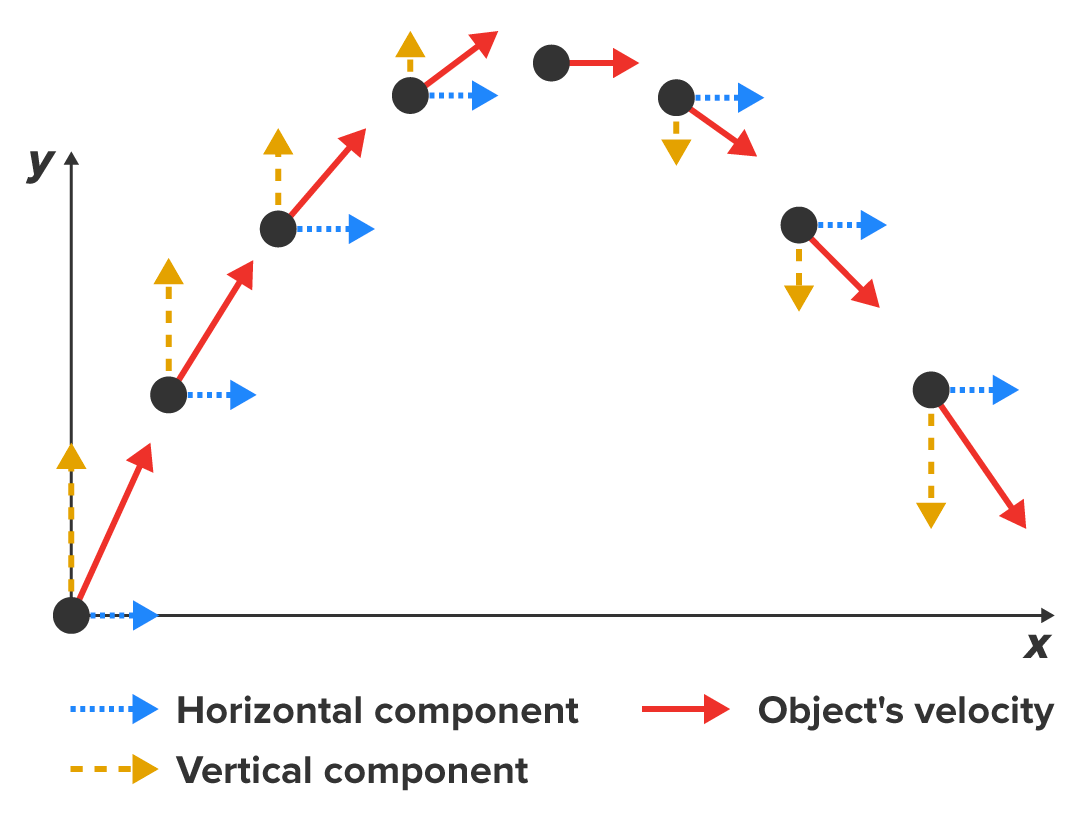
The velocity of a projectile’s symmetrical path combines both horizontal and vertical components of motion.
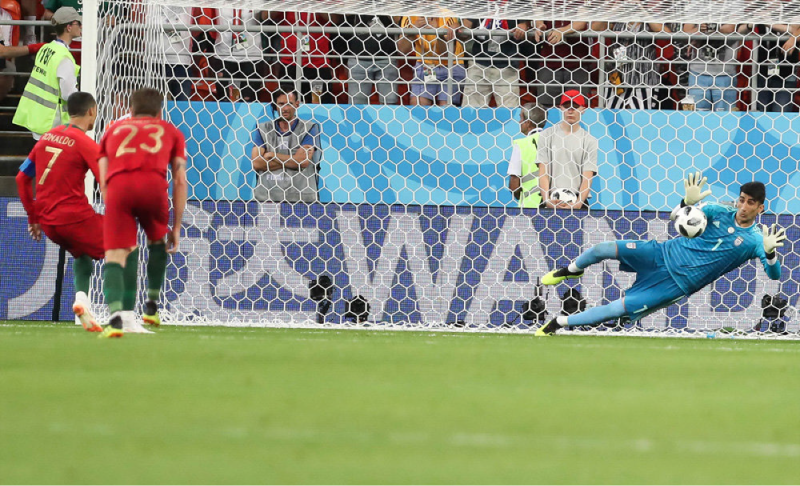
IN CONTEXT Real World Scenario: Record-Breaking KickBeiranvand saves a penalty kick at the 2018 World Cup
In 2019, Iranian goalkeeper Alireza Beiranvand showed just how far projectile motion can take a soccer ball. He launched a drop kick that traveled an incredible 78.014 meters (over 255 feet), earning him a Guinness World Record. It’s a real-world example of projectile motion in action where speed, angle, and air resistance all come together to make a jaw-dropping play.
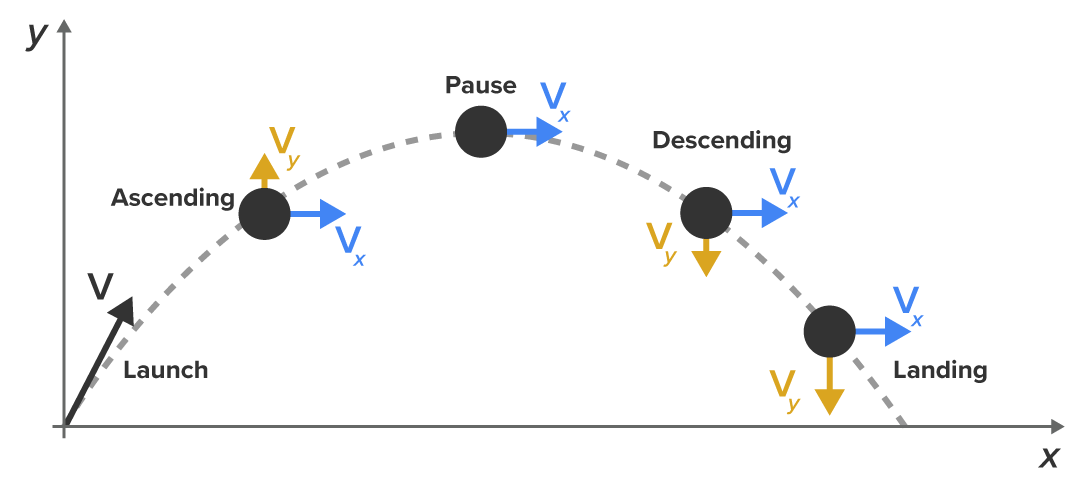
When you trace the path of a projectile, you can see how the horizontal motion (side-to-side) and vertical motion (up-and-down) work together to form the arc. The force of gravity pulls downward, so the vertical component of motion changes over time, but the horizontal component of motion remains steady throughout. For an object launched at 45 degrees and ignoring air resistance, we can describe the object’s velocity during key points in its flight.
An object moves through the air along a perfect arc—its path frozen at five key moments. From launch to landing: ascending, pausing, and descending.
At Launch
x-component of velocity: constant throughout flight
y-component of velocity: begins decreasing due to gravity
During Ascent
x-component of velocity: constant throughout flight
y-component of velocity: decreasing due to gravity continues
At Peak (Maximum Height)
x-component of velocity: constant throughout flight
y-component of velocity: 0 m/s — just before it changes direction
During Descent
x-component of velocity: constant throughout flight
y-component of velocity: increasing downward due to gravity
Just Before Impact with the Ground
x-component of velocity: same as launch
y-component of velocity: equal in magnitude to the initial but downward
try it
PhET Scientific Simulation: Launch Like a Physicist
Objective:
Ever wonder why quarterbacks throw at an angle or why long jumpers launch into the air instead of running straight? They’re using the physics of projectile motion; the same principles that govern how anything moves when it’s launched into the air and pulled down by gravity.
In this simulation, you’ll take control of a virtual cannon to explore how angle, speed, and gravity affect the path of a projectile. No need for safety goggles! Just adjust the settings, fire away, and watch the motion unfold in real time. Ready to test what makes a projectile fly farther, higher, or faster?
Set the cannon height to 0 m and air resistance to OFF.
Launch a projectile with a speed of 20 m/s at a 30° angle. Observe the trajectory.
Now try different angles (but keep the speed the same).
Select “Slow” to observe the motion in slow motion and examine the variations in the horizontal and vertical velocity vectors of the projectile motion.
Based on the experiment, try to explain the following:
At what launch angle does the projectile travel the farthest?
Use the simulation to test different angles (e.g., 15°, 45°, 60°), and compare the range of each path. What do you think is happening?
terms to know
Projectile Motion
An object moving through the air along a curved path.
Horizontal Motion
How far the object moves sideways during projectile motion.
Vertical Motion
How high or low the object moves during projectile motion.
2. Maximizing Projectile Range
When you launch a projectile, like throwing a ball at an angle, it follows a curved path because of the way gravity and forward motion work together. How far the projectile travels is called the range and there can be many factors affecting it.
One key factor affecting range is the launch angle, the angle between the direction an object is projected and the horizontal ground. In projectile motion, the launch angle determines how high and how far the object will travel.
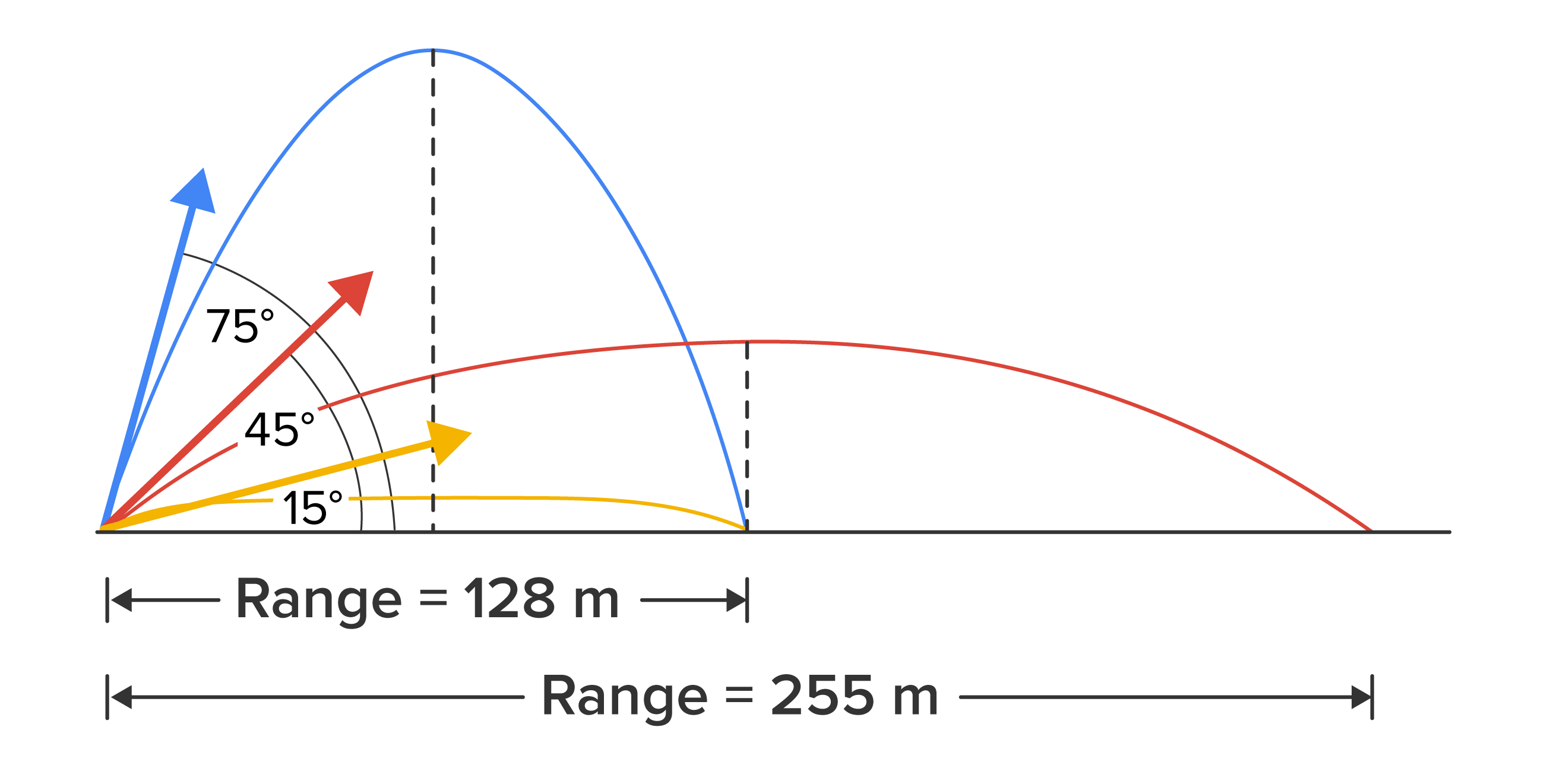
A larger launch angle (closer to 90°) sends the object higher but not as far.
A smaller launch angle (closer to 0°) keeps it low and fast but with limited height.
The ideal angle for maximum range, on level ground without air resistance, is 45°—a perfect balance of height and distance.
Three projectile paths launched at 15°, 45°, and 75° demonstrating that the 45° angle produces the maximum horizontal range. Changing the angle changes how much speed goes into each direction. A 45° launch angle gives equal parts upward and forward motion, making it ideal (without air resistance) for going the farthest.
brainstorm
In a situation with no air resistance, the best launch angle for maximum range is 45°. But real-world objects, like soccer balls or frisbees, experience air resistance. When air resistance is in play, the best launch angle drops to around 40°. Why do you think that is?
did you know
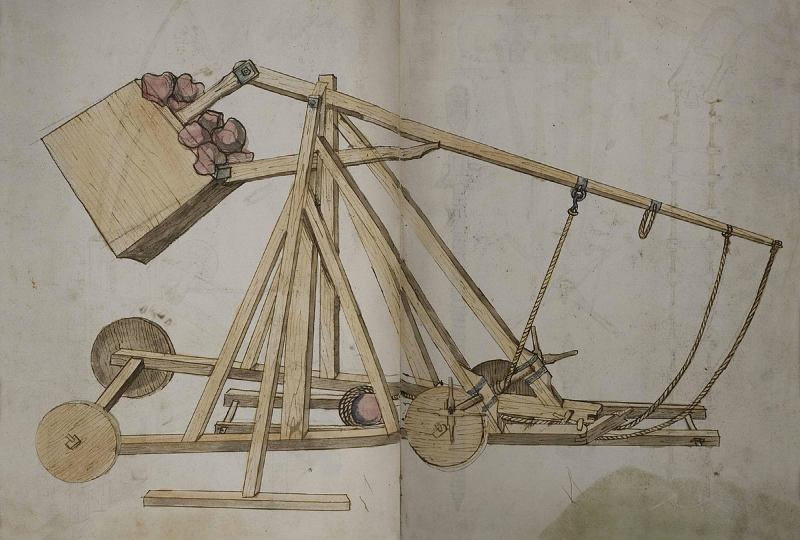
An illustration of Archimedes' catapult, which harnessed twisted rope tension and a lever arm to hurl heavy stones during the Siege of Syracuse.
In 212 BCE, during the Roman siege of Syracuse, Archimedes, one of history’s greatest scientists, used his understanding of physics to defend his city. He designed catapults that hurled heavy projectiles at enemy ships, applying key principles of projectile motion long before they were formalized. To maximize the distance those projectiles traveled, Archimedes would have had to carefully consider the launch angle and initial speed.
In real-life projectile motion, air resistance plays an important role in how an object moves through the air. As a projectile travels, the air around it slows it down a little, which means it won’t go as far or as high as it would in an ideal situation. For example, when you kick a soccer ball, its path is not a perfect curve because the air pushes against its motion, reducing its speed. This effect is more noticeable for objects that are light or have a larger surface area, like a shuttlecock or a piece of paper. Because of air resistance, the actual path of a projectile is slightly flatter and shorter than what we calculate when we ignore air resistance in basic physics problems. Understanding this helps explain why athletes prefer smooth, streamlined equipment and why objects of different shapes travel differently through the air.
terms to know
Range
The distance a projectile travels.
Launch Angle
Angle between the direction an object is launched and the horizontal ground.
summary
In this lesson, you explored how projectiles move through the air and how their motion can be separated into two independent parts: horizontal and vertical components. In projectile motion, you learned how gravity affects vertical motion while horizontal motion remains constant, creating a curved path. Then, in maximizing projectile range, you discovered how launch angle influences how far a projectile travels. Together, these ideas helped you understand and predict the motion of objects launched through the air.