Table of Contents |
A project management methodology is a way to help you plan and run your projects efficiently. A methodology is a structured approach or system of practices, techniques, procedures, and rules used to plan, execute, and complete a project.
Yes, no two projects are exactly alike, even if you use templates to try to copy past successes. Different teams have different goals and ways of working, which can vary a lot between industries. This means there’s no single way to manage every project. What works great for one team might be a disaster for another. For instance, many software developers found that traditional project management methods were not effective. Instead, these methods were slowing them down and hurting their results. So, they created new project management approaches that better suited their needs. Soon, other teams and industries began to adapt these new methods to fit their own unique situations. Now, there are many different project management methodologies to choose from, each tailored to different needs and uses.
When companies choose the best project management methodology, it involves looking at different factors related to the project, team, and organization. Important things to think about include how complicated the project is, what skills your team has, how much the stakeholders are involved, and what the project’s main goals are. By understanding these factors, you can pick a method that fits your project’s specific needs and increases the chances of it being successful. Therefore, choosing the right project management methodology depends on several important factors. Let’s visit some!
There are many different industries, so that leaves project managers with many different types of methodologies to choose from! In this lesson, we will focus on the five main ones that are used and then see how they are used across industries.
The Waterfall methodology is a traditional way to manage projects. It is one of the most traditional approaches because it has been used since the mid-20th century. It involves completing tasks and phases one after the other, in a straight line. You have to finish one stage before moving on to the next.
Here are the stages you usually follow in the Waterfall method:

| Waterfall or Traditional Methodology | |
|---|---|
| Pros | Cons |
| The Waterfall methodology suits projects with clear, unchanging goals, ensuring stakeholder clarity. It organizes steady, predictable projects, ideal for regulated industries needing detailed documentation. New team members can easily catch up due to clear layouts, making it effective for maintaining order and transparency. | The Waterfall methodology isn’t ideal for projects that might change, as it doesn’t handle changes easily. If you don’t have a full picture of all the requirements before starting, Waterfall might not work since you need all the details up-front. Moreover, if you need to test and adjust things often, this method isn’t flexible enough to accommodate frequent changes based on feedback. |
Industries That Use This Methodology
We often see companies in construction and engineering use this method, because often construction is a linear process, in that one thing needs to be done before another. For example, if you were building a house, you need to lay a concrete foundation first, before you can start framing the house. You couldn’t, say, install sinks before the plumbing lines are run to the street. This is why construction lends itself to the Waterfall method. Large, manufactured items, such as airplanes, often use this sequential method for the same reasons.
Agile project management is a flexible, iterative approach to managing projects that emphasizes collaboration, customer feedback, and rapid delivery of small, functional pieces of a project. What these methods have in common are a few key principles: They are collaborative, meaning teams work closely together; they are quick, allowing for fast progress; and they are open to changes based on data, which means they can adapt easily.
The Agile methodology involves working in short phases, with lots of testing and reassessment, so that teams can quickly adapt to new information or feedback. In many Agile approaches, all the tasks that need to be done are added to a list called a backlog. Teams work through this backlog in cycles, and project managers or product owners decide which tasks are most important, so the teams know what to focus on first.
| Agile Methodology | |
|---|---|
| Pros | Cons |
| Agile project management offers flexibility for evolving projects, allowing adjustments when the final solution is unclear. It enables fast progress, prioritizing adaptability over perfection. Agile is ideal for quick work and frequent stakeholder involvement, fostering ongoing communication and collaboration throughout the project’s life cycle. | Agile may not suit projects requiring extensive documentation, predictable outcomes, or fixed courses. It’s less effective if your team lacks self-motivation or if strict deadlines and deliverables must be met, as its flexible nature can hinder adherence to rigid requirements. |
IN CONTEXT
Agile Connection
During the pre-project phase, the Waterfall method focuses on formality and ensuring the project details are well defined. In other words, very clear elements are outlined. In Agile, a business case is still done but may be smaller in scope, since Agile focuses on an iterative process, where there is some planning, but not every detail is planned out like with Waterfall.
Industries That Use This Methodology
We often see Agile used in industries that are fast moving, such as software and technology. This is because, sometimes, all requirements aren’t clear up-front; therefore, a project needs to be open to meet the needs of users. Google, for example, uses Agile for developing Gmail and Maps. Many banks use Agile when developing their software or websites to quickly accommodate consumer digital banking needs. Since Agile can move quicker and in a less linear manner than Waterfall, it is best used when there are more unknowns, unlike building a house, where the steps are fairly clear and laid out.
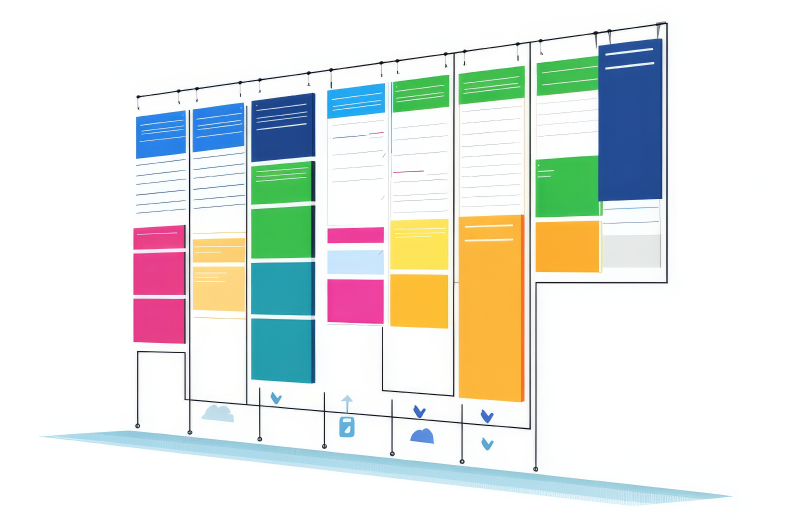
The Kanban methodology is another used in Agile project management, and it originally came from the manufacturing industry, actually the concept came from Toyota. It is a visual project management method used to manage work as it moves through a process. In Kanban, tasks are visually shown on a board called a Kanban board. This board has several columns, and each column stands for a different stage in the process of completing a task. Tasks start in a column for new work and are moved through the columns as they get done. The team takes tasks from a list called a backlog whenever they have the time and ability to work on them. This way, work is done continuously, and everyone can see what stage each task is in.
| Kanban Methodology | |
|---|---|
| Pros | Cons |
| Kanban offers several advantages, especially if you’re looking for a visual representation of your project’s progress. It provides at-a-glance status updates through its visual board, making it easy to see where each task stands. Kanban is ideal if you prefer to work on a continuous “pull” basis, where tasks are pulled from a backlog as the team has capacity. For example, giant retailer Zara uses Kanban to ensure the management inventory keeps up with customer demand. | Kanban might not be suitable if your process is very complex or has many stages, as it can become challenging to manage on a simple board. Additionally, if you prefer a “push” system, where tasks are assigned and scheduled ahead of time, Kanban’s “pull” approach might not meet your needs. |
Industries That Use This Methodology
Kanban is still used today by Toyota to manage inventory and production flow in the factory. We also see companies like Microsoft use this method to work on bug fixes for their software. Spotify uses Kanban boards to help visualize workflow and deliver new features for users. Kanban is often used in these industries to optimize manufacturing flow and works well when there is a physical workflow (like the production of cars) and the workflow is repetitive. Because it is a visual method, it allows for greater efficiency for teams.
The Scrum methodology is a type of Agile project management that acts more like a framework than a strict method. In other words, Scrum is one way to implement Agile. In the Scrum methodology, work is divided into short cycles called sprints, which last about 1–2 weeks. During each sprint, teams take tasks from a list called a backlog and focus on completing them. Small teams are led by a Scrum Master, who helps guide the team during the sprint. The Scrum Master is the person who guides and supports the team, ensures that everyone follows the Scrum methodology process, and removes any obstacles that might slow down the team’s progress. After each sprint, the team holds a “sprint retrospective” to review how things went and make improvements before starting the next sprint.
| Scrum Methodology | |
|---|---|
| Pros | Cons |
| Scrum offers several advantages for project management, particularly for teams aiming for continuous improvement. It encourages regular reflection and adaptation, making it ideal for environments where ongoing progress is valued. The short sprints in Scrum allow teams to concentrate on small, manageable tasks, which makes tracking progress and making quick adjustments easier. | The Scrum methodology also has its drawbacks. It requires full commitment from the team; if team members are not fully dedicated to the process, it can be challenging to implement the Scrum methodology effectively. Without this commitment, the benefits of regular reviews and adaptations might not be realized, leading to less effective project management. |
Industries That Use This Methodology
Since Scrum is focused on short sprints or time frames to accommodate changing needs, it works well for technology and software development. Remember, Scrum is one way that can be used to implement Agile, so many of the same types of companies that use Agile may also use Scrum as their approach.
The Lean methodology was started in manufacturing, especially with the Toyota Production System. It started with the Japanese idea of Kaizen, which means continuous improvement; Kaizen is now one of the core Lean principles. The Lean methodology is a business and project management approach focused on maximizing value to the customer while minimizing waste.
Originally, this meant cutting down on physical waste in the manufacturing process, but now it also refers to getting rid of wasteful practices in project management. There are three main types of waste in Lean, known as the 3Ms:
| Lean Project Management Methodology | |
|---|---|
| Pros | Cons |
| Lean project management offers several benefits, particularly if you’re seeking principles that help streamline processes and optimize your workflow. It focuses on consistently improving and adding value for the customer, which can ultimately lead to decreased costs. This method is effective if you’re dedicated to cutting waste and enhancing efficiency. | Lean might not be the best choice if your project can’t handle supply issues, such as not having enough inventory, or if there’s no room for errors, like essential equipment failing. Additionally, while Lean aims to reduce costs in the long run, it can be expensive to implement initially, which might be a challenge if your budget is limited. |
Industries That Use This Methodology
Many industries use the concept of Lean project management to help reduce waste and streamline internal processes. Often, this type of method is used in combination with other methods, and the advantage of doing this is to improve efficiency in projects, cut waste, control schedules, and streamline projects. For example, John Deere uses Lean project management in manufacturing processes but uses a Waterfall method when developing new hardware. It also uses Agile when developing software. So, as you can see, many companies will use a variety of project management methodologies in different aspects of their business to accommodate specific needs.
Let’s take one last look at the methods we’ve discussed and review their important aspects:
| Methodology | Elements | Pros | Cons |
|---|---|---|---|
| Waterfall Methodology | Good for projects that don’t change or where a clear path to completion is known |
|
|
| Agile Methodology | Flexible and iterative |
|
|
| Kanban Methodology |
|
|
|
| Scrum Methodology |
|
|
|
| Lean Project Management | Usually used in conjunction with other methods of project management; focuses on waste reduction and continuous improvement |
|
|
Source: THIS TUTORIAL WAS AUTHORED BY SOPHIA LEARNING. PLEASE SEE OUR TERMS OF USE.
REFERENCES
McDermott, O., Moloney, C., Noonan, J., & Rosa, A. (2024). Green Lean Six Sigma in the food industry: A systematic literature review. British Food Journal, 126(13), 455–469. www.emerald.com/bfj/article/126/13/455/1234086/Green-Lean-Six-Sigma-in-the-food-industry-a



