Table of Contents |
In project management, there’s something called the “triple constraint.” It’s so important that people also call it the “project management triangle,” the “iron triangle,” or the “project triangle.” When you’re in charge of a project, you must think about the triple constraint. The triple constraint in project management is really critical because it helps keep a project on track. It involves three main things: time, cost, and scope. Time is about how long the project will take, the cost is the money needed to finish it, and the scope is what needs to be done. If you change one of these, it usually affects the others.
EXAMPLE
If you want to finish the project faster (time), it might cost more money (cost), or you might not be able to do everything you planned (scope). Keeping a balance between these three helps ensure the project is successful. Let’s suppose you want to remodel your bathroom, but you originally planned the project for 2 months, but you have company coming and have decided you want it done in a month. You can increase costs to get it done faster (hire more workers, pay overtime, or rush shipping on materials), or you can reduce the scope, such as by skipping replacing the tile you’d originally planned to do.Imagine you’re working on a school project with a friend who is really good at coding, but they can only help for the next 3 months (time). They have their own ideas about how they want the project to turn out (scope). You know your friend will be more excited about the project if they get to make more decisions, which means the project could be done faster, and you would have less work to do (cost). However, this would mean giving up some of your own ideas for the project (scope).
In the school project example, the triple constraint helps you understand how time, cost, and scope interact and affect each other:
| Constraint | Example |
|---|---|
| Time | Your friend, the excellent coder, is only available for 3 months. This limits the project’s timeline. If you want to finish within this time, you might have to adjust the scope or the cost, like letting your friend make more decisions to speed things up. |
| Cost | You want to keep costs low while working with your team. Since your work is more expensive than your teammates’ work, you have to decide whether to help them or let them learn on their own, which could take more time. Balancing who does what work based on cost is a key part of managing the project. |
| Scope | Both you and your friend have ideas about the project. If you give your friends more control to keep them motivated and the project moving quickly, you might have to sacrifice some of your own ideas. Additionally, the project must meet all its requirements, so the scope is somewhat fixed, meaning you have limited flexibility in what can be changed. |
By using the triple constraint, you make decisions about which part of the project—time, cost, or scope—can be adjusted to meet your overall goals. This helps ensure the project is successful by keeping everything balanced.
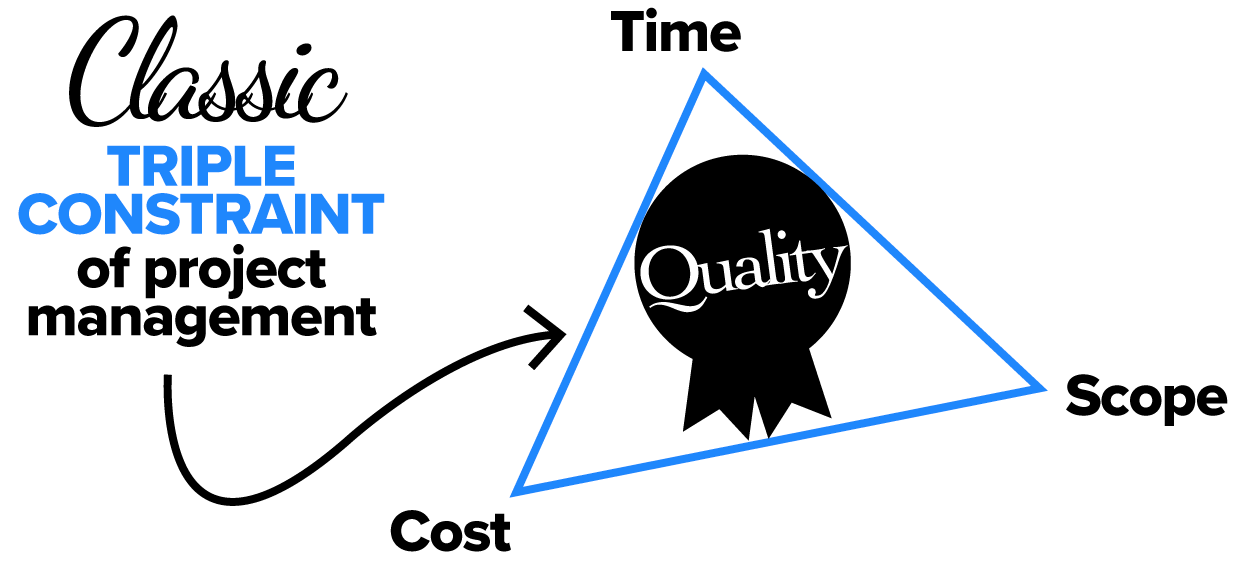
Here’s how it works:
Time: By carefully managing the timeline, you ensure that there is enough time to complete tasks without rushing. This prevents mistakes and allows for thorough checking and testing, which helps maintain quality.
Cost: Budget management ensures that there are enough resources to achieve the project’s goals. When the budget is balanced, you can afford quality materials, skilled labor, or the necessary tools, all of which contribute to a high-quality outcome.
Scope: Clearly defining and managing the scope ensures that all necessary features and requirements are included, which is crucial for meeting quality standards. If the scope expands, you can adjust time or cost to maintain the necessary quality level.
In the school project example, balancing these constraints means making sure that, despite any limitations, the final project meets its objectives and satisfies all requirements. By adjusting one constraint to accommodate changes, you prevent the others from being compromised, ensuring that the quality remains high.
In project management, the concept of “triple constraints” refers to three key elements: time, cost, and scope. These constraints are interconnected, meaning that changes in one can affect the other. Time, in particular, is crucial because it dictates the schedule for completing a project. If a project takes longer than planned, it can lead to increased costs and might require adjustments to the project’s scope, which is what the project is supposed to accomplish.
EXAMPLE
If building a new playground is delayed, it might cost more money to pay workers for extra days, or the project might need to be scaled back to stay within budget.Managing time effectively helps ensure that the project stays on track and within budget and meets its goals. This is why understanding the importance of time in relation to the triple constraints is essential for successful project management.
EXAMPLE
For instance, if a construction project, like building a school playground, is planned to be completed in 2 weeks but extends to 3 weeks, the additional time could lead to increased expenses, as workers would require payment for the extra week.Thus, understanding that time is a valuable asset helps highlight its direct impact on a project’s cost, emphasizing the importance of strategic time management in achieving successful project outcomes.

Cost refers to the budget needed to complete the project and managing it is crucial to ensure that the project does not become too expensive. If costs are not controlled, the project might run out of money, leading to delays or incomplete work. Cost is a crucial factor because it refers to the budget needed to complete the project. If the cost is not managed carefully, a project can quickly become too expensive, causing issues with the other two constraints.
EXAMPLE
If a project goes over budget, it might mean there isn’t enough money to pay for all the resources needed, like materials or workers, which could delay the project (affecting time) or require changes to what the project aims to achieve (affecting scope). For instance, if constructing a playground costs more than planned, the team might have to reduce the size of the playground or find cheaper materials.This demonstrates how important it is to keep track of costs to ensure that the project can be completed on time and as planned. Understanding how cost relates to the triple constraints helps ensure that projects are successful and meet their goals.
The scope includes all the tasks and goals that need to be completed to finish the project successfully. Managing scope is key because changes to the scope can impact both time and cost.
EXAMPLE
If the scope of a project, like building a playground, increases to include more features such as additional slides or swings, it might take more time to complete and cost more money. Conversely, if the scope is reduced, the project might be cheaper and quicker to finish, but it may not meet the original objectives.Therefore, keeping the scope well-defined and controlled helps ensure that the project meets its goals without going over budget or schedule. Understanding how scope relates to the triple constraints helps ensure that the project remains balanced and successful.
In project management, the “triple constraints” of time, cost, and scope are interconnected, each affecting the others. Managing time effectively keeps projects on schedule and within budget. Cost management prevents projects from becoming too expensive, avoiding delays and scope changes. Scope management ensures project goals are met without exceeding time or budget limits. Understanding these constraints helps in achieving successful project outcomes by maintaining balance and efficiency, highlighting the importance of strategic planning and resource allocation in managing projects effectively.
Project managers can change the cost, time, and scope of a project to keep it on track and within budget. This is called making trade-offs in the project triangle. Here’s how it works with some examples:
| Triple Constraint Scenarios Across Industries | |
|---|---|
| Industry | Scenario |
| Construction | Imagine building a small retail store that’s 2,000 square feet. The project is supposed to take 6 months and cost $300,000. If the client suddenly wants to add 500 more square feet, this increases the scope of the project. To handle this change, the project might need more time or a bigger budget to be successful. |
| IT | Suppose a sales team needs a new customer relationship management (CRM) system. They have 9 months and a budget of $250,000. The CRM needs to manage leads, sales reports, and contact tracking. If the sales team decides they want the CRM ready in just 6 months, they might have to reduce some features (scope) or increase the budget to get it done faster. |
| Manufacturing | Consider a company making 5,000 new smart home devices. Each device needs to have app integration and voice control, and they can’t cost more than $50 each to make. They also need to be ready in 3 months. If costs suddenly rise and each device can’t go over $40, the company might have to slow down production (taking more time) or retain fewer features (reduce scope) to stay on budget. |
Project managers use the following to handle the triple constraint, ensuring the project’s success.
Source: THIS CONTENT HAS BEEN ADAPTED FROM PRESSBOOKS "NSCC PROJECT MANAGEMENT” BY ADRIENNE WATT. ACCESS FOR FREE AT https://pressbooks.atlanticoer-relatlantique.ca/projectmanagement/ LICENSE: CREATIVE COMMONS ATTRIBUTION 4.0 INTERNATIONAL
REFERENCES
Bronte-Stewart, M. (2015). Beyond the iron triangle: evaluating aspects of success and failure using a project status model. Computing and Information Systems Journal, 19(2).
Pollack, J., Helm, J., & Adler, D. (2018). What is the iron triangle, and how has it changed? International Journal of Managing Projects in Business, 11(2), 527–547.



