Table of Contents |
During the early 1900s, schools in the United States underwent significant changes due to Progressive era reforms and the growing emphasis on standardization in education. These changes impacted how teachers taught, what students learned, and who was eligible to attend school. Leaders wanted schools to be more organized and fairer, so they created new rules, tests, and lessons that were implemented nationwide. While these changes helped make schools more efficient, they also caused problems for students from different backgrounds. In this lesson, you will learn how these reforms shaped teaching practices, curriculum development, and access to schooling during the early 20th century.
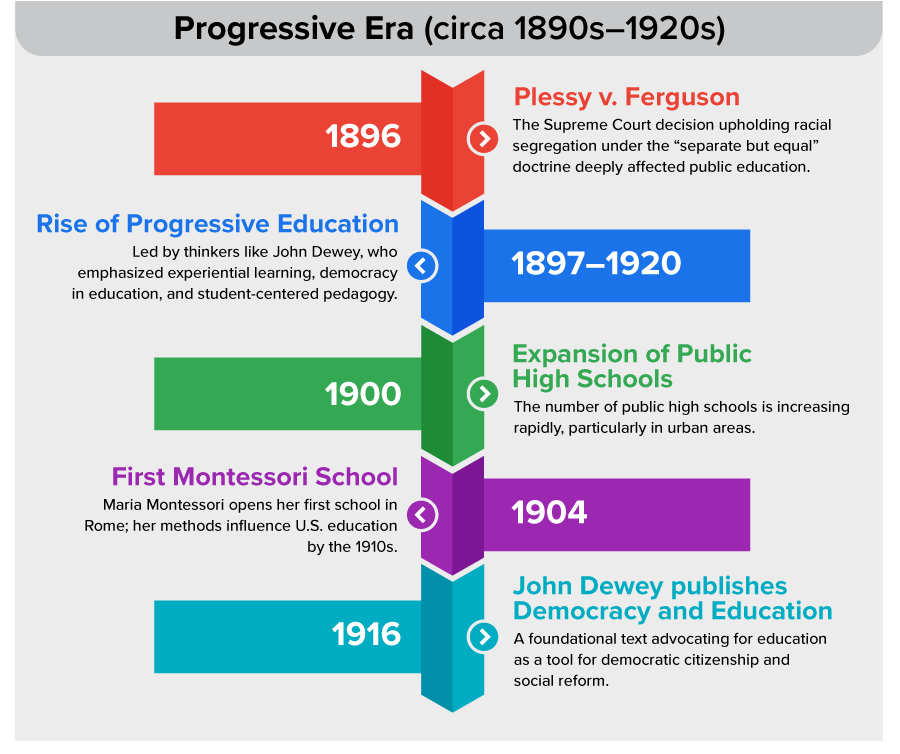
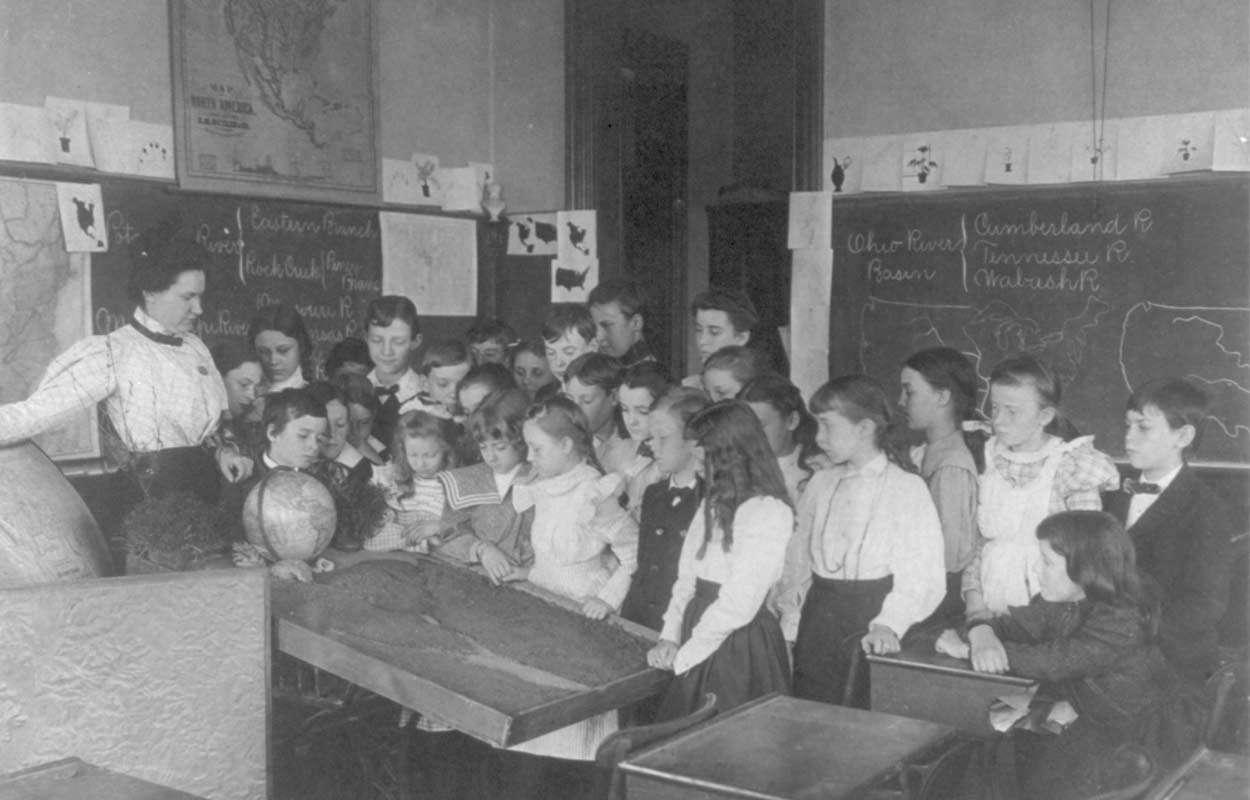
During the Progressive era, U.S. schools experienced significant reforms in teaching methods and curriculum. Educational practices shifted toward student-centered learning, promoting active participation rather than rote memorization. Students were encouraged to explore, inquire, and collaborate, while teachers tailored lessons to individual interests and learning styles. Experiential learning, or “learning by doing,” emerged as a key innovation, incorporating hands-on projects, science experiments, and outdoor activities to connect academic content to real-world experiences.
Educational reformers such as John Dewey and Maria Montessori advocated for these progressive approaches. Dewey emphasized the importance of preparing students for active citizenship through engagement with real-world experiences. Montessori developed pedagogical methods that promoted independence and curiosity by utilizing self-paced learning and specialized instructional materials.
The curriculum expanded beyond foundational subjects such as reading, writing, and mathematics. Schools incorporated new subjects, including civics, health, home economics, and vocational training, to foster practical skills and social awareness. Collaborative group work, problem-solving activities, and project-based learning became prevalent, reflecting an emphasis on holistic child development encompassing academic, social, and emotional growth.
Access to education increased as compulsory attendance laws were enacted, reducing child labor and ensuring that more children attended school. Public high schools expanded rapidly, providing educational opportunities for adolescents from varied backgrounds. However, progress remained inconsistent. Segregation, maintained by the Plessy v. Ferguson (1896) decision, resulted in Black students frequently attending underfunded schools, while Native American children were placed in boarding schools that suppressed their cultural identities. Despite these reforms, substantial disparities in educational access continued.
Overall, the Progressive era helped schools become more focused on the whole child. It encouraged active learning, real-world skills, and a more personal approach to teaching that still influences classrooms today.
To understand how these educational reforms were shaped and enforced, it’s important to examine the key legal landmarks of the Progressive era that influenced school policies and practices.
IN CONTEXT
Reformers such as John Dewey introduced the concept of student-centered learning, which emphasizes hands-on activities and learning through experience. These methods are still used in classrooms today. Schools also began offering vocational training, such as cooking and woodworking, to prepare students for jobs, which led to today’s career and technical education programs.
Educators focused on teaching the “whole child,” meaning they cared about students’ emotional, social, and physical development as well as their academics. Civic education also became more important, helping students learn how to be active and responsible citizens. These changes helped shape the modern school system and continue to influence how students learn today.
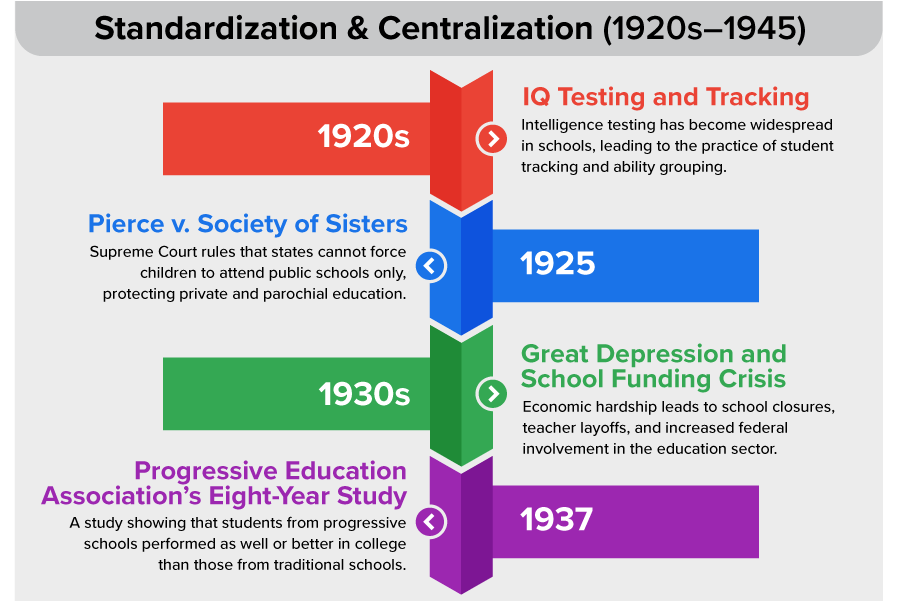
Between the 1920s and 1940s, U.S. schools underwent significant standardization and centralization to promote uniformity in teaching and learning. Large school boards and professional superintendents replaced local governance, implementing consistent rules, curricula, and expectations nationwide. Students studied the same core subjects, such as reading, writing, mathematics, and history, frequently using similar textbooks. High schools expanded vocational education by introducing courses such as typing, woodworking, and sewing to prepare students for specific careers.
A significant development during this period was the implementation of tracking, which utilized IQ tests to assign students to ability groups. Although tracking was designed to tailor instruction, it frequently reinforced existing inequities, especially for immigrant and minority students who were often misclassified due to language or cultural differences. Classrooms became highly structured, with instruction emphasizing memorization, drills, and discipline, which limited opportunities for creativity or individualized learning. Teachers had minimal flexibility to adapt lessons to students’ interests or needs.
While these reforms enhanced organizational structure and efficiency, they also diminished local input and created obstacles for learners with different needs. Segregation resulted in African American students attending underfunded schools, immigrant families encountered language barriers, and girls experienced limited educational opportunities. This period shaped the modern school system while also underscoring persistent issues of fairness and access.
Although this system helped schools become more organized and made it easier to measure student progress, it didn’t always meet the needs of every student. Lessons were often designed for the “average” student, leaving out those with different learning styles or special interests. Cultural differences and student voice were rarely included in lesson plans. As a result, learning felt less personal and flexible, and students had fewer chances to explore their own ideas or connect lessons to their lives.
IN CONTEXT
Later, school systems became more centralized. This means that decisions about schools were made by large city boards and professional leaders, rather than local communities. While this helped make schools more efficient, it also made it harder for parents and neighborhoods to have a say in how schools were run.
Even with these changes, many students were still left out. African American children were often forced to go to separate schools, and immigrant families faced challenges because of language and cultural differences. Girls also had fewer educational opportunities until later reforms. Overall, this era helped shape the school system we have today, but it also created problems with fairness and access.
Next, we’ll explore the key legal landmarks of the standardization and centralization era.
Progressive Era (1890s–1920s)—Modern Implications
Source: THIS TUTORIAL WAS AUTHORED BY SOPHIA LEARNING. PLEASE SEE OUR TERMS OF USE.
REFERENCES
Colgan, A. D. (2016). The epistemology behind the educational philosophy of Montessori: Senses, concepts, and choice. Philosophical Inquiry in Education, 23(2), 125–140. files.eric.ed.gov/fulltext/EJ1140350.pdf
DeBoer, J. (2012). Centralization and decentralization in American education policy. Peabody Journal of Education, 87(4), 510–513. eric.ed.gov/?id=EJ976083
Gibbon, P. (2019). John Dewey: Portrait of a progressive thinker. National Endowment for the Humanities. www.neh.gov/article/john-dewey-portrait-progressive-thinker
Katz, M. S. (1976). A history of compulsory education laws (Fastback Series No. 75). Phi Delta Kappa. eric.ed.gov/?id=ED119389
McCardle, T. (2020). A critical historical examination of tracking as a method for maintaining racial segregation. Educational Considerations, 45(2). files.eric.ed.gov/fulltext/EJ1250375.pdf
National Archives. (n.d.). Plessy v. Ferguson (1896). Milestone Documents. www.archives.gov/milestone-documents/plessy-v-ferguson
U.S. Department of Education. (2003). History and evolution of vocational and career-technical education: A compilation (ED482359). ERIC Clearinghouse on Adult, Career, and Vocational Education. eric.ed.gov/?id=ED482359
U.S. Department of Education. (n.d.). Smith-Hughes Act of 1917. U.S. Code Title 20 – Education. uscode.house.gov/view.xhtml?path=/prelim@title20/chapter2&edition=prelim



