Use Sophia to knock out your gen-ed requirements quickly and affordably. Learn more
×

Product Positioning

Author: Sophia
what's covered
In this lesson, you will learn about types of product positioning. Specifically, this lesson will cover:

Table of Contents

1. Product Positioning

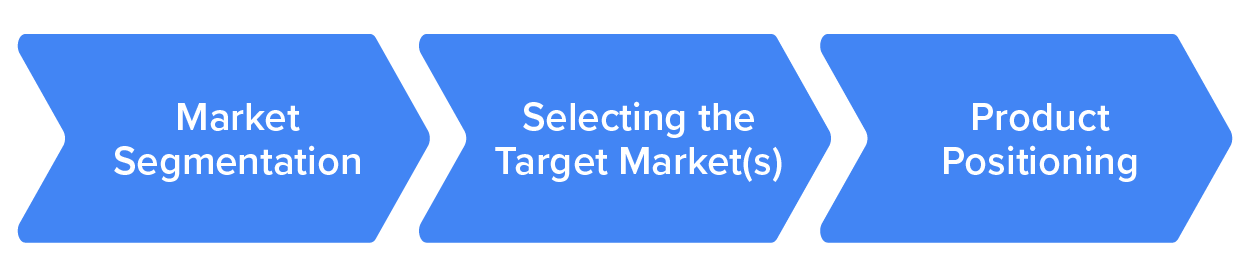
So far, you’ve segmented the market by dividing the market into distinct groups of customers using the segmentation process, and you’ve determined which customer group(s) you want to focus your marketing efforts on—the target marketing process. Product positioning is the process of deciding and communicating how an organization wants its market to think and feel about a product or service.

IN CONTEXT

This third and final step is contained in what’s known as the segmenting, targeting, and positioning model, the STP model. With the STP model, a company segments the market, selects the target market, and positions its products and services into the existing marketplace. In their book Positioning: The Battle for Your Mind, marketing gurus Al Ries and Jack Trout write, “The basic approach of positioning is not to create something new and different, but to manipulate what’s already up there in the mind.” The STP model is helpful in identifying your most valuable customers and developing products and marketing messages that are targeted specifically toward those customers. This allows you to interact with each market segment in a more meaningful way by personalizing your messages (and hopefully selling more of your product!).
EXAMPLE

Marriott International owns several different hotel chains that target specific consumer groups. Courtyard by Marriott focuses on over-the-road travelers who aren’t looking for luxury and all the amenities; they just want a basic, clean hotel in which to stay during their trip. Ritz-Carlton hotels are by their nature more luxurious and target those travelers who don’t mind paying a premium price for more luxury and amenities. Marriott ExecuStay hotels are aimed at professionals who need a longer-term place to stay (i.e., an extended stay hotel). Since these target groups are seeking vastly different things from a hotel stay, Marriott tailors its marketing messages (and hotels) to appeal to the unique wants and needs of each specific group.

As you can see, in this last step of the STP process, you want to first identify how you can most effectively position your product to target the customer segments that you’ve determined to be most valuable and then tailor the marketing mix that will be most effective in reaching them. There are two main types of product positioning in marketing: head-to-head and differentiation. Let’s take a look at both.

terms to know
Product Positioning
The process of deciding and communicating how an organization wants its market to think and feel about a product or service.
STP Model
When a company segments the market, selects the target market, and positions its products and services into the existing marketplace.

1a. Head-to-Head Positioning

Head-to-head positioning focuses on comparison. It involves directly competing with competitors on similar product attributes in the same market. For instance, let’s imagine that you have a small kiosk in a shopping mall where you serve freshly baked pretzels. If your kiosk makes different flavors of dough from scratch and your competitors use only processed frozen dough, you can set your pretzel business apart from your competitors in your customers’ minds by emphasizing that selling point.

IN CONTEXT

A classic example is when Avis (the car rental company) launched an advertising campaign that went head-to-head with Hertz, the market leader. Avis made a point of comparing itself to Hertz and made its position in the market a selling point using the slogan “When you’re only No. 2, you try harder. Or else.” This campaign positioned Avis as a direct competitor of Hertz and also did something unique: It highlighted its underdog status, turning it from a liability into an asset. The results? Prior to the ads, Avis was losing $3.2 million a year; after the ads, Avis improved its performance and earned $1.2 million. Remarkably, that was the first time in over a decade that Avis had been profitable.

term to know
Head-to-Head Positioning
Involves directly competing with competitors on similar product attributes in the same market.

1b. Differentiation Positioning

Differentiation positioning is all about emphasizing your product’s or service’s unique qualities vis-à-vis the competition.

key concept
Similar to head-to-head positioning, you’re going to focus on your offerings and attempt to convince customers to buy your products or services instead of those of the competition. However, dissimilar to head-to-head positioning, instead of competing in the same market, you’ll attempt to identify new markets and seek out customers who may be interested in your offerings because of those unique qualities you’ve identified. Common differentiation strategies are intended to draw consumers’ attention to the value, quality, or uniqueness of your offering.

For instance, Curves, the largest women’s fitness franchise in the world, succeeded by offering a fitness alternative to both home-based exercise routines and traditional health clubs. The experience of a Curves facility was entirely different from that of a typical health club. Instead of machines arranged in rows facing a TV, Curves arranged its machines in a circle to facilitate interaction among members. There were few (if any) mirrors and no men staring. The result was that Curves did not compete head-to-head with other health and exercise concepts; rather, it created new demand.

term to know
Differentiation Positioning
Involves emphasizing a product’s or service’s unique qualities vis-à-vis the competition.

1c. Positioning Statements

Essentially, a positioning statement briefly describes your brand, product, service, and target market. Not only does it define how your brand meets the customer’s needs, but it also tries to clarify why it does so better than your competition. It answers the question, “What experience do you want your customers to have with this product or service?”

Templates for writing your positioning statement abound. Here are just a few examples:

  • [Your brand] provides [your offering/benefit that makes you better than competitors] for [your customers] who [customer needs] because [the reason why your customers should believe you are better than competitors].
  • For [target audience], [brand name] is the [your market] that delivers [your points of differentiation] so they can [end benefit] because [your evidence].
Now let’s take a look at some examples of positioning statements for companies with which you’re likely familiar so that you can see these templates in action:

  • Amazon: “For consumers who want to purchase a wide range of products online with quick delivery, Amazon provides a one-stop online shopping site. Amazon sets itself apart from other online retailers with its customer obsession, passion for innovation, and commitment to operational excellence.”
  • Apple: “For individuals who want the best personal computer or mobile device, Apple leads the technology with the most innovative products. Apple emphasizes technological research and advancement and takes an innovative approach to business best practices—it considers the impact our products and processes have on its customers and the planet.”
term to know
Positioning Statement
A statement that briefly describes the brand, product, service, and target market.

1d. Perceptual Positioning Maps

A perceptual map is a visual diagram that shows how the average target market consumer perceives your product versus those of your competitors. A perceptual map uses two determinant attributes on a graph. Determinant attributes are those attributes that a customer uses in making their purchase decision. In other words, what do you believe consumers’ “hot buttons” are with respect to your product or service offering? You’ve got a vast array of determinant attributes to use. You could use price versus quality, sugar versus protein, or any number of other attributes. The bottom line is that these attributes should reflect what customers are looking for in the product or service. Once you’ve established the determinant attributes, you plot your product offering onto the map.

EXAMPLE

Let’s imagine that your company is getting ready to introduce a new nutritional drink for seniors. You might start out with determinant attributes like high/low sugar and high/low protein (although you could use other determinant attributes like price, taste, etc.). Now it’s time to map your offering as well as the competitors’ offerings on the perceptual map. The simple combination of these two scores places the product offering onto the map. It’s not necessary to list every single competitor on this perceptual map, but you should try for a list of at least 5 to 10 competitors.
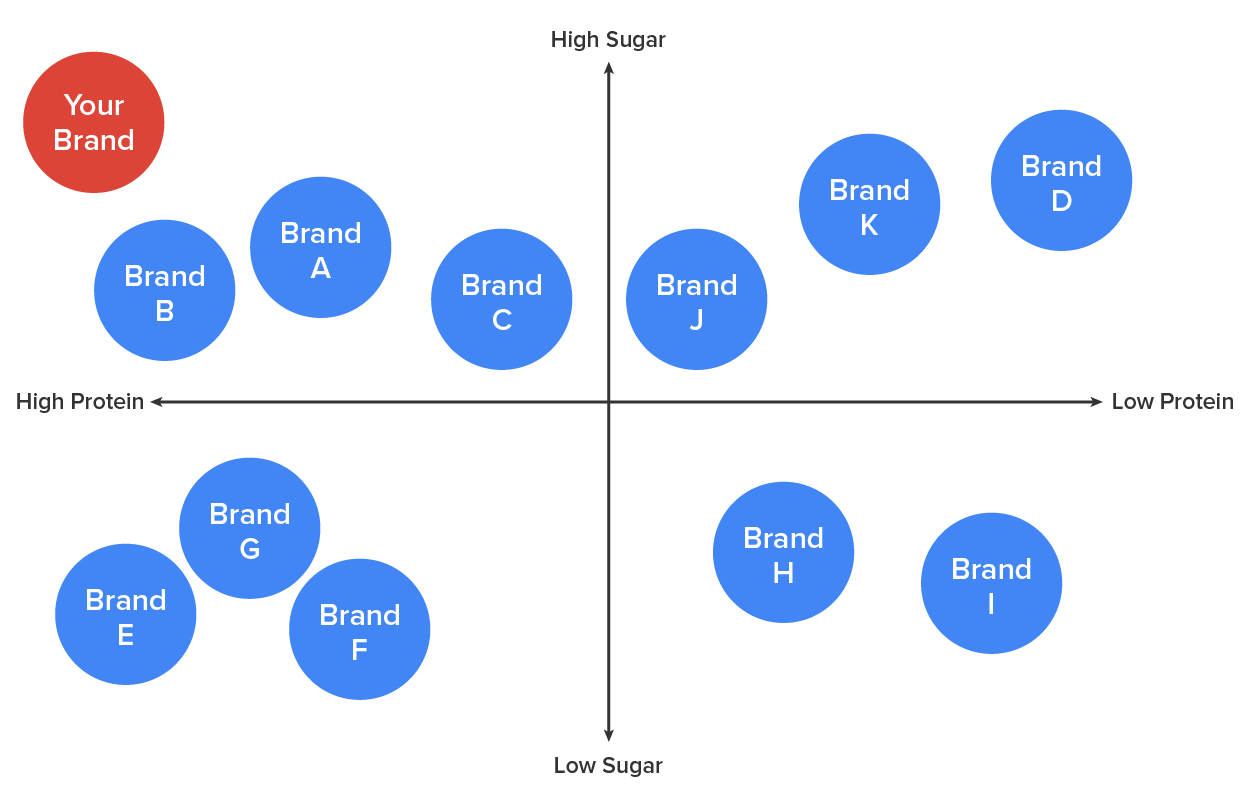
Perceptual map that shows the determinant attributes and your offerings and the competitor’s offerings.

Once you have developed the perceptual map, you will have a clearer idea of where your product or service offering stands vis-à-vis your competition. You will look at which brands occupy the same space as your offering (or a nearly identical space) based on consumer attitudes. Things to look for on your perceptual map include:

  • Do consumer attitudes toward your offering align with what you want them to think about it?
  • Do consumer attitudes toward your competitors’ offerings align what you thought consumers would think about them?
  • Look at the map closely and determine which of your competitors’ offerings consumers perceive as being closest to your offering.
  • Perceptual maps are also an opportunity to determine if there are any holes or gaps in the map. This may signal that there is potential for new offerings.
There are some other things to think about once you’ve completed your perceptual map. If consumer attitudes toward your offering aren’t what you expected, it may be necessary to change your marketing actions to correct or modify these consumers’ attitudes. Let’s assume for a minute that consumers view your competitors’ offerings as being very similar to yours. If this is the case, you may want to think about ways to make your offering stand out from the competition rather than going head-to-head with competitors.

big idea
If there are gaps in the map that you think you can fill based on your company’s capabilities, you may want to consider introducing a new offering or moving your offering into an unfilled position by modifying its features and attributes.

watch
View this video to see how Something's Brewin' tackles product positioning.

terms to know
Perceptual Map
A visual diagram that shows how the average target market consumer perceives your product versus those of your competitors.
Determinant Attributes
Those attributes that a customer uses in making their purchase decision.

summary
In this lesson, you learned about product positioning. Product positioning is the process of deciding and communicating how an organization wants its market to think and feel about a product or service. This third and final step is contained in what’s known as the segmenting, targeting, and positioning model, the STP model. With the STP model, a company segments the market, selects the target market, and positions its products and services into the existing marketplace. Head-to-head positioning focuses on comparison. It involves directly competing with competitors on similar product attributes in the same market. Differentiation positioning is all about emphasizing your product’s or service’s unique qualities vis-à-vis the competition. Similar to head-to-head positioning, you’re going to focus on your offerings and attempt to convince customers to buy your products or services instead of those of the competition. However, dissimilar to head-to-head positioning, instead of competing in the same market, you’ll attempt to identify new markets and seek out customers who may be interested in your offerings because of those unique qualities you’ve identified.

You also learned about positioning statements. A positioning statement briefly describes your brand, product, service, and target market. Not only does it define how your brand meets the customer’s needs, but it also tries to clarify why it does so better than your competition. It answers the question, “What experience do you want your customers to have with this product or service?” A perceptual map is a visual diagram that shows how the average target market consumer perceives your product versus those of your competitors. A perceptual map uses two determinant attributes on a graph. Determinant attributes are those attributes that a customer uses in making their purchase decision.


Source: THIS TUTORIAL HAS BEEN ADAPTED FROM OPEN STAX’S PRINCIPLES OF MARKETING COURSE. ACCESS FOR FREE AT https://openstax.org/details/books/principles-marketing. LICENSE: CREATIVE COMMONS ATTRIBUTION 4.0 INTERNATIONAL.

Terms to Know
Determinant Attributes

Those attributes that a customer uses in making their purchase decision.

Differentiation Positioning

Involves emphasizing a product’s or service’s unique qualities vis-à-vis the competition.

Head-to-Head Positioning

Involves directly competing with competitors on similar product attributes in the same market.

Perceptual Map

A visual diagram that shows how the average target market consumer perceives your product versus those of your competitors.

Positioning Statement

A statement that briefly describes the brand, product, service, and target market.

Product Positioning

The process of deciding and communicating how an organization wants its market to think and feel about a product or service.

STP Model

When a company segments the market, selects the target market, and positions its products and services into the existing marketplace.


