Table of Contents |
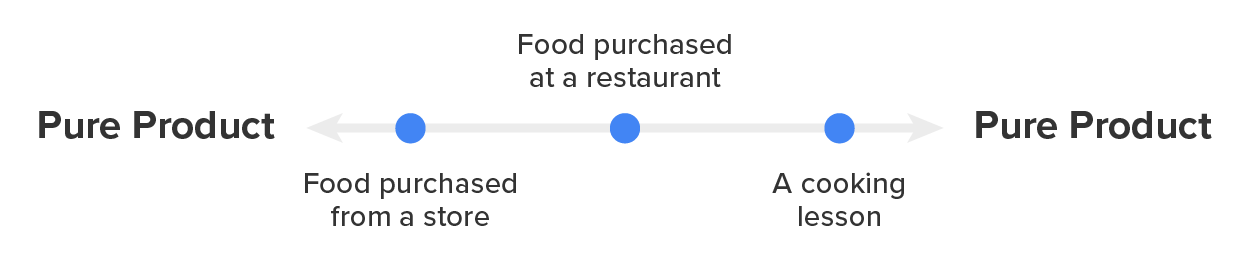
When a customer makes a purchase, they expect value from that exchange. Think about what you ate for breakfast today. You paid money to receive a product that satisfied your hunger. Is that all the value you received? Perhaps not. If you ate eggs, bacon, and coffee at a restaurant, you had both a product and a service experience. Maybe someone at the restaurant handed you a menu, took your order, brought your food, refilled your coffee, cleaned up dishes, and collected payment for your meal. The eggs, bacon, and coffee were the product, while the acts of the restaurant staff were a service. The summation of it all was the product–service experience.
Products are tangible items that are part of an exchange between a buyer and seller. Products can be seen, touched, owned, and stored. For example, the computer or tablet you’re using to read this textbook is a product. You may have visited a store to see and touch the product before purchasing to ensure it met your needs. Post-purchase, the computer or tablet is yours to own and store for later use as you please. The tangible nature of the product allows the consumer to possess it.
Many exchanges between buyer and seller fall somewhere in the middle of the product–service continuum.
Product managers classify products first by whether they are consumer products or industrial products. This classification is essential because businesses typically make product purchase decisions to create a consumer good. Meanwhile, consumers are buying products for their personal use. Therefore, this distinction impacts how product managers design, market, and sell products.
| Type of Product | Price | Consumer Decision-Making Process | Distribution |
|---|---|---|---|
| Convenience | Low | This is a habitual/automatic purchase process that involves little comparison shopping. | Widespread distribution at several retail outlets |
| Shopping | Low-Mid | There is time spent on the consumer decision-making process and comparison shopping for price and quality. | Selective distribution at retail outlets that match customer and brand type |
| Specialty | High | Having a specific brand or product in mind means little comparison shopping. Typically, this is a special purchase with a lot of planning. | Exclusive distribution at one or a select few retail outlets |
| Unsought | Variable | The consumer is unaware or uninterested, so they exert little thought or comparison shopping. | Variable distribution depends on the product |
Businesses purchase products to aid in manufacturing or creating consumer products or services.
EXAMPLE
If you have ever been to a doughnut shop, you might think about how the bakers produce a doughnut. The bakers have probably purchased baking equipment, ingredients for the doughnuts, boxes to package the doughnuts, and a service to make deliveries. Business and industrial products are classified as follows. Raw materials are the products that a business needs to purchase in order to make a consumer good, such as flour, sugar, and yeast in our doughnut example. Manufactured materials and parts are products used to create the product. For example, large baking sheets are manufactured materials specific to a bakery and purchased to enable product creation. Capital items are assets that are valuable to the business and have tangible value. For example, our bakery’s large ovens would be considered a capital item. Supplies and services are goods and services that are typically disposed of and do not contain a tangible value. For example, the bakery’s boxes are part of its supplies to package doughnuts.In marketing, we often say that consumers do not make rational decisions—this consumer decision-making process ties directly to how we think about products. Therefore, product marketers should ask themselves, “What’s the problem the consumer is trying to solve?” The answer to this question gets to the root of the core product. The core product is what your customer is actually buying: convenience, ego, ease, flexibility, etc. For example, if you have ever purchased single-use plastic water bottles, you were likely purchasing a core product of convenience.
The second level of a product is the actual product: a toaster, a waffle, or a sports car, for example. The actual product includes the product features, brand, level of quality, packaging, and design.
The third level of a product is the augmented product: warranties, customer service, product support, etc. The augmented product is the unseen aspects of the product essential to its service to you.
EXAMPLE
Butterball launches a turkey talk-line that provides tips on cooking the perfect Thanksgiving turkey each Thanksgiving. So if you have turkey roasting questions, the talk-line is ready and waiting to answer your questions in this augmented product. A hotel might provide concierge services to obtain tickets to events or limousine services, dry cleaning services, recommendations for local restaurants, etc. All of these would be augmented services.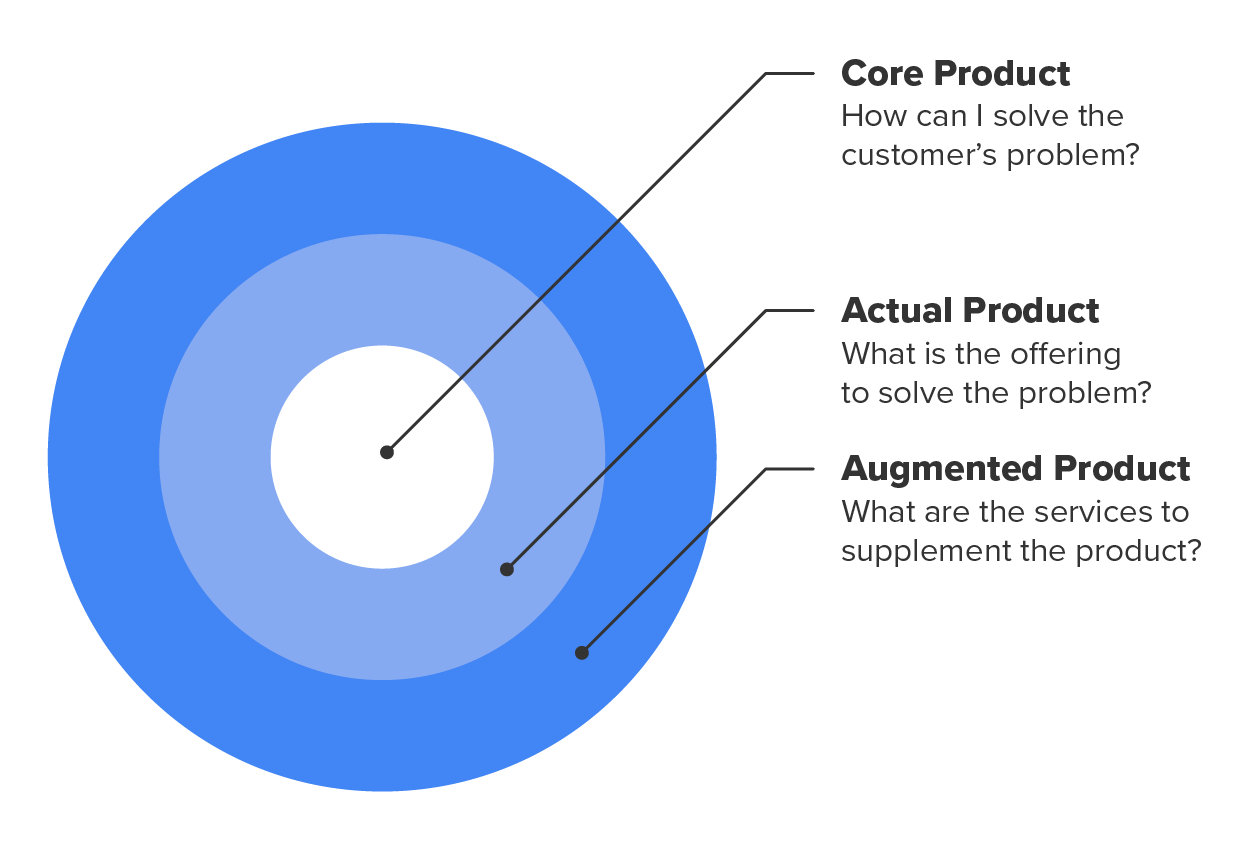
Companies typically sell many products, some of which are singular and some of which are part of a larger category of offerings. So, let’s start with a product item, a particular good that a company sells. For example, Domino’s Pizza sells its original hand-tossed pizza as a product item on its menu.
A company will also sell a product item as a part of a broader product line. A product line is a set of products that are similar or complementary.
EXAMPLE
Domino’s sells crunchy thin, handmade pan, Brooklyn style, and gluten-free crust along with its hand-tossed pizza crust as a part of a product line.A product mix contains all the products that a company sells. In addition to pizza, Domino’s sells salads, sandwiches, appetizers, pasta, desserts, and beverages. These products make up the product mix for Domino’s.
On the flip side, if product offerings are too similar, they may cannibalize (or steal from) the original product, resulting in lower profitability. For example, if Domino’s had 30 types of pizzas, the stores might have to stock extra ingredients to make those pizzas, but Domino’s might not sell more pizzas as a whole because the product line offerings are too similar.
Product line depth refers to the number of products in the line. Using our previous example, Domino’s carries five products in the pizza product line. Meanwhile, the product mix width refers to the number of product lines a brand carries. Domino’s offers seven product lines within its product mix (pizza, salads, sandwiches, appetizers, pasta, desserts, and beverages).
The product line depth and product mix width allow a company to diversify its offerings to maximize customer loyalty and mitigate risk.
EXAMPLE
If a customer enjoys Domino’s Pizza, they may extend their order to include one of the other offerings in the product mix. On the flip side, if a customer has a bad experience with the pizza, they might try chicken or pasta instead next time. However, it is essential to note that too many offerings can cannibalize one another and drive up the cost of goods sold because of the variations that each product requires.One of the reasons for an ample product line is to leave no room for competitors to solve a customer’s need. Companies use a product line filling strategy when they add products to the product line to ensure that competitors do not enter their market. If you wonder why Domino’s has so many pizza toppings, consider that it might be product line filling at work.
On the other hand, it might make more sense for a company to add product lines. The addition of product lines is a practice called product line stretching. There are three main ways to stretch a product line:
Source: THIS TUTORIAL HAS BEEN ADAPTED FROM OPEN STAX’S PRINCIPLES OF MARKETING COURSE. ACCESS FOR FREE AT https://openstax.org/details/books/principles-marketing. LICENSE: CREATIVE COMMONS ATTRIBUTION 4.0 INTERNATIONAL.



