Table of Contents |
Managers use costing systems to measure, record, and report expenses in order to calculate the costs of producing each individual product. We previously discussed job order costing, which is used when every product is unique depending on customer needs. But many businesses produce large quantities of a single product, or similar products, such as paint, shirts, pasta, or gasoline. Such businesses use a series of steps, referred to as processes to make large quantities of similar products. This business type requires a different costing system.
Process costing systems are designed for companies that mass-produce large quantities of similar products. For these types of products, the costs to produce a product are calculated according to the processes or departments a product goes through in the production process.
EXAMPLE
The Kellogg Company produces breakfast cereals on a continuous basis over long periods. Some of their products, like Corn Flakes, are made in huge quantities over many years. They might occasionally have changes to the product, such as when they offer a special variety of Corn Flakes to celebrate the Olympics, but these production runs are still enormous and not unique to a specific client. Thus, like many food processing companies, Kellogg uses process costing systems.Process costing can be used to analyze the costs that are related to each step of the production and distribution process, allowing managers to identify areas within the process where they can reduce costs. When managers are able to identify production costs, they will be able to set prices for their products and determine if the costs are on track to meet the company’s budgeted costs.
An advantage of using process costing is that it is easier to use than other costing methods. For companies that make similar products, process costing is a practical and simple costing system, since managers do not have to track the cost for each individual item, as with job order costing. Process costing also helps companies identify areas where costs can be cut. Process costing can help companies improve their overall operations by reducing costs and offering products at competitive prices. They do this by determining the cost of each step in the production process, allowing managers to target inefficient or outdated processes. Finally, process costing uses the same standardized costing method each period, which allows the company to compare changes in costs over time.
Some disadvantages to note are the possibility of errors and the fact that the calculations that are involved in the process costing system are time-consuming and often difficult. One of the common errors with process costing is including nonproduction costs in the calculation of production costs. This will provide inaccurate production costs, which might impact the cost decisions that a manager might make.
IN CONTEXT: Producing Cans of Coca-Cola
How was the Diet Coke I just finished drinking produced? A Coca-Cola bottling plant purchased cola syrup or a concentrate from the Coca-Cola Company, combined it with carbonated water, put it in cans, and sealed the cans. (Although these plants are usually called bottling plants, they also produce cans of Coke.)
In a bottling plant, the first process combines the syrup or concentrate with carbonated water to make cola. In the second process, empty cans are rinsed and inspected. A third process combines these two materials by pouring the cola into the cans. Next, tops are placed on the cans. Finally, the cans are combined into packages. This completes the work-in-process stage. The product enters the finished goods inventory when it is sent to the warehouse. The product becomes the cost of goods sold to the bottling plants when it is shipped to distributors or retail outlets.
Both job order costing and process costing have the primary goal of determining the cost of producing products. Similar to job order costing, process costing tracks the product costs of direct materials, direct labor, and manufacturing overhead through the three inventory accounts: raw materials inventory, work-in-process inventory, and finished goods inventory. But within those categories, when calculating overhead, job cost systems use just one work-in-process inventory account. Process cost systems, on the other hand, have a work-in-process inventory account for each process. Additionally, both job order and process costing use predetermined overhead rates to apply overheads to production.
EXAMPLE
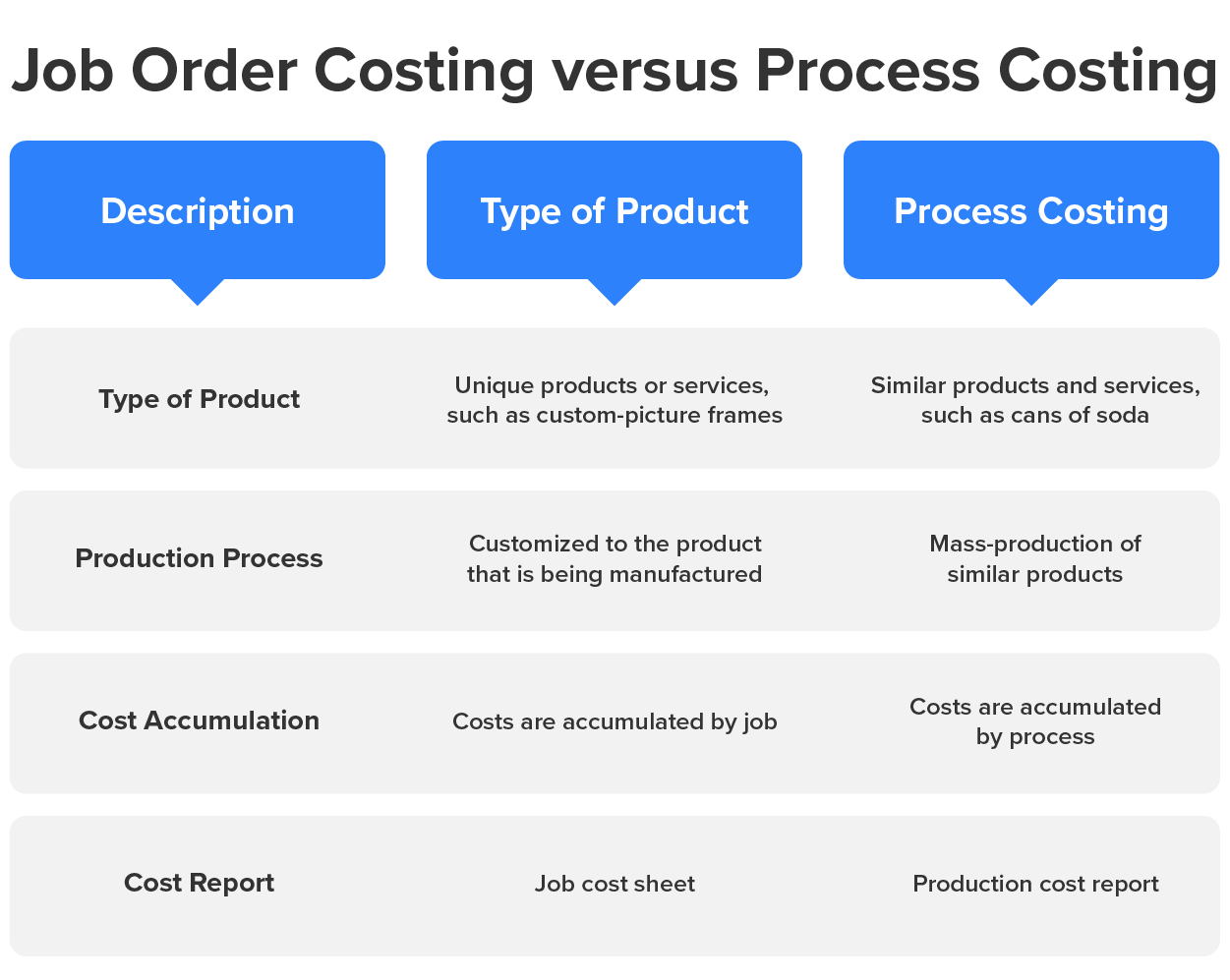
At a beverage company using process costing, the work-in-process inventory might be divided into work-in-process inventory accounts for the bottling department and for the mixing department. If they used job order costing, both departments would be folded into one work-in-process inventory.Within the production process, process costing does not rely on tracing the costs of each individual item, whereas job order costing does. Instead, process costing tracks costs based on the production processes. With the job order costing system, job sheets are used to report costs; while for process costing, the cost production report is used to report costs.
Here is a table that outlines the differences between job order costing and process costing.
Process operations can also extend to service companies, including mail sorting in large post offices or order processing in large retailers. Servicers that provide similar services to a variety of customers are potential users of process costing. Some examples of servicers that may use process costing would be a clinic dispensing flu shots, a delicatessen selling only pastrami sandwiches, and a commercial dark room that develops film.
Generally, service companies complete the service by the end of the period and have no work in process at the end of the period.
EXAMPLE
Nurses do not leave for their homes halfway through giving a flu shot, and the delicatessen does not partially serve a sandwich one month and complete it the next.Some service companies do have partially completed work at the end of the period. Certain types of dry cleaning and photo processing may still be in process at the end of a period. When calculating production costs for service companies that use process costing, materials can be substituted for any significant supplies, and conversion costs can be substituted for service labor and overhead.
There are various trends that are related to process costing. It is important to note the trends related to process costing in order to understand when the process costing system is used and why. One of the most important trends is that more service-based businesses are using process costing. For standardized services such as oil changes or completing tax returns, using process costing is easier and more useful than computing costs per individual job. Processing services through departments allows service companies to determine the costs for each department.
EXAMPLE
General Hospital has radiology and pulmonary facilities, both with special equipment and trained employees. When patients need services from any of the facilities, they are processed through departments to receive the necessary care. Dorothy is at the hospital to have blood drawn and get a scan of her chest. She starts by checking in, proceeds to the lab to have her blood drawn, is then sent to radiology to have the scan of her chest completed, and finally goes to the checkout station upon completion of both services. Dorothy’s visit to the hospital involves costs in several different departments.Another trend with process costing is the use of just-in-time production, which is a production system in which items are created at the time of customer demand. Many companies are increasingly adopting just-in-time techniques for managing their inventory. With a just-in-time inventory system, inventory levels can be minimal because the raw materials arrive as production is scheduled to begin, but no sooner. This will cut down the costs of storing and tracking inventory throughout the production process. Most companies that use the just-in-time inventory system do not have a raw materials inventory account since the raw materials are put directly into the work-in-process inventory.
EXAMPLE
McDonald’s is a company that uses just-in-time production. Although a McDonald’s franchise has all the supplies on hand that it needs to prepare any customer order, the employees don’t begin the process of cooking a burger or mixing a milkshake until the customer’s order is placed. This ensures that burgers don’t get cold waiting for customers to order them and that more food supplies aren’t used per day than are sold.Source: THIS TUTORIAL HAS BEEN ADAPTED FROM “ACCOUNTING PRINCIPLES: A BUSINESS PERSPECTIVE” BY hermanson, edwards, and maher. ACCESS FOR FREE AT www.solr.bccampus.ca. LICENSE: CREATIVE COMMONS ATTRIBUTION 3.0 UNPORTED.



