In this lesson, you will learn about the definition, players, and types of probation in the U.S. Specifically, this lesson will cover:
1. Probation
Probation is arguably the oldest, and certainly the most common, sanction. Its roots stem from concepts of common law from England, like many of our other correctional practices in the U.S. In early courts, a person was able to be released on their own recognizance, if they promised to be responsible citizens and pay back what they owed (financially or morally).
 IN CONTEXT
In the early 1840s, John Augustus, a Boston bootmaker, was regularly attending court and began to supervise such individuals as a “surety.” A surety was a person who guaranteed or paid individuals’ bonds, or the money necessary to secure their release awaiting trial. In turn, Augustus would take in many of these individuals, providing them with work and housing, to help ensure that they would remain crime-free and pay back society. He continued this practice for nearly two decades, effectively becoming the first probation officer and the “Father of Probation.”
Today, probation is a form of a “suspended” sentence, meaning that instead of serving a certain period in jail or prison, an individual is allowed to serve that same period of supervision in the community. However, the sentence is only suspended subject to certain conditions that the individual must continue to meet; if they deviate from those conditions, they may be ordered to finish their sentence in jail or prison. Conditions of probation often include:
- Reporting to a probation officer
- Submitting to random drug screens
- Not consorting with known felons
- Paying court costs and restitution
- Attending AA or NA courses
- Other conditions
Probation lengths vary greatly, as do the conditions of probation placed on an individual. Almost all people on probation will have at least one condition of probation, while some have many conditions, depending on the seriousness and nature of their conviction. Juvenile probation departments were also established within all states in the 1920s, and by the middle of the 1950s, all states had adult probation.
-
EXAMPLE
An individual on probation for a drug-related offense might be required to attend Narcotics Anonymous (NA) meetings, submit to random drug tests, and complete community service hours as part of their supervision.
-
- Surety
- A person or entity that guarantees an individual’s compliance with probation conditions, often by pledging to pay a sum of money if the individual fails to adhere to the terms.
- Probation
- A court-ordered period of supervision in the community, typically as an alternative to incarceration, where the individual must comply with specific conditions set by the court.
2. Probation Officers
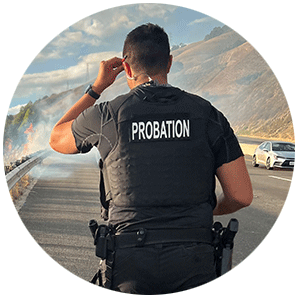 Probation officers usually work directly for the state or federal government, but they can also be directed through local or municipal agencies. Many counties have a community justice-level structure where probation offices operate. Within these offices, probation officers are assigned cases of people on probation that they manage. The volume of cases in a probation officer’s caseload can vary from just a few clients (if they are high need/risk), to several hundred clients. This depends on the jurisdiction, the structure of the local probation office, and the abilities of the probation officers themselves.
The role of the probation officer (PO) is complex and sometimes contradictory. A PO’s primary function is to ensure the compliance of individuals with the conditions of their probation. This is done through:
- Check-ins
- Random drug screenings
- Enforcement of other conditions that are placed on those on probation
Additionally, the PO may:
- Go out into the field to serve warrants
- Do home checks for compliance
- Make arrests as needed
At the same time, a probation officer is trying to help individuals on probation succeed. This is done by trying to help them get jobs, improve their education, or enter into substance or alcohol treatment programs. This is why the job of the PO is complex: They must be supportive while also enforcing compliance. Recently, there has been a movement within probation to have probation officers act more like coaches than just disciplinarians, an approach that may be associated with less probation revocation and recidivism.
-
How might a coaching-oriented approach to probation reduce recidivism? What challenges might probation officers face in balancing support with enforcement?
Another primary function of a probation officer is to complete PSI reports on individuals going through the court process. A PSI or pre-sentence investigation report is a psychosocial investigation of a person headed to trial. It includes basic background information on the individual, such as their:
- Age
- Education
- Relationships
- Physical and mental health
- Employment
- Military service
- Social history
- Substance abuse history
It also contains a detailed account of:
- Their current offense
- Witness or victim impact statements of the event
- Prior offenses, which are tracked across numerous agencies
Finally, the PSI also has:
- A section that is devoted to a plan or recommendations for supervision
This recommendations section may suggest the appropriate conditions of probation, if probation is to be granted. Judges use this information during sentencing discussions and hearings and will usually follow the PSI’s recommendations.
-
Essentially, any of the conditions of probation are prescribed by POs.
Important factors that inform whether an individual is sentenced to probation are contained within the PSI.
-
EXAMPLE
If the individual is largely a "prosocial" person—has an education, a job, and a family—they would be considered as having significant ties to the community. These ties to the community could weaken or break if a person was incarcerated.
Thus, providing a sanction that allows the individual to stay in the community is often the preferred approach, depending on the nature of the offense.
-
- Pre-Sentence Investigation Report
- A document prepared by a probation officer that provides the court with background information on a convicted individual to assist in determining an appropriate sentence, including details on their history, behavior, and circumstances.
3. Probation Success
There is mixed evidence concerning the effectiveness of probation. Recently, the Bureau of Justice Statistics listed the successful completion rate in 2020 at 43.4%—the lowest rate of successful completion since 2007 (Kaeble, 2021). There are a host of reasons associated with unsuccessful completion, including:
- Being incarcerated on a new sentence/charge
- Incarceration for the current sentence/charge
- Absconding (fleeing jurisdiction)
- Even death
Probation represents a form of "
tourniquet sentencing," a model where the intensity of a sanction may be increased to force compliance. In this way, an individual on probation who is not adhering to their conditions may face a
revocation hearing. This hearing may lead to:
- Informal admonishment by a judge
- Increase in the individual’s restrictions or probation length
- Increased level of control (moving from regular probation to intensive supervised probation)
- Even placement in a secure facility (jail, prison, or community corrections center) depending on the infraction
-
- Tourniquet Sentencing
- A model in the U.S. criminal justice system that increases the intensity of a sanction to force compliance.
- Revocation Hearing
- A legal proceeding where a court determines whether an individual on probation has violated the terms of their probation and, if so, decides whether to revoke probation and impose a different penalty, such as incarceration.
4. Intensive Supervision Probation
Intensive Supervision Probation (ISP) began in the late 1950s in California. The basic premise of ISP is to allow POs to have smaller caseloads that they monitor more closely. ISP and standard probation models are similar, differing primarily by the frequency of contacts with POs, the increases in surveillance and monitoring, and the volume of conditions.
-
Rather than meeting a PO once a month, a person on ISP would likely be meeting with their PO weekly, or even more frequently.
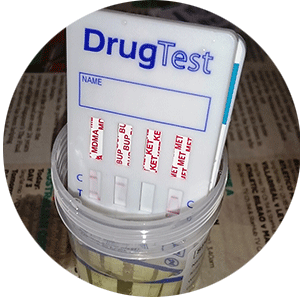
Additionally, individuals on ISP normally submit to drug screens weekly. The increased conditions of supervision often include more substance abuse treatment, either in the form of AA, NA, or some other residential or outpatient substance use treatment program.
The popularity of ISP with policymakers and correctional authorities is evidenced by its rapid spread throughout the United States, but some researchers have questioned its effectiveness.
-
One of the largest studies of ISPs examined their effectiveness in reducing recidivism and saving costs. In a random sample of 14 cities, across nine states, researchers evaluated the recidivism rates of ISP compared to those on regular probation. Surprisingly, the study found higher rates of technical violations among individuals in ISP, while there were no significant differences in new arrests by probation type. Moreover, when looking at outcomes over 3 years, researchers found that recidivism rates were slightly higher within ISP (39%) compared to regular probation (33%). Neither model offered substantive cost savings (Petersilia & Deschenes, 2004). Other studies have produced similar findings as to the effects of non-treatment-oriented ISPs.
These results may reflect the greater “criminogenic needs” of individuals placed on ISP; indeed, this model is reserved for individuals who are believed to be at greater risk of recidivism. On the other hand, such findings critique the very premise of ISP—it should not be surprising that the more you watch someone, the more you will find errors.
-
- Intensive Supervision Probation
- A stricter form of probation that involves closer monitoring, frequent check-ins with probation officers, and additional conditions aimed at high-risk individuals to ensure compliance and reduce the likelihood of reoffending.
In this lesson, you learned about probation, the oldest and most common alternative to incarceration, allowing individuals to serve their sentence under community supervision with specific conditions to follow. Originating in the 19th century with John Augustus, probation involves monitoring by probation officers who ensure compliance and probation success rehabilitation and prepare pre-sentence investigation reports to assist courts in sentencing decisions. While probation aims to keep individuals integrated within the community, failure to meet conditions can lead to revocation hearings and potentially stricter penalties, including intensive supervision probation (ISP).
ISP offers closer monitoring of high-risk individuals through smaller caseloads, more frequent check-ins, and stricter conditions like regular drug testing. Despite its popularity, studies have questioned ISP’s effectiveness, finding higher rates of technical violations without a significant reduction in new arrests compared to regular probation. These mixed results suggest that while ISP targets individuals with greater needs, increased monitoring may lead to higher detection of minor infractions rather than addressing underlying issues. In the next lesson, you will learn about intermediate sanctions.



