Use Sophia to knock out your gen-ed requirements quickly and affordably. Learn more
×

Prioritizing Attributes

Author: Sophia

what's covered
In this tutorial, we will learn how product designers decide which attributes to prioritize as they develop their product. Specifically, this tutorial will cover:

Table of Contents

before you start
Recall that there are many attributes to every product or service, such as size and color for a product or customer interactions for services. Some are features, the selling points of the product, and some are barely noticed. Many more lie somewhere in between, aspects of the product or service that aren’t important enough to be called “features” but will be part of the customer’s decision to purchase or not purchase the good or service. How do you know which attributes to weigh, and how much to weigh them?

1. Points of Parity and Must-Haves (POPs)

The outside environment is in constant flux, making it difficult or impossible to maintain a product design.

  • Some attributes of products were essential 5 years ago but are not today. For example, until recently, a CD player was an add-on most drivers wanted in their cars. Now, the CD player is usually not included, in favor of plug-ins for smart phones and other devices with digital music.
  • Some product features were not even available 5 years ago but are mandatory today. For example, the ability to connect easily to a smart phone for navigation and other conveniences is now a common add-on in vehicles.
  • Similarly, product designs and their accompanying meanings are constantly in flux. For example, even though cars with the ports to plug in devices have been around for over a decade, the ports themselves have changed (and seem to change every few years).
  • The importance of product attributes changes. The following classification scheme can be used to ascertain whether attributes and features are increasing or declining in importance. The classification scheme was derived from a variety of sources.
Points of parity are attributes that all (or most) of the products in a category have—the basic features found in a product or service. They help to define the prototypical product. A product, something that is tangible, does something, and has a function. For example, it provides sustenance, provides security and comfort, or helps us to complete tasks. There are core expectations for how it performs these functions, and how users interact with it.

Similarly, a service helps us find food or shelter, helps us change location, or helps us connect and communicate with others. Any service should do what it is meant to do and has expected attributes to be minimally acceptable.

If a product or service does not possess essential functionality, it will not last long in a competitive market. For example, an auto global positioning system (GPS) should have the ability to enter an address and display how long it will take to get to a location; a word processor should have spell-checking capabilities; and a movie theater should sell treats. Most services should allow you to create an account with personal information and preferences, and moreover, should protect that information.

For designers, points of parity are all important but also fall short of being features unless they surpass the competition. For example, a movie theater can hardly make the concessions a big selling point, unless it has a wider variety and better pricing than the competition.

term to know
Point of Parity
An attribute that all (or most) products in a category have; the basic features found in a product or service.


2. Points of Difference and Differentiators (PODs)

Recall that it is essential for a product to stand out against its competitors in some way, and that attribute that makes it different must be clear to customers; this is called differentiation. Points of difference describe these differentiators but also help distinguish a product from other products in the company’s own catalog.

Points of difference (PODs) are the unique characteristics that set a product or service apart from competitors. These can be tangible features, like a lifetime warranty on a garment, or intangible benefits, such as a loyalty program offering exclusive experiences.

Product and service features that are differentiators are often high-end features for customers who are willing to pay for them; such products are called Midas products. Another company might see economic value as their differentiator; these are sometimes called Hermes products. In the middle is a third option, called the Atlas product, that provides a balance of quality and economy.

Strong PODs can be leveraged to command premium pricing, build brand loyalty, and attract new customers. Examples include a bank offering superior customer service wait times, an airline boasting industry-leading fuel efficiency, or a software company providing unparalleled customer support options. By identifying and amplifying PODs, businesses can create a distinct market position and achieve sustainable competitive advantage.

hint
These names have no intended real-world associations, though there are companies with these names, such as Midas auto parts and Hermes luxury goods.

However, over time, differentiators become points of parity. A demand curve is a timeline that shows where features customers like most roll down from Midas products to Atlas products, and then to Hermes products. This happens as people come to think of the feature as indispensable, and as costs for developing these features drop.
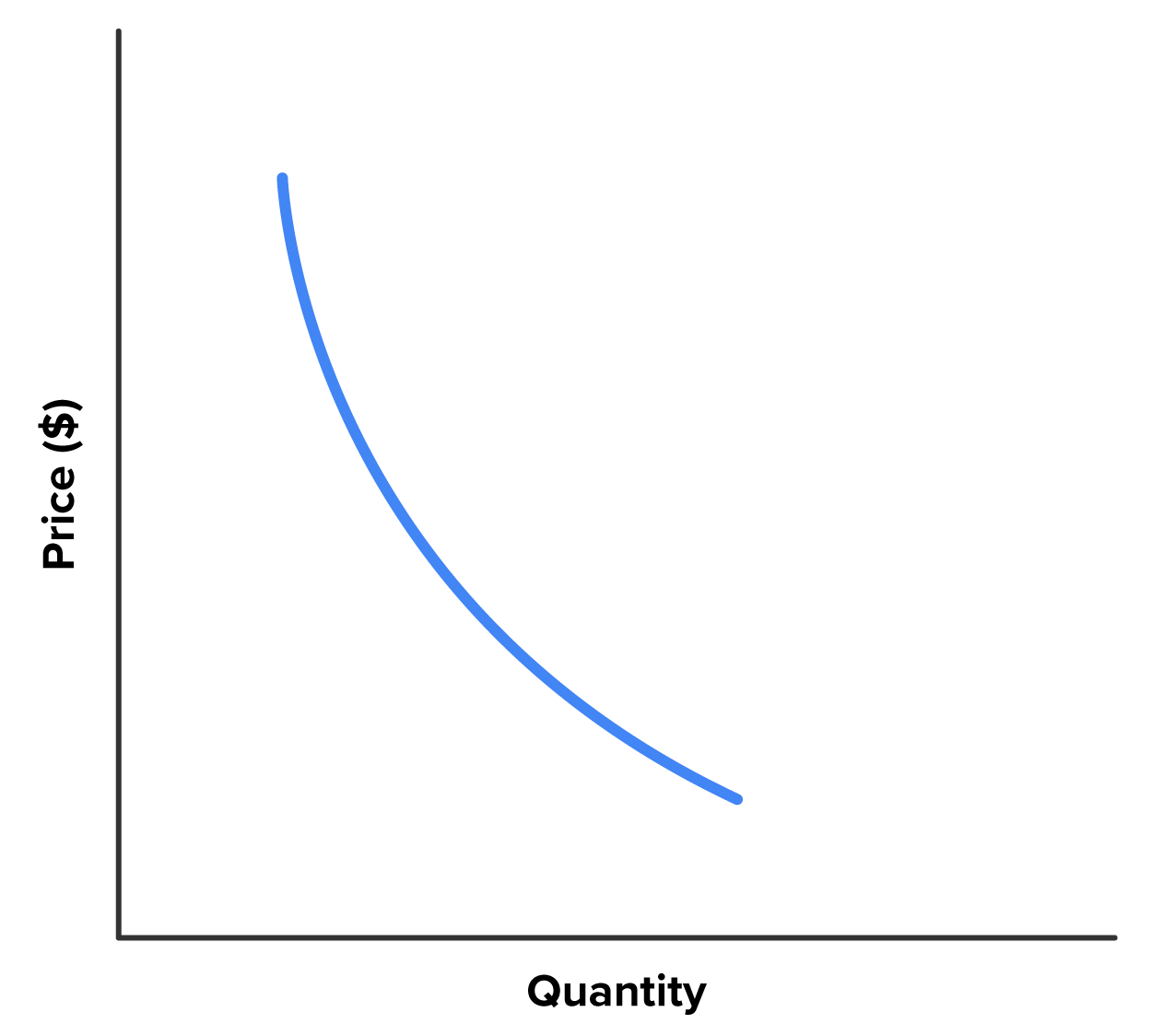
A graph showing that over time, demand for features increases and cost declines.

  • High-end vehicles in the early 2000s boasted of Bluetooth capabilities and GPS; these became the norm by 2020. As of 2024, the use of GPS has become obviated by the ability to display a smart phone’s mapping app.
  • Comfortable seating became a feature of movie theaters in the 2010s and has now become the industry norm (or a point of parity).
  • Thirty years ago, grammar and spell-checking were bonus features to word processing software but are now considered core functionality.
As you can see, many must-have features tend to roll down the demand curve, and the differentiators become points of parity over time. Other features, such as heated seats in cars or movie theaters selling alcohol, remain differentiators, as demand for these features doesn’t rise and cost doesn’t decline; they remain “nice to have, but not necessary” features.

Differentiators are not always based on cost or quality. Other differentiators might be focusing on a product as the environmentally friendly option, such as notebooks made of recycled paper. A restaurant might differentiate itself based on its menu, such as having more menu options for vegetarians. A line of pencils might differentiate itself by licensing popular characters for use in their design.

terms to know
Points of Difference
Design features that distinguish a product from the competition and from other products in the company’s own catalog.
Midas Products
Term for high-end and expensive products.
Hermes Products
Term for products that are differentiated by being low-cost alternatives.
Atlas Products
Term for products that differentiate by being a balance of quality and economy.
Demand Curve
A graph showing the decline in cost and increase in demand of new features or new products.


3. Blue Ocean Features and Exciters (BOFs)

Blue ocean features (BOFs) are those differentiators identified in the very early stages of R&D as part of a plan to find a new market.
  • BOFs have the potential to deliver a knockout punch by finding a brand-new uncontested marketplace, such as Uber did by creating a ride-sharing service in 2009.
  • Blue ocean features can be new, better ways of doing things. In the early 2000s, Netflix found a blue ocean market in loaning DVDs by mail, which people preferred to going to the video store. Netflix then became the first streaming platform, at first as a “bonus” to subscribers with a small list of options, but soon overtaking their mail service, which was finally retired in 2023.
  • Blue ocean markets may also be found when a market is in decline, as Cirque du Soleil did by reinventing the circus at a time when the interest in circuses was in decline.
  • Blue ocean markets may be people who are unserved or underserved. Nintendo has had a decades-long success by focusing on customers who are not typical gamers, tapping a different market than Sony and Microsoft, who otherwise dominate the gaming industry.
The features that make these products successful with blue ocean markets are exciters, the features and technologies that disrupt industries. Many exciters are derived from radical technological innovation. Examples include the printing press; armaments and tactical innovations; and networking, computing, and communications innovations. These are product or process innovations that eventually eclipse or overturn the existing dominant technology. However, some exciters are new applications of existing technology or features that appeal to underserved markets.


Recall that Gordon has an idea for a bicycle that can detect when a rider is struggling and gives an automatic boost. He considers whether this is a brand-new market, such as commuters who have only decided against bicycles because they did not feel up to the physical challenge. He considers whether it would appeal to a certain segment of people who already ride bicycles, such as beginners or older riders.

terms to know
Blue Ocean Features (BOFs)
Differentiators identified in the very early stages of R&D as part of a plan to find a new market.
Exciters
The features and technologies that disrupt industries.


4. Extinct and Vestigial Features (EXTs)

At the high end of prioritizing are the attributes that are either key features in hopes of capturing new markets or point-of-parity attributes that must be included to be competitive. At the other end are the attributes that need to be removed. These are attributes that are no longer necessary or are on the verge of becoming extinct. These are called sunset features. They are features that are on the verge of becoming obsolete and fading into darkness and oblivion. Sometimes sunset features cannot be completely removed because there may be a small subset of people that demand the feature. In this case, a decision has to be made to abandon the feature or keep the feature. Sometimes the decision to abandon is the best way to go because of cost issues and because the company is going down a new technology path.

EXAMPLE

As people moved to cloud storage for their files, many computers (especially laptops) stopped providing the CD/DVD drives that had been an industry norm for 20 years. The drives added considerably to the weight and cost of computers, and most consumers wanted the lighter/cheaper option. This led to confusion and protests from users who had used discs for their file storage and would have no way to access old files without a second purchase.

big idea
Some blue ocean markets can be found in the markets that other companies leave behind. Record players and records had nearly disappeared in the late 1990s, as people preferred to buy CDs. But a niche market still exists for the superior playback quality of records, leading to a resurgence in popularity even as the CD market collapsed in favor of digital devices and streaming services. Cirque du Soleil found a blue ocean market by reinventing the circus to focus on human performance and distancing themselves from the negative attributes of circuses that had caused their decline in popularity.

term to know
Sunset Features
Features that are on the verge of becoming obsolete and fading into darkness and oblivion.


5. Dissatisfiers (DISs)

There are instances when attributes of products can discourage consumers from using the products or services. These are called dissatisfiers (DISs). Dissatisfiers may be attributes facing extinction, due to cultural or demographic changes, or simply bad designs that quickly discourage their use.

EXAMPLE

The CD/DVD drives on laptop computers added to the weight and cost and were no longer needed by most users.

EXAMPLE

The decline of the traditional circus was largely due to heightened awareness of the mistreatment of animals.

EXAMPLE

The hype for Google Glass (wearable technology) and Segway (a means of transportation) both quickly faded when these were discovered to be impractical or even unsafe. These have more significance than the failure of one product, as their failure to catch on revealed problems with the core intended functionality of the product.

Now that we have reviewed the key concepts and terms related to FAD, in the next tutorial, we will see a template and how it is applied to the design process.

term to know
Dissatisfier (DISs)
Attributes that can actually discourage consumers from using the products or services.


6. Features Creep

The Swiss Army Knife™, now made by Victorinox, famously incorporates many tools into one pocket-sized utility. Depending on the model, a Swiss Army Knife™ may have anywhere from a dozen to several dozen tools, such as knives, nail clippers, scissors, can openers, screw drivers, and more. While having a tool available for so many needs is a great convenience, nobody would argue that the Swiss Army Knife™ is ever the best option. If you have a regular screwdriver, or a full-sized pair of scissors, you will use it over the miniature Swiss Army Knife™ versions.

Product and service design sometimes takes a “Swiss Army Knife™” approach to adding features, attempting to do more things without doing any of them well, or perhaps adding new features but letting the old ones stay because users are used to them because it is part of the product brand and identity, or simply because it is easier to leave them be. In software design, it may take considerable work to remove code without breaking the software, and even if visibility of a feature is removed, the code might remain.

Features creep is when so many features are added, and so few are discarded, that—like a Swiss Army Knife™—the brand can only brag that they have a lot of tools, not that any of them are especially good at what they do.

EXAMPLE

The cellular phone is a Swiss Army Knife™ that now has many points of parity beyond the simple ability to call or text someone, such as cameras and calculators. Although most tools can be downloaded as apps anyway, most phones come packed with their own versions of these features.

As designers consider which attributes to discard, then, it may not be that some are obsolete or that users are dissatisfied, but that they steal focus from the features they think are differentiators.

term to know
Features Creep
Occurs when so many features are added, and so few are discarded.

summary
In this lesson, we considered how product development prioritizes design attributes. Points of parity are considered attributes that all products in a category must have and thus, are high priority. Designers also prioritize points of difference and differentiators, the attributes that make their product or service different from the competition, and in many cases, different from other products sold by the same company. While differentiators may be cost or quality, designers are always looking for blue ocean features and exciters that will not only set their product apart but will find new customers. Developers also consider what extinct and vestigial features are no longer needed, that may even be dissatisfiers, or qualities that will make customers reject the product. Finally, designers must avoid features creep, or the tendency to keep adding attributes that do not improve the product’s overall purpose. By considering all these, developers can focus on the most important attributes.

Source: This tutorial has been adapted from Saylor Academy and NSCC “Operations Management”. Access for free at https://pressbooks.nscc.ca/operationsmanagement2/. License: Creative Commons Attribution 4.0 International.


Terms to Know
Atlas Products

Term for products that differentiate by being a balance of quality and economy.

Blue Ocean Features (BOFs)

Differentiators identified in the very early stages of R&D as part of a plan to find a new market.

Demand Curve

A graph showing the decline in cost and increase in demand of new features or new products.

Dissatisfiers (DISs)

Attributes that can actually discourage consumers from using the products or services.

Exciters

The features and technologies that disrupt industries.

Features Creep

Occurs when so many features are added, and so few are discarded.

Hermes Products

Term for products that are differentiated by being low-cost alternatives.

Midas Products

Term for high-end and expensive products.

Point of Parity

An attribute that all (or most) products in a category have; the basic features found in a product or service.

Points of Difference

Design features that distinguish a product from the competition and from other products in the company’s own catalog.

Sunset Features

Features that are on the verge of becoming obsolete and fading into darkness and oblivion.
