Table of Contents |
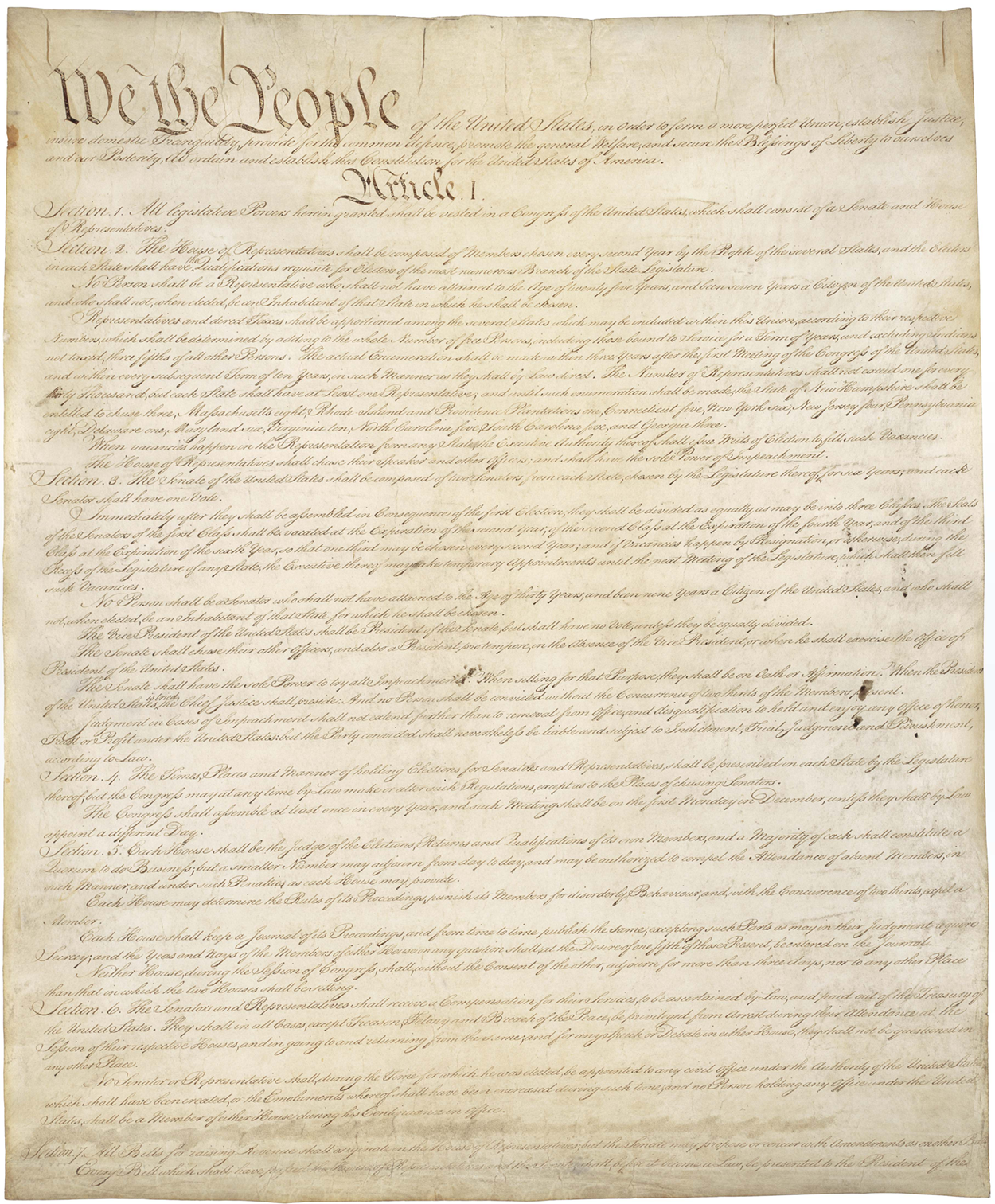
After continued debate and compromise, on September 17, 1787, the delegates to the Constitutional Convention in Philadelphia voted to approve the document they had drafted over the course of many months. The U.S. Constitution not only established a new form of government for the nation, but it also embodied very important principles that shaped the national government, including the separation of powers with checks and balances, the rule of law, and limited government (Figure 1).
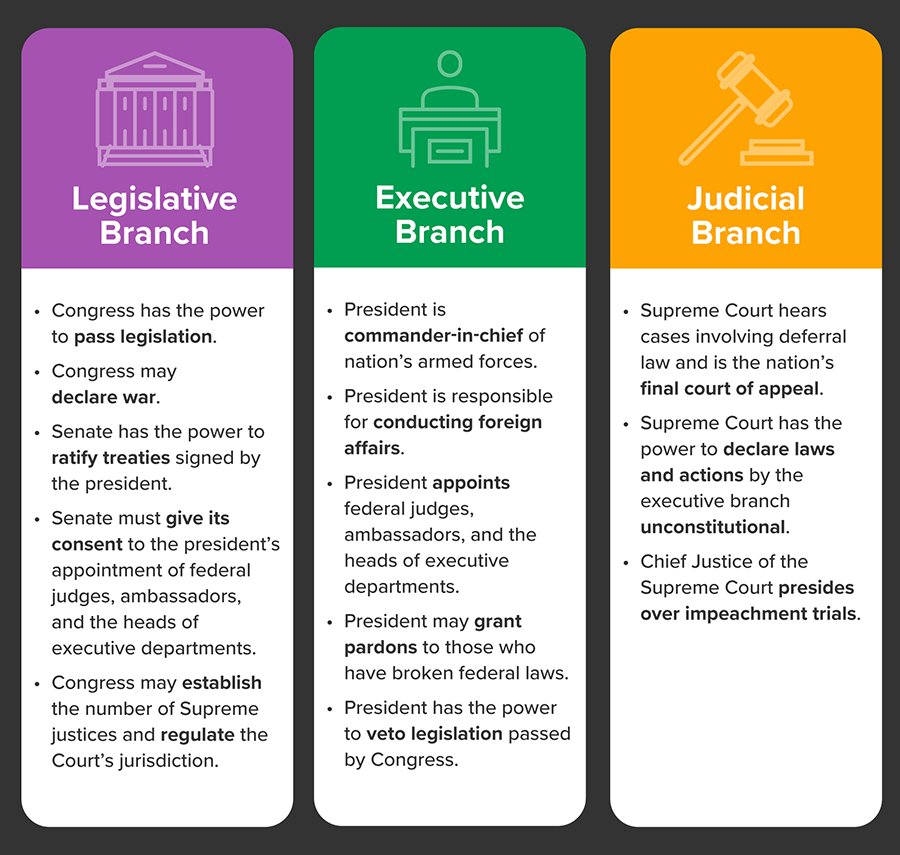
The representatives at the Constitutional Convention wanted to increase the authority of the national government while ensuring that it did not become too powerful. The framers resolved this problem through a separation of powers, dividing the national government into three separate branches and assigning different responsibilities to each one, as shown in Figure 2. The legislative branch, Congress, was given the power to make laws. The function of the executive branch, consisting of a president and a vice president, would be to enforce laws. And, a federal judiciary, notably the Supreme Court, was created to interpret the law. Neither the executive branch nor the judicial branch had existed under the Articles of Confederation.
The framers also created a system of checks and balances, by giving each of the three branches of government the power to restrict the actions of the others (Figure 3). This system would ensure that no one branch became too powerful.
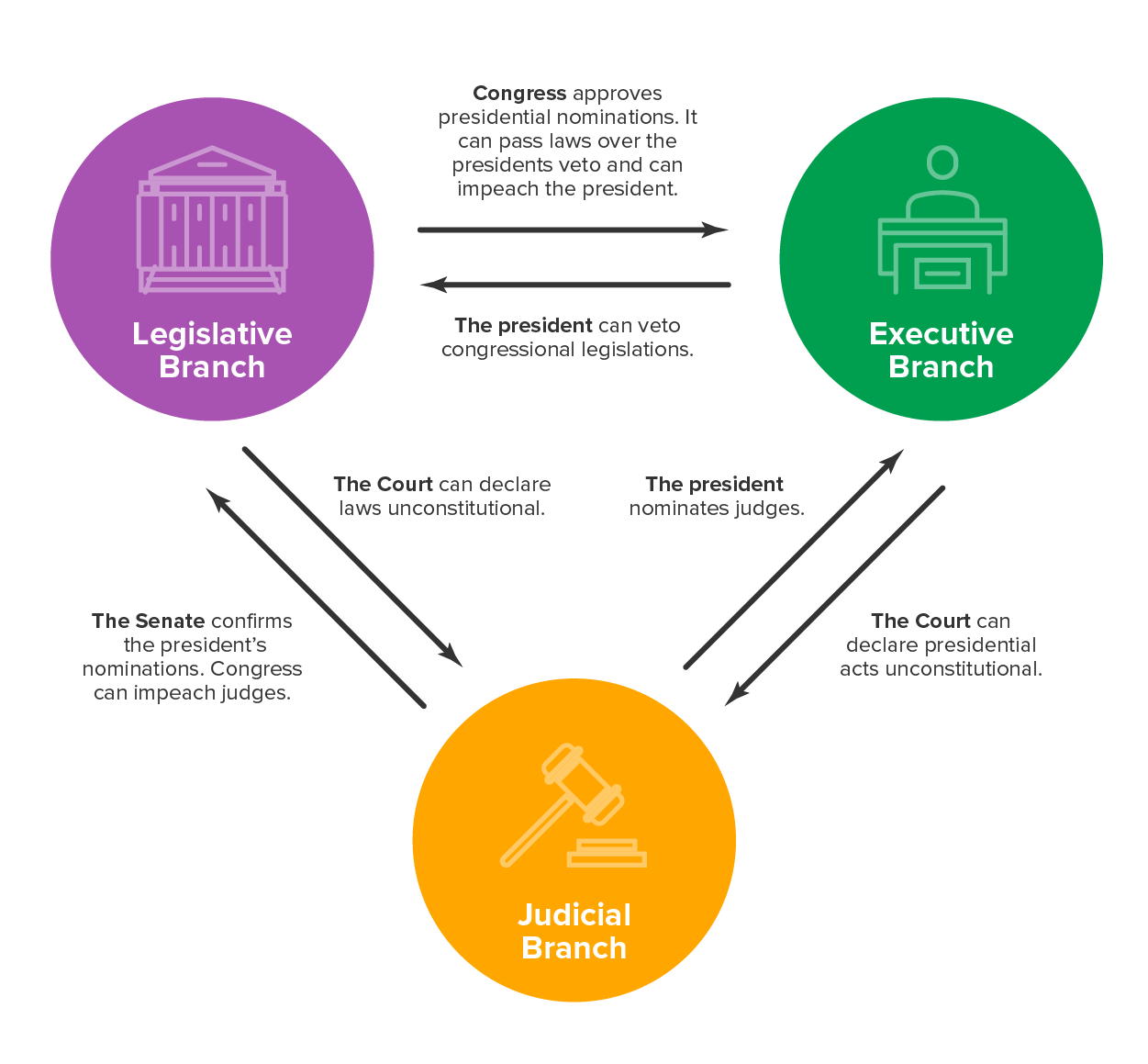
For example, the executive and judicial branches check Congress in a number of ways. Congress can pass laws, but its power to do so can be checked by the president, who can veto (meaning reject) a bill so that it cannot become a law. However, Congress can override the president’s veto with a two-thirds vote in each chamber, making the bill law, even if the president refused to sign it. The power of Congress to pass laws can also be checked by the judicial branch. The U.S. Supreme Court established its own authority to rule on the constitutionality of laws, a process called judicial review. This authority of the federal judicial branch was not asserted until a Supreme Court case in 1803, which recognized the power. The court can invalidate laws that it finds to be in violation of the Constitution.
Congress, in turn, can check many of the president’s powers. For example, Congress is able to limit the president’s power as commander-in-chief of the armed forces by refusing to declare war or provide funds for the military. This became an ongoing source of tension between Congress and the president throughout history. In 1972, Congress passed the War Powers Resolution to further limit the president’s ability to engage the country in military conflict. To date, however, Congress has never refused a president’s request for a declaration of war.
The president must also seek the advice and consent of the Senate before appointing members of the Supreme Court and ambassadors, and the Senate must approve the ratification of all treaties with foreign nations signed by the president.
Finally, Congress may even remove the president from office through an impeachment process. To do this, both chambers of Congress must act. The House of Representatives can formally impeach the president by bringing formal charges against the president. However, conviction and removal are done by the Senate by a two-thirds approval. The Senate tries the case in a proceeding overseen by the Chief Justice of the Supreme Court. If found guilty in these proceedings, the president is removed from office.
According to political scientist Richard Neustadt, the system of separation of powers and checks and balances does not so much allow one part of the government to control another, as it encourages the branches to cooperate. For example, knowing the president can veto a law the president disapproves of, Congress will attempt to draft a bill that addresses the president’s concerns before sending it to the White House for signing. Similarly, knowing that Congress can override a veto, the president will use this power sparingly.
To guarantee that the power of the national government would be restricted and that the states would retain a degree of sovereignty, the framers established a federal system of government. In a federal system, power is divided between the federal—or national—government and the state governments. The framers further limited the power of the national government by delineating certain rights for individuals that could not be violated.
Explicit powers, called enumerated powers, were granted to the federal government. All powers not expressly given to the national government, however, were intended to be exercised by the states. These powers are known as reserved powers.
The enumerated powers granted to the federal government included the power to declare war, impose taxes, coin and regulate currency, regulate foreign and interstate commerce, raise and maintain an army and a navy, maintain a post office, make treaties with foreign nations and with Native American tribes, and make laws regulating the naturalization of immigrants.
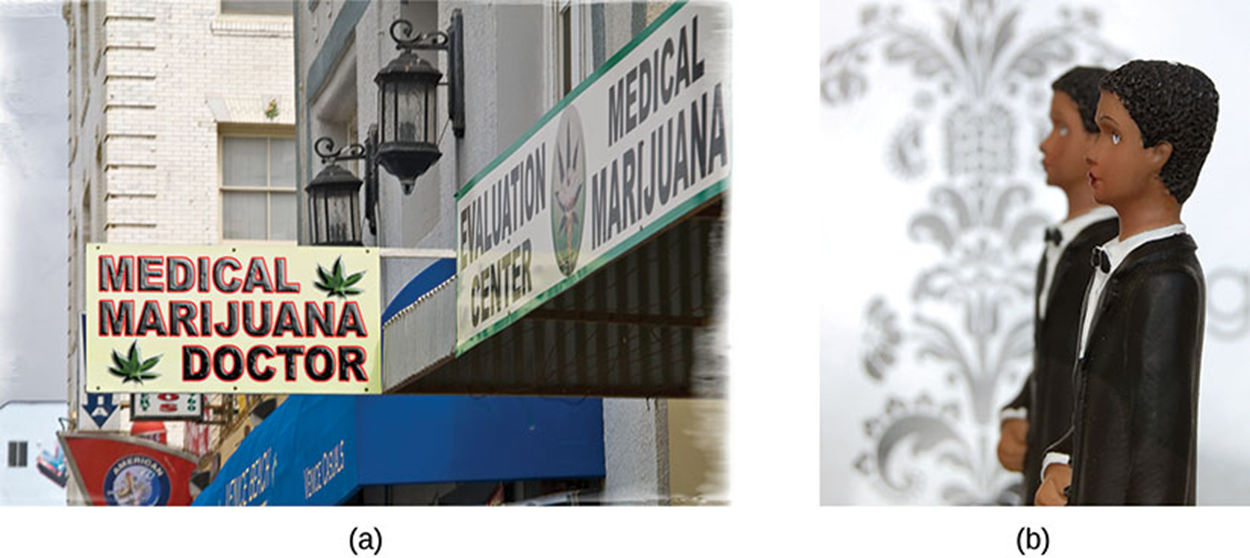
The states remained free to pass laws on many other matters, such as laws regarding public safety, education, marriage, and commerce within the borders of one state (Figure 4). Some powers, such as the right to levy taxes, were given to both the state and federal governments. Both the states and the federal government have a chief executive to enforce the laws (a governor and the president, respectively) and a system of courts.
Although the states retained a considerable degree of sovereignty, the supremacy clause in Article VI of the Constitution proclaimed that the U.S. Constitution, laws passed by Congress, and treaties made by the federal government were “the supreme Law of the Land.” In the event of a conflict between the states and the national government, the national government would triumph.
Furthermore, although the federal government was to be limited to those powers enumerated in the Constitution, Article I provided for the expansion of Congressional powers if needed to carry out its functions. The necessary and proper clause of Article I provides that Congress may “make all Laws which shall be necessary and proper for carrying into Execution the foregoing [enumerated] Powers….”
The Constitution also gave the federal government control over all “Territory or other Property belonging to the United States.” This would eventually lead the states into conflict when the United States expanded westward and population growth increased the power of northern states in Congress.
The Constitution restricted the power of the national government by providing for limited government. The belief that government and people should be limited by law so that individual rights are respected is known as the rule of law. The very existence of the U.S. Constitution reflects this concept because it outlines the parameters of the national government and because the government is held accountable to it.
However, the Constitution also listed specific rights that the national government would protect. Article I, Section 9 of the U.S. Constitution guarantees the right of the writ of habeas corpus, a court order directing that an officer who has custody of a prisoner show cause why the prisoner is being held, except in cases of invasion, rebellion, or threat of public safety. Furthermore, the Constitution also prohibits Congress from passing bills of attainder, laws that would declare someone guilty without a trial, or ex post facto laws, laws that retroactively criminalize an act that was not criminal when it was performed.
As we shall see, these rights were not enough for many Americans, who insisted that additional rights be added to the Constitution. These Americans pushed for what would eventually become the Bill of Rights, the first ten amendments to the Constitution.
Source: THIS TUTORIAL HAS BEEN ADAPTED FROM OPENSTAX "AMERICAN GOVERNMENT 3E". ACCESS FOR FREE AT OPENSTAX.ORG/DETAILS/BOOKS/AMERICAN-GOVERNMENT-3E. LICENSE: CREATIVE COMMONS ATTRIBUTION 4.0 INTERNATIONAL. Accessed by August 2022.



