Table of Contents |
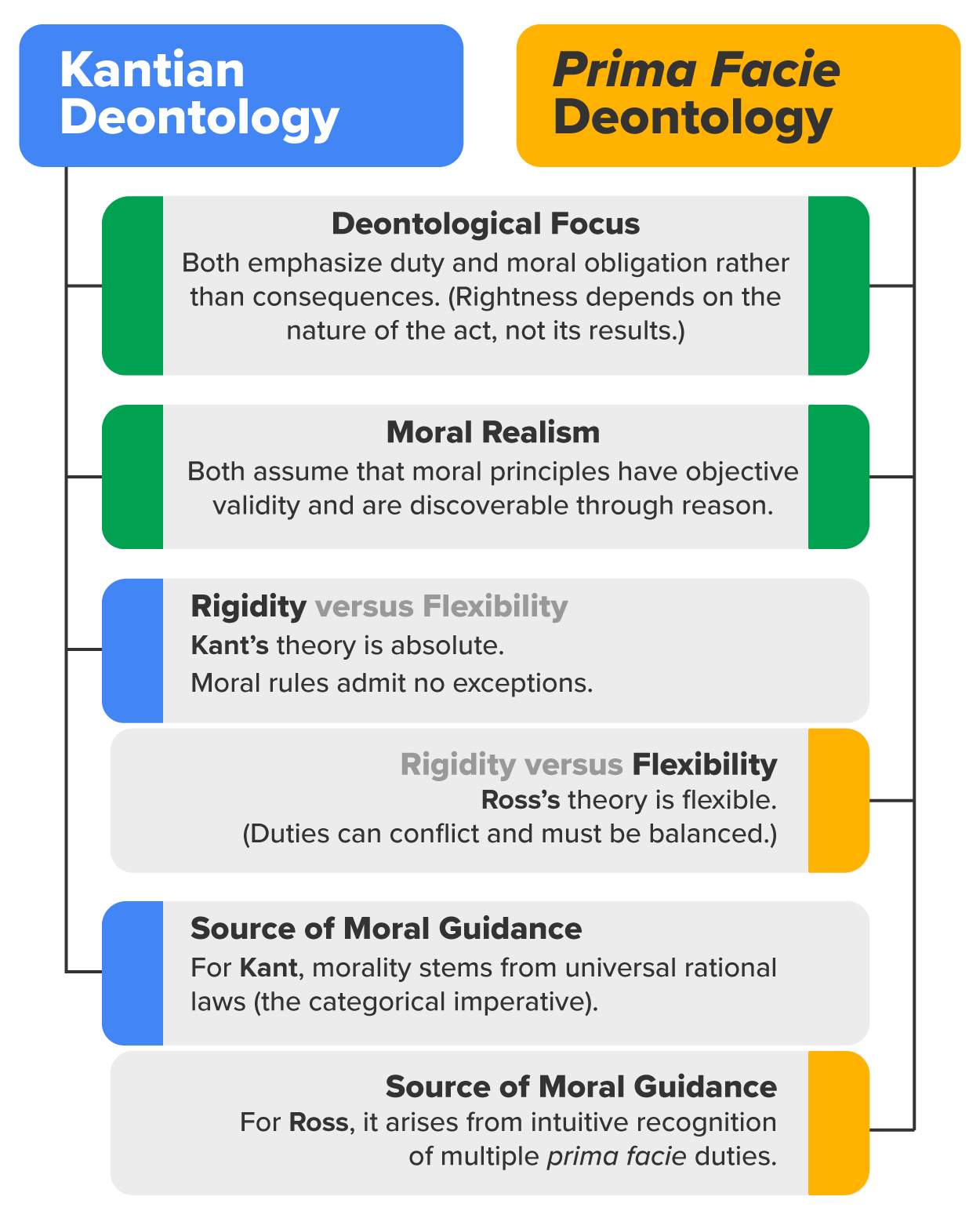
Prima facie ethics is a branch of deontological moral theory developed by the Scottish philosopher W. D. Ross in the early 20th century. Ross’s theory aimed to correct what he saw as the rigidity of previous ethical systems, particularly Immanuel Kant’s categorical imperative, which often offered no guidance when duties appeared to conflict.
Instead of proposing a single overarching moral rule, Ross introduced the concept of prima facie duties, or moral obligations that are binding unless they conflict with another, more important duty in a given situation. The Latin phrase prima facie means “at first glance,” suggesting that these duties are self-evident and should be followed unless overridden.
"I suggest “prima facie duty” or “conditional duty” as a brief way of referring to the characteristic (quite distinct from that of being a duty proper) which an act has, in virtue of being of a certain kind (e.g. the keeping of a promise), of being an act which would be a duty proper if it were not at the same time of another kind which is morally significant."
If we consider the following situation, we can come to understand why prima facie duties can seem both workable and intuitively true. Anyone living in cities today can understand that there are complicated systems intended to ensure that everyone is safe.
EXAMPLE
We have established speed limits for how fast someone should drive on roads. These limits are intended to protect the safety of pedestrians, people in other vehicles, and ourselves when driving. Driving too fast opens many opportunities for injury or death. Thus, we seem to have (mostly) agreed that it is the responsibility of drivers to follow the posted speed limits. However, if we are rushing an injured person to the hospital, we might find that we need not pay attention to speed limits. One duty (to follow traffic laws) has given way to another duty (to assist those who are injured). The obligation to follow the law appeared to be in play, but it was only a duty “at first sight”—or prima facie.Ross’s approach is appropriately considered deontological because it is both rule based and finds that morality is tied to duties. However, as opposed to Kant’s deontology, which does not allow for exceptions, Ross’s deontology accounts for our need to find which duties are more important than other duties. These prioritizations are not fixed but depend on the situation that one is in.
Unlike consequentialist theories like utilitarianism that evaluate actions based on outcomes, prima facie ethics emphasizes moral intuition, context, and duty. It offers a middle path between absolute rules and purely outcome-driven decisions.
Ross argued that our commonsensical moral experiences, such as feeling a duty to keep promises or make amends, are reliable indicators of ethical truths. These duties are not derived from a single principle but are recognized through reflection and practical reasoning.
As we saw above, Ross develops the idea that duties can give way to other duties. Instead of seeking out maxims of actions that can be applied universally (like actions conforming to the categorical imperative), Ross employs an understanding that we do have multiple overarching duties that give way to each other, depending on which is more important at the moment. These are his prima facie duties.
Shelly Kagan, however, prefers the term pro tanto obligations over Ross’s prima facie duties. Kagan argues that Ross’s terminology is misleading and invites confusion.
"It may be helpful to note explicitly that in distinguishing between pro tanto and prima facie reasons I depart from the unfortunate terminology proposed by Ross, which has invited confusion and misunderstanding. I take it that—despite his misleading label—it is actually pro tanto reasons that Ross has in mind in his discussion of what he calls prima facie duties."
Core to Kagan’s terminology is the clarification that there is a difference in what the terms suggest.
"A pro tanto reason has genuine weight, but nonetheless may be outweighed by other considerations. Thus, calling a reason a pro tanto reason is to be distinguished from calling it a prima facie reason, which I take to involve an epistemological qualification: a prima facie reason appears to be a reason, but may actually not be a reason at all."
Put more plainly, pro tanto expresses that obligations are real but defeasible, while prima facie expresses that there is only the appearance of obligations. At some level, this disagreement is one that might seem quite peculiar. No doubt Kagan and others are correct in that the label pro tanto applies much better to the phenomenon that Ross is describing. But given the importance of Ross’s approach and his overall method, prima facie continues to be used when describing his work and his approach.
It is rather like how we continue to use the term atom to describe a quite small particle composed of a nucleus, electrons, and protons. The term atom was originally used to refer to a particle so small that it was unobservable and could not be divided into component parts. Then, in 1897, a British physicist discovered electrons, and we began to accept that the atom was not the smallest particle after all. (In 1964, even the model of atoms comprised of protons, electrons, and neutrons was made more complicated by the discovery of quarks—which make up protons and neutrons.) Just like we continue to use atom today in a way that is not precisely true to its meaning anymore, we continue to use prima facie, though the term is not precisely correct.
Ross identified seven foundational duties, which he believed captured the most common moral obligations recognized across cultures. These are not ranked in a permanent hierarchy; rather, their importance varies depending on the context.
Applying prima facie ethics involves three key steps:
Let’s look at two example applications.
| Case | Application |
|---|---|
| Medical Ethics |
|
| Workplace Dilemma |
|
These cases demonstrate how prima facie ethics can be practically applied, offering a flexible yet principled approach.
While flexibility and realism are some of the strengths of prima facie ethics, it faces several criticisms:
Source: THIS TUTORIAL WAS AUTHORED BY SOPHIA LEARNING. PLEASE SEE OUR TERMS OF USE.
REFERENCES
Kagan, S. (1989). The limits of morality. Clarendon Press.
Ross, W. D. (1988). The right and the good. Hackett Publishing Company.



