Table of Contents |
Recall that the marketing mix elements include product, price, promotion, and place. Marketers create value through the maximization of benefits within an acceptable price point using the marketing mix elements. Price, however, is the only element of the marketing mix that directly produces revenue for the company. The other elements are considered costs to the organization. Another way to think of price as differing from the other elements is to understand that price not only creates perceived value for the customer but also harvests monetary value for the company. Because price is the revenue-generating element of the marketing mix, it is vital that marketers set the right price both to match buyer perceptions and to maximize company profits.
Recall that the goal of any for-profit company is to make a profit. The price marketers set for goods and services offered will have a direct impact on the company’s profit-making ability. Therefore, it is imperative that the price set is one that achieves value not only for the buyer but also for the company. Certainly, buyers would prefer a lower price—or even free—for goods and services. It’s simply not feasible for a company to give its products and services away for free; the company would cease to exist very quickly, which does not serve either the company or the buyer well. Rather, it is in the company’s interest to set prices that create value for the buyer and profit maximization for the company, as this gives the organization the best chance of continuing to create value in the long term.
In short, it’s the one that creates value for the buyer and simultaneously generates the maximum profit. If a price is set too high, the buyer may refuse to purchase because they do not see the value; in turn, the company loses out on profit. Alternatively, if the price is set too low, the company may lose out on profits when a buyer would be willing to pay a higher price.

Let’s look at this formula more closely.
Total revenue is the money generated from normal business operations. It is calculated by the sales price of a product multiplied by the quantity of units sold.
EXAMPLE
A company selling wireless earbuds for $19.99 that sold 5,000 units in one period has revenues of $99,950.Total costs of a company are the costs of sales and operating expenses. Total costs are all expenses related to operating the business that are directly related to producing a good or service and that are indirectly related to producing goods and services. In other words, it includes items such as building leases, employee salaries, and electricity as well as direct costs in producing the product, such as component parts and equipment.
Total costs can be categorized as either fixed or variable. Fixed costs are those expenses that do not change regardless of the number of units sold.
EXAMPLE
If the company selling wireless earbuds makes one unit or one million units, the company still has to pay the mortgage for the building it is occupying; the mortgage payment does not increase or decrease based on the number of units produced.Alternatively, variable costs do change based on the number of units produced. In the wireless earbud example, the company would spend more per unit if it ordered fewer units. If it ordered a higher quantity of units, the unit price would decrease.

What should you charge for a product or service? As you’ve probably discovered by now, pricing is not something that marketers approach without a lot of research. Using the five critical Cs of pricing can help to determine the best price—one that provides optimal value to the buyer and profit maximization for the company.
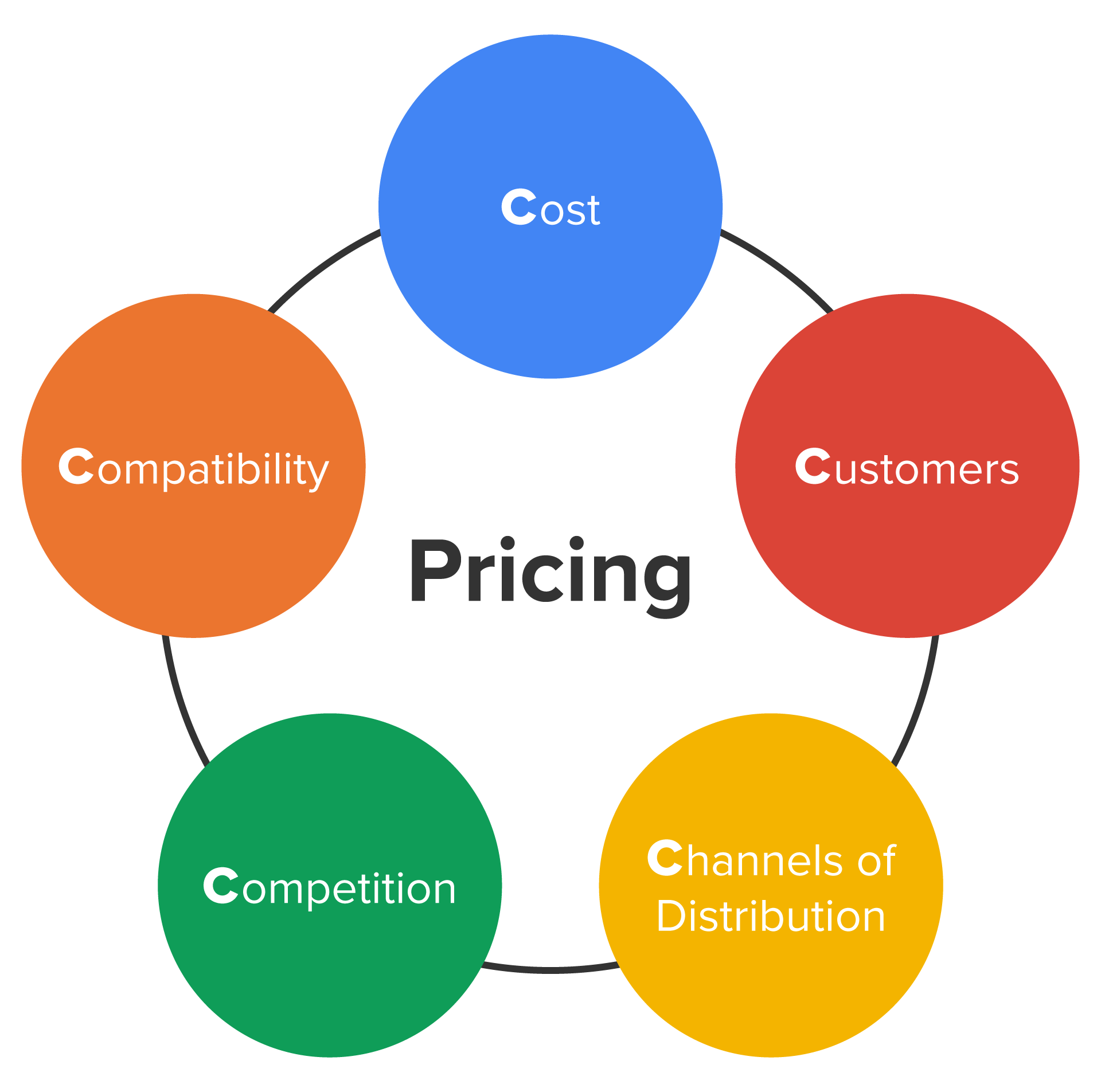
Cost: Cost is the most obvious element of the pricing decision. As we’ve already discussed, you must know the cost of doing business—both fixed and variable—before you can set an adequate price. However, cost alone cannot be the only basis on which a pricing decision is made. After all, buyers never know (and don’t care) how much it costs a business to produce its goods and services.
Customers: Customers are another key element in pricing decisions. Marketers must determine not only what customers expect a product or service to be priced at but also what those customers are willing to pay. Toyota manufactures cars and markets them toward the middle class. Through research, it has determined what its target market is willing and able to pay for a particular vehicle. Alternatively, Lexus, which is marketed as more of a luxury car, has a higher price point and is marketed to a different market than that of Toyota.
Channels of Distribution: Many products are sold through channels of distribution—intermediaries who move products from manufacturer to end users. Intermediaries affect the prices of products because they also need to maximize their profits. Therefore, pricing decisions must consider profits, expenses, and the value they are adding to the product or service.
IN CONTEXT
IKEA began as a mail-order catalog in 1953 in Älmhult, Sweden. Today, it is a global home furnishings brand that focuses on sustainability. Its distribution channel consists of the manufacturer, dealer, wholesaler, and retailer. Each of these channel members is in business to make a profit. Therefore, the price strategy that IKEA utilizes must help to ensure that each member is financially satisfied while making a profit itself and keeping the price that is of value to the end user. If any of the channel members (or the end user) does not find value in the price set by IKEA, the entire channel becomes weak and unsustainable.
Competition: Every company and product faces competition. Even the most unique products are competing for buyer dollars. Buyers’ perception of one product in comparison to that of alternatives has an important impact on pricing decisions.
EXAMPLE
Gazelle Bikes is a top-tier manufacturer of bicycles. The bikes offered by Gazelle have a starting price point of $1,499.16. One of Gazelle’s competitors, Giant, has a starting price point of $1,720.17. For bicycle enthusiasts, these price points are important when comparing one brand with another; an enthusiast who comes across a new brand of bicycles with a starting price of just $200 would not position it with Gazelle and Giant bicycles.Compatibility: Panama City Beach has been one of the most popular spring break destinations of college students for decades. In fact, it is considered the “Spring Break Capital of the World.” It is well-known for its late-night parties, concerts, and celebrity sightings. Hotels and clubs along the beach of Panama City drive their marketing efforts toward this segment of the market: college-aged spring break-goers. The prices they set for the weeks of spring break are compatible with both this segment of the market’s ability to pay and the businesses’ profitability. Conversely, hotels in areas of Florida that are more family-friendly set prices that are considered a value for families and promote the hotels toward families rather than college-aged partygoers.
Source: THIS TUTORIAL HAS BEEN ADAPTED FROM OPEN STAX "PRINCIPLES OF MARKETING". ACCESS FOR FREE AT openstax.org/details/books/principles-marketing. LICENSE: CREATIVE COMMONS ATTRIBUTION 4.0 INTERNATIONAL. Accessed by November 2023.



