Table of Contents |
Cover letters are an often misunderstood part of the job search process. A cover letter is a one-page document typically submitted with a resume or CV to indicate your interest in a specific position. A well-written cover letter concisely summarizes how your qualifications are an excellent match for the open position.
Cover letters are not always required by an employer, but writing one will make your application stand out. It will take time to write a good cover letter, and doing so will increase the likelihood of an interview. The work you put into your cover letter can also help prepare you for the interview phase of the hiring process. Even if a cover letter isn’t required, it can help you stand out as an applicant, because it emphasizes your interest and fit for the position and organization.
It may be tempting to use a generic cover letter for all of your applications, but doing so is one of the most common job-searching mistakes people make. There’s no quicker path to the discard pile than with a generic cover letter that isn’t tailored to a specific position and organization. An employer wants to be able to read a cover letter and immediately recognize how you’re a fit for a specific position at their company—don’t make them guess!
Now that you know the basics, let’s dive in deeper to learn how to write an eye-catching cover letter.
1. Prepare to Write. Before you start writing, gather information about the organization to help you better articulate why you’re interested in the position:
4. Start Writing. Use the information you collected to write a customized cover letter. It should show how you meet the position’s qualifications, and why you are a good fit for the organization.
EXAMPLE
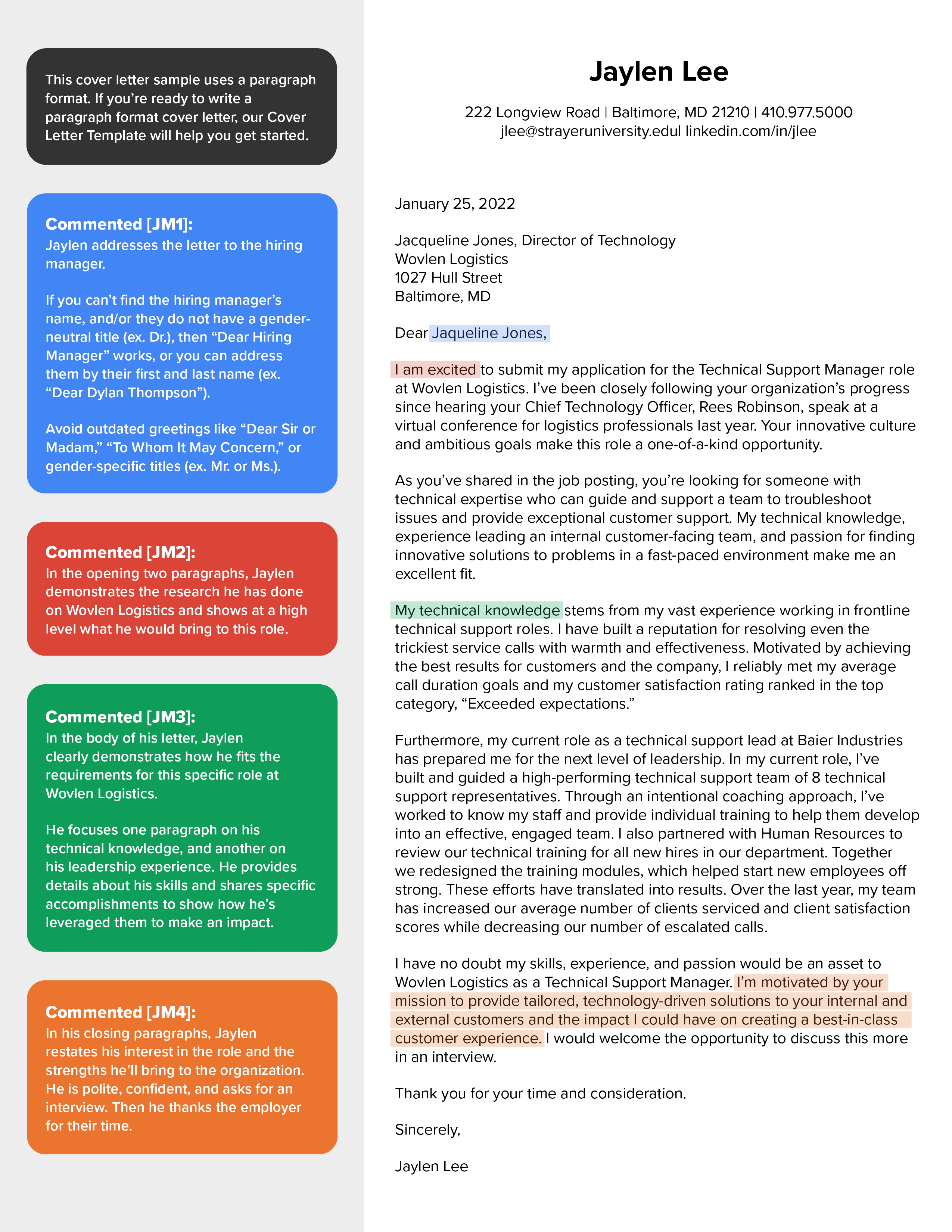
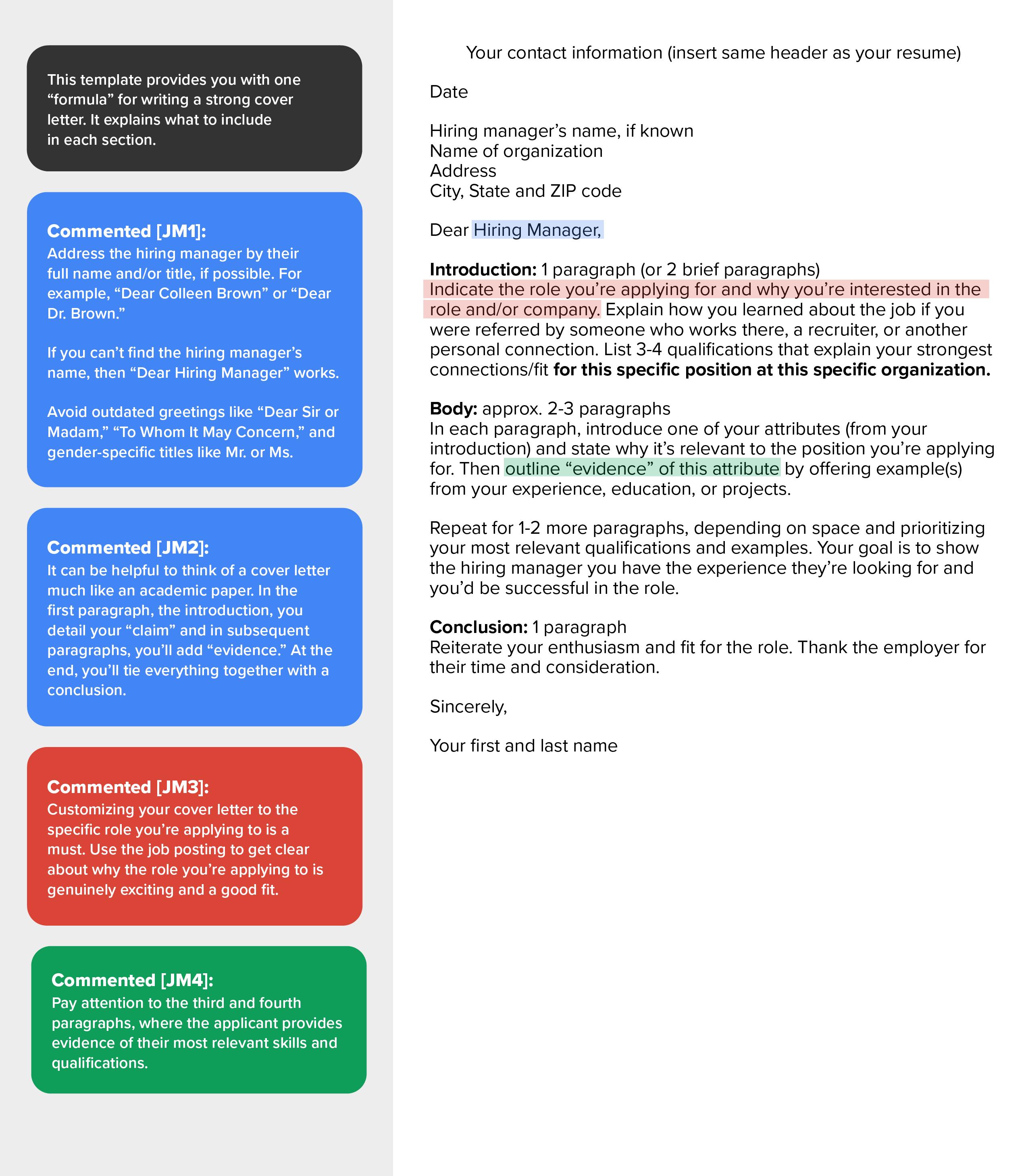
Here is a cover letter sample and template for you to use:Just like a paper you’d write for your academic coursework, a cover letter has three main sections: the introduction, the body, and the conclusion.
The following list briefly describes the purpose of each section, and has suggestions for possible content to include in your cover letter.
1. The Introduction. Start your cover letter with a short introductory paragraph that clearly identifies the name of the position you are applying for. In this first paragraph, you want to catch your reader’s attention, and encourage them to keep reading your letter.
2. The Body. The body of your cover letter should be two or three paragraphs. Use the job posting and the research that you have done on the employer to identify the organization’s needs. Then choose three or four of your most relevant qualifications or experiences to highlight, rather than including a comprehensive list of what you have to offer. You may also use the body of your cover letter to explain things your resume can’t, such as a career change, reentering the workforce, or relocation.
Begin each paragraph with a sentence that outlines the qualification(s) you plan to discuss in the paragraph. Then, demonstrate your qualifications by including evidence, rather than just making unverified statements about yourself.
EXAMPLE
Instead of saying “I am an effective fundraiser,” share more about the impact of your work, like this: “I am an effective fundraiser. Over the past three years, I have increased community giving by 200%, bringing in $500K annually.”Close each paragraph by linking your skills and qualifications to their needs.
EXAMPLE
“As your Director of Institutional Giving, I would apply what I’ve learned to engage the community, increase your average donation amount, and improve donor retention.”EXAMPLE
“I have no doubt these skills and experiences would make me a successful project manager at Lilan Incorporated, and I know I’d thrive in your mission-driven, fast-paced organization.”3. The Conclusion. Conclude your letter with a final paragraph that reiterates your interest in the position and closes on a positive note. This could include:
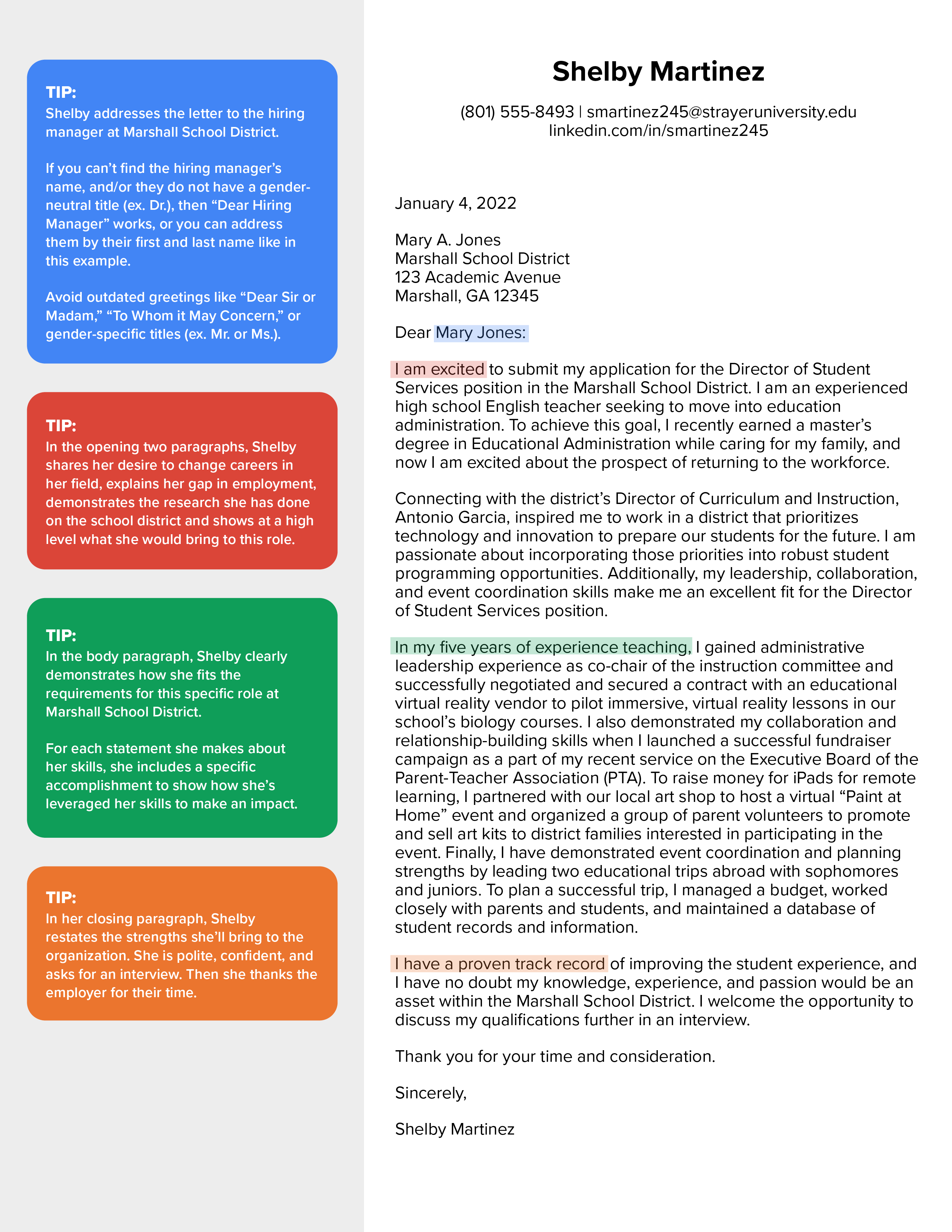
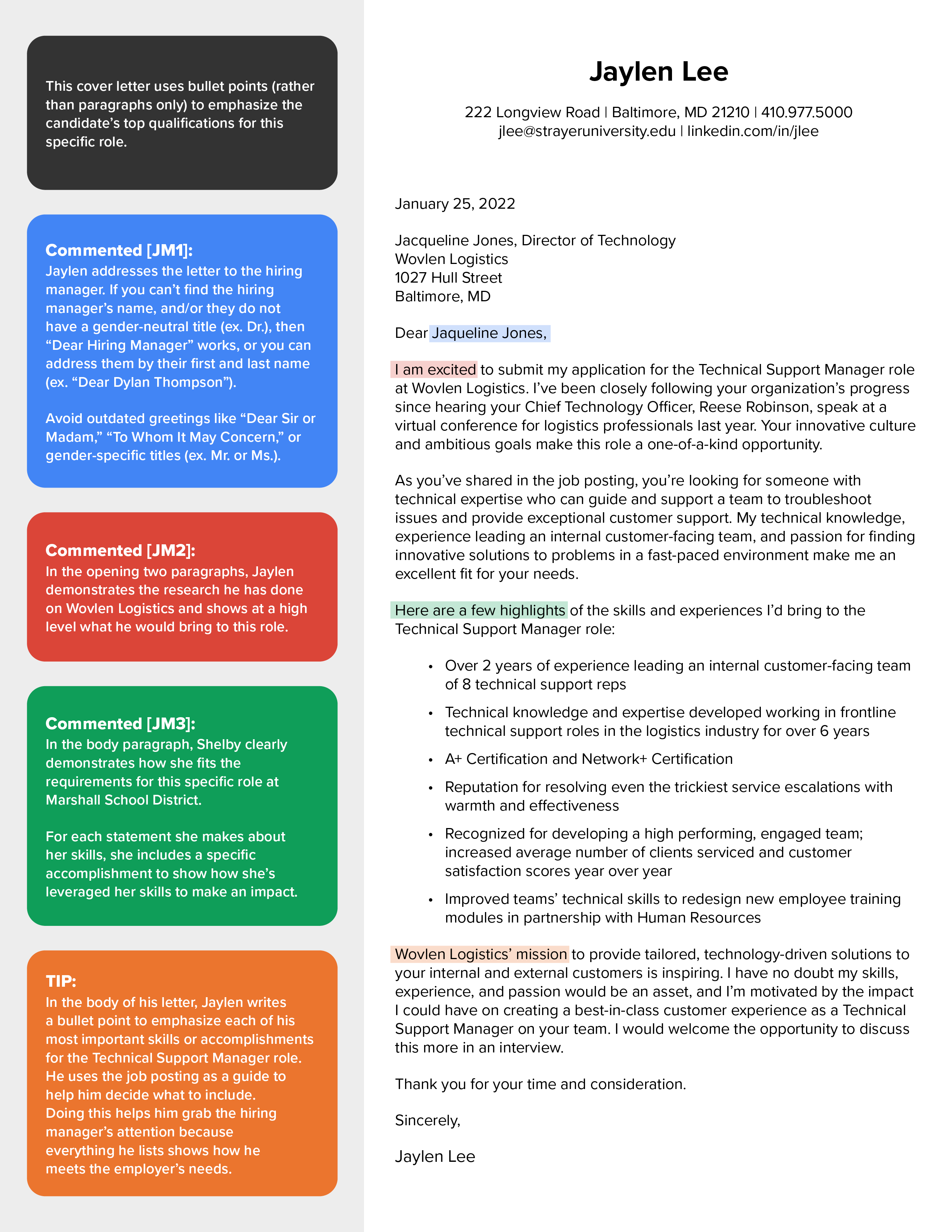
We encourage you to view all of the samples included in this tutorial before creating or revising your cover letter. The format and content of each sample will give you new ideas, even if you do not identify with the individual’s particular educational or professional experiences.
In each sample, the writer integrates what they know about the company to demonstrate their interest in the organization. They show their fit for the specific position they’re applying to by clearly describing what they offer. You’ll want to use these strategies in your cover letter, too. They’ll help you stand out in the hiring process.
An important note about samples and plagiarism: If you are using samples to help you start your own document, be sure to use your own words and that the information included in your document is unique to your skills and experiences. Employers can use a Google search or plagiarism checker if they are suspicious that the writing is not your own.
EXAMPLE
Here are two more cover letter samples for you to reference:A cover letter serves as a brief introduction to an employer. It’s your opportunity to catch their attention, and to show how you’ll bring value to the company.
Writing a customized, quality cover letter for each role you apply to is a must. When you customize your cover letter, you’re writing with the employer’s needs in mind. They have a problem they need to solve, or a gap they need to fill, and your cover letter describes how you will address it. This means that for every cover letter you write, you should include unique language that targets the specific position you are applying to.
A well-formatted cover letter uses the following best practices.
| Best Practice | Description |
|---|---|
| One Page or Less | This shows your ability to communicate in an effective, concise manner. It should also have single-spacing (double between paragraphs), one-inch margins, and a simple font (Arial or Times New Roman in 11- or 12-point size). |
| Formatted Using a Business Letter Structure | If you don’t know how to write a business letter, you can review the Cover Letter Samples and use the Cover Letter Template we have provided. |
| Error-Free | Your cover letter should be free of grammatical and spelling errors. Use a spelling and grammar checker prior to submitting your letter. It also helps to have another person proof-read your letter for you. |
| Formatted to Match Your Resume | Write your letter in the same font as your resume or CV. |
| Compliant with Applicant Tracking Systems (ATS) | Do not use tables, borders, templates, graphics, shading, or symbols. These make your document difficult or impossible for the ATS to read. Additionally, just like with your resume, you should incorporate the exact keywords from the job posting and show that you have the experience and skills the hiring manager is looking for. Doing so increases the odds of your application making it through the screening process and into the hands of the hiring manager. |
Here are the key areas of focus as you draft your cover letter:
| Sections | Description |
|---|---|
| Structure | Make sure that you include a header with your information first. This is where you include your contact information. Like your resume, try to keep the length of your cover letter to one page. |
| Greeting | Address the cover letter to the hiring manager. If you can’t find the hiring manager’s name, and/or they do not have a gender-neutral title (e.g., Dr.), then “Dear Hiring Manager” works, or you can address them by their first and last name (ex. “Dear Dylan Thompson”). Avoid outdated greetings like “Dear Sir or Madam,” “To Whom It May Concern,” or gender-specific titles (ex. Mr. or Ms.). |
| Introduction | In the first paragraph, you want to introduce yourself and make sure to state the role you are applying for. You can also add a sentence or two to summarize your experience and skills. |
| Benefits | You want to make sure you help the reader understand why you are right for the role. What benefits are there in choosing you over everyone else? Remember to focus on keywords from the job description. Think about what qualities the employer is looking for and how your skills and experience match up with those. You can even use a list here if it makes sense to showcase the skills you bring to the table. |
| Interest | This is where you show what you know about the company. Talk about what interests you about the work they do, their culture, history, and reputation. |
| Closing | The last paragraph should be brief but clearly indicate your enthusiasm for the role and that you look forward to speaking with them soon. |
| End with a complimentary close and your name. | Avoid anything informal as you close things out. Consider terms like “Sincerely” or “Regards.” |
Drafting a strong cover letter is a great way to demonstrate your strong communication skills to any potential employer. Organizations want to hire individuals who have strong writing skills and who can share ideas, feedback, and more in a clear and concise way. A good cover letter could be the reason you get an interview. It could also be a reason you are hired.
Source: THIS TUTORIAL WAS AUTHORED BY SOPHIA LEARNING. PLEASE SEE OUR TERMS OF USE.