The era in which humans first demonstrated the ability to craft tools and works of art out of stone is called the Paleolithic Era. This period in history is the longest period of time with reference to human history. This lesson focuses on 25,000 BCE, during which the Upper Paleolithic Period took place. This lesson covers:
"Prehistory" means prior to written history, or the period of time before humans began recording events using a system of writing. “Paleolithic” comes from the word “paleo,” which means “old,” and “lithic,” which means “stone.” The Paleolithic Era is the period of time that marks the emergence of the first stone tools by humans, and it is the longest defined period of human history.
hint
In the past, we used the terms BC, Before Christ, and AD, Anno Domini, or "In the year of our Lord" in Latin. This meant that our entire calendar and system of dating objects was based on the year that we thought Jesus was born. Now scholars use the terms CE, which stands for Common Era, and BCE, or Before the Common Era. Note, 25,000 BCE is the same as 25,000 BC, but without focusing on a specific religion. You will see these abbreviations used throughout this course.
term to know
Paleolithic
Early stage of prehistory characterized by the development of stone tools, sculpted figures, and paintings on cave walls.
2. Art History and Archaeology
The emergence of stone tools is important, as it corresponds to an evolutionary shift in the brain and physical development of human beings. The ability to problem solve by creating tools specific to a task likely corresponds with the advent of true creativity, which is where the interest of art historians comes in. These tools had functionality and therefore do not qualify as art for art’s sake. At the same time, they involved creativity and are steps on the path to producing objects that more closely resemble works of art.
EXAMPLE
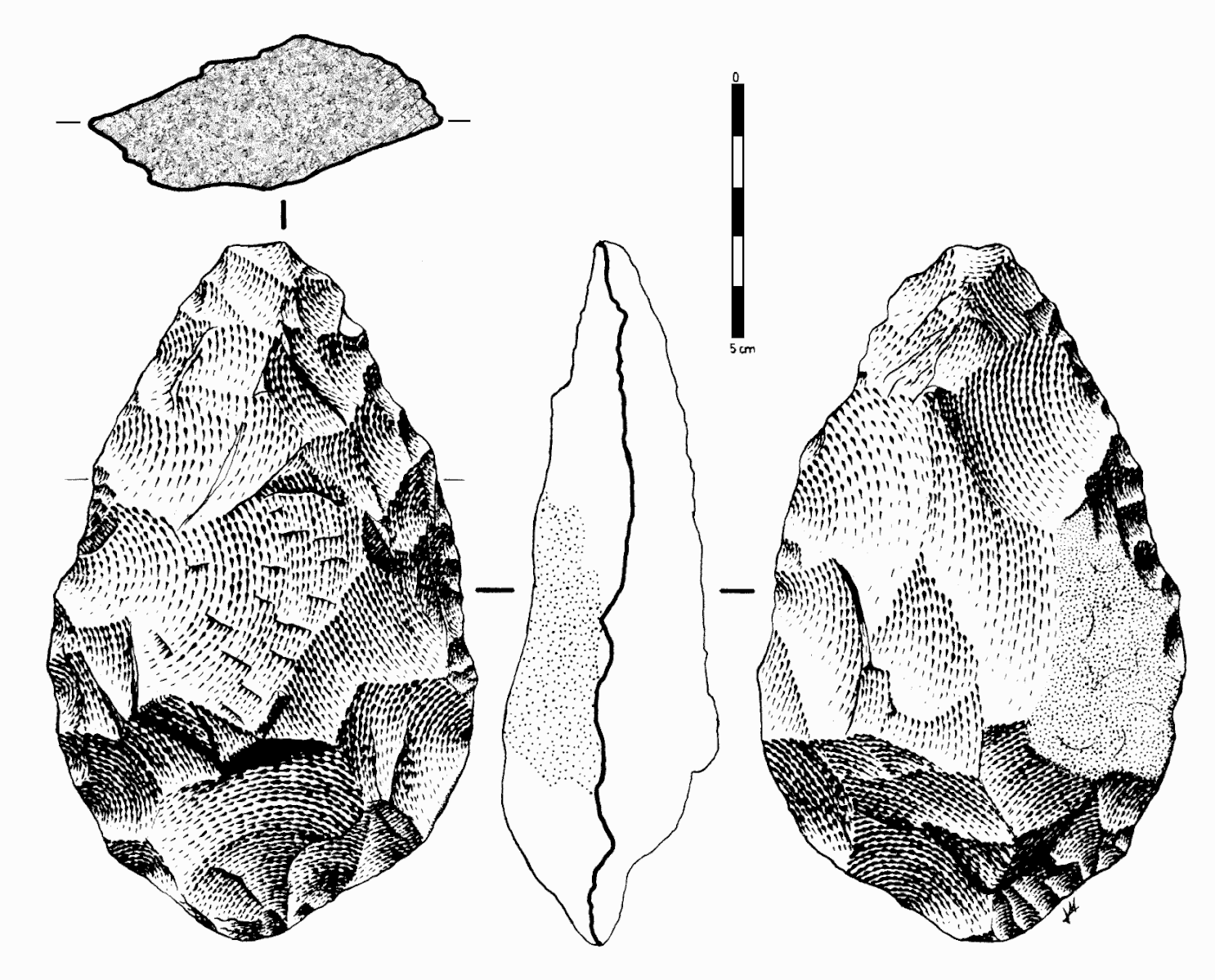
Below is an example of a stone hand ax. This is one of the first tools in human history. Artist unknown Acheulean hand ax Duero Valley, Spain 2.6 million years ago Flint
Our conception of what art is today has evolved over time. While viewed as art in our present-day context, the prehistoric artifacts we still discover today most likely had a very different purpose or function in their time.
The line between art history and archaeology can be blurred at times. The reason for this is that we can only evaluate artifacts using our understanding of these people, which itself is based purely on archaeological evidence. There is no written record to go by, and this introduces a lot of speculation. When studying an artifact from this era, the first step is to identify objects made by humans by asking:
Was it considered art as we understand art to be in its time?
What was the purpose of these images?
did you know
Using what is known of the people who lived during the Paleolithic Era, we can come to some reasonable conclusions. The lifestyle was nomadic, as people moved depending upon the migratory patterns of their food sources, as well as because of climatic changes.
terms to know
Artifact
An object made by a human being, in particular, an object of historical or cultural importance.
Archaeology
The study of human history and prehistory through the excavation of sites and analysis of artifacts.
3. Prehistoric Art and Sculpture in the Round
During this period of time, there was no formal way to document historical events. Instead, historical traditions were likely committed to memory and passed along orally. The memory image refers to the artist creating an image based upon what they remember, rather than having a physical reference. This reliance upon memory may account for the large degree of abstraction present in these images. Abstraction is repeatedly found in prehistoric works of art scattered around the world.
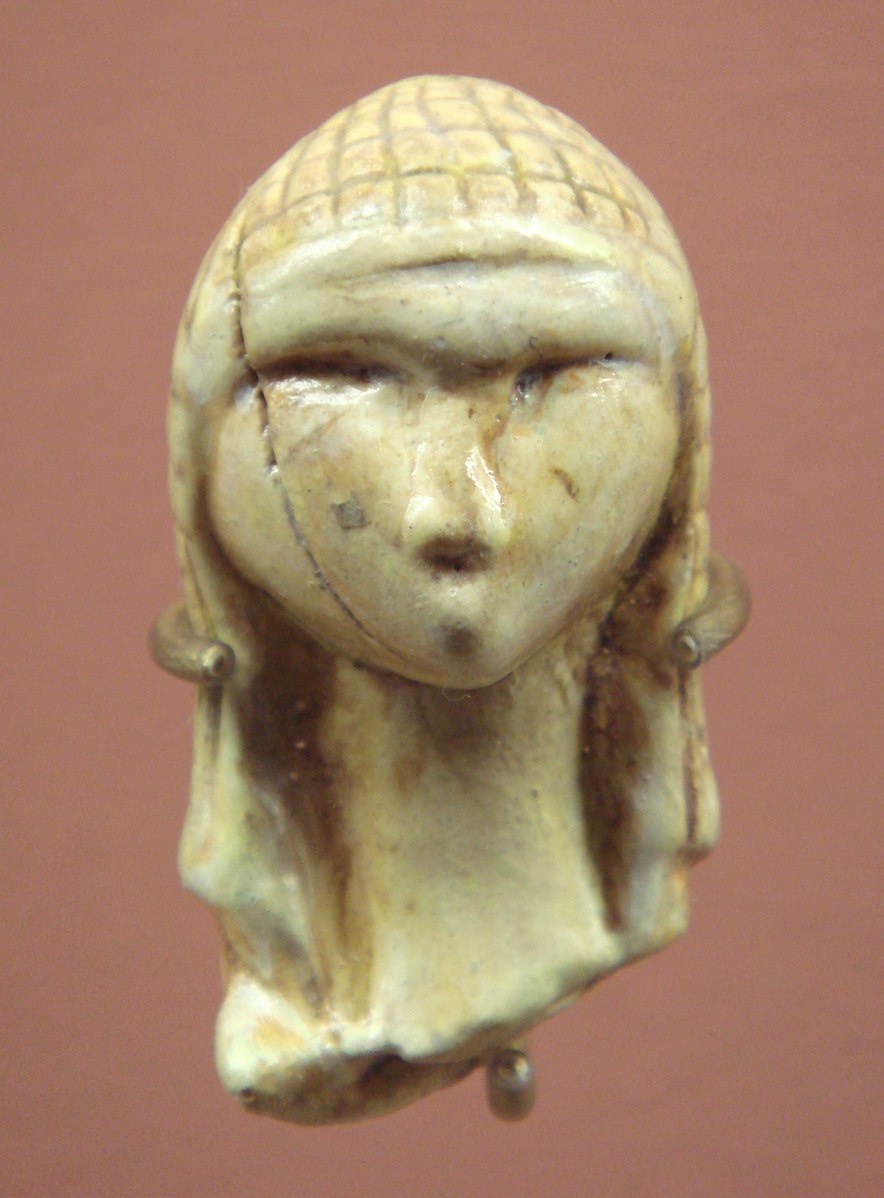
Take a look at the image of Venus of Brassempouy, below. Some individual characteristics are missing altogether, and some are very generalized. This is an example of abstraction.
Artist unknown Venus de Brassempouy Brassempouy, France ~25,000 years ago, Upper Paleolithic period Mammoth ivory
Sculpture in the round is an object that is freestanding, in that it isn’t attached to any other surface. This particular sculpture cannot technically stand on its own, but it most likely was never designed to do so.
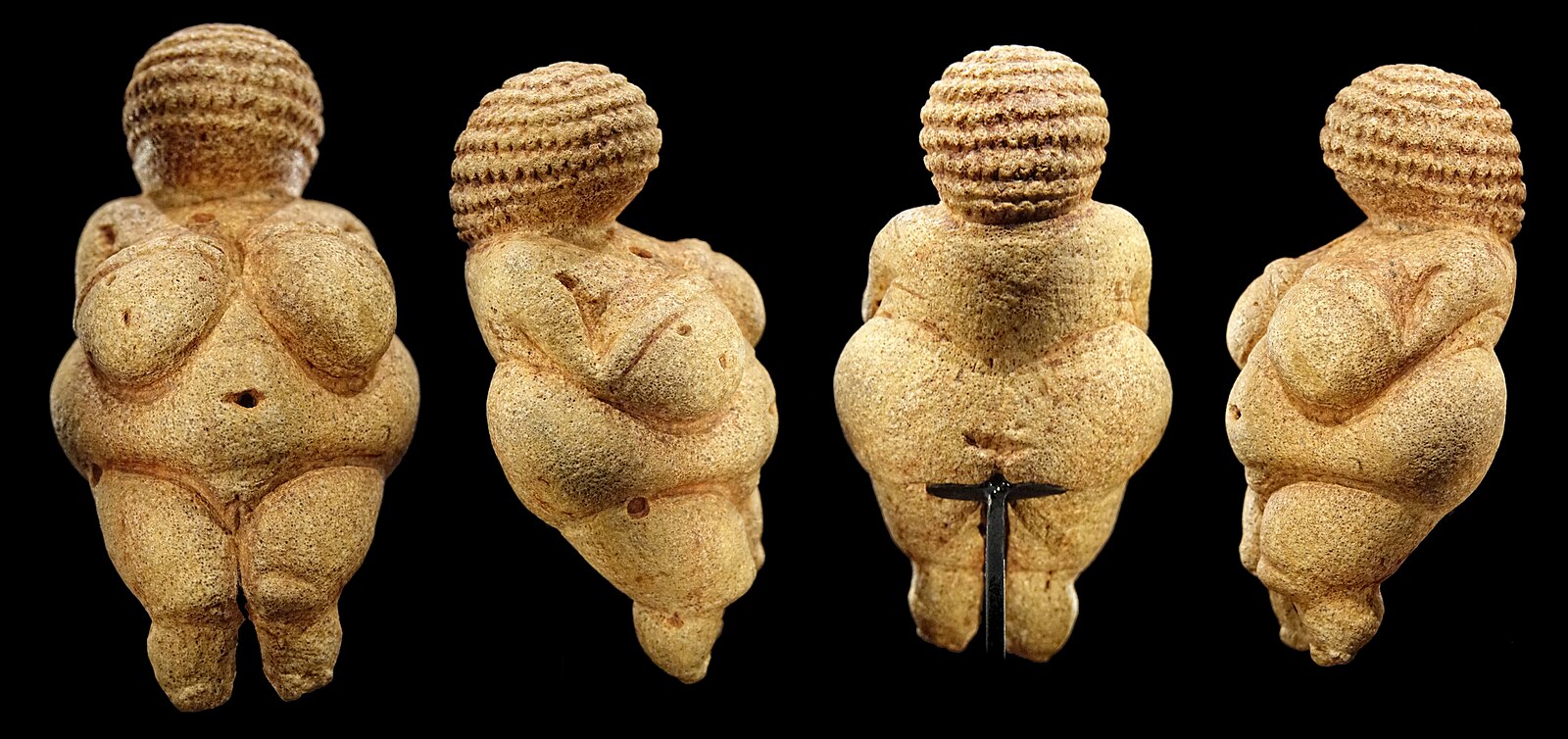
One of the most famous examples of prehistoric sculpture in the round is called the Venus of Willendorf, pictured below. The name is based upon the location of its discovery in Austria. It’s one of the earliest examples of human sculpture, dated to around 24,000 BCE.
Artist unknown Venus de Willendorf Naturhistorisches Museum, Vienna, Austria c. 25,000 BP Oolitic limestone
Notice the high degree of abstraction in the female physical features, in the exaggeration of the breasts, buttocks, belly, and sexual organs. In contrast, the head, face, and arms are much less prominent, or missing altogether.
did you know
Some scholars believe the Venus of Willendorf was created as a personal fertility idol, due to its depiction and size—it’s about 4 inches tall. All of these facts may give insight into the society that produced it—for example, the possible status of women or the nomadic lifestyle they had. All of these images are rather small and portable.
Some also believe that it may have been an artistic self-interpretation or created simply for the sake of creating something aesthetically valuable. We do not know for certain what was the function of the Venus of Willendorf, but we can make educated guesses based on the information that we have on this figurine and other similar goddess images. We should be careful, though, not to jump to conclusions, given the lack of written evidence.
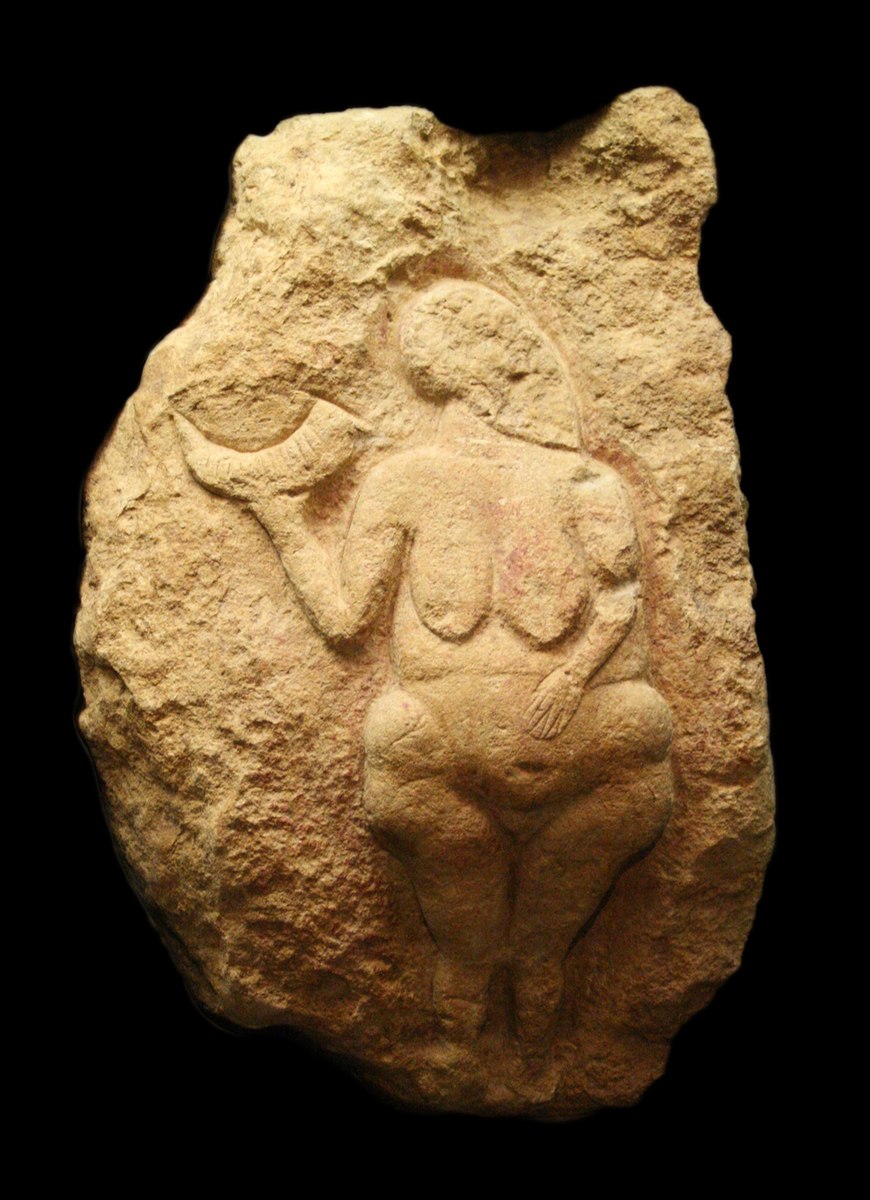
Relief sculpture is another type of sculpture where the carving projects outward from a flat surface, such as wood, stone, or other material.
The Venus of Laussel is a type of relief sculpture. It is a fertility figure holding what appears to be a ram's horn.
Artist unknown Venus of Laussel Musée d'Aquitaine, Bordeaux, France c. 25,000 BP Red ochre and limestone
big idea
The Paleolithic Era is a period in human history when humans first demonstrated the ability to craft tools and works of art out of stone.
terms to know
Memory Image
An image of something previously experienced that remains in the mind.
Abstraction
The process of extracting parts of an idea or concept, not specific or detailed.
Sculpture in the Round
A type of sculpture that is completely freestanding, not attached to another surface.
Relief Sculpture
A sculptural technique in which the carved image projects outward from a flat surface.
summary
Humans first demonstrated the ability to craft tools and works of art out of stone during a period of time called the Paleolithic Era. In this lesson, you learned about prehistory, the period of time before humans began recording events using a system of writing.
You learned how art history and archaeology can sometimes overlap, such as in the case of tools that were developed during the Paleolithic Era, which were both functional, studied by archaeologists, and creative pieces of art, studied by art historians.
Finally, you examined examples of prehistoric art and sculpture in the round. Remember, abstraction is repeatedly found in prehistoric works of art scattered around the world, many times due to the memory image to which an artist must resort to create a work of art, rather than physical reference.
Source: THIS TUTORIAL WAS AUTHORED BY SOPHIA LEARNING. PLEASE SEE OUR TERMS OF USE.
Attributions
Acheulean hand ax | Author: José-Manuel Benito | License: Public Domain