Table of Contents |
Consuming healthy foods at every phase of life is important, and it begins in the womb. Good nutrition is vital for any pregnancy and helps an expectant mother remain healthy. Nutrition impacts the development of the fetus and ensures that the baby thrives in infancy and beyond.
A poorly developed placenta cannot deliver optimal nourishment to the fetus, and the infant will be born small and possibly with physical and cognitive abnormalities. If this small infant is a female, she may develop poorly and have an elevated risk of developing a chronic condition that could impair her ability to give birth to a healthy infant later in life. Thus, a woman’s poor nutrition status can adversely affect not only her children but also her grandchildren.
A whole new life begins at conception. Organ systems develop rapidly, and nutrition plays many supportive roles. For medical purposes, pregnancy is measured from the first day of a woman’s last menstrual period until childbirth, and typically lasts about forty weeks. Major changes begin to occur in the earliest days, often weeks before a woman even knows that she is pregnant. During this period, adequate nutrition supports cell division, tissue differentiation, and organ development. As each week passes, new milestones are reached.
A pregnancy may happen unexpectedly; therefore, it is important for all women of childbearing age to get 400 micrograms of folate per day prior to pregnancy and 600 micrograms per day during pregnancy. Folate, which is also known as folic acid, is crucial for the production of DNA and RNA and the synthesis of cells. A deficiency can cause megaloblastic anemia, or the development of abnormal red blood cells, in pregnant women. It can also have a profound effect on the unborn baby.
Typically, folate intake has the greatest impact during the first eight weeks of pregnancy, when the neural tube closes. The neural tube develops into the fetus’s brain, and adequate folate reduces the risk of brain abnormalities or neural tube defects, which occur in one in a thousand pregnancies in North America each year. Folate also supports the spinal cord and its protective coverings. Inadequate folic acid can result in birth defects, such as spina bifida, which is the failure of the spinal column to close. The name “folate” is derived from the Latin word folium for leaf, and leafy green vegetables, such as spinach and kale, are excellent sources of it. Folate is also found in legumes, liver, and oranges.
During pregnancy, a mother’s body changes in many ways. One of the most notable and significant changes is weight gain. If a pregnant woman does not gain enough weight, her unborn baby will be at risk. Poor weight gain, especially in the third trimester, could result in low birth weight, infant mortality, or intellectual disabilities. Infant birth weight is one of the best indicators of a baby’s future health.
Pregnant women of normal weight should gain between 25 and 35 pounds in total through the entire pregnancy. The precise amount that a mother should gain usually depends on her beginning body mass index (BMI).
| Prepregnancy BMI | Weight Category | Recommended Weight Gain |
|---|---|---|
| Below 18.5 | Underweight | 28–40 lbs. |
| 18.5–24.9 | Normal | 25–35 lbs. |
| 25.0–29.9 | Overweight | 15–25 lbs. |
| Above 30.0 | Obese (all classes) | 11–20 lbs. |
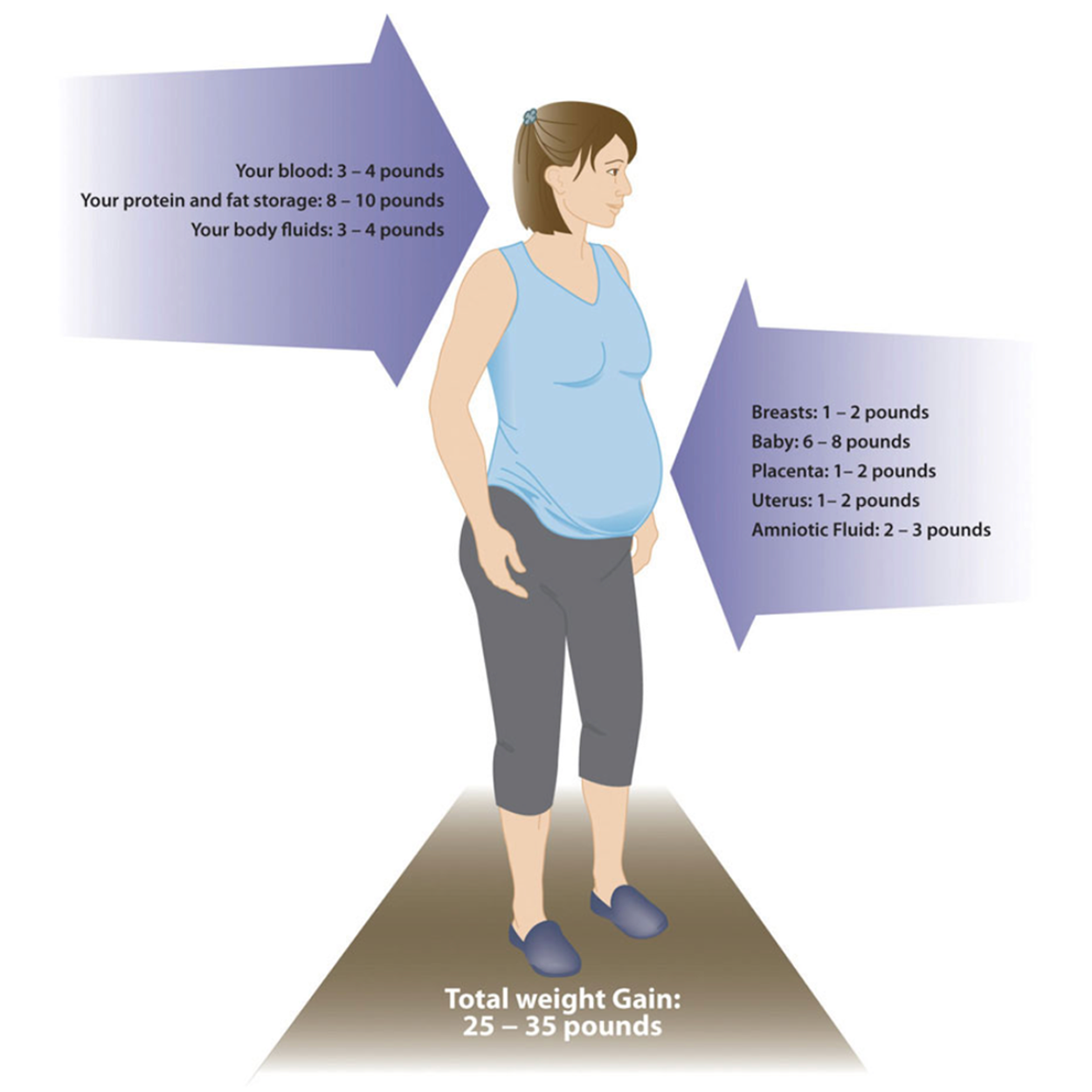
The weight an expectant mother gains during pregnancy is almost all lean tissue, including the placenta and fetus. Weight gain is not the only major change. A pregnant woman also will find that her breasts enlarge and that she has a tendency to retain water.
IN CONTEXT
Starting weight below or above the normal range can lead to various complications. Pregnant women with a prepregnancy BMI below twenty are at a higher risk of a preterm delivery and an underweight infant. Pregnant women with a prepregnancy BMI above thirty have an increased risk of the need for a cesarean section during delivery. Therefore, it is optimal to have a BMI in the normal range prior to pregnancy.
Generally, women gain 2 to 5 pounds in the first trimester. After that, it is best not to gain more than one pound per week. Women who are pregnant with multiples are advised to gain even more weight to ensure the health of their unborn babies. The pace of weight gain is also important. If a woman puts on weight too slowly, her physician may recommend nutrition counseling. If she gains weight too quickly, especially in the third trimester, it may be the result of edema, or swelling due to excess fluid accumulation. Rapid weight gain may also result from increased calorie consumption or a lack of exercise.
During labor, new mothers lose some of the weight they gained during pregnancy with the delivery of their child. In the following weeks, they continue to shed weight as they lose accumulated fluids and their blood volume returns to normal. Some studies have hypothesized that breastfeeding also helps a new mother lose some of the extra weight, although research is ongoing.
Source: THIS TUTORIAL HAS BEEN ADAPTED FROM LUMEN LEARNING’S “NUTRITION FLEXBOOK”. ACCESS FOR FREE AT https://courses.lumenlearning.com/suny-nutrition/. LICENSE: creative commons attribution 4.0 international.
REFERENCES
MedlinePlus medlineplus.gov/ency/patientinstructions/000603.htm
Utah Department of Health, Baby Your Baby. “Weight Gain during Pregnancy.” © 2012 Baby Your Baby. www.babyyourbaby.org/pregnancy/during.



