Table of Contents |
As you have already learned, a prefix is a word component that appears at the beginning of the medical term and adds meaning to the word root.
Combining a knowledge of prefixes with your growing knowledge of word roots will help you understand an increasing number of medical terms.
Prefixes often indicate:
- Number, such as bi-, meaning “two”
- Position, such as sub-, meaning “under”
- Direction, such as intra-, meaning “within”
- Time, such as brady-, meaning “slow”
- Negation, such as a- and an-, meaning “without”
Because prefixes often indicate number, position, direction, time, or negation, the tables below provide introductions to prefixes divided into these common categories.
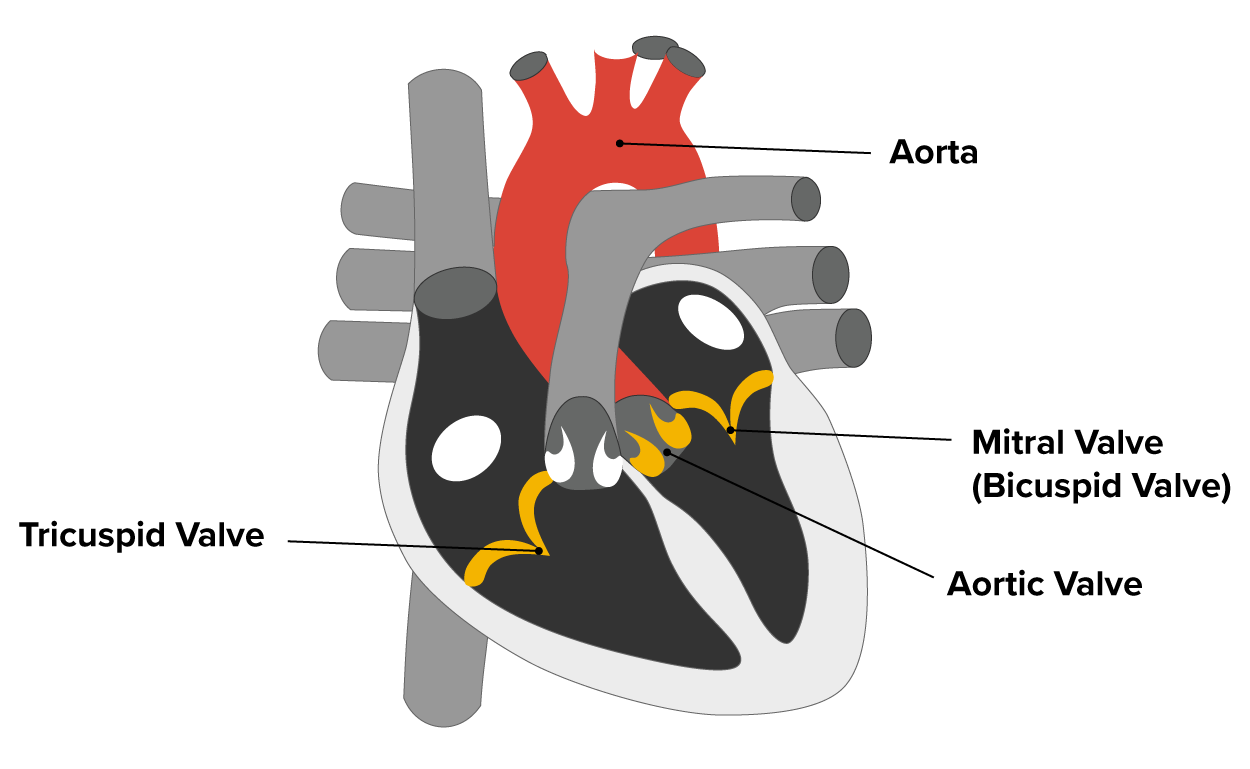
First, consider examples of prefixes indicating number or quantity. Note that sometimes these terms are used in descriptions, such as tricuspid. The tricuspid valve is located on the right side of the heart, as shown in the illustration below. Although only two cusps (flaps) can be seen in the illustration, there are three in a three-dimensional, real heart. The right-hand valve genuinely only has two cusps. Although it is commonly known as the mitral valve, it can also be called a bicuspid valve.
| Prefixes Indicating Number or Quantity | |||
|---|---|---|---|
| Prefix | Meaning | Example | Definition |
| Mono- | One, single | Monocyte | A type of white blood cell (cyte = cell) |
| Uni- | One | Unilateral | Having one side; relating to one side (lateral = side) |
| Bi- | Two | Bilateral | Having two sides; relating to two sides (lateral = side) |
| Tri- | Three | Tricuspid | Having three cusps, as in the tricuspid heart valve |
| Poly- | Many | Polyuria | Excessive urination |
| Oligo- | Few, deficient | Oligospermia | Low sperm count |
Some prefixes indicate position or location. You have already encountered some of these. Here are some examples used in sentences.
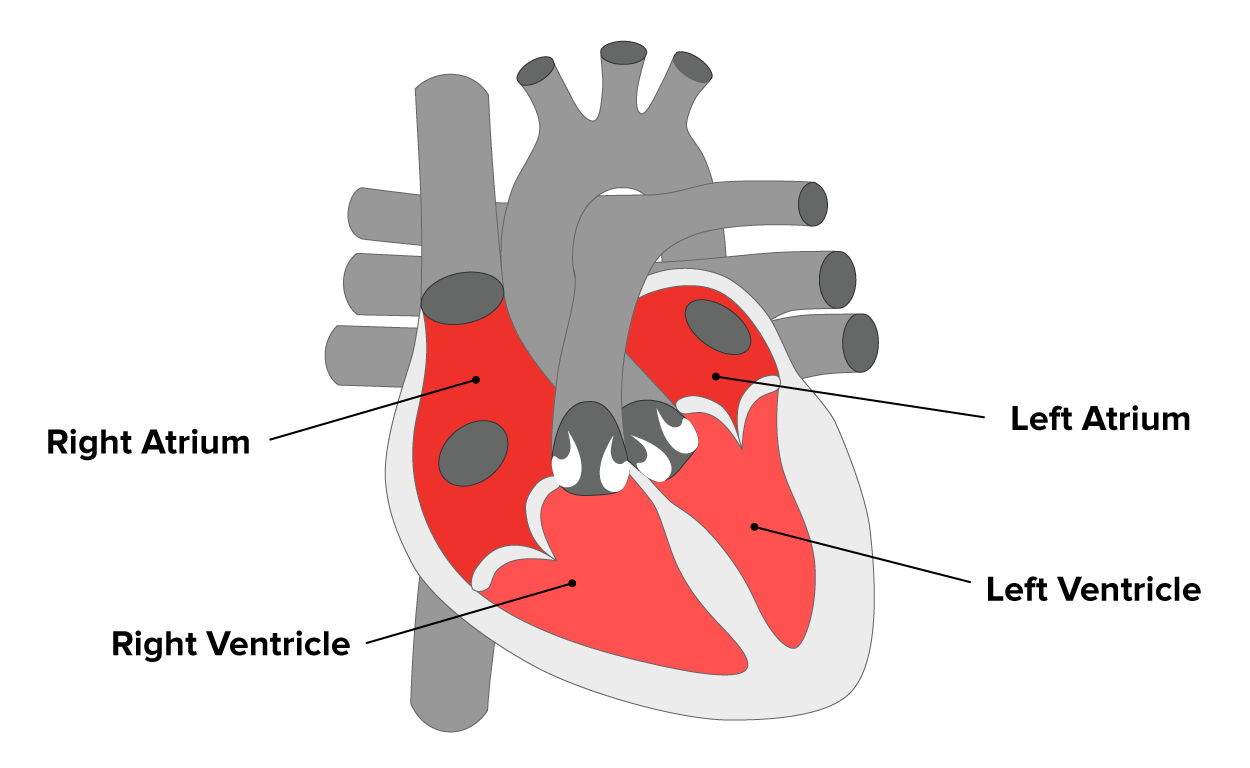
- Supraventricular tachycardia occurs when the heart rate is too fast due to electrical impulses that are produced by tissue in the upper (supra) chambers of the heart (the atria, as shown in the illustration below).
- An intraosseal infusion is used to deliver something, such as medication, directly into the bone. Commonly, intravenous infusions are used when fluids or medication are delivered into a vein. When that isn’t possible for some reason, intraosseal (IO) infusions can sometimes be used instead.
- An intravenous injection is given into a vein.
| Prefixes Indicating Position or Location | |||
|---|---|---|---|
| Prefix | Meaning | Example | Definition |
| Sub- | Under, below | Subcutaneous | Under the skin |
| Supra- | Above, over | Suprapubic | Above the pubic bone |
| Inter- | Between | Intervertebral | Between vertebrae |
| Intra- | Within, inside | Intravenous | Inside a vein |
| Epi- | On, upon | Epidermis | Outer layer of skin |
| Peri- | Around | Pericardium | A sac that surrounds the heart |
| Retro- | Behind, backward | Retroperitoneal | Behind the peritoneum (a membrane lining the cavity of the abdomen and covering the abdominal organs) |
Finally, some prefixes provide information about time or speed. In this lesson, you have already encountered the term tachycardia. The prefixes pre- and post- are commonly used to describe when procedures or events take place. For example, preoperative testing is performed prior to surgery for reasons such as making sure a patient is healthy enough for surgery or for planning the surgery.
| Prefixes Indicating Time or Speed | |||
|---|---|---|---|
| Prefix | Meaning | Example | Definition |
| Tachy- | Fast, rapid | Tachycardia | Rapid heartbeat |
| Brady- | Slow | Bradykinesia | Slow movement |
| Pre- | Before | Prenatal | Before childbirth |
| Post- | After | Postoperative | After surgery |
| Ante- | Before, forward | Antenatal | Before childbirth |
Prefixes indicating size, degree, or comparison are commonly encountered in everyday conversation as well as medical conversation. Think about terms like preapproval, which are used in many contexts (including medical). For example, someone could be preapproved for a mortgage loan or preapproved (preauthorized) by insurance to get medical testing.
| Prefixes Indicating Size, Degree, or Comparison | |||
|---|---|---|---|
| Prefix | Meaning | Example | Definition |
| Micro- | Small | Microscope | A device that magnifies small objects |
| Macro- | Large | Macrophage | A type of relatively large white blood cell |
| Mega- | Enlarged | Megacolon | Enlarged colon |
| Hypo- | Below, deficient | Hypoglycemia | Low blood sugar |
| Hyper- | Above, excessive | Hypertension | High blood pressure |
| Iso- | Equal, same | Isotonic | Equal concentration |
It is very important to be familiar with prefixes indicating negation or absence. For example, viruses (microscopic, nonliving agents that cause disease) are acellular, meaning that they do not have cells. This is one reason that they are considered nonliving, as all living organisms have one or more cells. Remember that all living organisms have one or more cells, which are the fundamental structural and functional units of life.
Consider also the term anesthesia. The prefix "an-" is used at the beginning of the term because properly administered anesthesia removes the ability to sense pain (sensation).
| Prefixes Indicating Negation or Absence | |||
|---|---|---|---|
| Prefix | Meaning | Example | Definition |
| A- | Without, lack of | Asymptomatic | Without symptoms |
| An- | Without, not | Anemia | Without sufficient red blood cells (-emia refers to blood) |
| Im- | Not | Immobile | Not moving |
| In- | Not, into | Involuntary | Not under conscious control |
| Non- | Not | Nonmalignant | Not cancerous |
| Iso- | Equal | Isotonic | Equal concentration |
Finally, consider some prefixes that indicate condition or state. These are also commonly used. For example, “dys” is used in terms like dysmenorrhea (painful menstruation), dysfunction (not working correctly), and dysregulated (not properly regulated).
| Prefixes Indicating Condition or State | |||
|---|---|---|---|
| Prefix | Meaning | Example | Definition |
| Dys- | Bad, difficult, painful | Dysphagia | Difficulty swallowing |
| Eu- | Good, normal | Eupnea | Normal breathing |
| Mal- | Bad, poor | Malnutrition | Poor nutrition |
| Ortho- | Straight, correct | Orthopedic | Related to correcting bone and muscle conditions |
| Pachy- | Thick | Pachyderma | Thick skin |
Here are some examples of common medical terms with prefixes.
- Hyperthyroidism: Hyper- (excessive) + thyroid/o (thyroid) + -ism (condition) → Overactive thyroid function.
- Intracranial: Intra- (inside) + crani/o (skull) + -al (pertaining to) → Located within the skull.
- Polyarthritis: Poly- (many) + arthr/o (joint) + -itis (inflammation) → Inflammation of multiple joints.
As you start using prefixes to build and interpret medical terms, be aware of common errors that could cause confusion.
IN CONTEXT
Here are some examples of common medical terms showing some possible errors that can occur with prefixes.
1. Incorrect prefix attachment.
2. Using similar-sounding prefixes incorrectly.
- Incorrect: "Cardiopostsurgery"
- Correct: "Postcardiac surgery" (since "post-" must precede the root)
3. Confusing prefixes that indicate opposites.
- Intercostal (between the ribs) vs. Intracostal (inside the ribs)
- Hyperkalemia (excess potassium in blood) vs. Hypokalemia (low potassium in blood)
| Term | Definition | Audio |
|---|---|---|
| Intravenous | Administered into a vein |
|
| Preoperative | Before surgery |
|
Source: THIS TUTORIAL HAS BEEN ADAPTED FROM “OPEN RN | MEDICAL TERMINOLOGY – 2e” BY ERNSTMEYER & CHRISTMAN AT OPEN RESOURCES FOR NURSING (Open RN). ACCESS FOR FREE AT https://wtcs.pressbooks.pub/medterm/ LICENSING: CREATIVE COMMONS ATTRIBUTION 4.0 INTERNATIONAL.
REFERENCES
Cleveland Clinic. (2025). Bicuspid Aortic Valve. Bicuspid Aortic Valve



