Table of Contents |
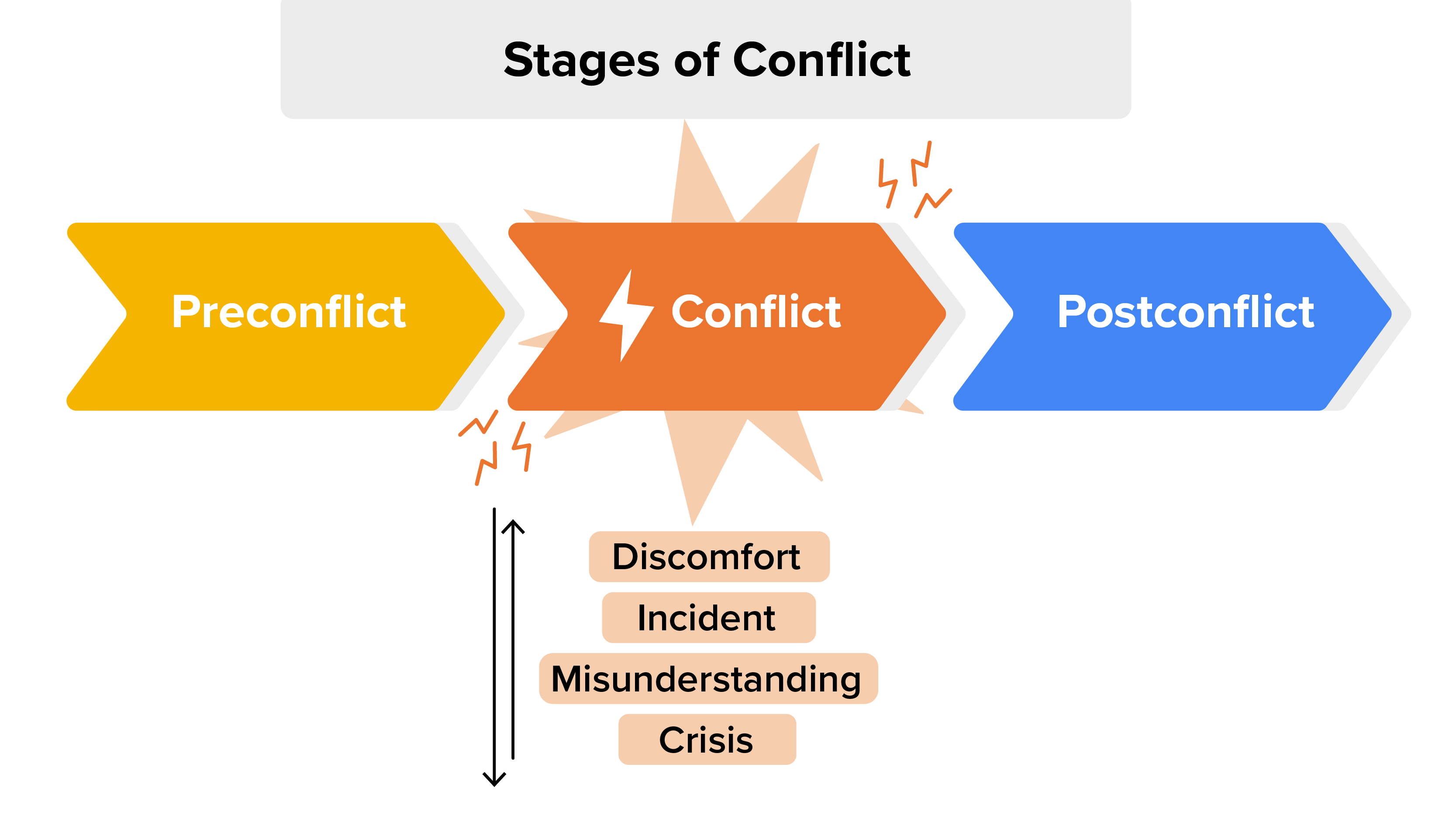
The preconflict stage is when a problem begins to manifest without the parties’ knowledge. It’s a period of latent tension where the seeds of conflict are sown. The following examples illustrate what the preconflict stage might look like:
EXAMPLE
You enjoy your job and the work you do. However, your company has hired a new divisional VP, leading to management changes. You’ve met the new managers, and everything seems fine at the moment. However, issues could be brewing beneath the surface without your awareness.EXAMPLE
You’ve been asked to take on more responsibilities at work, including tasks you feel untrained for. You feel uneasy about this extra work.EXAMPLE
New neighbors have moved in next door, and the yard is messy compared to the previous residents. This makes you uncomfortable.EXAMPLE
A new family moves into your neighborhood. They have many visitors, but they seem nice, and your kids get along. Although you’re a little surprised by all the visitors, everything appears fine for now.EXAMPLE
Your spouse has been given extra assignments at work, requiring frequent travel. You start feeling tired a lot but haven’t connected your exhaustion with your spouse’s increased duties.The conflict stage delineates the journey of a conflict, tracing its development from the initial signs of discord to the phase immediately prior to resolution. It begins with discomfort, leading to incidents, misunderstandings, and tension. If not managed, these can escalate into a crisis.
The discomfort stage is when parties are aware their needs are not being met but do not yet understand the specifics of each other’s roles. Resolving conflicts at this stage can prevent escalation.
EXAMPLE
You like hosting gatherings at your home, but it has become a tradition that you’re always the host. This is starting to feel like a burden, and others aren’t offering to help.EXAMPLE
You’ve been asked to take on more responsibilities at work, including tasks you feel untrained for. You feel uneasy about this extra work.EXAMPLE
New neighbors have moved in next door, and the yard is messy compared to the previous residents. This makes you uncomfortable.Because the discomfort stage is often where conflict begins, it’s the easiest stage in which to resolve a conflict by tackling it early.
Let's revisit some of the examples from above.
EXAMPLE
You’ve started to feel uncomfortable hosting relatives in your home, like it might be a little much. You could tackle the conflict early by calling another relative who lives in the same town. You might explain the situation like this: “You know I enjoy having people over, but it’s starting to feel like a lot. Would you ever consider having the family come to your house? How could we work together and share the responsibility when people come to town?”EXAMPLE
With the new neighbors, you might mention that you’ve noticed the trash hasn’t been picked up the last couple of times, and you’re wondering about that. In this way, you begin to open up a conversation about your concerns.The incident stage occurs when parties become aware of each other’s roles in their unmet needs through a specific event.
EXAMPLE
At a team meeting, a trainee presents your idea as his own, leaving you feeling betrayed.EXAMPLE
Your son watches a movie at your sister-in-law’s house that you don’t approve of, making you uncomfortable with her providing after-school care.During the incident phase of conflict, there is often a tendency to minimize the incident by saying or thinking things such as:
Let's revisit the examples from above.
EXAMPLE
If the conflict is already in the incident stage, you could perhaps go to the coworker you’ve been training and ask to talk with him. You can share that you were a little uncomfortable with his remark in the meeting. Having this conversation actually brings the issue into the open at this stage.EXAMPLE
You could talk to your sister-in-law; maybe you need to revisit the conversation about what you expect when your son is over at your sister-in-law’s home. This would be the time to try to resolve the conflict because it’s still in an early stage.The misunderstanding stage is when parties adopt negative views of each other based on differing interpretations of interactions.
EXAMPLE
Your sister-in-law brings unexpected guests to a holiday dinner, leading to a misunderstanding about the guest count.EXAMPLE
A coworker’s snippy emails make you feel bossed around, but you later discover he’s overwhelmed with work.Let's revisit the examples from above.
EXAMPLE
You decide to talk to your sister-in-law about why she came to the gathering with three extra people that you didn’t even know about. Through this conversation, you discover that she did leave you a phone message, but you never received it. The message pops up on your phone the next day.EXAMPLE
You’ve been feeling really resentful about these emails from your coworker, so you decide to talk to him about it. You might say, “You know, I’m really upset. What’s with all these emails? I kind of feel like I’m being bossed around here.” By sharing your feelings, you learn that your coworker has been so busy that he’s just been trying to get his emails sent; he hasn’t really been paying attention to the tone or how he might be coming across. He absolutely didn’t mean anything by it.In a misunderstanding or potential misunderstanding, a party is having a reaction to an incident that has happened. As we’ve discussed before, conflict can start at any stage, but it’s important to address it at the earliest possible stage because conflicts can escalate or de-escalate back and forth through the stages.

In the tension stage, communication becomes difficult or impossible, and parties consistently attribute negative traits to each other.
EXAMPLE
Susan is in conflict with her siblings about their elderly father’s living arrangements. Discussions have become so tense that they can no longer communicate effectively.EXAMPLE
You’re working on a project with a coworker who prefers to rush tasks, while you prefer a thorough approach. This difference has led to tension and enlisting allies on both sides.As we’ve discussed before, it’s important to remember that during a conflict, the stages can escalate or de-escalate back and forth from tension to misunderstanding to discomfort. Thus, it’s always a good idea to address a conflict at the earliest possible stage.
Once a conflict has reached the tension stage, it might be very difficult for the conflicting parties to even talk to each other. In this case, they may decide they need some outside help.
Let's revisit the examples from above.
EXAMPLE
Susan decides to bring the family’s priest to sit down with the family and facilitate a discussion. Things have become so tense that it is impossible for the siblings to get together in the same room without arguing. Having an outside party facilitate a discussion really allows all of the siblings to voice their feelings, and they are able to clear the air.EXAMPLE
At work, you might decide that you need to talk with the team leader about the project. Bringing in the team leader to discuss your concerns might be a way of stepping in at this point during the tension stage.The crisis stage is marked by open conflict, where parties may engage in heated arguments or retaliatory behaviors.
EXAMPLE
Your new neighbors retaliate by playing loud music after you complain about their noisy parties, escalating the conflict.EXAMPLE
After your father falls while the stove is on, you and your siblings argue intensely about moving him to a care facility.As we’ve discussed before, conflicts can escalate and de-escalate between the stages depending on what is done to resolve the conflict during any one stage. In general, it’s good to resolve a conflict in the earliest stage possible. Crisis is the most difficult stage within which to resolve a conflict, but it can still be done.
Let's revisit the examples from above.
EXAMPLE
The next time the neighbors throw a party, you consider calling the police to shut it down. But your spouse reminds you that this would be a further escalation of the conflict and potentially dangerous to people in the neighborhood. You and some of your other neighbors decide to try and set up a community mediation. Bringing in a third party may allow you to talk to the new neighbors about these issues and restore some harmony within the neighborhood.EXAMPLE
After your father’s fall, you call your siblings. You might say something like “I’m going to call the doctor today. Let’s all meet with the doctor and talk to him about what might be best for Dad.” You are going to bring in a medical resource. You could also involve someone that the family trusts as a mediator to help you all have a conversation to resolve the conflict.Resolution is the deliberate action or set of actions taken to address the needs of the parties involved and resolve the conflict. Resolution can occur at any stage of the conflict cycle and leads to the postconflict stage, where relationships can be repaired or redefined.

Here are examples of resolution at each stage.
EXAMPLE
Discomfort Stage of Conflict: You notice that you’re feeling increasingly frustrated at work but can’t quite pinpoint why.EXAMPLE
Incident Stage of Conflict: During a team meeting, your colleague takes credit for an idea you previously shared, making you realize the underlying issue.EXAMPLE
Misunderstanding Stage of Conflict: After receiving curt emails from your coworker, you start believing they are deliberately disrespectful.EXAMPLE
Tension Stage of Conflict: Every attempt to discuss project timelines with your teammate results in an argument, and you both start blaming each other for delays.EXAMPLE
Crisis Stage of Conflict: Following a heated argument, your coworker retaliates by intentionally blocking your parking spot, escalating the conflict to an unmanageable level.Conflicts can move between stages, escalating to more intense or harmful stages or de-escalating to less intense stages.
EXAMPLE
Escalation: Calling the police on a neighbor’s party would escalate the conflict.EXAMPLE
De-escalation: Investing in soundproofing to mitigate noise from a neighbor’s party would de-escalate the conflict.Source: THIS TUTORIAL WAS AUTHORED BY MARLENE JOHNSON (2019) and STEPHANIE MENEFEE and TRACI CULL (2024). PLEASE SEE OUR TERMS OF USE.



