Table of Contents |
The planning phase is often called prewriting. Prewriting tasks include identifying your audience and purpose, organizing your thoughts, and creating an outline. It may also include dialogue with others or research. In other cases, the phases of prewriting might include less formal preparation, like thinking things through while driving to work or sipping your morning coffee.
Even short messages can require prewriting. For example, say that, for reasons outside your control, you have to cancel a meeting that was hard to schedule. Before you open a new email message, you might think of the best way to pass on the news and how much personal information you should share. In short, you are thinking about your audience, your purpose, the tone of your email, and the relationship you have with the recipient.
By the time you do start to compose the message, you probably have a mental outline of what you want to say. You might have a few key phrases in mind to use, like “unavoidable family emergency,” to make it clear that only something very important would compel you to reschedule, while respecting personal boundaries and not going into details.
While a mental list might be enough preparation for a short message, longer messages and documents might take more consideration before you set fingers to the keyboard. However, you will be guided by the same principles of considering your audience and purpose in mind. In fact, you might want to go further than keeping your audience and purpose in mind, and actually write it down! You might want to write a reminder to yourself, following this simple format (but you will fill in the blanks):
This document is for __________. Its purpose is to __________ and also to __________.
This can be written and highlighted at the top of your outline, or jotted down on a post-it note and attached to your keyboard or monitor. Either way, as you write you should see it constantly, and remind yourself who you are writing for and why.
For longer messages and documents one of the key challenges is deciding how to organize and sequence the information you’re delivering. Some common prewriting strategies to get this started include freewriting, brainstorming, clustering, and concept mapping.
Freewriting is the practice of putting all of your thoughts down on paper without worrying about spelling, grammar, or organization. While it’s called “free,” the idea does not suggest that you are free to write about anything at all, but that you are free of worries about mechanics or structure. Your only goal is to get everything on paper. Some people call this a “brain dump,” because you are dumping out onto paper or screen all the contents of your brain (on a particular topic) so that you can later sort through them.
In preparing a work-related message or document, this process is most useful as a list of important elements to include in the message; you may also include words or phrases, that you feel have the right tone for the situation, or reminders to yourself of words or phrases to avoid using.
EXAMPLE
Yonit is writing an orientation guide for new staff at her office building. She was tapped for the role because she’s worked in the office a long time and in many different capacities, so she “knows it all.” However, her vast knowledge also makes it hard for her to even get started. There are too many things whirling around in her mind, from copy room codes to parking policy to emergency evacuation plans! She begins to jot down all of her ideas on index cards so she can sort them later. She gives herself a few days to generate ideas as they occur to her. At the end of the week she hasn’t written a word of the document, but does have a comprehensive list of things she needs to write about. This will make the actual writing process quick and straight-forward.Brainstorming plays the same role as freewriting but is a group process of spontaneously sharing ideas rather than an individual process. It may be done in dialogue or with each person freewriting, then sharing their responses with a group. When done vocally, people are encouraged to speak up and discouraged from criticizing or questioning ideas until all the ideas are expressed. If it’s done in-person, there is usually a dedicated recorder to capture all the ideas on paper or a whiteboard, as well as a facilitator (which may be the same person). Brainstorming can take place in a meeting, webconference, or in a collaborative writing space, like a wiki or Google Doc.
EXAMPLE
Ahmed is revamping his organization's website. He wants to start from the beginning with a completely new organization to the website, instead of relying on the same structure they have been using previously. He begins by assembling a large, diverse group of stakeholders, and runs a brainstorming session to generate a list of possible functions for the website. Since Ahmed is facilitating the brainstorm, he asks a colleague to record all of the ideas on large sheets of paper, which they can save and use later as they continue the process.Clustering is a process of grouping your ideas from a brainstorm or freewriting session into themed clusters, so you can better visualize the shape the final document might take. You might cluster your ideas as you write them down or do so as a second step.

Many people use Post-It notes for their brainstorming sessions so that they can be easily clustered into like topics or moved around. Individual writers can use notes and a tack board.
EXAMPLE
As Yonit finishes the “brain dump” phase of her process for the new staff orientation guide, she begins sorting her index cards into stacks that make the most sense together, such as technology, policies, and a glossary of terms new staff will need to know.Concept mapping is a way to further organize your thoughts by connecting the terms, ideas, or clusters in a visualization that shows relationships between ideas. Clustering is simply grouping ideas, while mapping shows the structure or sequence of those clusters and the relationships between them
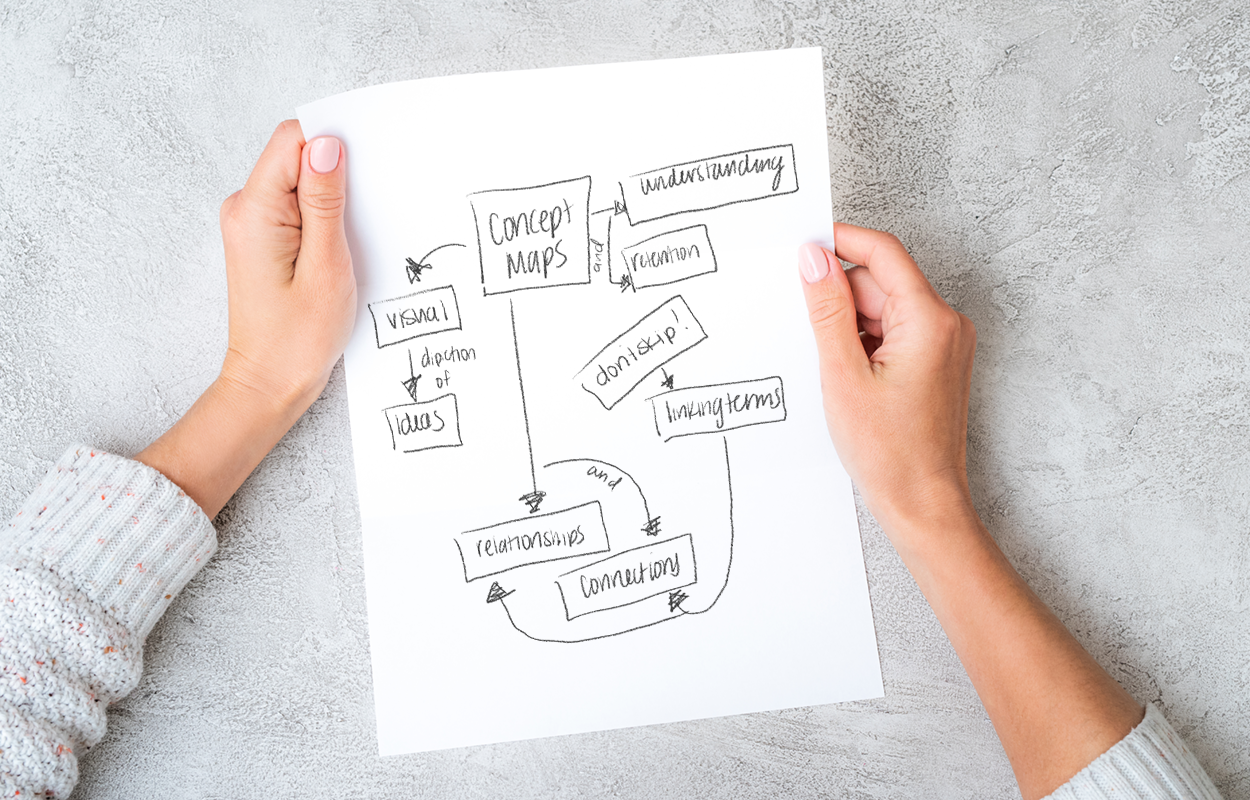
EXAMPLE
After the brainstorm session, Ahmed can begin mapping the ideas generated by the group by consolidating ideas into top, second, and third level menu items. He can show the options for the hierarchy of these menu items in a concept map by making their relationships visual with simple mapping symbols like circles and arrows.Outlining further organizes your list of ideas by showing their overall sequence and structure in linear, written format but with short phrases instead of fully developed sentences or paragraphs. This is a critical step for longer documents and can even be crucial in shorter messages. Just as a drawing outline would be a rough sketch of the figures in the drawing to fill in later with color, a document outline shows the key elements that can be developed in more detail. In most cases, the outline document itself becomes the first full draft of the document.
You may have had a class where you were asked to create an outline of a school report or project and told to use a strict structure of Roman numerals, capital letters, and Arabic numerals for each section, that may have looked something like this:
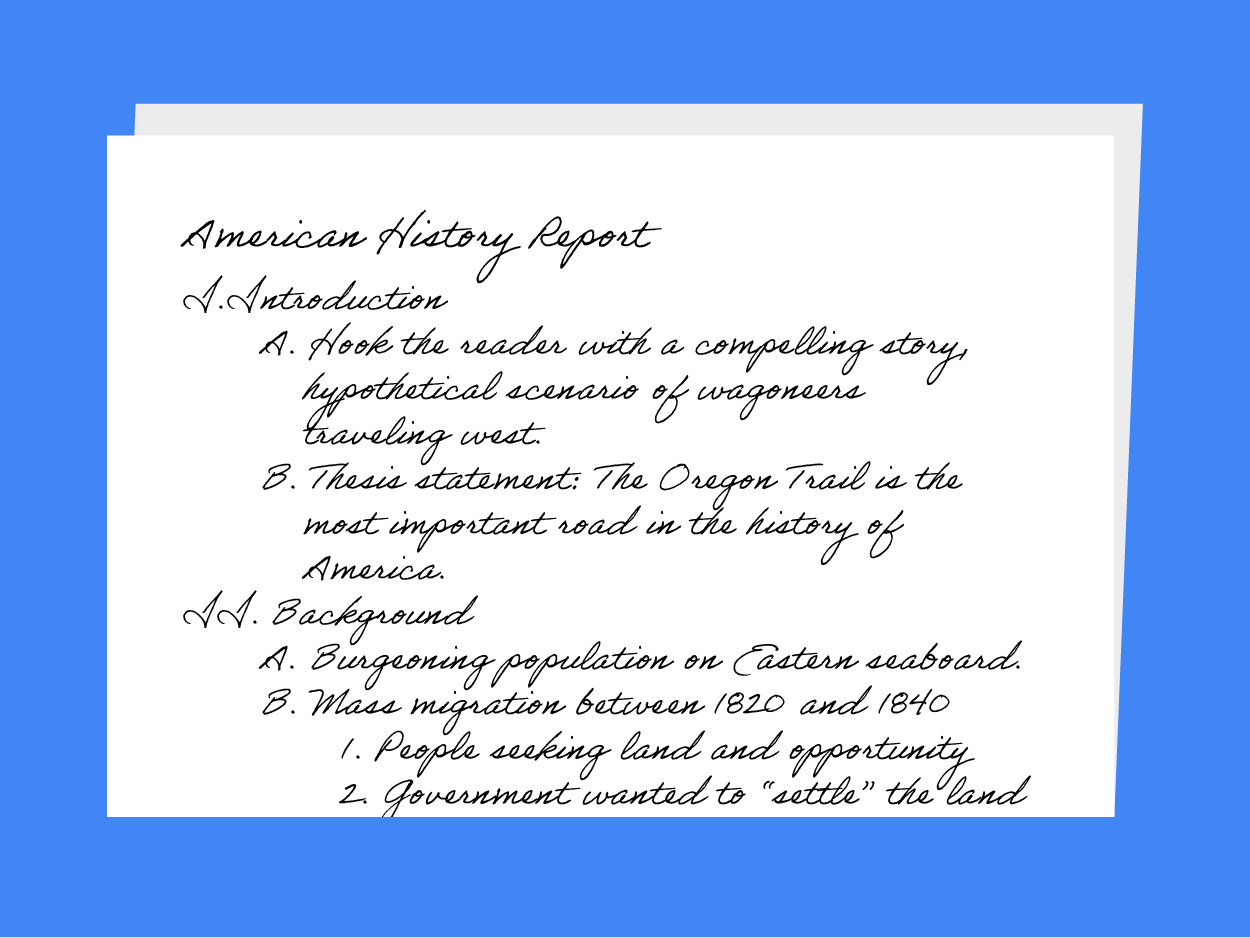
This is called a formal outline. Note that this is not the same “formal” as formal communication, but a more specific and rigid set of conventions. The outlines you produce for work rarely need to follow such a structure. Your report may be a simple bulleted or numbered list, and it may be written in a mix of short phrases, complete sentences, and notes to yourself. For example, here is an outline for an email soliciting customer feedback.
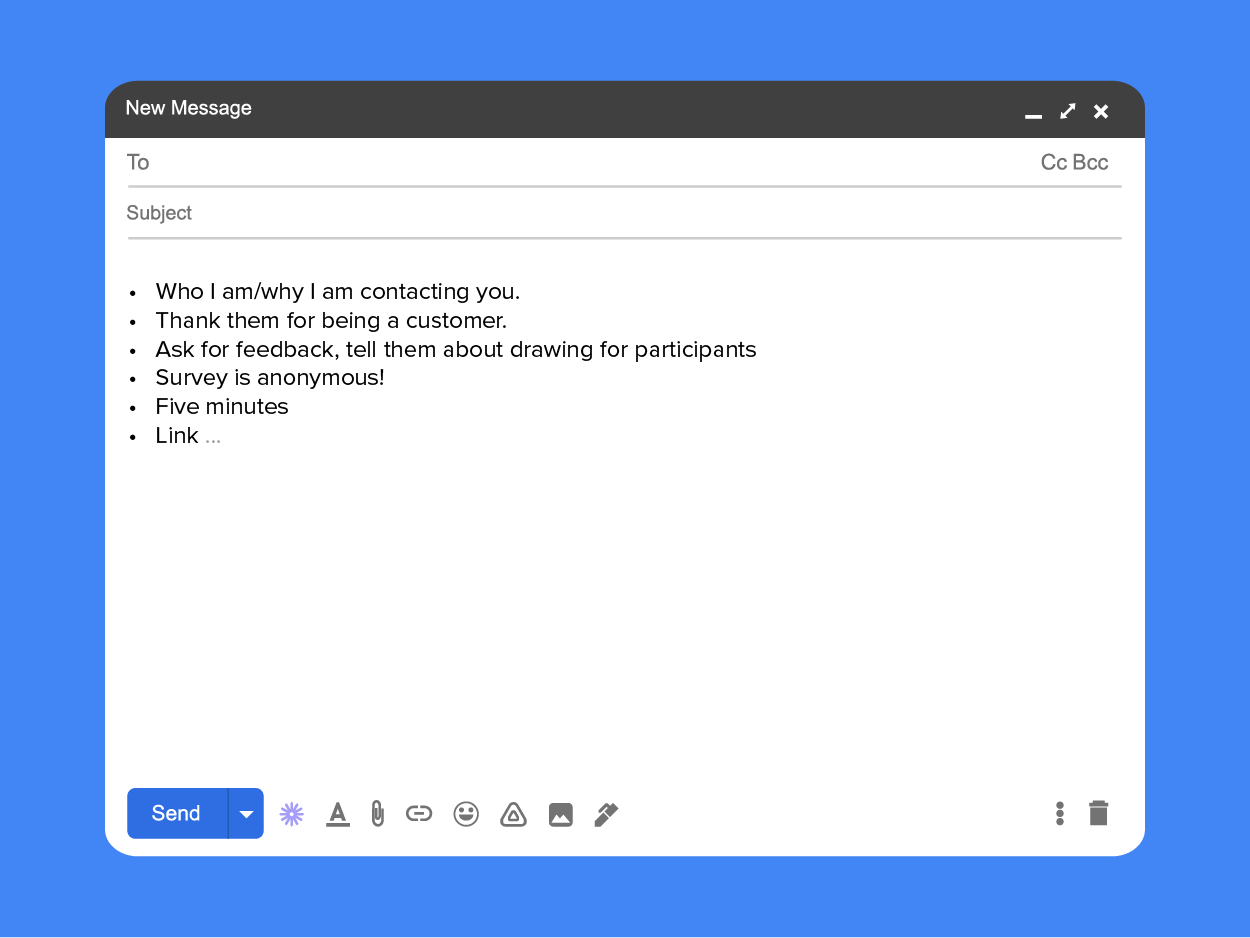
Even a longer report outline usually won’t have a formal structure, but is more likely to have points and supporting points. An outline with both topics and subtopics, or ideas and supporting points, is called a multi-level outline.
Sometimes an outline will serve a secondary purpose of sharing your ideas with others and getting approval. This still isn’t usually a “formal outline” in the technical sense, but will be more formal than a set of notes only you will read. It needs to be “formal” in the broader sense of being appropriate for work, clearly written, and reflecting positively on your work.
Finally, since your outline headings will be turned into document headings, you want to make sure they are parallel and consistent. For example, remember Yonit’s employee orientation guide from the above example. After organizing her cards, she creates an outline like this:
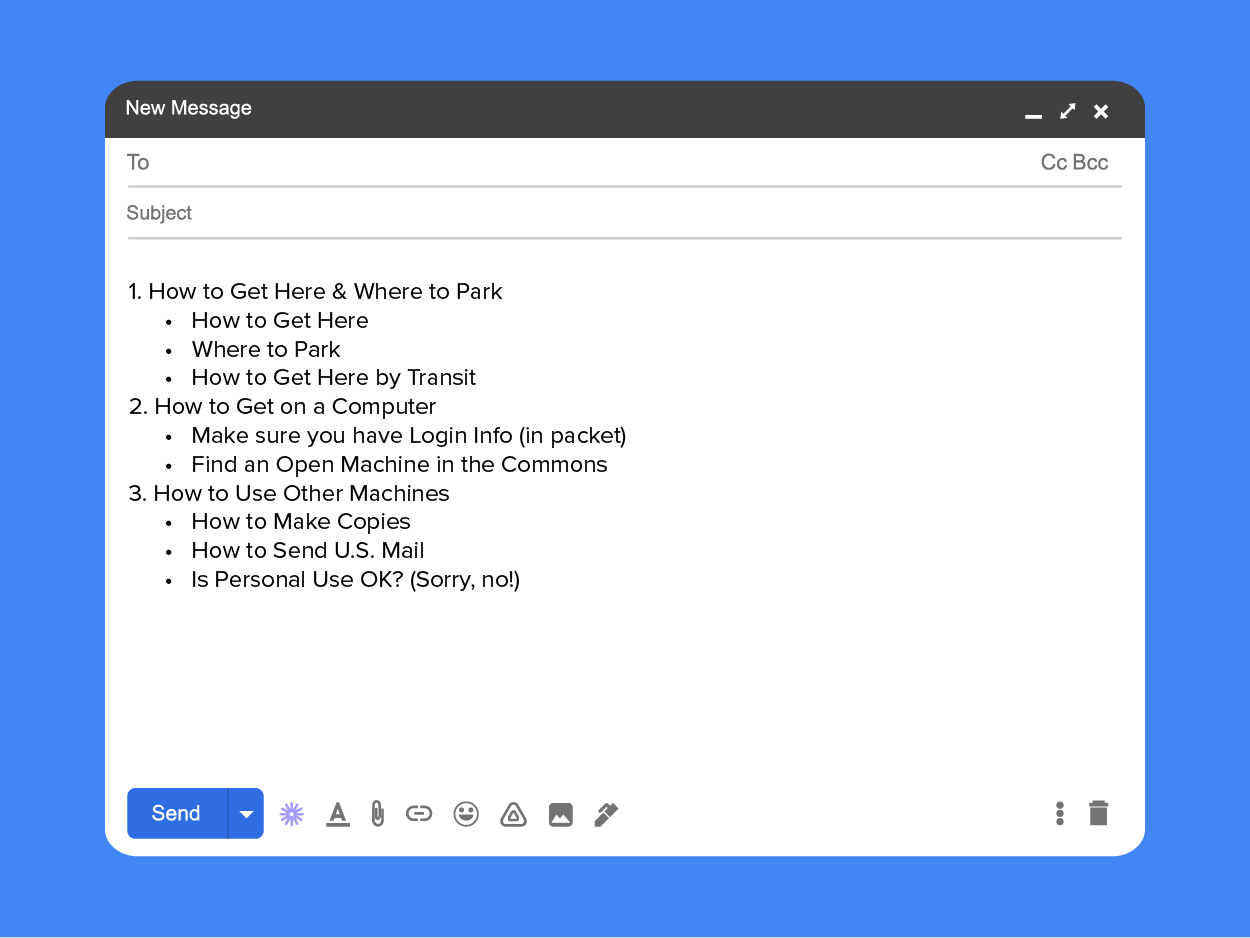
Her outline is still less formal than an outline for an academic or legal document, but sufficient to share with her supervisor and get approval before she gets to work. It will also mean her first draft is less likely to require lots of revisions, because she has established a logical structure and consistency in labeling from the start. Best of all, she doesn’t have to worry about staring at a “blank page,” because she has already generated a lot of content.
Source: This tutorial has been adapted from Lumen Learning's "Business Communication Skills for Managers." Access for free at https://courses.lumenlearning.com/wm-businesscommunicationmgrs. License Creative Commons Attribution 4.0 International.



