Table of Contents |
Personal selling is the one-on-one interaction between a company representative (salesperson) and the buyer (customer or prospect). The interaction is intended for the salesperson to uncover the needs and wants of the prospect and discuss how the product or service will help to satisfy the customer’s needs and wants. The salesperson works to develop a relationship with the prospect with the intention of having them buy the company’s product and become a customer.
IN CONTEXT
Personal selling is one of the most expensive forms of promotion because it is a one-on-one, person-to-person form of communicating with the customer. The role of the salesperson is to inform and persuade the customer. This is usually done in what is termed an exchange situation where the salesperson is exchanging knowledge and something of value and the customer is exchanging money for the item of value. Personal selling is ideal for products that can be customized, are complex, and have a relatively high price point.
Typically, personal selling is most often used in business-to-business (B2B) markets. Business buyers have longer buying cycles, more complex buying situations, and larger budgets. The pharmaceutical industry is well-known for using personal selling. Company representatives must have a high degree of training and knowledge about the products they are selling to physicians and hospitals. It is also very common to have a sales force to sell equipment and machinery to manufacturing plants. Businesses rely on the knowledge and service of the sales force selling them products.
In the business-to-consumer (B2C) market, personal selling is used for items that cost more or items that have a high degree of variation. We find sales representatives when we buy automobiles, home improvement products, and insurance. The job of the sales representative is to determine our needs and provide solutions that fill those needs.
When compared to advertising, which has a very general message directed to a very large audience, personal selling is an individualized message for one or several people within the buying group. When evaluating the costs of personal selling, it is typically hundreds to thousands of dollars per person reached.
While some salespeople have a natural inclination for selling, others are highly skilled with the technical knowledge of the products they are selling. Understanding customers, the buying situation, and the product being sold are a few of the skills needed to master the art of selling.
The promotion mix includes the marketer’s tactics for communicating with consumers. Determining how to use the promotion mix is dependent on the goals and objectives of the overall marketing strategy as well as the nature of the product, the market segments being targeted, and the message the marketer wishes to send.
IN CONTEXT
Generally, marketers will use a combination of the promotion mix tactics to create an integrated approach to connecting with customers. Out of all the promotion mix strategies, personal selling is the strategy that connects directly with the customer in a one-on-one setting and focuses on building relationships. Personal selling is ideal if the product is more complex in nature, higher in price, and customizable according to a customer’s needs.
Relationship selling is a method of personal selling used to better understand the needs and wants of the buyer. If the product is relatively high in price and has some customizable attributes, the salesperson will strive to become a trusted advisor to the customer. This allows the salesperson to develop a relationship that will create trust and ultimately fit the best product with the customer to fulfill their needs and wants and solve a problem they are having that puts them in the market for the product.
EXAMPLE
TalEx, a fast-growing human resource company, works with its clients to find the right talent for open positions at a variety of companies. Sales representatives for TalEx work as trusted advisors to collaborate with clients to help find the right staffing solutions for growing companies.Personal selling is best utilized as a promotional strategy when the products are higher in price, variable in nature, and require some explanation or education. Hilton Grand Vacations (HGV) employs real estate agents to sell club memberships. Due to the variety of membership purchase levels, the explanation and education of how to use the membership, and the higher price of the time-share vacations, the sales force spends time educating clients about the product.
The selling process is a seven-step process used for selling a product. The process can be multifaceted, lengthy, and complex, depending on the product and the prospect. While all salespeople are different, generally most sales professionals go through the same selling process.
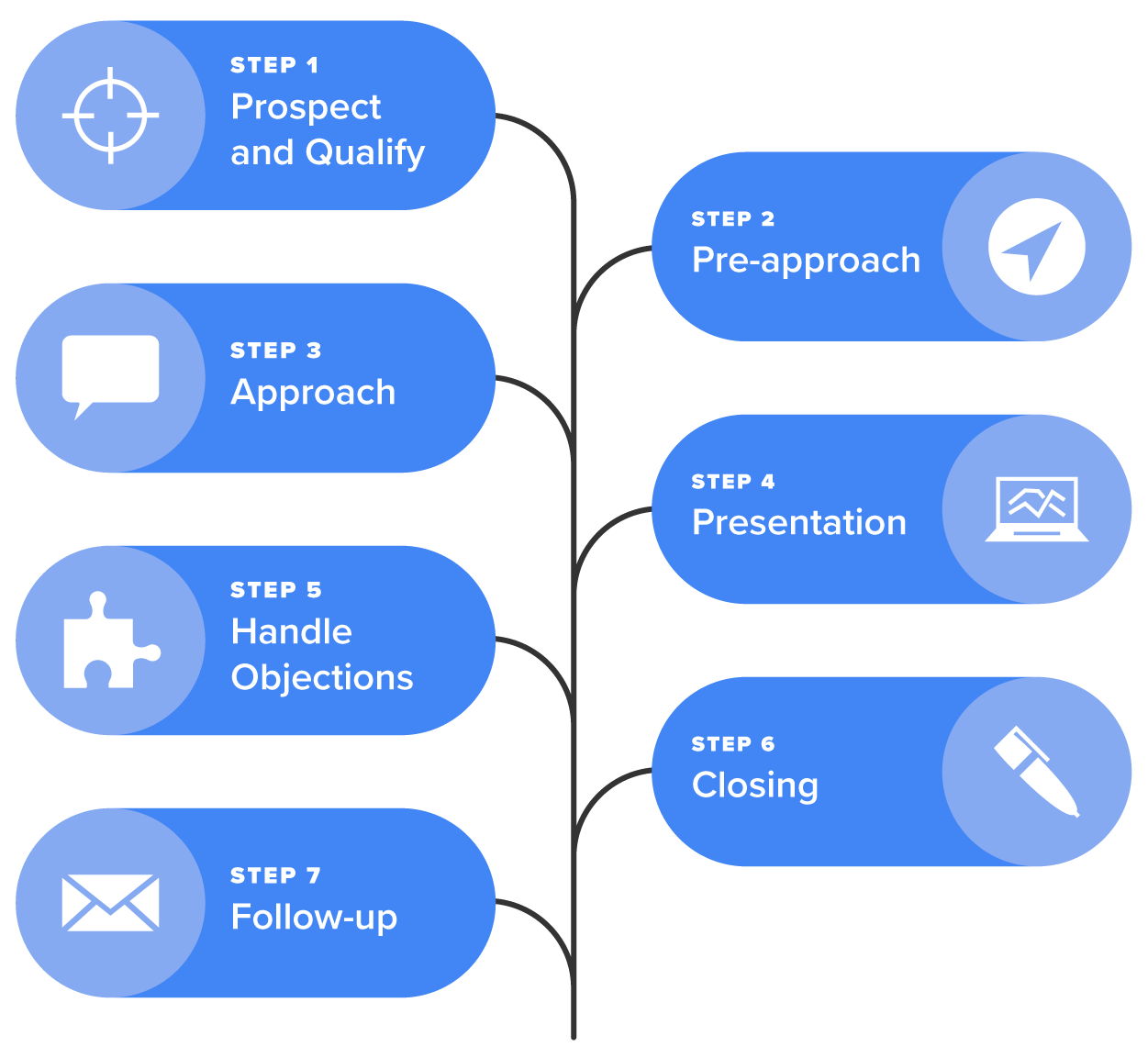
The first step in the sales process is to find, or prospect for, strong potential customers. In prospecting, sales professionals will work to create and develop a database of potential customers, called sales leads, through lead generation. Getting the names and contact information for the database is the act of prospecting. Each business or company has its own methods of prospecting and qualifying. For some companies, the process is rigorous and lengthy; for others, it can be nothing more than a quick phone conversation.
IN CONTEXT
There are many methods of lead generation. Utilizing digital strategies is one example. Many companies may prospect leads through a digital advertising campaign that triggers potential customers to sign up for information about a product. Other forms of prospecting can include meeting potential customers at trade shows, use of a referral program, or purchasing a list of customers from a third-party company that meets the criteria for the target market.
Once the sales professional has a database of leads, the next step is qualification of those leads to determine if they are the right candidates for a company’s products. There are many reasons why a candidate may not be a good fit for a company’s products. For example, some leads may have recently purchased a competitor’s product, and others may not be in a financial position to afford the product. The sales professional wants to reduce the list to include only the leads who are a good fit and are more likely to be receptive to purchasing the company’s products. Qualification may also include making sure the contact has the authority to make the purchasing decision.
You might be asking yourself how a salesperson or company tracks these leads and keeps all the various communication touchpoints organized. They typically have two software tools to help them: sales force automation (SFA) and customer relationship management (CRM) software. Sales force automation software is used to acquire a customer, and customer relationship management software is used to retain and manage customers after the sale.
The pre-approach stage can best be described as a thorough analysis or research of the potential candidate. It is in the pre-approach stage that the sales professional will conduct a very detailed study of the prospect, which will often include information about specific product needs, what current brands they might be using, brand awareness, who the decision makers are, and general knowledge of personal interests and financial standing. The research findings are meant to help the sales professional find out needs and wants as well as the best way to approach the prospect for the sales presentation.
Some of the research that sales professionals seek to review as part of their investigation may include interviews with other clients, financial reports, credit histories, and any sources of public information. Most companies with a sales force and sales process will use robust customer relationship management (CRM) databases to collect, filter, and track prospects through the stages of the sales process. Information that is uncovered during the pre-approach will be added to prospect records in the CRM system.
Information gathered in the pre-approach helps the sales professional during the approach phase to contact the prospect to build rapport and gather more information on the needs and wants of the prospect. During this phase, it is very important for the sales professional to create a positive impression, ask the right questions, and begin building a relationship with the prospect.
Once the prospect has made it through the approach stage, the sales professional is ready to present the product to the prospect. During the presentation stage, the goal is to showcase the features about the product that will be of most benefit to the prospect based on the needs uncovered during the pre-approach and approach stages. Often the presentation may include education on the aspects of the product that the prospect will find most beneficial to solve their problems. This is the time for the sales professional to highlight the benefits of the product and answer questions the prospect might have.
EXAMPLE
College admissions departments work with students to showcase the best of the university in an attempt to persuade them to enroll. Part of the presentation process includes tours of the campus, meetings with current students, attending classes, and experiencing campus life.The best sales professionals are good listeners. Good listening strategies work to build rapport and create winning strategies. When you listen carefully to your prospects, they will tell you exactly how to sell to them. Using information provided by the prospect, a good sales professional will be able to turn it into a winning sale.
Preparation during the qualification, pre-approach, and approach stages of the sale process provides the sales professional with the information they will need to handle objections. In many situations, seasoned sales professionals are able to successfully present the product and answer questions without having objections. Good research on the customer and an understanding of how the product will help them and solve their problems allow the sales professional to avoid objections. However, when the customer does present an objection, the skilled sales professional will need to be agile in handling them.
Asking for the order is perhaps the hardest step in the sales process for many sales professionals. Up to the point of the close, the sales professional has spent a tremendous amount of time and energy with the prospect. Much of the work of the sales professional has been around building a relationship with the prospect.
Many sales professionals fear the possibility of rejection. They also consider that they may get the timing wrong. However, if the sales professional has prepared, they know that asking for the order is the point where they make the prospect a customer.
Source: THIS TUTORIAL HAS BEEN ADAPTED FROM OPEN STAX’S PRINCIPLES OF MARKETING COURSE. ACCESS FOR FREE AT https://openstax.org/details/books/principles-marketing. LICENSE: CREATIVE COMMONS ATTRIBUTION 4.0 INTERNATIONAL.



