Table of Contents |
Perfect competition is a market structure in which there are a large number of buyers and sellers of an identical product. Price and quantity decisions are influenced by the conditions assumed to be true about the market.
A market is said to be perfectly competitive if these four conditions are met:
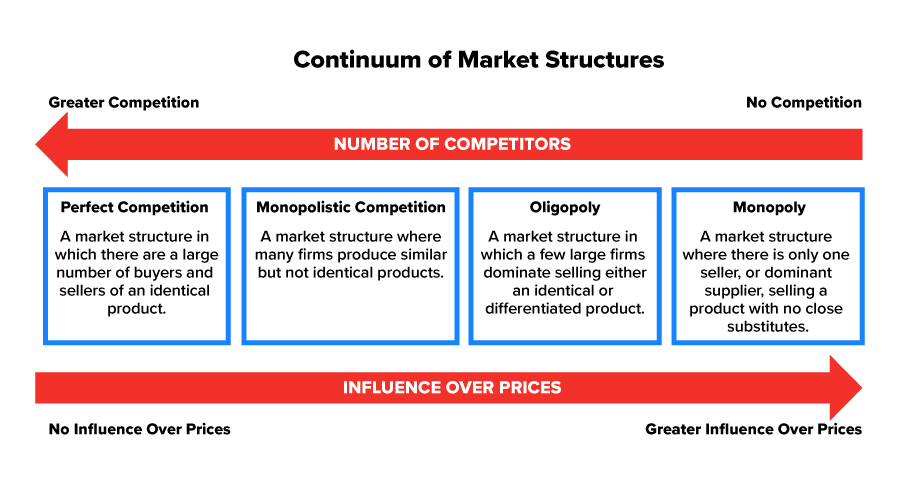
Perfect competition is on the far left of the continuum of market structures graphic below. Notice that in a perfectly competitive market, a firm faces the greatest competition and has no influence over pricing.
In a perfectly competitive market, there are a large number of buyers and sellers in the market. Each buyer and seller represents a tiny fraction of the total market quantity, such that no individual buyer nor firm exercises market power. Market concentration is low, which means that the market, rather than the firm, determines product price.
The firm’s pricing behavior is characterized as price-taking, given its horizontal demand curve. A perfectly competitive firm is known as a price taker, because market supply and demand will determine the market price–both buyers and sellers take the price offered by the market. Graphically, the market equilibrium price occurs where the supply and demand curves intersect. The firm sells more or less output without affecting the equilibrium price, therefore, the firm has a horizontal demand curve. An individual firm has many competitors selling identical products at the market-determined price. Raising prices above this equilibrium price, however, will cause sales revenue for the firm to plunge to zero. Each firm makes its own decisions about output independent of any other firm in the market.
IN CONTEXT
Tropicana Premium Fresh oranges are grown in the United States, Chile, South Africa, Spain, and Uruguay. Tropicana purchases oranges in bulk from orange growers. A single orange grower has no influence over the price even if the grower believes their oranges are sweeter than all other growers’ oranges. Tropicana has contracts with these orange farmers, and if any one farmer says they are not taking the going price, then Tropicana will simply switch its purchases to other growers. There are many orange sellers from which Tropicana can choose.
So, what does this mean? It means there is only one price for these oranges. Demand for oranges by Tropicana is perfectly elastic, which you learned about in Challenge 2.1 on elasticity, and in Challenge 2.5 on firm revenue. There is one horizontal demand curve at the equilibrium price in a perfectly competitive market. Growers are price takers. Selling a higher or lower volume has no effect on the going price.
In a perfectly competitive market there are a large number of firms in the market selling identical products, which means that buyers do not distinguish between vendors and vendor products. An Idaho potato grown by one farmer is indistinguishable from any other vendor’s Idaho potato.
In a perfectly competitive market it is easy to enter and exit the market, because there are no barriers. A barrier is anything that makes it difficult to get in or get out of that industry. Barriers to entry are present in other market types, but not in perfect competition. A barrier to entry might be a legal, technological, or a market force that discourages or blocks potential competitors from entering a market. In any market with barriers, the barriers protect the profits of established firms.
EXAMPLE
Occupational licenses are barriers to entry. Occupational licenses are state-issued credentials that a worker must possess to work in certain jobs as an athletic trainer, commercial fisherman, or barber. These affect about 25% of the U.S. labor force. A 2019 study conducted by CATO, a research institution, concluded that occupational licensing reduces labor supply by an average of between 17% and 27%. Restricting the number of persons entering an occupation helps keep wage rates higher for those already in the field.In a perfectly competitive market neither buyers nor sellers have a competitive information advantage. All parties in a transaction are in possession of the same information. This is characterized as symmetric information. Symmetric information is also referred to as perfect information. All buyers and all sellers are assumed to know everything needed to make the best choices, because they have the same information about the product and pricing. Markets with symmetric information allocate resources efficiently.
In this lesson you learned about the characteristics of a perfect competition market structure. To recap, a market is said to be perfectly competitive if there are a large number of sellers and buyers of the product, there are no barriers to entry, all firms in a market sell identical products, and all buyers and sellers have perfect or symmetric information about the products and pricing. Firms operating in perfectly competitive markets have no market power and are price takers. The following table summarizes the characteristics of the perfect competition market structure.
| Characteristic | Perfect Competition |
|---|---|
| Number of Sellers | Large |
| Barriers to Entry | None |
| Nature of Product | Identical |
| Information | Perfect (Symmetric) Information |
| Market Power | None |
| Pricing Power | Price Taker |
| Demand Curve | Horizontal |
| Example | Green bell pepper sellers at farmer's market |
Source: THIS TUTORIAL HAS BEEN ADAPTED FROM OPENSTAX “PRINCIPLES OF ECONOMICS 2E”. ACCESS FOR FREE AT https://openstax.org/books/principles-economics-2e/pages/1-introduction. LICENSE: CC ATTRIBUTION 4.0 INTERNATIONAL.
REFERENCES
Blair, P. Q., & Chung, B. W. (2019, May 1). How Much of a Barrier to Entry Is Occupational Licensing? Cato.org. Retrieved July 25, 2022, from www.cato.org/research-briefs-economic-policy/how-much-barrier-entry-occupational-licensing



