Use Sophia to knock out your gen-ed requirements quickly and affordably. Learn more
×

Paying Taxes: Individual Income Taxes

Author: Sophia

what's covered
In this lesson, you will learn about income taxes, the sections of a federal income tax return, how to file a return, and how to determine if you would owe a payment or receive a refund. This lesson provides suggestions to help you prepare your tax return and supplement resources to help estimate withholding amounts and complete a withholdings certificate. Specifically, this lesson will cover the following:

Table of Contents

1. Types of Taxes

The income you earn is taxed by the government to raise money for federal programs and services. In the United States, federal, state, and municipal governments impose taxes, and you may be subject to all three. How? You may live in one state and work in another.

EXAMPLE

Many people live in Virginia or Maryland but commute to work in Washington, D.C. Or you may live in one town (also called municipality) and work in the neighboring town. States, such as Virginia and Washington, D.C., have an arrangement so that you are not paying income taxes in both states, so do not fear.

Most income-earning adults must pay taxes; however, if you earn income below a certain level, you do not have to pay taxes, but you do need to file an income tax return. People with higher incomes pay more taxes since income tax is a progressive tax, meaning as your income rises, you pay more taxes at a higher tax rate. Similarly, if you examine income tax rates, the percentage increases as the income increases. The categories are called tax brackets.
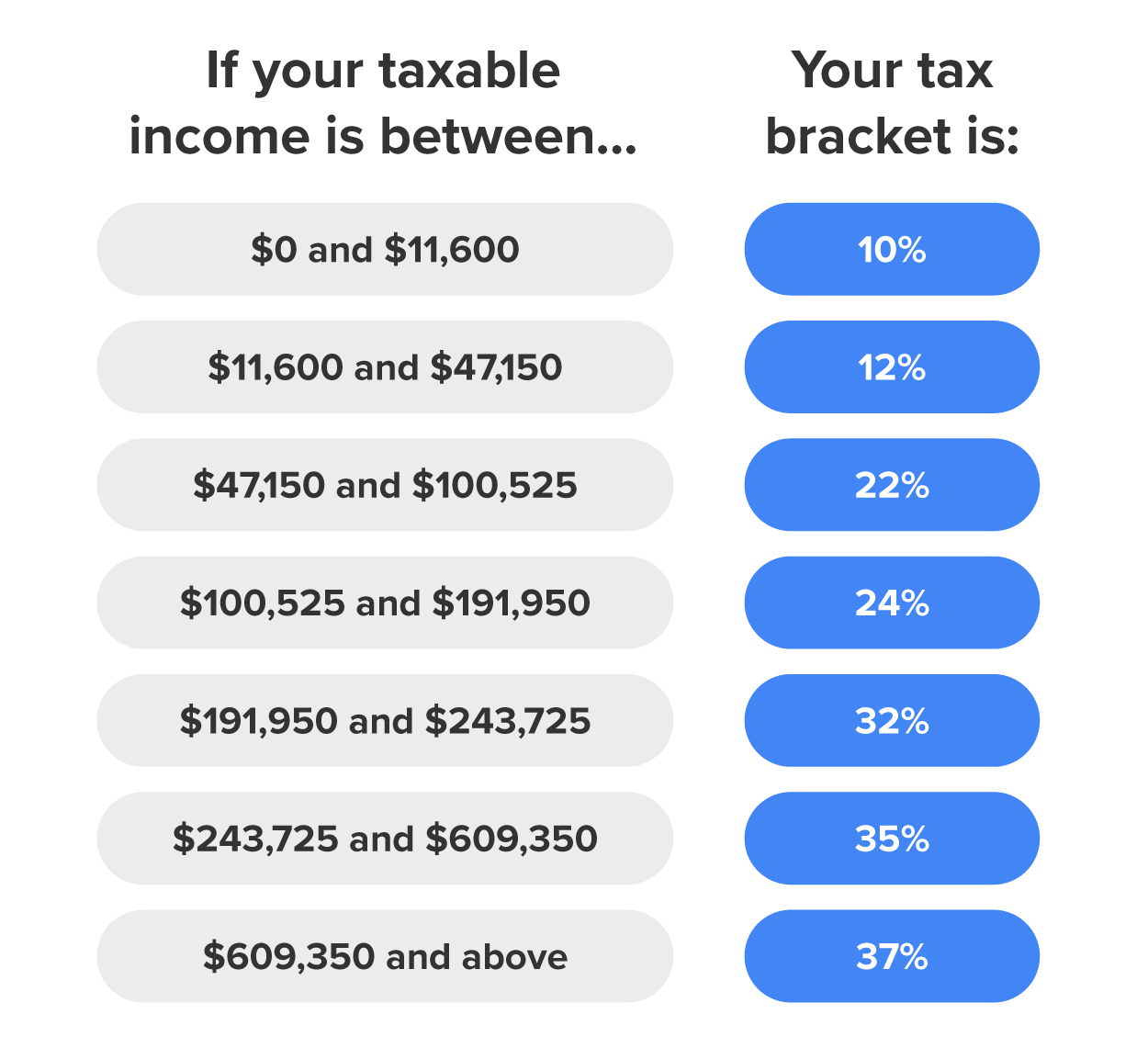
The image is a table outlining the U.S. federal tax brackets for the year 2024 for individuals with a filing status of “Single.” It provides information on how different ranges of taxable income correspond to specific tax rates. For taxable income between $0 and $11,600, the tax rate is 10%. For income between $11,600 and $47,150, the tax rate is 12%. Income between $47,150 and $100,525 falls into the 22% tax bracket. If your income is between $100,525 and $191,950, you are in the 24% tax bracket. The 32% tax rate applies to income between $191,950 and $243,725. For income between $243,725 and $609,350, the tax rate is 35%. Finally, for any income above $609,350, the tax rate is 37%.
2024 U.S. federal income tax brackets (single)

learn more
If you would like more information about tax brackets, check out this Moneychimp page.

EXAMPLE

Let us calculate the tax on income of $65,000 to see how progressive income taxes work:

Note: This tax bracket information was collected in 2024 (mid-year). Keep in mind that tax brackets can change from year to year, so make sure you look for the most up-to-date information. However, the year used for this example allows you to understand tax brackets to calculate income taxes.

The first $11,600 is taxed at 10%, while the next $35,550 (47,150 − 11,600) is taxed at 12%, and the remaining $17,850 ($65,000 − $47,150) is taxed at 22%. So, your total income tax amount is the sum of these incremental taxes, or $9,353, calculated below.

Tax Bracket Bracket Amount Taxed Tax % Tax Amount
($11,600 − 0) $11,600 .10 $1,160
($47,150 − $11,600) $35,550 .12 $4,266
($65,000 − $47,150) $17,850 .22 $3,927
Total Income Tax $9,353

Your official tax bracket or rate is the percentage that you pay on your last dollar of taxable income, or 22% in the situation above.


try it
Your turn. See if you can calculate income tax in this scenario. To check if you are correct, select the “+” icon to drop the answer down.

Emma, a 30-year-old graphic designer, lives in New York City and just got offered a job that earns her $80,000 annually. To be able to plan a budget, she decides to calculate her taxes using the progressive tax rates to see how much federal income taxes will be withheld from her pay.
To calculate the federal tax on an income of $80,000 using the progressive tax rates, Emma breaks her income down into the amounts taxed at different tax rates and calculates the tax for each bracket:

Tax Calculation:
Tax Bracket Bracket Amount Taxed Tax % Tax Amount
($11,600 − 0) $11,600 .10 $1,160
($47,150 − $11,600) $35,550 .12 $4,266
($80,000 − $47,150) $32,850 .22 $7,227
Total Income Tax $12,653


Emma’s total income tax amount is $1,160 + $4,266+ $7,227 = $12,653.

Emma’s official tax bracket or rate is the percentage she pays on her last dollar of taxable income, which in this case is 22%.

key concept
Taxes are paid on:

  • Wages
  • Salary
  • Interest, dividends, and gains from selling assets
  • Self-employed income from a business
  • Rental property
  • Royalties (income from books or other items you author or create)
  • “Other” income, such as alimony, winnings (such as the lottery), prizes, or company gifts.

The state and local governments also impose a sales tax (or consumption tax) on food, clothing, and housing. States also charge an excise tax on items, such as alcohol, cigarettes, autos, fuel, and highway use.

States, municipals, and counties also charge property taxes on real estate (land and buildings) and personal assets, such as auto, all-terrain vehicles, and boats.

“Nothing is certain except death and taxes.”
Benjamin Franklin (1789)

Then, there are estate taxes paid at death on the value of the wealth transferred to living beneficiaries. We will learn more about minimizing estate taxes in a later lesson.

terms to know
Progressive Tax
A rate or percentage of income paid to the U.S. government that rises as your income increases.
Tax Bracket
A category or range of income to which an income tax rate is charged.
Sales Tax
A charge on food, clothing, and housing imposed on purchases by state and local governments. Also known as a consumption tax.
Excise Tax
A charge on items, such as alcohol, cigarettes, autos, fuel, and the use of highways, imposed by state governments.
Property Tax
A charge on real estate (land and buildings) and personal assets, such as auto, all-terrain vehicles, and boats, imposed by states, municipalities, and counties.
Estate Tax
A charge paid at death on the value of the wealth transferred to living beneficiaries.


2. Filing a Federal Income Tax Return

Income tax is an essential part of personal financial planning since federal income taxes decrease wealth and affect you at every life stage. Income tax returns are submitted as a(n):

  1. Individual or family unit
  2. Corporation
  3. Nonprofit corporation
  4. Trust
Although all taxable entities are required to file an income tax return every year, individuals with low incomes and not-for-profit organizations (such as charities or academic institutions) do not pay taxes. Corporations earn income, and their profits are taxed under corporate tax rates that are different from individual tax rates. However, corporations may pay dividends to stockholders, which represents income that is taxable on the individual’s personal income tax return. Similarly, any monetary distributions from a trust must be reported as taxable income on the individual’s personal tax return. A trust is an account that holds stocks, bonds, life insurance, property, and more and is professionally managed for the benefit of a beneficiary.

The amount of taxes due depends on your filing status as one of the following:

  • Single: This includes people who have never been married, widowed, or divorced.
  • Married Filing Jointly: Two adults file as one “individual” by combining their taxable incomes, deductions, exemptions, and credits.
  • Married Filing Separately: Two married adults file separate tax returns of their own taxable incomes, deductions, exemptions, and credits.
  • Head of Household: One adult files but claims family members as dependents.
An overview of the topics that follow is provided in the table below. The total taxable income from all sources, or gross income, is shown at the top, minus deductions to determine taxable income. The tax rate is then applied to taxable income to determine the tax liability, from which prior payments are subtracted to equal the final tax amount due to the Internal Revenue Service (IRS) or the refund to be paid back to the individual.

Basic Income Tax Overview

Gross Income
-Deductions to Obtain Adjusted Gross Income
Adjusted Gross Income (AGI)
-Either: Standard Deduction or Itemized Deductions
Taxable Income
-Less Taxes
Income Tax Liability
-Tax Credits
-Tax Payments (Withholding or Quarterly Estimates)
Net Tax Due or Refund

When filing personal individual income taxes, if you have basic income and minimal deductions, you may only need to file Form 1040 and no schedules, known as supplemental tax forms, included in your tax return filing. Next, we will look at U.S. Federal Income Tax Form 1040 to learn about each section and what information is needed if your financial situation is more complex.
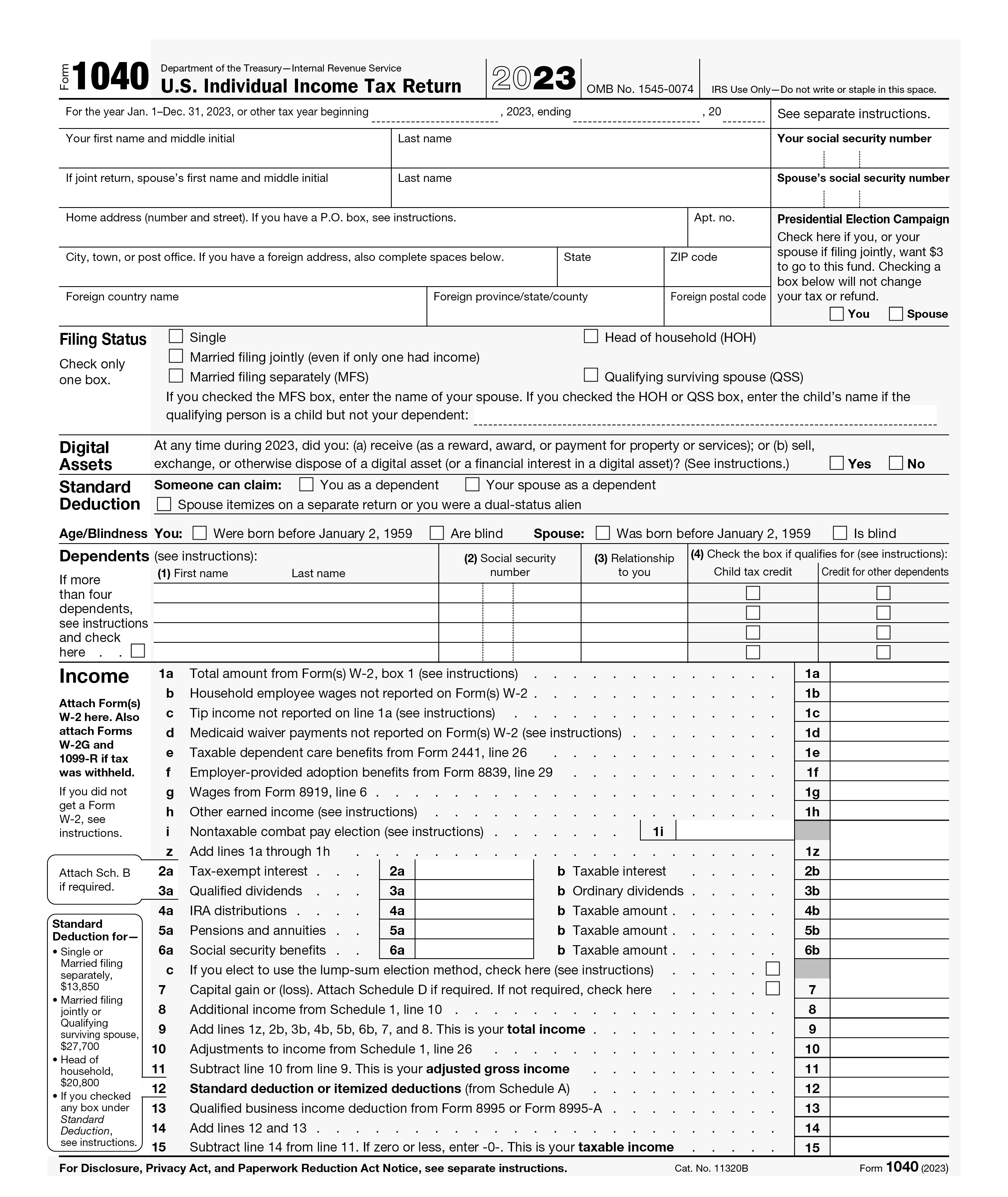
An image of the front page of the 2023 U.S. Federal Individual Tax Form 1040.
U.S. Federal Individual Tax Form 1040 (2023, front)

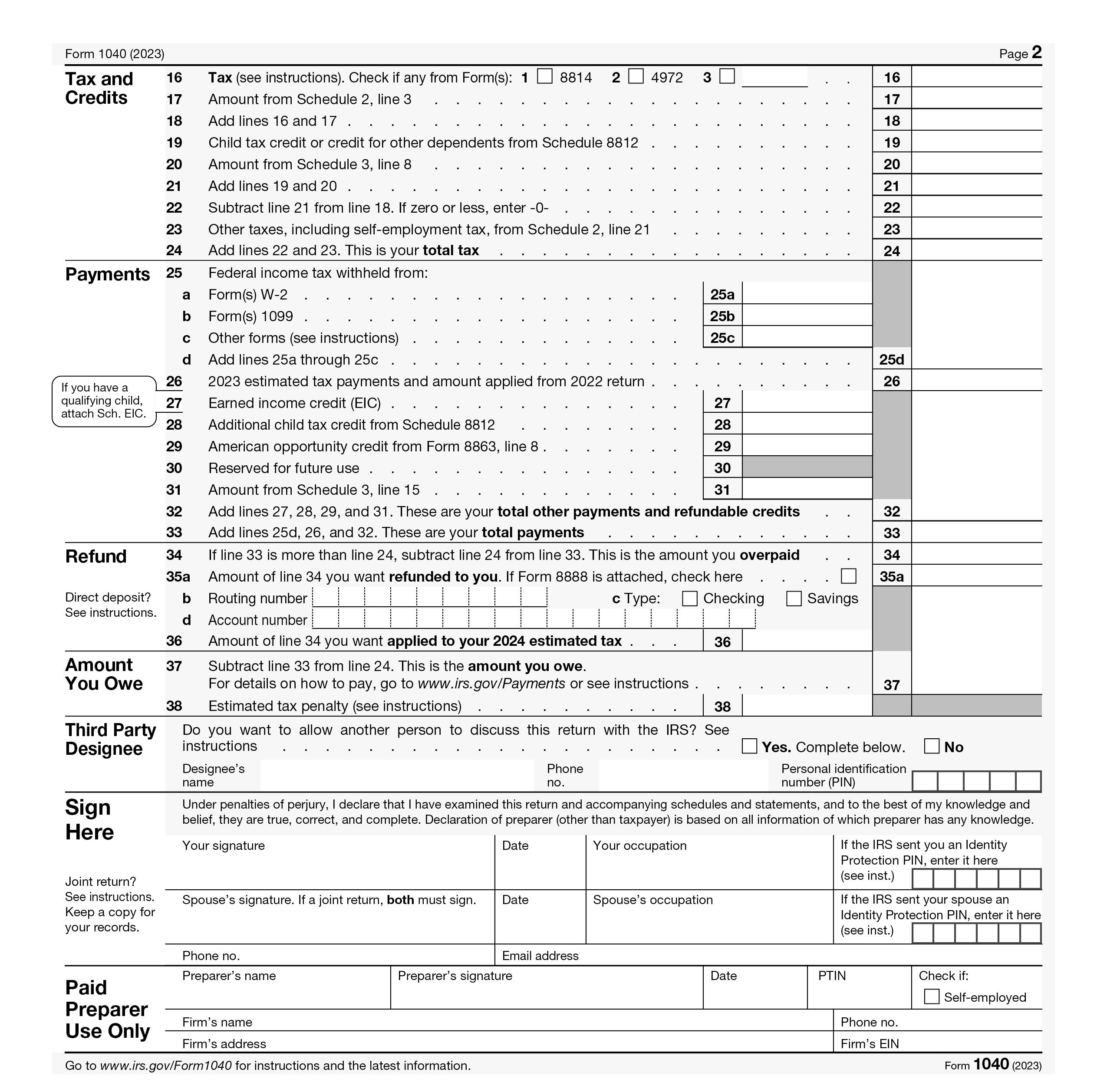
An image of the back page of the 2023 U.S. Federal Individual Tax Form 1040.
U.S. Federal Individual Tax Form 1040 (2023, back)

learn more
To see the previous year’s Form 1040 U.S. Individual Income Tax return (downloadable as a PDF), visit Forms & Instructions | Internal Revenue Service.

Note: It may be helpful for you to download Form 1040 and follow it as you read the sections of it below.

Income

Income from all sources must be reported on the 1040 form in Section 1, and specific types of income or expenses must also be reported on a separate schedule. Depending on your financial situation, you may need to complete a few separate schedules when filing your tax return; however, you should only complete those that apply to you. Examples of these schedules are if you have any interest or dividend income (Schedule B), business income (Schedule C), self-employment income (Schedule SE), or capital gains or losses from investments (Schedule D). There are other schedules as well for less common types of income.

After all income is reported on the 1040 form, the next step in filing taxes is to subtract several deductions from your taxable income. Also, note that nontaxable income that should not be taxed is removed. These two items are explained below:

Taxable Deductions

Deductions from your total income that lower your taxable income include alimony, business use of your car, expenses of teachers and individuals in the military reserves, contributions to health savings and retirement accounts, some self-employment taxes, interest on student loans, charitable donations, home mortgage interest, and more. See the IRS.gov website for a full list.

Nontaxable Income

Examples of income that is not taxable are:

  • Welfare benefits
  • Interest from some municipal bonds
  • Small personal gifts
  • Most inheritances
  • Workers’ compensation
  • Veterans’ benefits
  • Federal tax refunds
  • Some scholarships and fellowships
learn more
Refer to the IRS.gov website for a detailed list.

By excluding the nontaxable income from your total income, your adjusted gross income (AGI), or taxable income after allowable deductions, becomes lower and reduces the amount of taxes you will pay.

terms to know
Trust
An account that holds stocks, bonds, life insurance, property, and more and is professionally managed for the benefit of a beneficiary.
Adjusted Gross Income (AGI)
Taxable income after the subtraction of allowable deductions.

2a. Standard or Itemized Deductions, Exemptions, and Credits

In addition to the above deductions that decrease your taxable income, an additional deduction is available for individuals who are disabled. There are also credits that reduce your income before taxes further; however, some are allowed only if their sum is above a certain percentage of your income. These deductions are listed in Line 12 of the tax return.

Which Should I Choose: Take a Standard Deduction or Itemize?

When determining your taxable income, you can either take a standard deduction, a fixed amount determined by the government that reduces your taxable income, or you can itemize your deductions, which involves detailing each allowable expense or exemption to be subtracted from your taxable income before taxes are calculated. The best decision is to choose whichever is the largest deduction to lower your taxable income. Most taxpayers choose the standard deduction. However, if you are a homeowner or a business owner or have many other deductions, you may have a lot of allowable deductible expenses. If your deductible expenses are greater than the standard deductions below, then you should consider itemizing.

As a reference, the standard deductions in 2024 for all filers are as follows:

  • Single or married filing separately: $14,600
  • Married filing jointly or qualifying surviving spouse: $29,200
  • Head of household: $21,000
learn more
For the current year’s standard deduction amounts, refer to the IRS.gov website.

Credit for Dependents

Within the section titled “Tax and Credits,” taxpayers receive a deduction from their taxable income or an exemption (credit) based on the number of dependents, known as a child tax credit or credit for a dependent. Dependents are children, elderly parents, or disabled siblings who rely financially upon you and are unable to care for themselves. After all deductions and exemptions are subtracted from adjusted gross income, the balance is the taxable income, upon which taxes are calculated.

terms to know
Standard Deduction
A fixed amount determined by the government that reduces your taxable income on Form 1040.
Itemize (Deductions)
To detail each allowable expense or exemption that is subtracted from your income before taxes are calculated.
Exemption (Credit)
A deduction from taxable income that taxpayers receive on Form 1040 based on the number of dependents.
Dependents
Children, elderly parents, or disabled siblings who rely financially upon you and are unable to care for themselves.
Taxable Income
The balance on which taxes are calculated after all deductions and exemptions are subtracted from the adjusted gross income.

2b. Payments and Refunds

In the section titled “Payments,” the total amount of tax payments you have paid over the year is entered. The amount of taxes you have already paid is based on the W-4 that you completed prior to work. The W-4 indicates the number of dependents you plan to declare on your end-of-year tax return and determines the amount of money that is withheld from each pay period as payment toward the total tax amount due annually at the end of each year. As an added note, you can alter the number of dependents at any time.

learn more
If you want to learn more about withholding amounts or how much money will be taken out of your paycheck, you can find an estimated withholding amount based on your income tax filing status (single, married filing jointly or separately, or head of household) at the IRS website.

Visit Publication 15-T (2024), Federal Income Tax Withholding Methods | Internal Revenue Service (IRS.gov). In the table of contents on the left, select Percentage Method Tables for Automated Payroll Systems and Withholding on Periodic Payments of Pensions and Annuities.

If you would like more information on the W-4 or Employee’s Withholding Certificate, visit 2024 Form W-4 (irs.gov).

Notes on the W-4:
  • Steps 1 and 5: These steps must be completed. Steps 2, 3, and 4 are optional unless they apply to you.
  • Step 2: Complete this step if you work multiple jobs or your spouse/partner also works and you plan on filing jointly.
  • Steps 3 and 4: Claim your dependents and make any adjustments needed.

did you know
Some individuals declare a higher number of dependents so they can ensure they have enough money to pay their taxes when they file their returns. However, keep in mind that this causes your take-home paycheck to be lower. Other people prefer to declare no dependents and receive their full pay so they can invest the money until taxes are due.

Over the year, you will pay federal, state, and local income taxes as withholdings from your paychecks. However, if you are self-employed, you must make quarterly estimated tax payments. If your self-employment income is large, you must ensure the federal, state, and local estimated payments are not lower than your current year’s estimated income or past year’s taxes; otherwise, you may be subject to a penalty plus interest. Keep in mind that withholdings are used in part to fund your future Social Security and Medicare benefits in later years.

key concept
A tax refund is the return of your money overpaid to the IRS throughout the year by withholding more than you owe. Conversely, if you owe more taxes when you file, then you are not withholding enough each pay period.

The deadline for filing your tax return and payment is April 15 of the year following the tax year ending on December 31. You may request an extension until October 15, but if you miss a deadline without filing for an extension, you will owe penalties and interest even if you expect to receive a refund.

At the end of each year, the tax process starts again as employers must send Form W-2 to each employee, detailing all wages earned and withholdings. You may also receive a Form 1099 from your bank showing the interest and dividends you earned or other 1099s that report income from part-time labor or a retirement fund. Remember, all income must be reported on your tax return. The IRS will check the accuracy of your tax filing by comparing your reported wages against the amount reported by your employer, bank, or other institutions that pay you.

terms to know
Form W-2
A statement detailing all wages earned and withholdings that employers are required to send to each employee at the end of the year.
Form 1099
A statement from a bank showing the interest and dividends earned or other income from part-time labor or a retirement fund.

2c. Help With Tax Return Preparation and Filing

Help is available, but, first, be sure to keep all receipts, bank statements, asset purchases, and detailed records of anything you intend to claim as proof of deductible expenses. Deductible expenses must be provable, so it is critical that you keep receipts of your expenses. If you do not know where to start, are afraid of making a mistake, or prefer to have a professional complete your tax return, there are many professional tax preparers available to you. Many tax preparers are personal financial planners, accountants, or financial institutions that can prepare your tax return and help with financial advice.

A certified public accountant (CPA) has received special training and passed exams to earn certification. If your financial situation involves a business or trusts, you should consult an expert who can help file your return. A professional can also help you if the IRS has questions about your income, deductions, or both. It is wise to use a professional if you have a complicated tax filing or substantial wealth since the extra tax schedules needed when filing can be confusing and must be accurate. In addition, there are also several apps that help you keep track of expenses and even help you file your tax return by asking you questions that guide you through Form 1040 and the supplemental schedules. Once your 1040 form is complete, you should print it and then submit it by mail or “e-file” directly with the IRS.

After you submit your tax return, it is reviewed by the IRS for accuracy. Next, you will receive a refund if you overpaid, or your payment will be processed if you owe more taxes. The IRS will flag any returns that contain errors and investigate all differences between the income you report and those reported by your employer. Other red flags that cause the IRS to question the accuracy of your return are high deductions for expenses or charitable donations. If the IRS decides to conduct an audit, this means it will thoroughly investigate the claims on your tax return and require you to submit additional information either by mail or in a personal interview. Financial strategies that minimize or avoid taxes are legal; however, tax evasion, or intentionally reporting inaccuracies, such as understating incomes and gains or overstating expenses and losses, is illegal. This is why keeping detailed records is so important.

Keep a record of your tax return by printing a copy if you completed it electronically or used an app and file the paper copy along with a printout of all detailed expenses and income, as well as all paper receipts, in a clearly labeled file. If records are saved in a cloud storage space, print the records in case the cloud storage becomes corrupt or your files are no longer accessible due to software updates or other technology issues. A general rule is to keep all tax records for 6 years in case the IRS needs to see prior years’ records as part of the audit.

terms to know
Certified Public Accountant (CPA)
An individual who has received special training and passed an exam to earn certification.
Audit
When the IRS thoroughly investigates the claims on your tax return and requires you to submit additional information either by mail or in a personal interview.
Tax Evasion
Intentionally reporting inaccuracies on an income tax return that are illegal, such as understating incomes and gains or overstating expenses and losses.

summary
In this lesson, you learned about the types of income taxes and filing a federal income tax return, including the sections on taxable deductions, exemptions, and credits as well as where tax payments are entered to determine if you owe payment or will receive a refund. Suggestions for finding help in preparing and filing your tax return were provided.

Source: THIS TUTORIAL WAS AUTHORED BY SOPHIA LEARNING. PLEASE SEE OUR TERMS OF USE.

Terms to Know
Adjusted Gross Income (AGI)

Taxable income after the subtraction of allowable deductions.

Audit

When the IRS thoroughly investigates the claims on your tax return and requires you to submit additional information either by mail or in a personal interview.

Certified Public Accountant (CPA)

An individual who has received special training and passed an exam to earn certification.

Dependents

Children, elderly parents, or disabled siblings who rely financially upon you and are unable to care for themselves.

Estate Tax

A charge paid at death on the value of the wealth transferred to living beneficiaries.

Excise Tax

A charge on items, such as alcohol, cigarettes, autos, fuel, and the use of highways, imposed by state governments.

Exemption (Credit)

A deduction from taxable income that taxpayers receive on Form 1040 based on the number of dependents.

Form 1099

A statement from a bank showing the interest and dividends earned or other income from part-time labor or a retirement fund.

Form W-2

A statement detailing all wages earned and withholdings that employers are required to send to each employee at the end of the year.

Itemize (Deductions)

To detail each allowable expense or exemption that is subtracted from your income before taxes are calculated.

Progressive Tax

A rate or percentage of income paid to the U.S. government that rises as your income increases.

Property Tax

A charge on real estate (land and buildings) and personal assets, such as auto, all-terrain vehicles, and boats, imposed by states, municipalities, and counties.

Sales Tax

A charge on food, clothing, and housing imposed on purchases by state and local governments. Also known as a consumption tax.

Standard Deduction

A fixed amount determined by the government that reduces your taxable income on Form 1040.

Tax Bracket

A category or range of income to which an income tax rate is charged.

Tax Evasion

Intentionally reporting inaccuracies on an income tax return that are illegal, such as understating incomes and gains or overstating expenses and losses.

Taxable Income

The balance on which taxes are calculated after all deductions and exemptions are subtracted from the adjusted gross income.

Trust

An account that holds stocks, bonds, life insurance, property, and more and is professionally managed for the benefit of a beneficiary.

