In this lesson, you will explore the world of particle physics and uncover how scientists study the smallest building blocks of matter. Specifically, this lesson will cover:
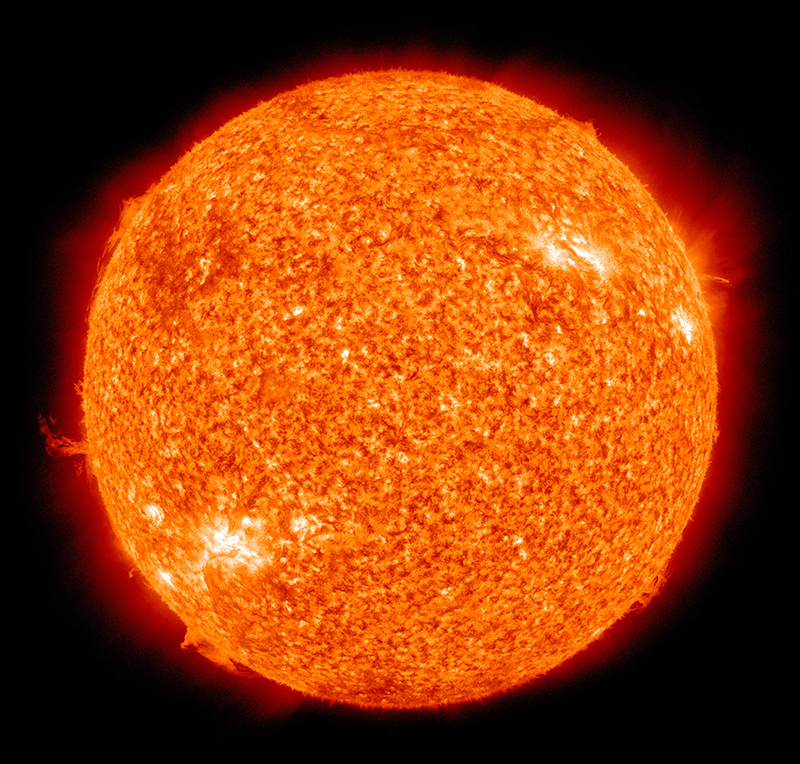
Particle physics is the study of the smallest building blocks and the rules they follow. What makes it fascinating is that these rules don’t always match our everyday experience. At very small scales, particles can behave like waves, energy comes in packets, and forces work through fields we can’t see. By understanding these tiny ingredients and how they interact, particle physics helps explain big questions—like why atoms hold together, why some materials conduct electricity, and what powers the Sun.
1a. Evolution of Particle Physics
The ancient Greeks believed that if you kept cutting matter into smaller pieces, you would eventually reach something that could not be divided: an “atom.” Today, we know that atoms are not the smallest pieces. They have their own parts: electrons orbiting a nucleus made of protons and neutrons. Later, scientists discovered that even protons and neutrons are made of smaller particles called quarks. Every time we think we have reached the smallest building block, we find something even smaller.
Atomic physics studies atoms, the basic units of elements and compounds. Nuclear physics looks inside the nucleus, where protons and neutrons live. Particle physics goes even deeper, and it’s the branch of physics that studies the smallest pieces of matter and the forces that act between them. These particles might be the true building blocks of everything in the universe. But, will we ever find the smallest piece that cannot be divided? Or, will there always be something smaller waiting to be discovered? That’s the mystery scientists are exploring today.
Particle physics is not just about tiny things. It connects to the biggest questions in the universe. How did the universe begin? Why does matter exist? Could the smallest particles explain the largest structures, like galaxies? This journey can be more exciting than science fiction because it’s real, and we are still writing the story.
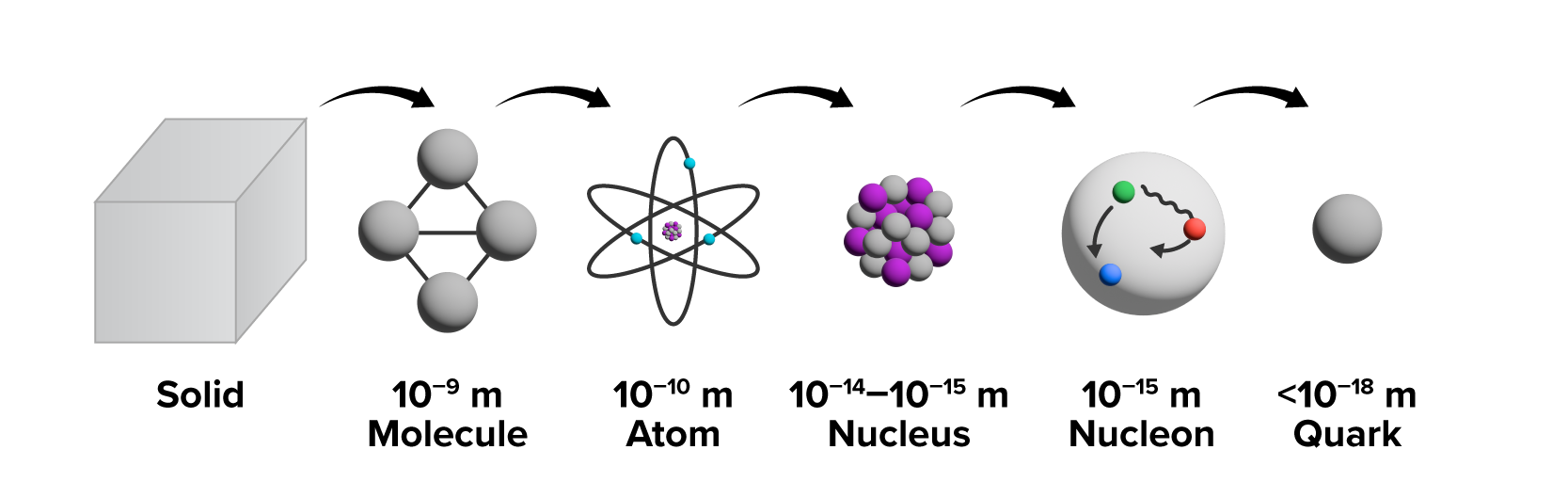
Matter is built in layers: molecules are made of atoms, atoms contain a nucleus with electrons, and nuclei are made of protons and neutrons. Protons and neutrons are composed of quarks. Quarks and electrons may be the most basic building blocks of everything, though scientists continue to search for even deeper structures.
IN CONTEXT Vera Rubin and the “Missing Mass” Problem (Dark Matter)
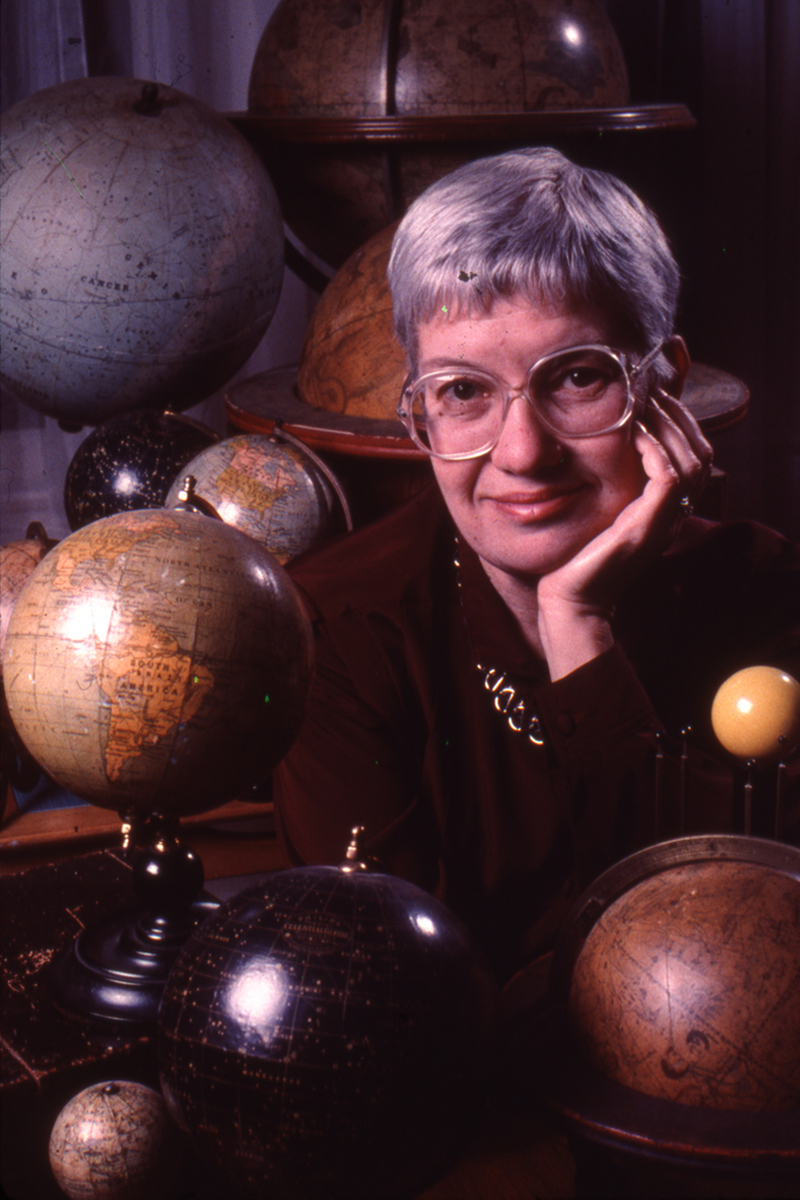
Rubin circa 1985
In the 1970s, astronomer Vera Rubin helped reveal one of the biggest mysteries modern particle physics is still trying to solve. By measuring how fast stars orbit in spiral galaxies, Rubin found that the outer stars move much faster than they should if the galaxy’s mass were only the matter we can see (stars, gas, and dust). Instead of slowing down with distance, the galaxies’ “rotation curves” stayed unexpectedly high—strong evidence that galaxies contain far more mass than is visible.
This connects directly to particle physics because one leading explanation is dark matter: invisible matter that does not emit or reflect light but still exerts gravity. If dark matter is made of new, undiscovered particles, then understanding the universe’s “building blocks” requires more than atoms, protons, and electrons—it requires finding what dark matter is made of. That’s why particle physicists use detectors deep underground, particle accelerators, and space-based instruments to search for particles that could account for Rubin’s missing mass.
terms to know
Quarks
Tiny particles that make up protons and neutrons.
Particle Physics
The branch of physics that studies the smallest pieces of matter and the forces that act between them.
1b. The Yukawa Particle
Imagine trying to figure out how invisible forces, like gravity or magnetism, actually work. For a long time, scientists used only the idea of fields to explain this, and that picture is still incredibly important. But in 1935, a physicist named Hideki Yukawa had a bold new idea: What if forces are carried by particles?
Think of it like playing catch. If you throw a ball to someone, the ball transfers energy between you. Yukawa suggested that forces work the same way by exchanging tiny “carrier particles,” which are tiny bits that mediate fundamental forces in nature. For the strong nuclear force (the force that holds protons and neutrons together in the nucleus), Yukawa predicted a new particle called the pion a type of subatomic particle that acts as a carrier of the strong nuclear force. This particle would pop into existence for a tiny fraction of a second, travel between the proton and neutron, and then disappear. These short-lived particles are called virtual particles because we can’t see them directly, but we know they exist because of their effects.
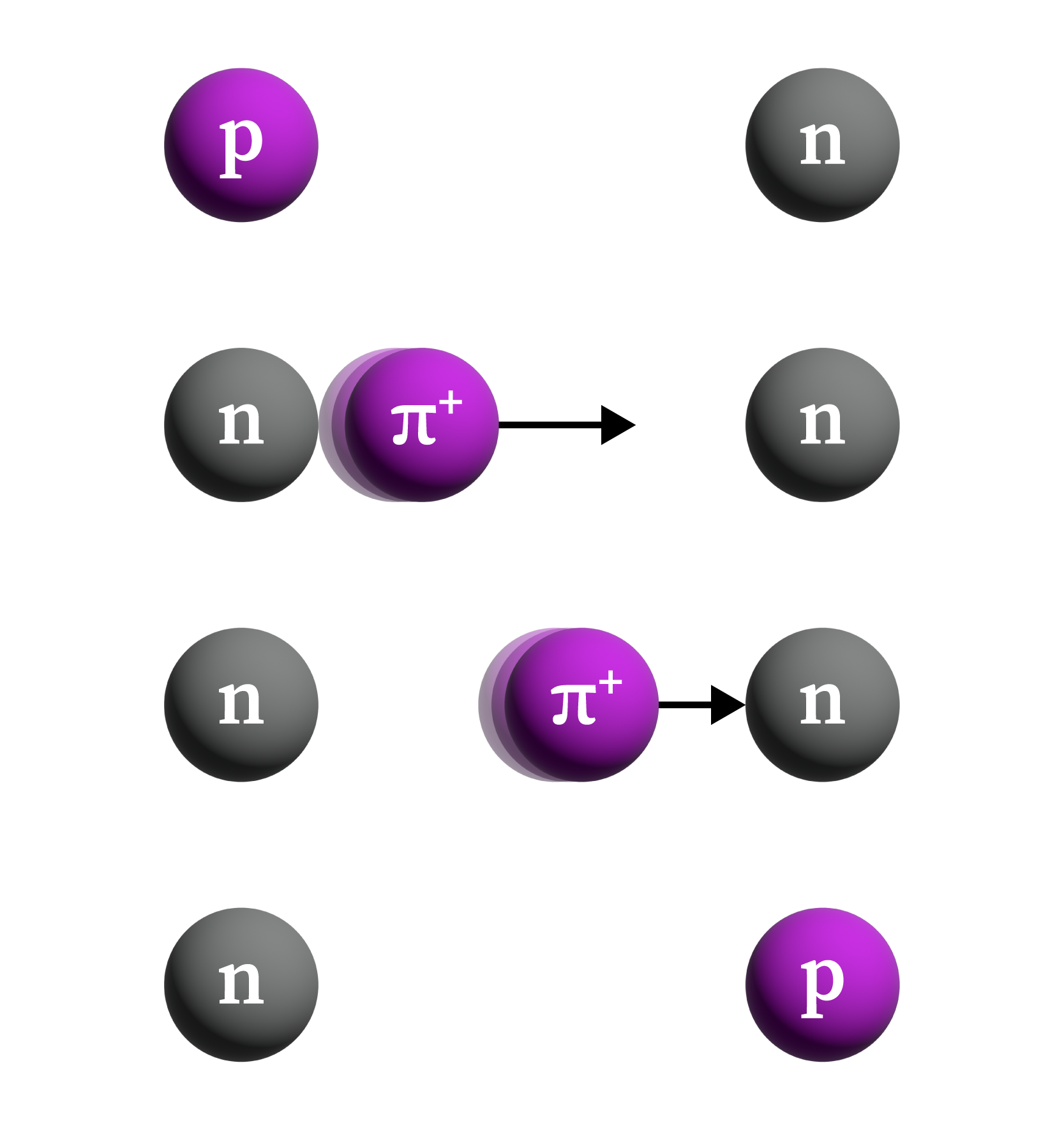
In this diagram, the strong nuclear force is transmitted between a proton and a neutron by the creation and exchange of a pion. A proton emits a pion and converts to a neutron. The pion transmits force information to the neutron. When a neutron absorbs the pion, it turns into a proton.
Yukawa even used the range of the strong force to estimate the pion’s mass; the shorter the range, the heavier the particle. This is a consequence of Heisenberg’s Uncertainty Principle in that a heavier particle will have a shorter lifetime and thus not travel as far before it decays. His idea connected quantum mechanics, relativity, and particle physics, and it changed how we understand forces forever. Today, this concept applies to all fundamental forces, from the strong force inside atoms to the electromagnetic force that powers your phone.
did you know
Space isn’t truly empty! Even in a vacuum, tiny particles can suddenly appear and disappear in less than a blink. This bubbling activity is called quantum foam. Imagine boiling water, bubbles constantly form and vanish. Quantum foam is like that, but instead of bubbles, it’s particles popping in and out of existence everywhere in the universe, even inside the space between atoms.
Yukawa’s proposal that forces are carried by exchanging particles was groundbreaking, but how do we prove it if these particles are invisible? His predicted particle, the pion, exists only for a fraction of a second inside the nucleus. To observe it, scientists needed to give the nucleus enough energy to “free” the pion, turning energy into mass. This could happen during high-energy collisions, but the energy required was enormous, greater than 100 million electron volts (MeV).
The unit is used to express mass in particle physics because of the relationship between energy and mass described by Einstein’s equation.
formula to know
Einstein’s Mass-Energy Equivalence Equation
Where E is the energy, m is the mass, and c is the speed of light.
When the mass is measured in kilograms (kg), and the speed of light is measured in meters per second the SI unit of energy is joules (J).
Since particle physics often deals with extremely small masses, using kilograms would involve writing very tiny numbers, which is inconvenient. Instead, scientists use energy units like the Mega electron Volt (MeV) divided by to represent mass. This approach is practical because particles are often created or studied in high-energy collisions, so their mass and energy are closely related. For example, the mass of a proton is about and an electron is about making calculations easier and more intuitive than using kilograms.
step by step
The mass of an electron is approximately Convert this mass into using the conversion factor
Step 1: Calculate the energy of an electron.
Einstein’s mass-energy equivalence equation
Where E is the energy, m is the mass, and c is the speed of light.
Step 2: Convert joules to electron volts.
Let’s now convert joules to electron volts using the conversion factor,
Since is mega,
Step 3: Convert energy (in mega electron volts) to mass (in ).
So, the mass of the electron is
In 1947, scientists finally detected pions in cosmic-ray experiments. Cosmic rays are high-energy particles from space that slam into Earth’s atmosphere, creating collisions powerful enough to produce new particles. These experiments revealed three types of pions: two charged and one neutral, written as and The charged pions have identical masses of about while the neutral pion is slightly lighter at about These values matched Yukawa’s prediction closely. Because their masses fall between those of electrons and protons, pions were classified as mesons, a new family of particles. Since then, hundreds of subatomic particles have been found. Some fit neatly into patterns, while others remain puzzling.
Yukawa’s theory was a major milestone in understanding the strong nuclear force. It proposed that this force between protons and neutrons was mediated by pions, explaining its short range. This idea worked well for nuclear physics at the time, but as particle physics advanced, scientists discovered that protons and neutrons are made of quarks, and the strong force actually operates at the quark level. Modern quantum chromodynamics (QCD), which is a theory in modern particle physics that explains the strong interaction, shows that gluons (not pions) are the true carriers of the strong force, binding quarks together inside nucleons. Pions remain important as effective exchange particles in low-energy nuclear interactions, but gluons are now recognized as the fundamental force carriers in the strong interaction.
The table below summarizes the fundamental forces and their carrier particles.
Force
Carrier Particles
Symbol of the Carrier Particle
Electromagnetic
Photon
γ
Strong Nuclear
Gluon
g
Weak Nuclear
W and Z bosons
Gravity (hypothetical)
Graviton
G
These discoveries have led to deep insights about matter, energy, and the forces that shape the universe. Yukawa’s idea opened the door to a new era of physics, one where the smallest particles help explain the biggest mysteries.
terms to know
Carrier Particles
Particles that mediate fundamental forces in nature.
Pion
A type of subatomic particle that acts as a carrier of the strong nuclear force.
Virtual Particles
Short-lived particles, which we can’t see directly but know exist because of their effects.
Mesons
The family of pions.
Quantum Chromodynamics (QCD)
A theory in modern particle physics that explains the strong interaction.
Gluons
The true carriers of the strong force, according to quantum chromodynamics.
summary
In this lesson, you learned about the science of particle physics, which investigates the tiniest components of matter and their role in shaping the universe. You explored the evolution of particle physics, from the Greek concept of indivisible atoms to the discovery of quarks and the ongoing search for deeper structures. Finally, in the Yukawa particle, you discovered how forces can be explained by the exchange of particles, Yukawa’s prediction of the pion, and how experiments confirmed its existence, opening the door to modern particle physics. Together, these ideas reveal how studying the smallest particles helps answer the biggest questions about the universe.
 a type of subatomic particle that acts as a carrier of the strong nuclear force. This particle would pop into existence for a tiny fraction of a second, travel between the proton and neutron, and then disappear. These short-lived particles are called virtual particles because we can’t see them directly, but we know they exist because of their effects.
 is used to express mass in particle physics because of the relationship between energy and mass described by Einstein’s equation.

 the SI unit of energy is joules (J).
 to represent mass. This approach is practical because particles are often created or studied in high-energy collisions, so their mass and energy are closely related. For example, the mass of a proton is about
  and an electron is about
  making calculations easier and more intuitive than using kilograms.
 Convert this mass into






 is mega,





 and
and  The charged pions have identical masses of about
  while the neutral pion is slightly lighter at about
  These values matched Yukawa’s prediction closely. Because their masses fall between those of electrons and protons, pions were classified as mesons, a new family of particles. Since then, hundreds of subatomic particles have been found. Some fit neatly into patterns, while others remain puzzling.